Porsche Cayenne Electric 2026 review | Accomplished and potent electric luxury SUV
Porsche Cayenne Electric cars for sale
4.0
Expert review
Pros
Rich and engaging to drive
Combination of range and power
Luxurious interior has just the right amount of digital tech
Cons
Can easily become very expensive
Range will plunge if you make the most of its power
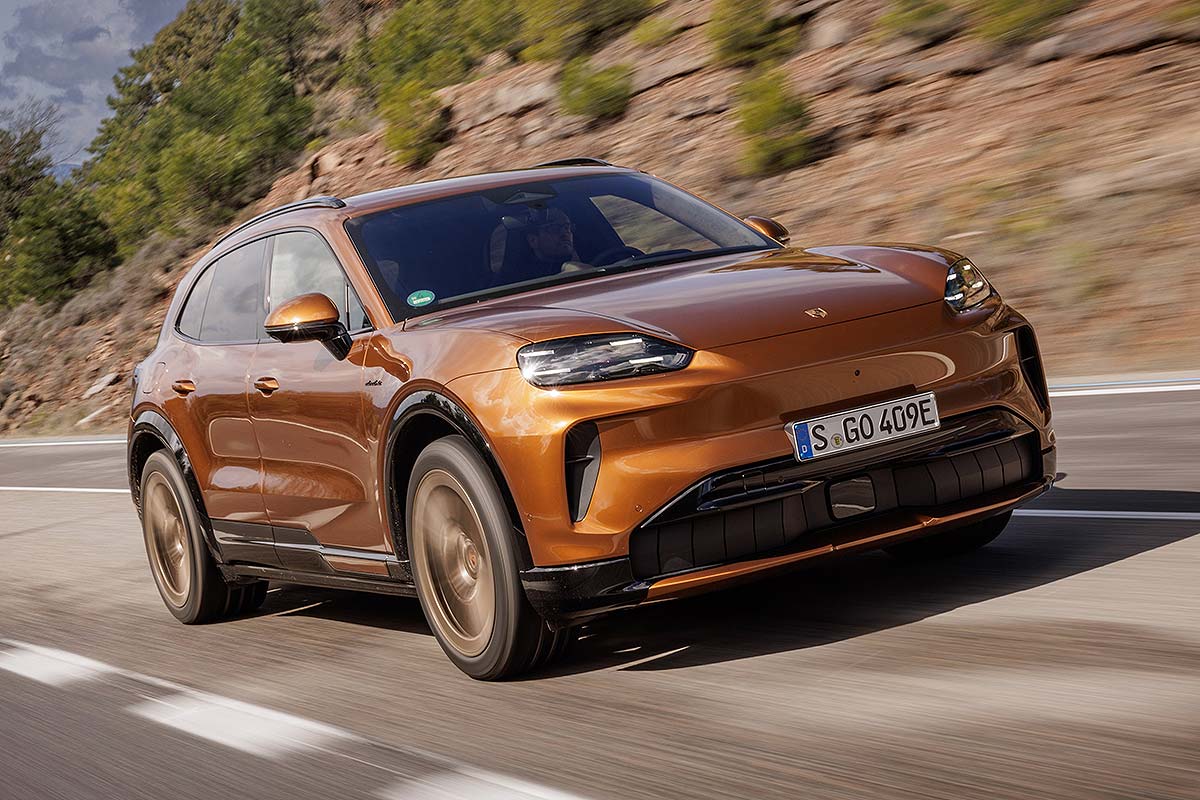
Wind-cheating design looks blander than a regular Cayenne
The CarGurus verdict
The Porsche Cayenne has been a hugely successful luxury SUV for the famous sports car brand, and bosses now hope the Cayenne Electric can kickstart the electrification of this sector. We like it, as it drives in an even more driver-focused way than the regular Cayenne, particularly the headline-grabbing Turbo.
The Porsche Cayenne Electric is also practical, comfortable and refined when it needs to be, and it has some impressive next-gen interior tech. Even the on-paper range is up to spec, although it will tumble if you unleash all the performance. Of course, the Cayenne Electric is expensive, and you’ll need to add options to experience the car at its finest. Yet it’s still a very capable new SUV overall – and one that will certainly give the upcoming new Range Rover Electric pause for thought.

What is the Porsche Cayenne Electric?
The Cayenne Electric moves the full-size Porsche luxury SUV into fully electric format for the first time. It has dabbled with hybrids and plug-in hybrids for years now – and the regular Porsche Cayenne range continues to offer electrified versions alongside the high-performance petrol models – but this is the first time a bespoke Porsche Cayenne Electric has been offered.
The larger sister car to the Porsche Macan Electric (the Cayenne uses a heavily modified version of the same architecture), the near-five-metre-long Cayenne Electric aims to get a foothold in the luxury EV SUV sector. This elite arena exists above the likes of the BMW iX, and will soon be joined by vehicles such as the Range Rover Electric and upcoming Bentley electric SUV. It’s also coming to market before Ferrari’s hotly-anticipated first EV arrives…
The Lotus Eletre arguably got there first, but it has hardly set the world alight. And many of Porsche’s own customers still prefer the petrol-powered Macan SUV over its new Macan Electric replacement. So the Cayenne Electric will have its work cut out in some quarters. Nonetheless, the firm hopes a combination of all-round driving prowess combined with some truly boastworthy performance figures will help do the talking.
Those numbers? How about up to 1,140bhp from the Turbo, with overboost and launch control engaged. That makes for the most powerful Porsche production car ever – one that blasts to 62mph in just 2.5 seconds, exactly matching the mighty new Porsche 911 Turbo S. If you don’t use all the performance, though, battery range will also impress. The regular 435bhp Cayenne Electric can travel up to 399 miles between charges.
Throw in exceptional rapid charging ability of up to 400kW, battery regeneration technology that’s a match for Formula E racing cars, an entirely new Porsche infotainment setup, newfound off-road prowess and even the ability to tow up to 3.5 tonnes, and you’ve an intriguing new electric luxury SUV that is packed with potential. You’d expect no less for prices starting from £83,200, mind.

How practical is it?
The Porsche Cayenne Electric is a large car, longer overall than the regular Cayenne (only the Porsche Panamera is longer overall). It's nearly two metres wide, and the wheelbase stretches to more than three metres. Visually, it looks sleeker than a normal Cayenne, thanks to its aero-tuned design, but there’s no escaping the fact this is a big car.
Interior practicality benefits accordingly, though. It feels like a commodious, commanding vehicle to sit in, with a high-end and high-tech cabin. It’s generally of premium quality too, particularly some of the upholstery options, although cheaper plastics are evident in places as well. I like the curved, oval-shaped instrument display, which references the Porsche 911. Here, it’s fully digital.
The side windows are deep, and there’s a broad ledge at the top of the door to rest your arm on – Range Rover-style. The front windows are frameless, giving a pillarless coupe-like feel, which makes it seem that bit more special. As for the seats, they are superb. They’re more driver-focused than the lounge-like chairs in a Range Rover, which is all to the good, given the car’s performance. I did notice the climate controlled seat in both my test cars was rather noisy, though.
Rear-seat space in the Porsche Cayenne Electric is superb. There’s an abundance of legroom, foot space and headroom. Again, the seats are firm and bolstered, giving a ‘semi-bucket’ feel, and my test car was fitted with the gorgeous (and optional) soft cushion headrests. The rear seats are available with electric adjustment too, so I could whirr the backrest into a reclined position. That said, the middle seat is much less comfortable, and its short, upright position won’t be very pleasant on anything but local trips.
The Porsche Cayenne Electric has extra-long rear windows, which are again frameless. They stretch far back behind you, and there’s no visible C-pillar, giving the cabin a bright, open feel. The rear door bins, however, are tiny – heavily compromised by the massive rear speakers.
The 781-litre boot is enormous: even bigger than the gigantic Mercedes-Benz E-Class Estate. There’s also a 90-litre ‘frunk’, or front boot, for those who like to mimic the front stowage compartment of Porsche sports cars. The boot is better trimmed than many regular car interiors, and of course has an electric tailgate. As air suspension is standard, there’s a row of buttons allowing you to lower the rear end, making it easier to load. The rear seat-backs can be folded electrically, too; the space expands to 1,588 litres.
A quick note on the flush exterior and door handles; they’re electronic, with a manual backup. If you pull them lightly, the door will gently release, for a ‘soft-open’ action. Pull them harder and you activate the manual release. They take a bit of getting used to, but I eventually grew accustomed to pulling them gently, which gives an added premium feel.
The ultimate indulgence may be ‘surface heating’ for the door and centre armrests. Working in combination with the heated seat, these warm up using integrated elements, meaning you’ll no longer shiver if you place a bare elbow on the door arm rest in the depths of winter. Pure decadence, and I loved it.

What's it like to drive?
The Porsche Cayenne Turbo Electric is a phenomenally fast car on paper. In practice, the most powerful production Porsche is much more manageable than you’d think. Power can be measured out precisely, and it has an effortless, long-legged feel that is very premium. There’s no hesitation, and of course no gearchanges, meaning it glides along more smoothly than even the most potent V8-powered Cayenne. You can choose a simulated V8 sound if you wish, which becomes nicely pronounced if you choose the Sport Plus drive mode from the steering wheel dial selector.
Then curiosity will get the better of you… and the never-ending surge comes to the fore. No matter what the road, the Porsche Cayenne Turbo Electric always has power in reserve; it’s a remarkable sensation. Engaging launch control, which releases that full 1,140bhp, is genuinely explosive and felt like it bruised my insides. If you want a sudden burst of overtaking power, a ‘push to pass’ function gives 10 seconds’ of full surge, for another way to experience its full potency. The rear-biased power delivery is also fun, giving a classic 911 tail-led flow through corners. This is a genuinely entertaining car to drive.
A huge amount of clever technology delivers this sense of well-controlled engagement, including air suspension with adaptive dampers and Porsche Active Suspension Management (PASM), along with optional rear axle steering. This aids fast, precise handling, with extra-responsive steering that belies the car’s size and weight (and helps make it easier to drive on tight roads).
The test Cayenne Turbo Electric also had Porsche’s ingenious Active Ride suspension, which keeps the body flat no matter what’s going on below. It even leans into corners, motorbike-style, to further smooth things out. No matter how aggressive your inputs, it keeps things in check, almost like a magic carpet. The £6,799 option price sounds expensive, but is absolutely worth it.
A standard Porsche Cayenne Turbo Electric ‘wow’ detail is its active aero pack, which includes dynamic cooling flaps at the front, plus rear ‘Aeroblades’ that whirr out of the bumper at speed. In combination with a roof spoiler, the kit helps with stability, while also looking extra-cool. The active front cooling flaps will open up during rapid-charging, too.
The regular Cayenne Electric, with up to 435bhp and a launch control 0-62mph time of 4.8 seconds, naturally doesn’t feel anything like as fast. It’s still quick, but doesn’t give you that ‘kick’, and you’ll have to work the accelerator more eagerly to release the power. It doesn’t have the rewarding rear-led feel of the Turbo out of corners, either. By most standards, it’s still a rapid electric SUV, but it’s a measure of the Cayenne Turbo Electric’s sophisticated power delivery that the regular version feels so different.
Still with air suspension as standard, the Porsche Cayenne Electric still rides nicely, cushioning the worst of our pothole-strewn roads. But it is more irritable than the Active Ride car, with a little more wheel patter and reaction to expansion joints. It rolls that bit more into corners, and feels more like the large, heavy electric SUV it is. It’s still good in isolation, but the Active Ride benefit is clear. Note, you can’t option it on the standard model, but can do on the Cayenne S Electric ‘sweet spot’.

Technology, equipment & infotainment
The centrepiece of the Porsche Cayenne Electric’s interior is its ‘bent’ portrait-format touchscreen which the firm calls the Flow Control display. It’s a fantastically high-resolution screen that runs Porsche’s latest operating system seen in the Macan Electric, further developed to create a distinctive ‘driver experience’. Needless to say, it’s fully connected, offers over the air (OTA) updates and has an AI-supported ‘Voice Pilot’ using large language models.
The Flow Control display brings an integrated hand rest too; place your palm on the soft pad and it’s perfectly steadied so you can use precise finger inputs. This makes it less tiresome to use, and because you can keep your hand in the same place, you can even use muscle memory to action some inputs without looking.
This is the key evolution over the Macan Electric. Having the shortcuts within reach of your fingertips aids usability, and the square format of the screen makes more sense for navigation. The system also doubles up as a gaming console – you can download games as well as music, video and charging apps.
The driver’s wraparound display comprises a 14.25-inch OLED instrument cluster. This includes a ‘Signature Screen’ view, that resembles the round dials of an air-cooled Porsche 911, modernised for the electric age. There’s an optional head-up display that uses augmented reality to help with sat nav directions – I found it worked well, particularly the way it turned into bends in response to the steering – and information is virtually displayed about 10 metres in front of the Cayenne Electric, to help with readability.
Also optional is a 14.9-inch co-driver display, which offers entertainment, app control and video streaming even while driving (a clever filter means the driver can’t see it). Porsche adds that the digital key can be integrated with Apple or Google Wallet, or shared with Apple or Android devices via SMS or AirDrop. Up to seven additional users are possible, if you’re feeling particularly generous.
Even the EV charging system is high-tech. It offers up to 400kW of rapid charging power, but Porsche engineers stress it’s not just the peak power that’s impressive; it will reliably serve up nearly 300kW up to 70 percent charge, and 175kW up to 80 percent full. This allows the large 113kWh battery to go from 10-80 percent charge in less than 16 minutes. It’s able to recover up to 600kW during recuperation too, which is on a par with a Formula E racing car.

Porsche Cayenne Electric running costs
A big, heavy, high-performance luxury SUV is never likely to be the most efficient of EVs, and so it proves, with Porsche claiming electric efficiency of 3.1 miles per kWh (3.0 miles for the Turbo). The reality will be lower; during high-speed testing, I saw 2.0 miles per kWh from the Turbo, and 2.3 miles for the regular model.
On the other hand, you may save on energy costs compared to putting petrol in a regular Cayenne – particularly if you regularly charge at home. Porsche will help cut the cost of public charging too, with the Porsche Charging Service offering lower rates at big-brand charging stations such as those operated by Ionity. A three-year subscription is included.
Electric cars can get through tyres if you drive them enthusiastically, and the Porsche Cayenne Electric has big tyres – 20 inches on the regular car and 21 inches on the Turbo – with an array of optional wheel choices (my test Turbo had high-end 22-inch wheels). So be prepared to fork out a lot for rubber, particularly if you use the Turbo’s full 1,140bhp.
It perhaps goes without saying that insurance will be expensive, and Porsche servicing can be pricier than other premium brands. But the fact that the Cayenne is an EV will help to cut costs here, at least when compared to a petrol model.

Porsche Cayenne Electric reliability
Porsche is not new to electric cars. It has been producing the Taycan since 2019, and introduced a heavily evolved version in 2024 that took on board early feedback to improve the car’s reliability. These learnings went into the Porsche Macan Electric, introduced in 2025. The Cayenne Electric advances Porsche’s EV engineering yet further.
It’s too soon to say how reliable the Porsche Cayenne Electric will be, of course, but there’s reason to be confident. It uses engineering taken from the Formula E racetrack – and in motorsport, reliability is all. The hope is that this race-bred tech will prove just as dependable on the road.
According to the latest What Car? Reliability survey, the Porsche brand overall is a little below average for reliability, finishing in 19th place. This places it ahead of key rivals such as Audi and Mercedes-Benz, but well below Lexus, Tesla and BMW.
- Porsche Cayenne Electric customers can choose from 13 standard colours, nine wheel designs, 12 interior combinations and up to five interior and accent packages. Then there’s the Porsche Exclusive Manufaktur, Paint to Sample and one-off Sonderwunsch programs, for even further personalisation. The array of options offered on the Cayenne Electric is enormous, too. The only limit will be your bank balance…
- The Porsche Cayenne Electric can tow up to 3.5 tonnes – but only if you choose the optional off-road package, at £2,036, which adds more rugged lower body styling and increased off-road approach angles. Otherwise, it’s a 3,000kg maximum braked trailer load.
- This is Porsche's first car to support inductive ‘wireless’ charging. It’s said to be coming later this year, and will allow owners to simply drive over a pad on their driveway and leave the car charging at up to 11kW. This is well in excess of the usual 7kW UK wallbox charger speed, and Porsche expects it to be a popular option that will be fully supported by dealers – even down to installation.
- If you want the best all-rounder: The regular Porsche Cayenne Electric ticks all the boxes. For most people, 435bhp on overboost will be more than enough, as will 0-62mph in 4.8 seconds. This version also has the best range of the two launch cars, at up to 399 miles.
- If you want ultimate performance: Choose the Porsche Cayenne Electric Turbo. It has huge reserves of acceleration at nearly all speeds, and the sheer spectacle of a launch control-assisted standing start simply has to be experienced, even if you’re only brave enough to do it once.
- If you want the best Porsche Cayenne Electric all-rounder: Although we haven’t driven it yet, the Cayenne S Electric is likely to be the best all-rounder. It combines the suspension wizardry of the Turbo with a power output (and price tag) that positions it between the range-topper and the entry-level model – and takes the range to just over 400 miles. The 666bhp machine is on sale now, priced from £99,900.

