Mazda CX-30 Review (2019-present)
Mazda CX-30 cars for sale
3.0
Expert review
Pros
Head-turning looks, inside and out
Good to drive
Choice of front- and four-wheel drive
Cons
Skyactiv-X engine is sophisticated, but sluggish in the mid-range
Rear legroom is in short supply
Boot is small and lacks clever features

The CarGurus verdict
Leaving aside the issue of whether it really qualifies as an SUV, the Mazda CX-30 is an eye-catching car that’s good to drive, generally refined, and has a well-made, stylish interior. There’s all-wheel drive if you really need it, and the option of a six-speed automatic gearbox, but the manual is so much better.
However, despite the Skyactiv-X petrol engine’s technical sophistication, it’s disappointingly sluggish in the mid-range and needs to be driven hard to deliver its full performance. Its economy gain over its Skyactiv-G stablemate doesn’t justify its extra cost, either. Other overall negatives are the lack of rear legroom and a so-so boot.
But if you’re smitten with the way the CX-30 looks, and many are, take one for a test drive. You may discover that its drawbacks are trifling and its other qualities are just what you’re looking for.

What is the Mazda CX-30?
Based on the Mazda3 family hatchback but with a shorter wheelbase, the CX-30 is marketed by Mazda as a compact SUV that slips into the range between the Mazda3 and the larger CX-5. Visually, the CX-30 looks like an exceptionally stylish but tall family hatchback. That perception is reinforced from behind the wheel because you don’t sit especially high like you do in a regular SUV.
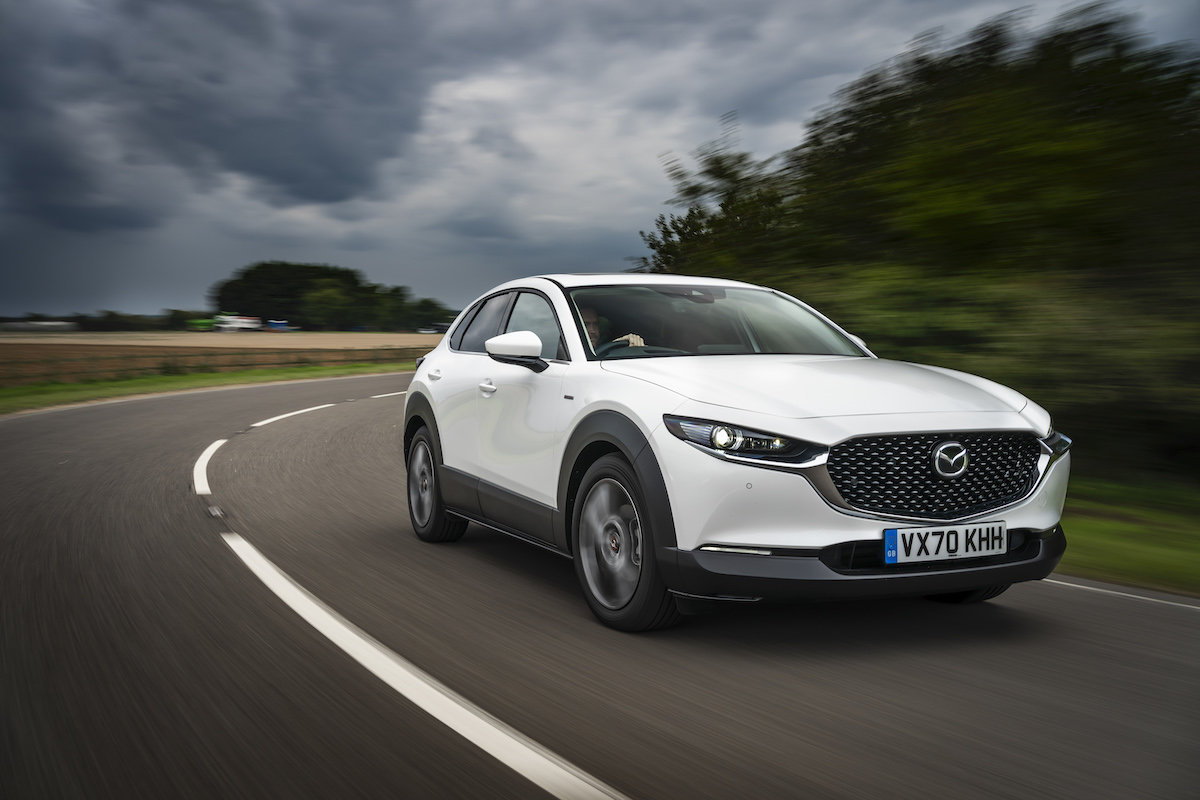
Mazda has tried to create the illusion of an SUV, though, with chunky black cladding around the wheel arches and the lower portions of the doors to provide alleged protection against the rigours of off-roading. That contrasting hue works well with some of the CX-30’s paintwork, but in the solid white which is the car’s only standard (no cost) colour, it has the unfortunate effect of making it look as though it’s the basic model, intended for utility companies.
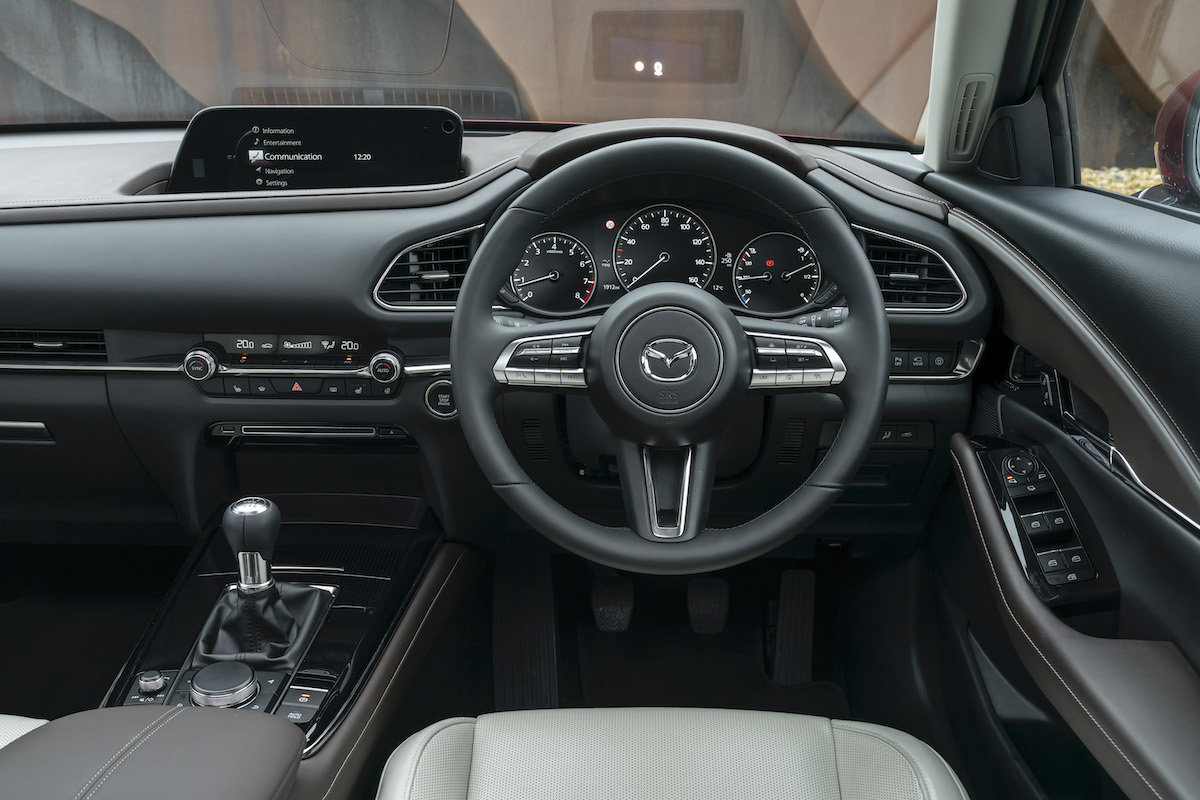
Yet the CX-30 is a head-turner, with a hint of coupe in its roofline. The cabin is neatly designed, too – minimalist without seeming stark – and very well made (think BMW quality). All models have a head-up display as standard and the infotainment system – operated via a rotary dial on the centre console, because Mazda considers a touchscreen too distracting for drivers – is intuitive.

How practical is it?
There’s plenty of adjustment for the driver’s seat and steering column, so it’s easy to find a comfortable driving position, but the CX-30 isn’t quite so comfortable in the rear. Although it’s based on the Mazda3 hatchback, it has a shorter wheelbase, which takes a bite out of rear legroom.
At 430 litres, the boot is a decent size for a small SUV, but if space is a priority, then you’re better off with a Skoda Karoq, which has a 521-litre boot (Skoda is known for its roomy cars). The Mazda’s rear seats fold in a simple 60:40 split arrangement, but they don’t flatten to the point where they’re flush with the boot floor, and neither do they slide fore and aft when they’re upright, so again, more practical compact SUVs are available.
What's it like to drive?
There are no diesel engines, just a pair of 2.0-litre petrols. The older of the two is called Skyactiv-G and produces 120bhp. The more modern version is called Skyactiv-X and, while the name is similar, it uses more advanced technology. The 178bhp unit is what’s known as a compression ignition engine, which uses high combustion pressure – just like a diesel engine – to ignite the fuel as well as a spark. The advantage is diesel-ish fuel economy – 47.9mpg – without a diesel’s exhaust particulates, and comparatively low CO2 emissions of 151g/km.
Both engines also feature a mild hybrid system, known as Mazda M Hybrid, with a small electric motor hooked up to a battery to provide a boost to the performance at low-to-mid-range engine speeds. However, neither engine is especially perky, particularly mid-range, and they’re a tad rowdy when revved hard.
Generally, though, the CX-30 is a pleasure to drive, with responsive steering, a smooth ride quality, lively handling, and one of the best manual gearshifts of any SUV – thank the MX-5 sports car for that.
Technology, equipment & infotainment
The CX-30 has five basic trim levels and, to date, one limited edition, the 100th Anniversary. The entry-level grade is SE-L, followed by SEL-Lux, Sport-Lux, GT Sport, and GT Sport Tech.
All are very generously equipped, with automatic headlights and wipers, adaptive cruise control, air-conditioning, and a head-up display.
An excellent six-speed manual transmission is standard, with the option of a smooth six-speed automatic. Cars fitted with the Skyactiv-X engine can be ordered with Mazda’s i-Activ part-time all-wheel drive system.

Mazda CX-30 running costs
With its technically advanced compression ignition petrol engine, the official Combined fuel consumption figure for the 2.0-litre Skyactiv-X engine is 47.9mpg, which is reasonably impressive for a vehicle that weighs almost 1,500kg. In real-world driving, you’re more likely to average around 40mpg, and some owners report about 38mpg for the Skyactiv-G model, which should be cheaper to buy in the first place.
Mazda offers a service plan to spread the cost of regular maintenance and may take the form of an up-front one-off payment that covers three years/37,500 miles’ worth of servicing, or a monthly payment. Service intervals are every 12,500 miles or 12 months, whichever happens sooner. In terms of insurance, the CX-3 sits in groups 12-21.

Mazda CX-30 reliability
Mazda as a brand has a reputation for building sturdy cars. It has often appeared towards the top of owner satisfaction surveys, although it was a middling 16th out of 31 manufacturers in the 2024 What Car? reliability survey, so neither brilliant nor terrible.
There have been a few little issues with the CX-3, affecting a small number of cars and mostly related to electrical systems. Several owners report a severe power drain from the car’s main battery (there’s a secondary battery for the mild hybrid system) and while a new battery fixes the problem in some cases, in others it doesn’t.
The main control module for the engine and transmission is known to play up, causing clunky shifts from the six-speed automatic gearbox, a loss of power, and even stalling. The radar-controlled adaptive cruise control can also be affected, jolting excessively as it comes on and off to maintain the distance to a vehicle in front. A software update remedies these ills, as well as the inadvertent activation of the automated Smart Brake Support (emergency braking assist) system, which in extreme circumstances, could bring the CX-30 to a complete and abrupt halt.
A further beneficiary of a software update is the LED adaptive headlights which, in a few cases, aimed themselves too high. Affected cars should have been attended to by now, but you never know.
Manufacturing issues in CX-30s produced between late 2019 and early 2020 resulted in a couple of recalls. Brake caliper mounting bolts can loosen, reducing braking performance, and the caliper could potentially grind against the inside of the wheel. A batch of poorly made fuel tanks meant that, when brimming your tank, petrol can flow into the charcoal canister – the purpose of which is to trap petrol vapour in a bid to reduce air pollution – which may then leak; that leak is a potential fire hazard. There’s also a very small chance it could also cause the engine to stall on the move.
- Mazda worked hard on the CX-30’s safety level. Its five-star EuroNCAP accident protection rating included the highest score yet recorded for adult occupant protection: 99%. Its child protection score was 86% and safety assist 77%. Standard across the board are automatic emergency braking, blind-spot monitoring, lane departure warning with lane-keep assist, a driver attention alert system, and a rear cross-traffic alert for when you’re backing out of a driveway onto a road. Top spec models also feature a front cross-traffic alert system that uses laser cameras to help when you’re edging forwards into the road.
- The CX-30 features digital instruments that are blessed with very crisp graphics, even if they don’t display the plethora of information that some rival’s systems do. The infotainment screen in the middle of the top of the dashboard is also clear and simple to operate, using a BMW-style rotary dial down by the gear lever. Mazda eschews touchscreen systems on the grounds that they’re too distracting while you’re driving. For the same reason, the heating and ventilation controls are of the traditional physical dial variety, so there are no irritating menus to navigate to simply get air in your face.
- Mazda celebrated its 100th anniversary in 2020, and released special editions across, including the CX-30 100th Anniversary, only 100 of which were sold in the UK. All have Snowflake White Pearlescent paint, burgundy leather upholstery and carpets, a 100th anniversary logo embossed onto the headrests, and badges for the floor mats and key fob. If you’re lucky, the previous owner will also give you the commemorative key presentation box, the 100th anniversary book, and the 1:43 scale model of the Mazda R360 that inspired the limited edition’s colour scheme.
- The best all-rounder: While the 120bhp 2.0-litre Skyactiv-G petrol engine isn’t as fast or as economical as the 178bhp Skyactiv-X, the differences aren’t that great, and the former is much cheaper. Unless you have a pressing need for extra traction, stick with front-wheel drive rather than the four-wheel drive, and the manual gearbox is so slick ‘n’ quick you won’t want the auto. The SE-L Lux trim is so well equipped that you won’t want much else.
- If you live in a rural area: Country roads can be a slimy mess during the winter months, even if it doesn’t actually snow, so if you live in the sticks, there’s some sense in tracking down a used Skyactiv-X CX-30 with the i-Activ all-wheel drive system. This is part-time four-wheel drive; the car mostly runs in front-wheel drive mode, but when sensors detect slippery conditions, the drive transfers in varying amounts to the rear wheels to help with traction. Don’t think this makes the CX-30 a serious off-roader, though.
- If you want an automatic: The CX-30 is available with a smooth, six-speed automatic gearbox for folk who don’t fancy or can’t drive a manual. This was a £1,500 option when the CX-30 was new, though, so it will remain dear on the used market. Fuel consumption is 4.3mpg worse on the Skyactiv-X model, too.

