Mercedes-Benz EQB 2026 review | A good-value seven-seat electric SUV
Mercedes-Benz EQB cars for sale
4.0
Expert review
Pros
High quality interior
Seven seats in an electric vehicle
Quiet and comfortable
Cons
Other SUVs are more fun to drive
Third-row seats are cramped
More expensive than petrol or diesel models
The CarGurus verdict
The Mercedes EQB is not for you if you want a performance SUV – there are plenty of alternatives that are more fun to drive. But in our humble opinion, there are far too many SUVs, both electric and petrol, that try to be sporty when really they should just aim to be comfortable. The EQB is confident and smooth to drive, and it offers a compelling blend of practicality, premium finish and low running costs.
If you don’t strictly need the seven seats, there are roomier and better value electric vehicles that can also deliver a longer driving range in-between charges. But if you do want to seat seven people inside an electric car, the Mercedes EQB is more than up to the job. It's generally a lovely vehicle to drive and to live with.

What is the Mercedes-Benz EQB?
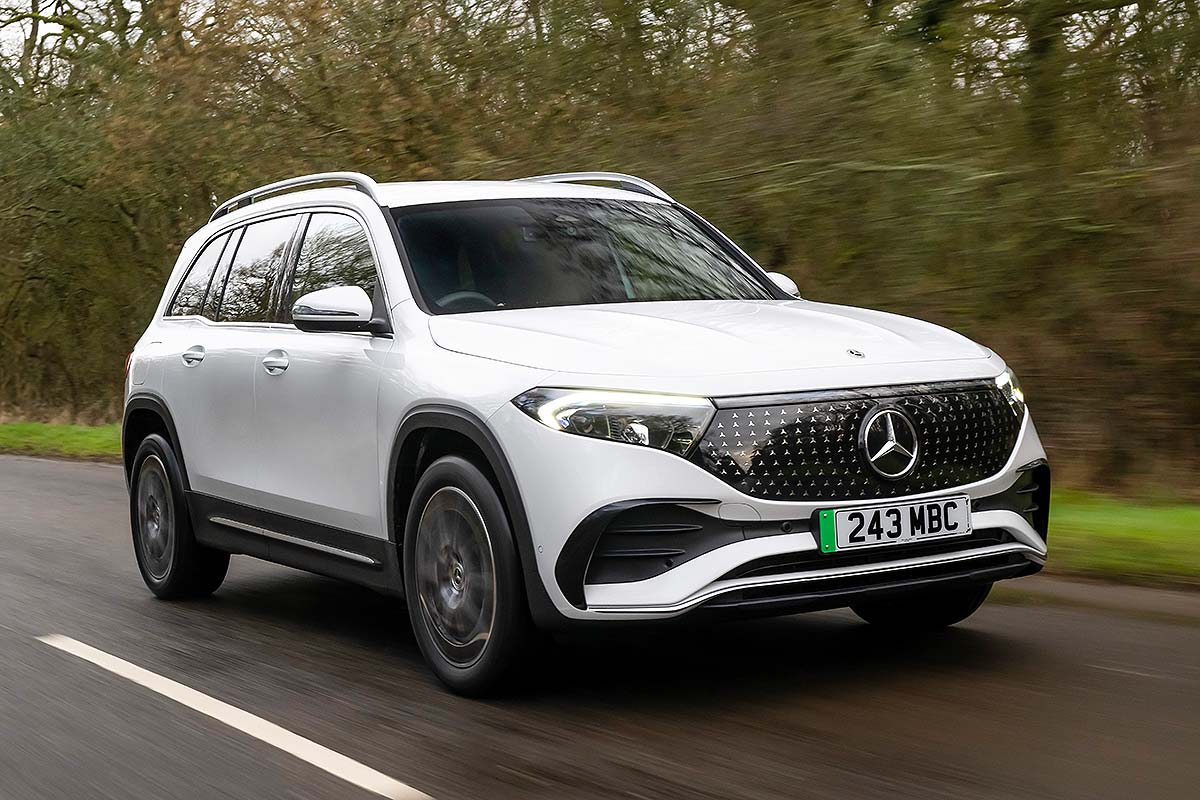
The Mercedes-Benz EQB was the fully electric version of the GLB: a boxy-looking, seven-seat family SUV that could be described as ‘compact’. It’s certainly smaller than many seven-seat SUV alternatives, such as the Audi Q7.
Revealed in 2021, the EQB was initially sold in EQB 300 and EQB 350 guises, both with a dual electric motor setup for all-wheel drive, and both using a 66.5kWh battery. Single-motor variants followed, including one with a larger 70.5kWh battery for an extended range, then in 2023 the whole EQB line-up was revised. Post-facelift cars received exterior and interior design tweaks, the latest ‘MBUX’ infotainment tech and upgraded driving assistance systems.
In December 2025, Mercedes unveiled the new GLB. Along with hybrid petrol and diesel engines, an electric GLB became part of the model range for the first time. As a result, the EQB as we know it is effectively dead, and Mercedes no longer allows you to configure a car on its website. There are new examples still available from stock at the time of writing, but if you want an electric seven-seat Mercedes built to your own exact specification, you’ll need to be looking at a new GLB.
In either case, the seven-seat electric SUV market was a relatively small one at the EQB’s launch, but there is now more choice. The most premium rival is the Volvo EX90, but there is also competition from the Kia EV9, Hyundai Ioniq 9, Peugeot e-5008 and long wheelbase Volkswagen ID.Buzz. It's also worth noting that the Tesla Model Y is once again available with a seven-seat option.
You could consider the Mercedes-Benz EQV and Peugeot E-Rifter as well, if you’re willing to forsake SUV style for the practicality of what is essentially a van. The number of rival seven-seat EVs will only continue to grow.

How practical is it?
The electric EQB sacrifices a little of the internal combustion-engined GLB's practicality. Its floor has been raised to accommodate the batteries underneath, so you’ll find less foot space beneath the seats for passengers in the middle or third rows. You can still comfortably get two tall adults in the middle-row seats, though, which slide and recline in a 60:40 split. The boot is also a little smaller, with a maximum of 675 litres in the EQB with the third row of seats folded, compared to 770 litres in the GLB. Fold the second row of seats down in a EQB and you’d have 1,710 litres to play with, whereas in the GLB you have 1,805 litres. The compromise isn’t severe, but it’s certainly there.
There’s enough space for a few soft bags behind the raised third row, but with the seats toppled flat you can carry a double buggy or a couple of golf bags quite easily. It's annoying that there is nowhere to store the charging cable, though, and the EQB is not as spacious inside as five-seat alternatives such as the Skoda Enyaq and the Ford Mustang Mach-E.
Kids or young teenagers will be happy enough in the slim, rearmost seats that you pull up from the boot floor – even if they’ll have their knees bent up due to the batteries stored below. Access to the third row is tight behind the middle seat, which tilts and slides forwards at the pull of a lever, but the two back seats are best reserved for the lithe and youthful, anyway. Basically, stick the kids in the back seats and the grandparents in the middle row – which has an ideal hip-height for those with limited mobility. There are Isofix child car seat fittings in the third row, as well as on the outer two seats of the middle row.
From the front, the cabin looks and feels lovely, with dense, classy materials and ambient lighting all over the place, while the driver's seat gets electric adjustment, including adjustable lumbar support for a comfortable and supportive position. It’s certainly a better driving position than you'll find in the Tesla Model Y. The EQB’s cabin is classier and more conventionally laid-out, too.
If you need to tow a trailer or caravan, post-facelift EQBs gained towing capability for the first time, including a tow bar and a trailer setting for the electronic stability control. The maximum towing capacity varies between models, ranging from 1,400-1,700kg, but sadly this functionality is only available with the five-seat version of the EQB. Boo.
Other practical touches include the optional roof bars, roof-mounted bicycle racks and storage boxes, as well as various interior mats and child seats.

What's it like to drive?
There have been four specifications available throughout the EQB’s life. The all-wheel drive EQB 300 4MATIC and EQB 350 4MATIC arrived first of all in 2021, both with 66.5kWh batteries and serving up 225bhp and 288bhp respectively. Mercedes-Benz later launched the EQB 250 and EQB 250+, both with a single 188bhp electric motor driving the front wheels. We didn’t get the ‘regular’ 250 in the UK, a car that used the same 66.5kWh battery as its all-wheel drive siblings, but we did get the 250+, which made use of a larger 70.5kWh battery.
Performance wise, every version of the EQB was electronically limited to a top speed of 99mph. As for the 0-62mph sprint, the 250+ managed 8.9 seconds, the 300 a sprightly 8.0 seconds and the 350 a rapid 6.2 seconds. Interestingly, though, the very earliest versions of the EQB were actually a little quicker. The 300 managed to hit 62mph in 7.7 seconds, while the 350 we drove at launch did 0-62mph in 6.0 seconds, which is hot hatchback pace when you think about it. Furthermore, the power was delivered predictably, with plenty of gusto. The all-wheel-drive system tackled corners in a neutral and confident way.
As various trim levels came and went (there were many, with each adjusted year on year), the EQB’s weight fluctuated. But generally, the lightest model of the bunch was the single-motor 250+ at 2,105kg, while the 300 and 350 models range between 2,105kg and 2,175kg. There’s a fair amount of body lean in corners, no doubt thanks to that heft, but the EQB still soaks up the worst of a road’s bumps and creases. It’s a bit fidgety over town roads, but smaller wheels will help to reduce this, and there’s no doubt it’s a lot more comfortable than the Tesla Model Y.
The brake regeneration system has an adaptive mode as standard, meaning the car will brake more heavily if it senses a car, corner or junction up ahead or free-wheel on an open stretch of road. There are also various non-adaptive levels of brake regeneration that you can select with the steering wheel paddles.
As for range, as you’d expect, that varies depending on the trim. Putting aside special editions, at one point or another you could choose between Sport Executive, AMG Line, AMG Line Executive, AMG Line Premium and AMG Line Premium Plus (going in order of least plush to most jam-packed with technology and creature comforts). Every advance in trim level brings with it a little more weight, which in turn impacts energy consumption. In addition, software tweaks in the facelift models also brought improvements in mileage. Broadly speaking, however, the EQB 250+ with its 70.5kWh battery would deliver 290-321 miles of range. The all-wheel drive 300 and 350 models, both fitted with the smaller 66.5kWh battery, would achieve somewhere in the region of 242-255 miles of range from a full battery.

Technology, equipment & infotainment
The infotainment system comprises a broad slab perched on the dashboard, within which are two screens: one the central 10.0-inch touchscreen and the other a 10.0-inch digital driver’s readout. Apple CarPlay and Android Auto phone connectivity, built-in navigation, a touchpad, voice control and more are included on every EQB, whether you’re buying an early model or the last of the line. The sheer variety of control methods can be confusing, but generally it’s a great system to use, with fantastic graphics, a quick screen response and (mostly) logical menu layouts.
As mentioned in our section on driving dynamics, the trim levels on offer have varied throughout the EQB’s production life. From least to most feature-packed, they included Sport Executive, AMG Line and latterly AMG Line Executive, AMG Line Premium and AMG Line Premium Plus. We won’t get into the weeds of what every single version included year by year, as we could be here for a long time. At launch, what was then the entry-level AMG Line came with 18-inch alloy wheels, electric folding door mirrors, a reversing camera, lane-keep assist, heated front seats and climate control air-con.
Further up the trim-level ladder, you could enjoy luxuries such as keyless entry, wireless phone charging, augmented reality navigation, a head-up display, 19- or 20-inch wheels, more powerful sound systems and a panoramic sunroof. Be mindful that some earlier models didn’t include tech like adaptive cruise control as standard (you had to pay an additional £1,495 for the Driving Assistance Pack). Some models also featured ‘Comfort’ suspension with traditional springs and dampers, while others had electronically controlled dampers for a broader range of ride and handling capability.
As for the EQB’s charging technology, it’s nothing to write home about, but nor is it hopelessly off the pace. All versions can charge at speeds of up to 100kW, allowing a 10-80 percent boost in 32 minutes. With an 11kW charger, that same boost will take you five hours and 45 minutes, while charging with a 7.4kW wallbox at home will require nine hours and 15 minutes. For comparison, a Peugeot e-5008 can charge at up to 160kW (and offers a 97kWh battery for an extended range, as well as a regular 73kWh unit), while the latest Volvo EX90 with its 800-volt charging technology can achieve a 350kW charging speed (and comes with either a 104kWh or 111kWh battery).

Mercedes-Benz EQB running costs
The electric Mercedes EQB will be cheaper to run day-to-day than any petrol or diesel alternative, provided you do most of your charging at home. It is, however, more expensive to buy than plenty of seven-seat petrol- or diesel-powered SUVs – including as a used car.
Prices started at just under £53,000 and rose to more than £61,000. A Peugeot e-5008 is around £48,000, for example, while the Kia EV9 is £66,000 and a Volvo EX90 starts from £80,000.
Although not a perfect comparison, as they are all cars with different specifications, the least expensive version of the new electric GLB unveiled at the end of 2025 is available for £46,000.
A full charge of the EQB will cost around £16 from a standard home charger, assuming you’re paying 24p per kWh for your electricity at home. That can be cut in half if you use off-peak tariffs and charge overnight, which is easy to do as you can set charging times via the Mercedes phone app, or via the car’s touchscreen. Even if you don’t get cheap off-peak electricity, you’ll still likely cut your car fuel bill by at least 50 percent if you go electric – again, provided you can charge at home.
Insurance and maintenance costs for the Mercedes EQB are comparable with its rivals. You can opt for fixed price servicing for up to four years, which costs from £30 per month.

Mercedes-Benz EQB reliability
The EQB didn’t feature in the What Car? Reliability Survey in 2025, so there is no specific data to speak of. However, Mercedes-Benz ranked a disappointing joint 22nd with Audi out of 30 car manufacturers overall. More positively, the smaller EQA electric SUV featured in the rankings for electric SUVs up to five years old, claiming eighth position out of 28 vehicles.
With any new car there’s a certain leap of faith, as you may just buy the one vehicle out of 1,000 that doesn’t quite work the way it should. But some degree of comfort can be taken from Mercedes-Benz’s three-year, unlimited-mileage warranty, which can be extended at additional cost. The battery pack is covered by a separate eight-year, 100,000-mile warranty as well.
- Charging in the Mercedes EQB is via a CCS and Type 2 socket. These are the standard European socket types, compatible with all home wallboxes and the vast majority of public chargers. All the cables you need to charge at home or at public charge points were provided as standard, although you had to pay extra if you wanted a cable for charging via a three-pin domestic plug socket.
- With the Mercedes EQB’s charging speed of up to 100kW, you can get a 100-mile top-up in around 20 minutes if you plug into a DC rapid charger offering 100kW (or greater) power output. Many of the chargers in the UK’s service stations are only rated at 50kW, which will get you the same 100-mile top-up in around 40 minutes. However, ever more charging stations with greater speeds are being built.
- All electric cars are more efficient in warm weather and at slower speeds. It’s a fact of modern lithium-ion battery technology and means that real-world range can vary in any EV, depending on the conditions and where you drive. As a worst-case scenario, the Mercedes EQB will likely manage around 160 miles to a charge on the motorway and in cold weather. Warmer temperatures and slower speeds could see it cover 240 miles or more before you need to plug in.
- If you want the best value: Go for the EQB 250+ Sport Executive. You’re paying the least amount of money, but you get the bigger battery. There’s also a good amount of technology included throughout the car as standard .
- If you want the best family car: All Mercedes EQBs have seven seats, but if you want to make the kids happy, step up to AMG Line Premium (or the Premium Plus on later models) for a panoramic glass sunroof. It really does make the back seats brighter and more pleasant.
- If you want the sportiest: Go for the EQB 350 4Matic. You get all-wheel drive and the most power, with 288bhp for a 0-62mph time of 6.0-6.2 seconds. For sporty styling, you’ll need an AMG Line model or above, as these had more aggressive bumpers, less chrome trim and often darker alloy wheels.


