Mercedes-Benz V-Class Review (2015-present)
Mercedes-Benz V-Class cars for sale
4.0
Expert review
Pros
Excellent space and practicality
Lots of standard equipment
Poshest-feeling car in the class
Cons
Ludicrously expensive compared with rivals
Smartphone integration costs you extra
Lofty running costs, too
The CarGurus verdict
In most ways, the V-Class is really good. It ferries its occupants about in a comfortable yet controlled manner, it has acres of space for people and bags, it comes with plenty of luxury kit and it’s - by some considerable distance - the classiest-feeling vehicle of its type. Any self-respecting VIP would be happy to spend plenty of time in one, and to be honest, that’s probably the important thing here.
However, its enormous price does make it difficult to justify on an objective level. Many rivals offer a very similar mix of abilities, but do so for many, many thousands less. It’s one of those cars where, if you want a V-Class, then only a V-Class will do. If you’re not absolutely sold on the must-have status of the big Merc, though, then choosing one of the alternatives will save you an absolute packet.

What is the Mercedes-Benz V-Class?
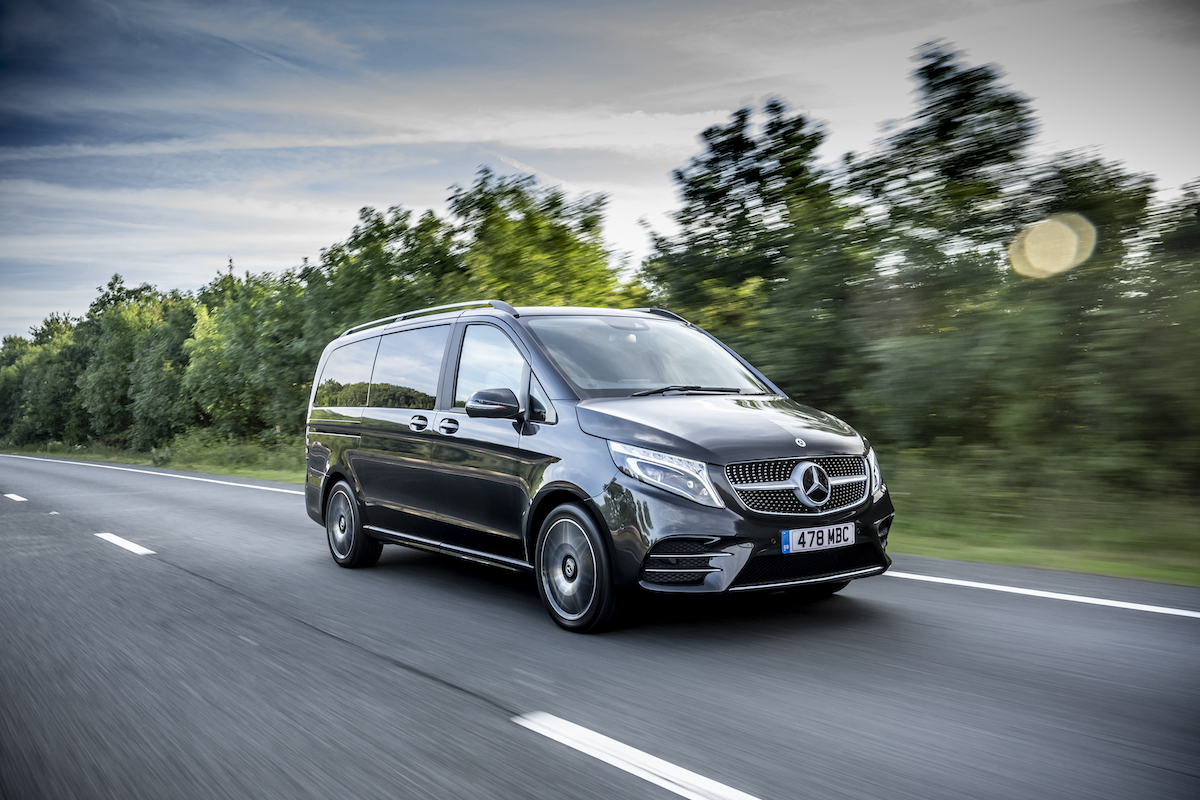
This eight-seater MPV is based on the Vito panel van, which gives the V-Class its boxy shape and, as a result, its cavernous interior space. However, much more has gone into the transformation than simply adding portholes and pews. Most notably, the interior has undergone a major overhaul compared to the Vito commercial vehicle, meaning that the cabin has the same feeling of sophistication and luxury you’d expect in pretty much any Mercedes passenger car. Just as well when the firm markets the V-Class as a high-quality luxury product, with only high-spec versions available, not to mention a correspondingly high price.
In terms of where the V-Class sits in Mercedes’ model range, it’s a bit of a tricky one. Granted, it’s a passenger car, so it sits alongside the firm’s regular models such as the A-Class, C-Class and E-Class, plus its vast range of SUVs. But, being distinctly van-like, the V-Class model is something of an outlier.

How practical is it?
You’d expect anything shaped like a van to excel in this area, and happily, the V-Class does. It’s offered in two lengths - Long and Extra Long, the latter of which has an extra 23cm between the axles - but whichever of the variants you pick, interior space is simply vast. Even if you’re a tall adult, you’ll have plenty of headroom and legroom to get comfortable no matter which seat you wind up in. The standard car has eight seats - two up front and two rows of three behind - and these can be slid, folded or removed altogether to turn the V-Class back into a van. However, if you’re going to even attempt to take the rear seats out, make sure you have some very burly assistants to hand, because they’re incredibly heavy and very difficult to manoeuvre. If your focus is on luxury rather than sheer numbers, there’s a seven-seat option that replaces the three-seat bench in the middle row with a pair of swivelling captain’s chairs.
The precise amount of boot space you get depends on a variety of factors (which body length you’ve gone for, how many of the seats are installed at the time, where they sit on their runners, etc) but even with the potential luggage space at its minimum, you’re unlikely to struggle to carry anything you need to carry. True, the enormous tailgate can be impossible to open in tight parking spaces, but the rear window opens independently, allowing you to drop small items into the boot without you having to trouble the tailgate. The electric sliding doors on both sides of the car makes getting in and out an absolute doddle for passengers.
As the V-Class is based on a van, you might be worried that the interior won't deliver the luxury feel that your well-heeled passengers will expect. Don’t be. Compared to the Vito, the cabin has received a thorough overhaul, and pretty much all the materials and finishes on display have the sheen and the substance to make the V-Class feel genuinely special.

What’s it like to drive?
If you discount the EQV electric version then you have two choices of engine in the V-Class. Both are 2.0-litre four-cylinder twin-turbo diesels, the V220d having 163 horsepower, while the V300d tops that up to 233 horsepower. So far, we’ve only tried the latter, but the good news is that it’s really impressive. You wouldn’t expect a vehicle like this to be hugely fast, and indeed it isn’t, but it does feel a sight perkier than you might expect, given the small size of the diesel engine relative to the enormous size of the body. The V300d gets up to speed briskly and easily, seemingly without breaking a sweat. That’s thanks to a generous surge of low- and mid-range torque, plus an automatic gearbox that always seems to know exactly which of its nine forward gears is best for the job at hand. It swaps between its various cogs smoothly, too, while the engine also stays smooth and quiet for the vast majority of the time.
Obviously, any car that majors on carrying people - especially VIP-type ones - needs to place comfort above all else on the list of dynamic priorities, and that’s just what the V-Class does. The suspension is soft, making it really good at absorbing lumps and bumps of all types, but it’s not so soft that you feel the body bouncing around untidily. You do feel that slight tremor through the floor that you feel in all van-based vehicles, but it’s not as prevalent as it is in many, so the feeling of sophistication isn’t ruined. And when you’re undertaking long journeys in your V-Class, you’ll really appreciate the steady, stable feel of the steering at high motorway speeds.
Obviously, any vehicle that’s more than five metres long and weighs in at more than two tonnes isn’t going to be the most wieldy when you get to a set of bends, and sure enough, you encounter plenty of body lean if you enter a corner slightly too briskly. However, keep your entry speeds reasonable and there’s easily enough control there to keep things effortlessly civilised for you and your very important passengers.
And yes, the sheer size of the car can be a little daunting when you’re manoeuvring and parking, but the high-up driving position, enormous windows and slab-sided design mean your visibility is tremendous, making it surprisingly easy to place the car accurately. What’s more, parking sensors and a reversing camera are standard-fit, while a 360-degree camera is an affordable option.

Technology, equipment & infotainment
There’s only one trim level available on the V-Class, and that’s AMG Line. This means all versions (aside from the Marco Polo version that we’ll talk about in a moment) come with broadly the same list of standard equipment, and as you’d expect on a luxurious car costing this much, that list is extensive.
On the outside you get 19-inch alloy wheels, anodised roof rails, metallic paint and blacked out rear windows, while inside, you have leather upholstery, electrically adjusting heated front seats, two-zone climate control, cruise control and an infotainment system that includes DAB radio, Bluetooth, and built-in satnav. That said, it beggars belief that, even when you’re paying this much for a car, you’re still made to pay extra for Apple CarPlay and Android Auto connectivity. The infotainment system is also one of Merc’s older ones, and the small screen and unintuitive menus mean it’s not as easy to use on the move as the firm’s more recent efforts, and the graphics look pretty dated, too. The screen sensitivity is pretty good, which is just as well because the central trackpad controller is hopelessly imprecise.
In terms of driver assistance systems, you get most of the basic stuff, but the cruise control is not an adaptive system, while features such as blind spot assist and rear cross traffic alert are not provided.

Mercedes V-Class running costs
We’ve said it before, but it’s worth saying again: the V-Class is very expensive. Any of the various versions will cost you upwards of £70,000, and if specify a Marco Polo version, you’ll be paying well upwards of eighty. Granted, pretty much none of the car’s people carrier rivals come cheap, but you’ll pay a heck of a lot less for those than you will for the Mercedes.
It’s not massively efficient, either. Official WLTP fuel economy figures suggest an average return of between 36- and 37 mpg depending on the spec of your car, while the weight of the extra hardware on board the Marco Polo takes that down to less than 35 mpg. You should get reasonably close to those figures if you cover mainly motorway miles, but if you spend the majority of your time delivering folk to city-centre locations, you’ll get considerably less. CO2 emissions are correspondingly high, meaning tax implications.
Insurance won’t come cheap, either. The V220d has the lowest grouping at 37 or 38 (out of 50), while the V300d sits in group 43 and the Marco Polo in 44.

Mercedes V-Class reliability
The bare minimum you should expect in terms of warranty on a new car these days is three years or 60,000 miles, whichever comes soonest. Mercedes betters this slightly with a three-year, unlimited-mileage arrangement, but it’s not a patch on what some rival manufacturers in this space offer. As we’ve already mentioned, Toyota’s Proace Verso is offered with an initial three-year warranty, but every time you get it serviced at a recognised Toyota dealer, your warranty is extended by another year and 10,000 miles, up to a maximum of 10 years or 100,000 miles. That’s no contest.
Even though the V-Class has been around a fair old while, there aren’t all that many of them about, so getting a true picture of how reliable it’ll be is slightly tricky due to a shortage of data. As a brand, Mercedes’ performance in this area has been quite up and down in the last few years, so it’s also quite difficult to make judgements based on that. However, you can hopefully take solace in the fact that it’s based on the Vito van, which is designed to put in hour upon hour of hard graft without going wrong, and consistently performs well in various van-based reliability surveys.
- Fancy a V-Class but also have a thirst for the outdoors? Well, the Marco Polo version that we mentioned earlier could well be for you. It’s a factory-fit camper van version that comes with a pop-up sleeping compartment in the roof, a rock-and-roll bed below, plus a kitchenette with a fridge, a two-burner hob and a bunch of storage. All good fun, but it’s ludicrously expensive.
- Fancy a V-Class and love music? Well, then it might be worth specifying you car with the optional Burmester sound system upgrade, which boasts 15 speakers and a 640 watt multi-channel amplifier.
- A bigger car means a more expensive car, right? Well, not in the case of the V-Class. For reasons we can’t quite fathom, Mercedes actually charges you more money for the Long version, meaning you pay less for the Extra Long. We can only think that’s because the Long comes with a panoramic roof while the Extra Long doesn’t, but even so, it seems odd.
- If only a V-Class will do: Sure enough, the V-Class is one of the best van-based MPVs out there, and for some, it’s the only car that’ll do for luxurious multi-person transport. However, compared to other rivals that do a similar job, it’s very, very expensive. Yes, it feels like the poshest of the lot, but that poshness comes at a hefty cost.
- If you want poshness for less cash: The Volkswagen Multivan is the successor to the Volkswagen Caravelle, and does a very similar job to the V-Class. It doesn’t quite have the Merc’s feeling of effortless plushness, but it gets pretty close and it will cost you thousands less.
- If you want reliability and a long warranty: The Toyota Proace Verso is arguably more workmanlike that its German rivals mentioned, but it does all the important practicality stuff just as well. What’s more, Toyota’s reliability record is pretty much second-to-none, and if you get it serviced according to schedule at a recognised Toyota dealer, your warranty could last up to 10 years.
- If you want an electric option: Mercedes isn’t the only firm to offer an all-electric car in this sector of the market in the form of the EQV. No, the Peugeot Traveller and Citroen Space Tourer - both based on the same underpinnings as the Toyota, as it happens - also come as EVs, although they have a rather limited range.

