Nissan 350Z Review (2003-2010)

Pros and cons
What we like
Terrific chassis
Brilliant engine
Affordable prices
What to consider
Cheap interior
No rear seats
Thirsty
The CarGurus verdict
The Nissan 350Z won’t work for you if you need more than two seats. What’s more, its slightly cheap-feeling interior isn’t up there with the best of its rivals, which all feel rather more upmarket from within.
Having said that, these are the 350Z’s only real downsides, in almost every other way it’s a brilliant sports car that isn’t all that expensive to buy these days. It’s handsome, it’s fast, it sounds great, and it’s a hoot to drive. And while it’s quite thirsty, your other running costs should be fairly reasonable, especially given it’s one of the more reliable choices among its contemporaries.
So if you’re in the mood for a sleek coupe that works as a daily driver as well as an exhilarating back-road blaster, a used Nissan 350Z fits the bill very nicely indeed.
out of 5 expert review
Practicality
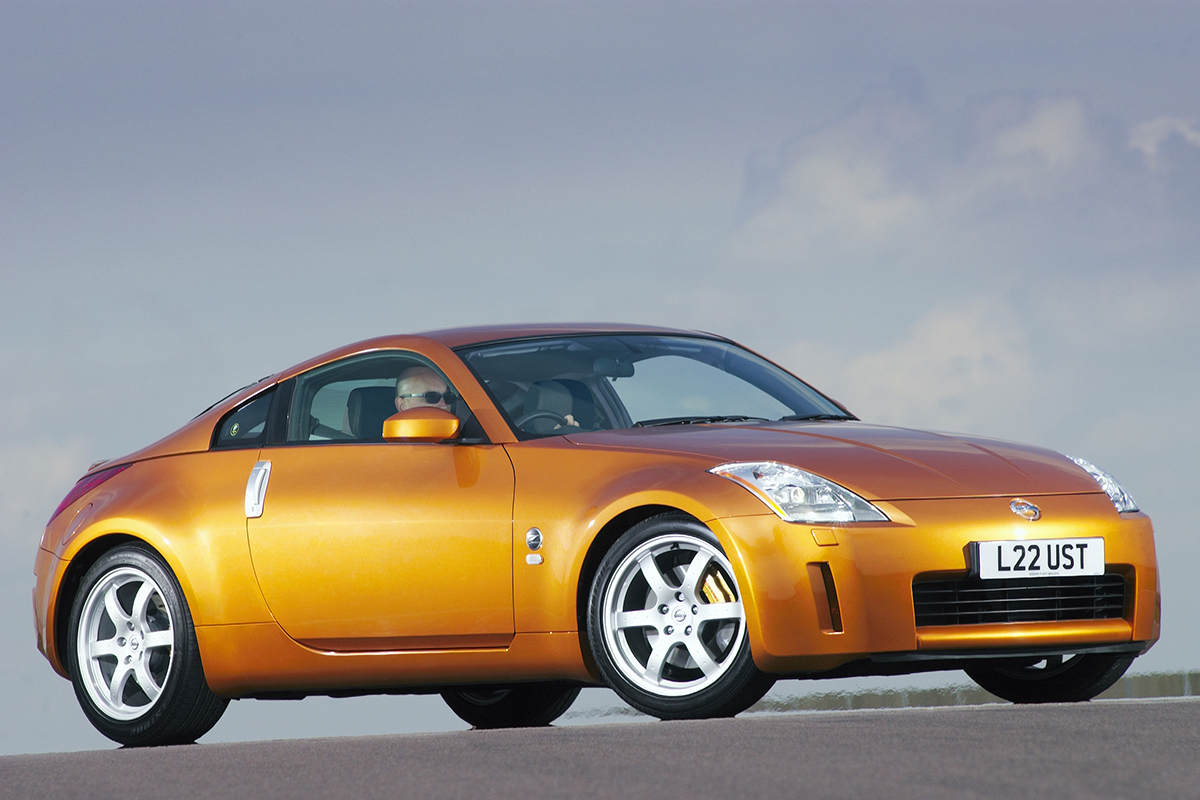
The 350Z is only a two-seater, which makes it less versatile than the Audi TT. But that car is a bit of an outlier in this class, as most of the 350Z’s rivals only sport two seats, too. What’s more, if it did have two rear seats, they’d be so tiny as to be useless for anything but luggage – which is why the additional storage locker you get instead actually makes a bit more sense.
In addition to this, the Nissan 350Z coupe has a good-sized boot with a wide-opening hatch. But access is spoiled by the strut brace that runs across the boot opening, and rather prevents you from sliding in larger items.
The Roadster model has a boot that’s smaller still, of course, but you still get that extra storage compartment, which makes it a little bit more practical than convertible versions of similar cars.
Driving
The 350Z is very, very good to drive. The best cars to buy are those made from 2007 onwards, which gained more power, mostly at the top end of the rev range. This makes them extremely rewarding to drive hard, with the engine spinning freely right up to the 7,500rpm red line, which combines with the big dollop of low-down grunt all 350Zs have to make for a truly exhilarating drive.
Even earlier cars are terrific fun, though; a little less rev-happy, but just as gutsy, and benefiting from the same brilliantly balanced chassis. What’s great about the 350Z is that there’s plenty of grip, but if you want to indulge in lurid tailslides, it’ll allow you to do that too, and in a very predictable way that’s easy to control. That it does all this, yet rides comfortably and cruises well, makes it a particularly good all-rounder.
The Nissan 350Z Roadster weighed 150kg more than the standard car thanks to all the additional bracing it needed to cope with the loss of its roof (not to mention the electric roof mechanism itself), and that extra weight naturally made it a touch less nimble than the coupe. Having said that, this was still an exciting car to drive, and it brought with it one extra big benefit: easier access, in dry weather at least, to that V6’s magnificent exhaust note.

Tech and equipment
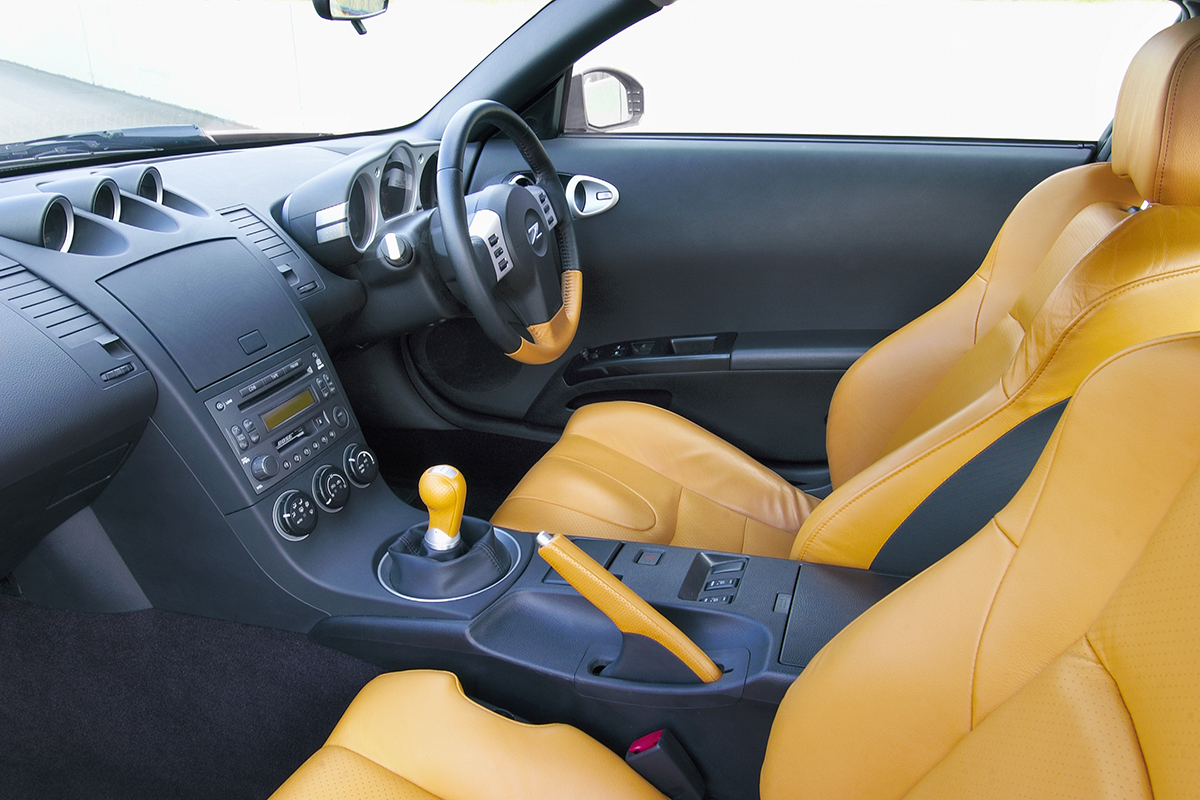
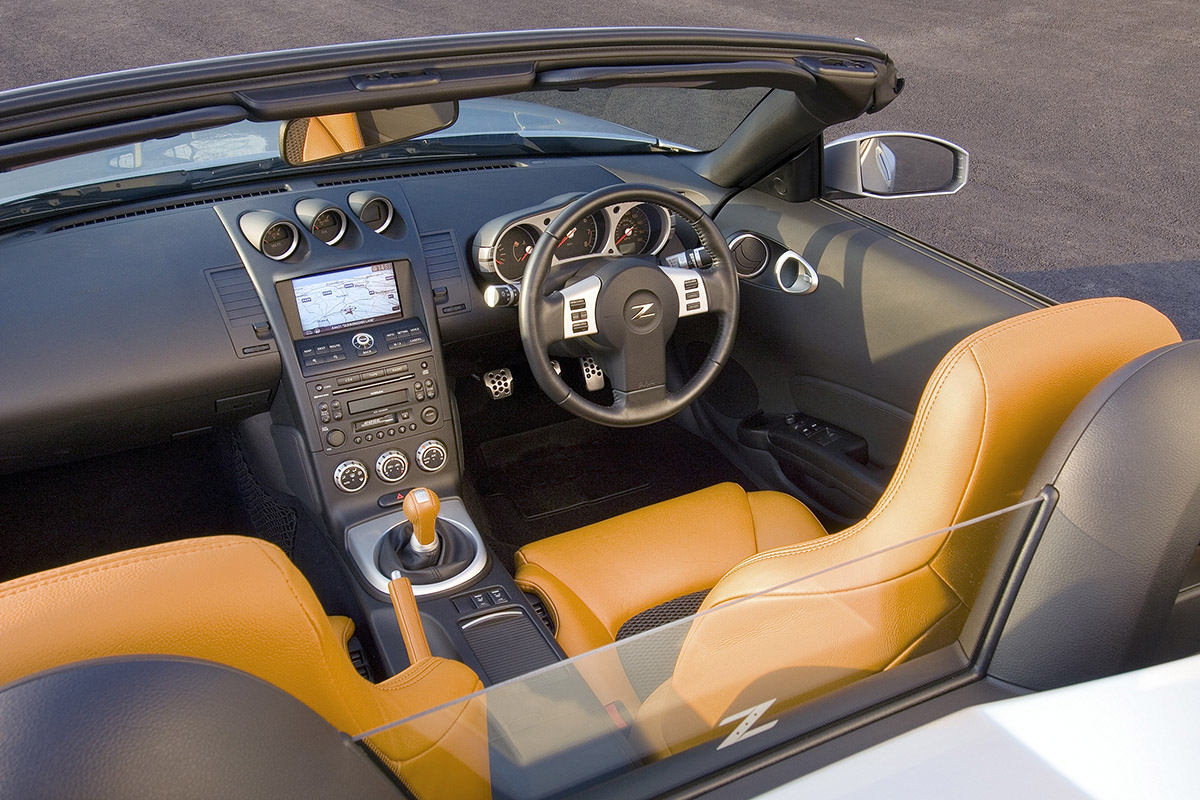
The 350Z was a cheap car for what it was, and you can tell when you climb aboard, because while the interior looks good, it’s made from rather ordinary-feeling materials that don’t wear too well.
On the plus side, by the standards of its time, the 350Z is a well-equipped car; the standard model came with a six-disc CD changer, climate control, xenon headlamps and 18-inch alloy wheels.
Most 350Zs sold in the UK, however, were the higher-spec GT version, and this gained heated, electrically adjustable leather seats, cruise control, and a higher-spec sound system sourced from Bose, which came with a subwoofer.
In 2006, the 350Z had a (very) minor facelift. Cosmetically, it was all but unchanged, but the specification was boosted slightly by the addition of new, bi-xenon headlamps, which were standard on both grades.
Look out for the rare GT4 Edition, too; created in 2005 as part of a tie-up with the Gran Turismo 4 video game, this special edition brought with it an upgraded engine which produced 300hp (and went on to become the standard engine fitted to all 350Zs the following year), and special alloy wheels. It was available either in yellow or black, and only 176 were imported, and that rarity means it today commands a significant premium over and above the standard car.
Running costs
A big, naturally aspirated engine spells trouble as far as fuel economy is concerned, so it comes as no surprise that a fuel economy figure of no more than around 20-25mpg on average, depending on your driving style and which model you choose (the later, more powerful versions will likely be toward the bottom end of this scale).
Keep in mind, too, that servicing intervals on the 350Z are a little shorter than those of a normal car, at every 9,000 miles, though unless you’re a high-mileage driver, that probably won’t worry you as it’ll need servicing every year anyway.
Servicing costs aren’t too high, either, with most Nissan parts costing as much as or less than those you’ll find on most premium rivals. The 350Z will be much cheaper to run than, say, a Porsche Cayman, for example. What’s more, there are plenty of knowledgeable Japanese car specialists around who’ll be able to look after your 350Z for a reasonable sum while still offering plenty of experience with Nissan performance cars, and lots of good advice.
What’s more, the 350Z is fitted with a metal timing chain, and if the car has been well looked after, this should last its lifetime without needing to be changed. By contrast, most Audi TTs of the same era use a rubber timing belt, which needs changing every few years at rather a significant cost.
On the whole, the 350Z is one of the more reliable cars of its age and type, with a better reputation for longevity and dependability than most of its premium-branded rivals.
An upshot of this is that there are actually relatively few common issues to worry about when checking one over. In fact, the biggest issue of all is rust, which affects the rear arches and the front and rear subframes most of all – to catch these latter rust spots, you’ll need to get underneath the car and check both of them carefully, which might require a ramp or a trolley jack and some axle stands (or if not, at least take a torch with you so you can see them clearly while lying on the ground).
Keep an eye on the oil level, too; the V6 is known to like a drink of the stuff, especially if you’re looking at one of the 300hp cars. And if it sounds like there’s a lot of engine noise, you could be looking at a cracked exhaust.
The 350Z’s at an age at which its suspension will be getting tired, so listen out for knocks from bushes, and have a look at the bush that secures the differential to the body – when it’s worn it eventually disintegrates into a gloopy mess that runs down the diff, so if there are black run marks beneath it, it’ll want replacing.
If there’s a clicking noise from the rear of the car while driving along, however, that isn’t too much of an issue – it just means the driveshaft splines need lubricating, which is a relatively easy DIY job, or can be done quickly and affordably by a specialist.
Check all the electrics work, and check the window glass drops when you open the door (and rises again when you close it); window motors are known to go haywire.


What owners say
Three things to know
– In total there were two significant changes to the 350Z throughout its lifetime. The first came in 2006, when the original 280hp engine (known to enthusiasts by its engine code, ‘VQ35’) was upgraded to the 300hp 'RevUp' unit that had been introduced with the GT4 Edition. But the most extensive upgrade came in 2007, when the engine was heavily reworked to give it more power at the top end of the rev range, and bring total output up to 313hp. This upgrade is often referred to as the HR, or High Response, after the suffix that was added to its engine code. At the same time, the engine was moved lower in the car, to improve its centre of gravity, and some very minor cosmetic tweaks were made – most notably, a new bonnet bulge to echo that of the original Datsun 240Z, the 350Z’s ancestor. – Some of the 350Zs you’ll see advertised at the cheaper end of the spectrum will be Japanese imports. You can tell these cars apart because they’re badged ‘Fairlady Z’ instead, and usually have a smaller, squarer aperture in the rear bumper for the number plate. These cars don’t differ enormously in specification from the UK-spec models (though the GT is known as the ST), but they are worth less. It’s important to check the history carefully, to make sure the car was serviced properly both before and after it was imported (and note that the pre-import history will be in Japanese, so you might need some help with translation). What’s more, keep in mind that an imported car will be harder to sell when the time comes, as UK cars are perceived to be more desirable (and are therefore more sought after); because of this, some dealers will be less willing to part-exchange an import. – The 350Z was a popular car among tuners and modifiers, which means many of the examples you’ll see for sale have been tweaked. These are not necessarily cars to avoid, but you’ll want to make sure the modifications are high-quality and have been added sympathetically. Some of these modifications will be fairly minor – many are cosmetic – but others will be more substantial; some tuners even added turbos or superchargers to their 350Zs to make their cars even faster. If the car you’re buying is one of these, you’ll want to make doubly sure that it’s been done well by checking out the reputation of the tuner who did the work online; of course, it’s also imperative to make sure the suspension and brakes have been upgraded to suit all that extra power, too.
Which one to buy
- If your budget can stretch to it, the obvious choice is to go for a 2007-on 350Z GT coupe. That way, you get the most powerful, most exciting engine and the highest specification – and of course, you get the newest cars too, as an added bonus.
- If it’s a Roadster you’re after, the same advice applies – though keep in mind that Roadster versions are trickier to find, as far fewer were sold than hard-tops. This isn’t necessarily a bad thing, but it does mean you might have to look harder to find the car that’s right for you.
- If it's the exclusivity you desire, however, you’ll want to seek out one of the GT4 models. Be prepared to spend a great deal of time looking, though.