Nissan X-Trail 2026 review | A surprisingly capable and versatile family SUV
Nissan X-Trail cars for sale
4.0
Expert review
Pros
Hugely practical
Lots of safety equipment
Comfortable on long journeys
Cons
e-Power model is not as economical as you might hope
No plug-in hybrid option
Some rivals offer more space in the third-row seats

The CarGurus verdict
We really like the Nissan X-Trail. It’s a quiet, comfortable and confident drive, teamed with a very well equipped and roomy interior that benefits from the always-popular option of a seven-seat layout. Safety standards, in particular, are also hard to fault.
We’re not totally convinced by the real-world – or even the official – fuel economy of the X-Trail e-Power hybrid system, but it is at least very similar, if not a touch better, than you will achieve with conventional, non-electrified petrol alternatives. You’re also getting usefully better performance and refinement, so there are clear benefits. Even so, a future fully electric X-Trail could make an even stronger case.
Even without a plug-in option, the Nissan X-Trail is a fine and functional seven-seat family vehicle that offers exactly what a lot of buyers are looking for.

What is the Nissan X-Trail?
The Nissan X-Trail started life in 2000 as a rugged and utilitarian 4x4 that won many fans for its no-nonsense ability (including being a great tow car). The same attributes applied to the second-generation X-Trail, which landed in 2007. With the arrival of the third-generation car in 2013, however, Nissan shifted the focus from ruggedness to refinement, and the X-Trail became the brand’s large, seven-seat family SUV.
That’s the same formula Nissan has applied to this fourth-generation X-Trail. It majors on interior versatility, with both five- and seven-seat variants on offer. Both are well equipped and come with a strong suite of safety technology, including blind-spot intervention and adaptive cruise control.
Powertrains include a 1.5-litre turbocharged petrol mild hybrid with 161bhp, but Nissan expects its e-Power hybrid model to be the default choice for most buyers. This is an interesting and rather unusual set-up first seen in the Nissan Qashqai. It uses a 2.1kWh lithium-ion battery and a 201bhp electric motor to drive the front wheels, while the 1.5-litre petrol engine acts purely as a generator to charge the battery. There is no direct mechanical drive from the petrol engine to the wheels in the X-Trail e-Power – it’s always powered by its electric motor – although you can’t plug it in.
You can also order the e-Power with Nissan’s e-4orce four-wheel-drive system, which adds a second electric motor on the rear axle for a combined output of 210bhp. This not only improves traction in poor conditions, but also enhances stability and overall comfort. It includes drive modes suited to snow and light off-roading, too.
Prices put the X-Trail in contention with five-seat alternatives like the Toyota RAV4, Mazda CX-5 and Nissan’s own Qashqai, as well as seven-seat SUVs such as the Peugeot 5008 and Skoda Kodiaq. It also elbows into the territory of slightly bigger and pricier seven-seat SUVs, including the Hyundai Santa Fe.

How practical is it?
The Nissan X-Trail gets a very roomy 575 litres of boot space in five-seat mode (585 litres in the version that doesn’t have seven seats), which is a really good-sized load space even by the standards of this class. The low load lip and flush boot floor make it easy to lift a double buggy in, too. Pull up the third row of seats and there is space for the tonneau cover to sit in the remaining strip of luggage space, with a few soft bags as well. The five-seat X-Trail also benefits from a ‘Flexible Luggage Board’ system, which offers a variety of underfloor and boot sectioning functions so that you can hide your valuables and/or keep your groceries secure on the journey home from the shops.
Getting into the third row of seats requires a bit of dexterity – more so than in the Hyundai Santa Fe, for instance, but roughly on a par with the Peugeot 5008. An average-sized adult will be OK back there for short journeys provided those in the middle row are willing to slide the seats forward. Again, it’s roughly on a par with the Peugeot 5008 or Skoda Kodiaq, but usefully better for third-row passenger space than a Land Rover Discovery Sport.
More realistically, it’ll be the kids in the back and the grandparents in the middle seats, and the X-Trail’s third row is just great for occasional flexibility. It provides the sort of seating versatility that makes light work of family motoring.
In five-seat mode there is masses of legroom and headroom in the X-Trail, plus the seat-backs can be reclined in a 60:40 split, or in a more versatile 40:20:40 layout from Tekna trim and up.
There are two Isofix fittings in the middle row, but none in the occasional seats in the seven-seat model, nor on the front passenger seat. If you do need more than two pairs of Isofix fittings, consider the Peugeot 5008 which has three individual seats in the middle row, each with a pair of Isofix mounts for ultimate child seat practicality. Mind you, if you only need to fit one or two car seats, one benefit that the Nissan X-Trail offers is wide-opening rear doors, which hinge to 85 degrees. They offer fantastic access to the middle row of seats.
Up front, there is plenty of space even for a tall driver to get comfortable, with ample headroom and legroom whether you’ve optioned the panoramic glass sunroof or not. There are also lots of cubbies, including a hidden area to store your wallet or keys beneath the centre console. The door pockets will hold a large drinking bottle.
Perceived quality is a big step up in the latest Nissan X-Trail, with contrast-stitched leather on top-spec models, plus durable but tactile materials in other areas. You’ll also find nicely damped and straightforward rotary air-con controls, which are a refreshing change from the in-screen controls that are common inside many rivals.
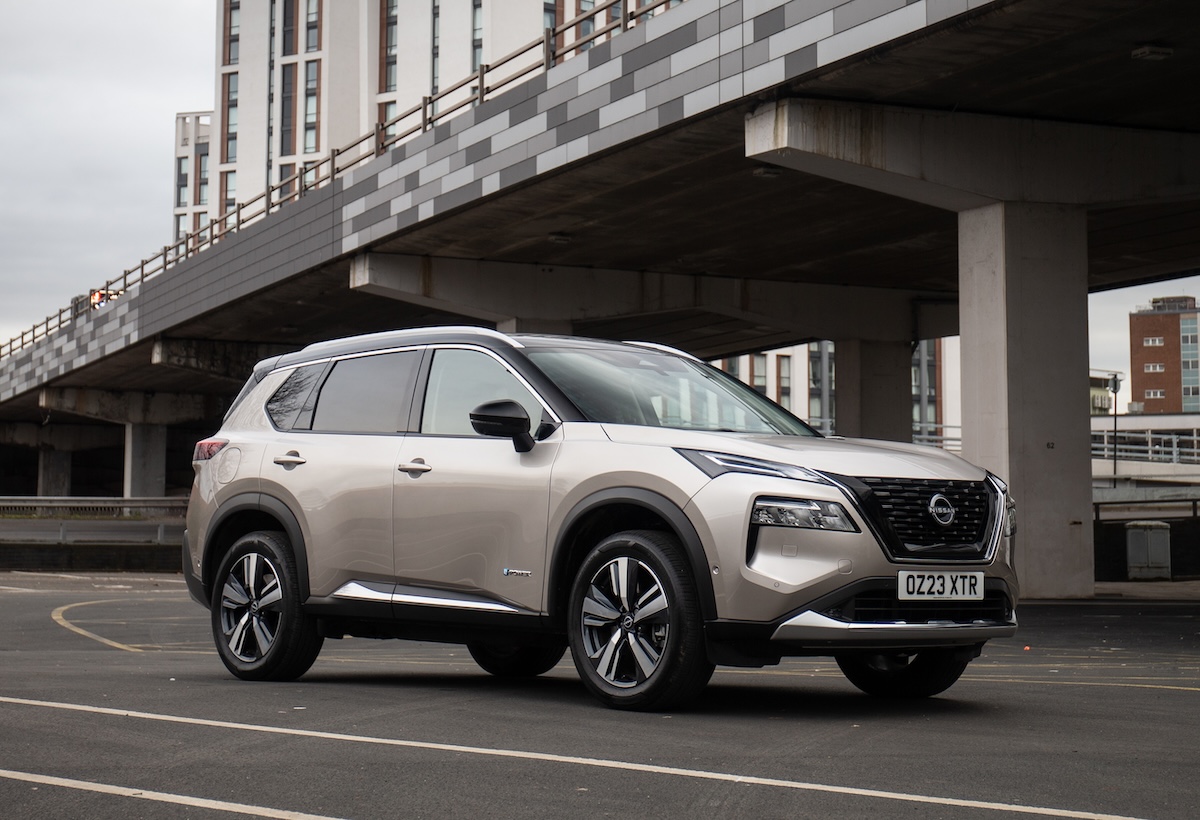
What's it like to drive?
The X-Trail is very calm and comfortable to drive, which is exactly what you want from a family car like this. The hybrid X-Trail e-Power can feel a bit unusual to start with, especially if you’ve never driven an electric vehicle. This is because it has characteristics of a pure electric car thanks to its novel hybrid system. The electric motors that drive the wheels mean there is no conventional gearbox shifting ratios – just a smooth and linear delivery, resulting in plenty of torque and a constant stream of acceleration. You build up to 62mph in 7.0 seconds in the e-4orce four-wheel-drive model, or 8.0 seconds in the front-driven X-Trail e-Power.
That is quick enough for confident mid-range bursts of speed or brisk motorway merges, but if you demand swift acceleration there is a noticeable background groan from the petrol engine as it works harder to generate electricity. It’s not the most pleasant sound, but is relatively subdued – certainly more hushed than the hybrid and CVT gearbox combination in a Toyota RAV4. The rest of the time, the X-Trail e-Power is impressively quiet, and you barely notice the petrol engine operating in the background.
You can also select an ‘EV’ mode via a button on the dashboard, which prioritises electric driving at lower speeds, although the battery is small (2.1kWh), so you’ll only manage a very short distance – typically a mile or two – before the petrol engine cuts in. The benefit of the X-Trail e-Power being driven by electric motors is that you also get regenerative braking. By default, this feels no different to everyday engine braking from a petrol or diesel motor, but you can select ‘e-Pedal’ mode for very heavy brake recuperation – just as in the Nissan Leaf and Nissan Ariya electric cars.
Ride comfort is very good. Even on larger alloy wheels the X-Trail remains settled and composed, even if it can feel fidgety over scruffy urban roads. Bump absorption over speed humps is well judged, and at motorway speeds the car feels stable, quiet and relaxed. The steering is light and easy to predict, so while the X-Trail will wash wide if you go into a corner aggressively, you get a good sense of how much grip there is. By the standards of big, efficiency-focused family SUVs, the X-Trail has decent performance and is one of the more comfortable and refined options in its class.

Technology, equipment & infotainment
The infotainment system in the X-Trail is fit for purpose, but not the best in class. Its graphics lag behind what you get in a Kia Sportage or Hyundai Tucson, and it isn’t always obvious where to find certain system settings (such as turning off voice control on the navigation guidance). However, the main features are easy to find, there’s wireless Apple CarPlay and Android Auto connectivity, and also Amazon Alexa voice control to further help you find what you’re looking for. Between that, a clear and easy-to-read digital driver’s readout, and a standard head-up display on higher spec models, it’s hard to quibble with the tech on board the Nissan X-Trail.
The X-Trail is one of the best vehicles in its class for safety equipment, and comes with autonomous forward emergency braking that can sense pedestrians and cyclists as well as other cars. Blind-spot warning, lane-departure warning and adaptive cruise control are standard across the range. The entry-level Acenta Premium trim is reasonably well equipped, with 18-inch alloy wheels, LED headlights, dual-zone climate control, front and rear parking sensors, a rear-view camera, wireless phone charging, wired Apple CarPlay and Android Auto, and an 8.0-inch touchscreen infotainment system.
However, most buyers will go for higher-spec trim levels such as the N-Connecta, which adds a larger 12.3-inch touchscreen, wireless Apple CarPlay and Android Auto, ambient lighting, an electric tailgate and an around-view monitor. Tekna is a really generously-equipped spec that includes 19-inch alloy wheels, a sunroof, a 10.8-inch head-up display, a heated windscreen, a heated steering wheel, front and rear heated seats, three-zone climate control, electrically adjustable front seats, and retractable sunshades in the back. Tekna+ is the ultimate option, with premium leather seats, 20-inch alloys and a 10-speaker Bose sound system.
The X-Trail received a minor update mid-way through 2024, which saw the entry-level Visia trim axed (it didn't sell very well), and a new mid-range N-Trek trim level introduced. This is mainly a style-focused offering based on the N-Connecta, with glossy black finishes for the roof rails and mirror caps, plus revised front and rear bumpers with darkened elements, and water-resistant seat upholstery. The other trim levels also received slightly more equipment.

Nissan X-Trail running costs
The Nissan X-Trail is very competitively priced against its key rivals, but it does start to get expensive in higher-spec e-Power models, especially by the time you’ve added the optional seven-seats and e-4orce four-wheel drive. The range tops out at a price that rivals a plug-in Hyundai Santa Fe, but we’d point to the still-well-equipped N-Connecta or Tekna trims for great value and all the kit you’re likely to want or need.
Residual values are very good on the Nissan X-Trail, which also means that monthly costs will be competitive. Fuel bills should be acceptable, with the standard e-Power managing a WLTP-tested figure of up to 49.5mpg. Choosing the four-wheel-drive e-4orce brings that down to around 44mpg, depending on trim. The 1.5 MHEV mild hybrid – which has an automatic transmission as standard – manages up to around 40mpg. In our test of the four-wheel-drive X-Trail e-Power, we managed between 36mpg and 42mpg in real-world driving.
If there are any reservations over the costs of the X-Trail, it’s whether the e-Power engine will really deliver the fuel economy gains that you’d expect of a hybrid. Ultimately, even the mild-hybrid Peugeot 5008 manages similar official figures, while a diesel Skoda Kodiaq and the hybrid Toyota RAV4 manage closer to 50mpg in the WLTP tests. The plug-in hybrid Hyundai Santa Fe can offer significantly lower fuel costs if regularly charged, along with lower Benefit-in-Kind rates for company car users.
Even so, provided you enjoy the way the X-Trail drives, and are confident that its hybrid powertrain and low-to-mid 40ish mpg will work for you, it still stacks up well for affordability.

Nissan X-Trail reliability
Nissan came a hugely disappointing 29th out of the 30 manufacturers included in the 2025 What Car? Reliability Survey. More encouragingly, the X-Trail achieved a respectable 15th place out of 76 cars in the family SUV class, beating several premium and more expensive rivals.
A three-year, 60,000-mile warranty is standard, which is also what you’ll get on a Peugeot 5008 or Skoda Kodiaq. But the Kia Sportage, Toyota RAV4 and Hyundai Santa Fe all offer usefully longer warranties.
- If you thought the X-Trail’s various driver aids were impressive, there is more. Nissan also introduced a new central airbag in the front of the car. In addition to the driver and passenger airbags, and indeed the side and curtain airbags, this central airbag attempts to prevent front occupants from coming into contact during a collision. By any measure – even compared to the high standards set by Hyundai, Kia and premium brands such as Volvo – the Nissan X-Trail really does have an impressive level of safety kit.
- Don’t be confused by the descriptions of the Nissan X-Trail’s 1.5-litre mild hybrid petrol engine. A mild hybrid is, in essence, a normal combustion engine with a clever alternator that delivers an additional electric boost in order to improve fuel efficiency. You drive it and live with it just as you would any normal petrol car. Just as you do, in fact, the hybrid X-Trail e-Power, which – as we’ve described – doesn’t offer the option of being able to charge from mains electricity (which may or may not be a benefit, depending on how you plan to use your car). There is currently no plug-in hybrid X-Trail, and Nissan has instead focused on its e-Power hybrid system for this generation. If you want a plug-in Nissan SUV, you’ll need to look at the fully electric Ariya, while the Leaf – now also an SUV – remains Nissan’s smaller electric option.
- The Nissan X-Trail is similar in size to rivals such as the Peugeot 5008 and Skoda Kodiaq. What sets it apart is Nissan’s unusual e-Power system, which delivers electric-motor drive without the need to plug in.
- If you want the best value: The Acenta Premium 1.5 mild hybrid promises to balance equipment levels and ownership costs quite nicely. The e-Power engine is well worth considering if you value the lower CO2 emissions, and it’ll be more economical than the mild hybrid as well. That said, we only saw around 42mpg from the e-Power e-4orce X-Trail even in quite sedate use, while economy dipped to more like 35mpg on rural roads.
- If you want the best family car: The Nissan X-Trail Tekna with seven seats is a great family car, with its glass roof, more flexible middle row of seats, rear climate controls and sun shades: it really does promise to keep everyone happy. Again, do consider the e-Power as the refinement is great, but don’t expect hugely impressive economy as even the official figures only peg it at roughly 44mpg in seven-seat e-Power Tekna guise.
- If you want the best company car: Go for the N-Connecta e-Power hybrid, since its lower emissions will lead to lower company car tax bills. The better fuel economy will keep your boss happy, too. N-Connecta is a very happy medium for equipment, as it’s usefully cheaper than Tekna but still gets the full 12.3-inch touchscreen and lots of other luxuries.
- If you want the best long-distance car: The Tekna e-Power hybrid will be ideal, as it’s a super-refined and comfortable motorway cruiser, while the electrically adjustable seats with lumbar adjustment, head-up display and glass roof make for a bright and comfortable interior.
- If you want to tow: The mild hybrid is actually the strongest choice on paper, with a braked towing capacity of up to 2,000kg in five-seat form (1,800kg as a seven-seater). If you prefer the hybrid e-Power system, you’ll need the e-4orce four-wheel-drive version, which can tow up to 1,800kg (1,650kg in seven-seat guise). The front-wheel-drive e-Power is limited to just 670kg, so is not suitable for caravan-towing.