Toyota C-HR Review (2024-present)
Toyota C-HR cars for sale
4.0
Expert review
Pros
Low running costs
Distinctive styling
Good to drive
Cons
Expensive compared with rivals
Safety systems can be overly intrusive
Lots of random beeps and bongs
The CarGurus verdict
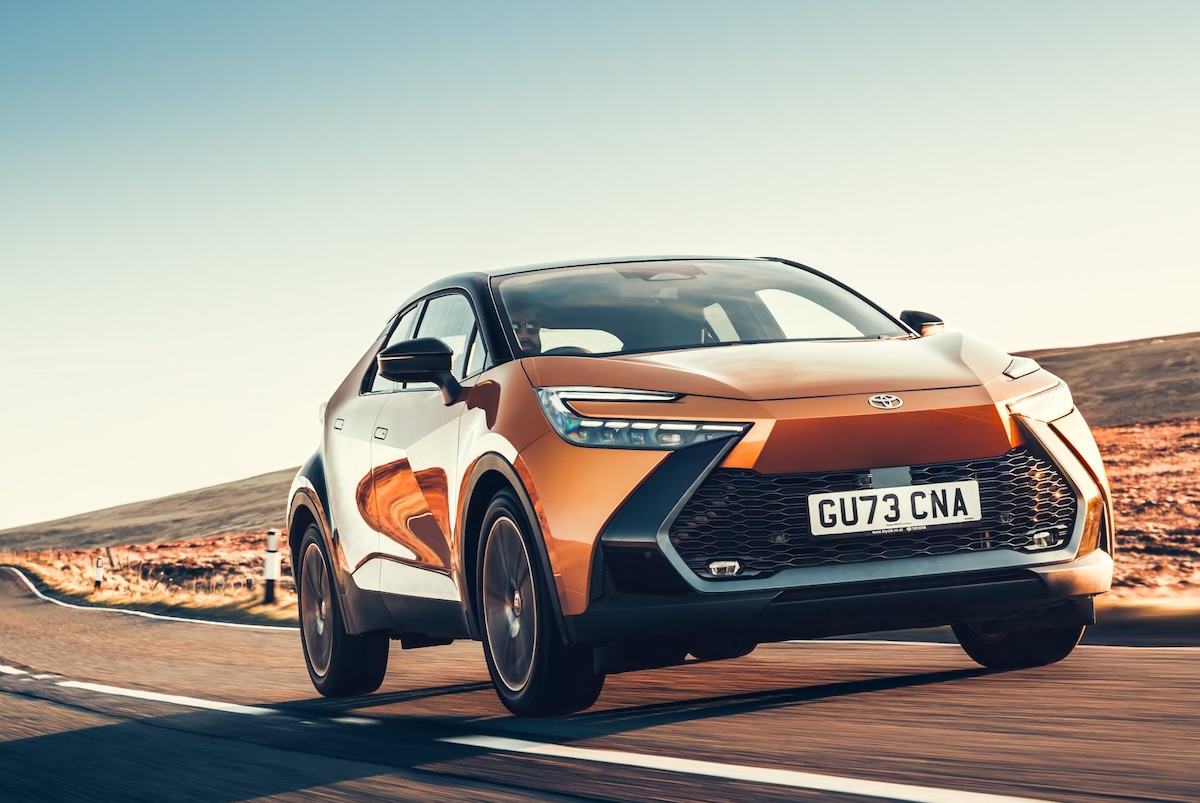
The Toyota C-HR is not the cheapest or roomiest option in its class, but it is a very good crossover in a lot of ways. It’s hard not to admire the bold styling, and while the seemingly random beeps and bongs that the car emits can be annoying, they don't detract too much from what is a really good all-rounder.
The C-HR's hybrid-only powertrain line-up also means it is a very efficient car and thus should be cheap to run. What's especially impressive is that Toyota hasn't forgotten that it should also be comfortable and enjoyable to drive. Overall, much like the original C-HR, this second-generation model is highly recommendable, if not a runaway class leader.

What is the Toyota C-HR?
The Toyota C-HR is a five-seater compact crossover to rival the likes of the Volkswagen T-Roc, Seat Ateca, Lexus LBX and Audi Q2. It is available as either a self-charging hybrid or as a plug-in hybrid, both of which promise low running costs and Toyota’s trademark excellent reliability.
Designed and built in Europe, with European customers in mind, this second-generation C-HR stands out with its concept car-like styling, which includes the option of a bold two-tone paint scheme. While it is far from the cheapest option in this ultra-competitive sector of the car market, Toyota has certainly pulled out all the stops to make it stand out.

How practical is it?
While it lacks the versatility of the Renault Captur’s sliding rear seats, the C-HR is roomy enough for four people to travel in comfort, and five at a push. Those in the rear have decent legroom (a six-foot-tall passenger can sit behind a six-foot driver with just enough knee room to spare), and there’s lots of room for feet to fit under the seats in front. Despite the C-HR’s sloping roofline, headroom is OK, and because the panoramic roof on higher-spec models doesn’t require a sun blind it doesn’t eat into headroom.
Boot capacity varies by model. Go for the self-charging hybrid with the 1.8-litre petrol engine and there’s 388 litres of space. For context that’s about what you get in a Volkswagen Golf. Upgrading to the 2.0-litre petrol engine for the self-charging hybrid reduces boot capacity to 364 litres due to the relocation of the 12-volt battery from under the bonnet to the boot. The plug-in hybrid has a boot volume of 310 litres.
In the front of the C-HR you’ll find a usefully large glovebox plus a shelf above, as well as further storage under the armrest plus a couple of cupholders and a wireless charging pad for your phone on all but the Icon trim. The door bins are, however, slightly narrow.
What’s it like to drive?
Toyota’s self-charging hybrid system is well proven, and while its performance and power delivery have been refined over the years, its strengths and weaknesses remain largely unchanged. In its favour is that it is extremely smooth and quiet at low speeds and with light to medium use of the throttle. Electric-only running is limited to very low speed/short-distance use or when coasting, but with good anticipation of road and traffic conditions you can expect to cover as much as 50% of town driving in electric mode.
Less impressive is the drone made by the engine under hard acceleration, which is a characteristic of the CVT automatic gearbox that Toyota uses. This is more noticeable in the 1.8-litre version of the drivetrain, which produces 138bhp for a 0-62mph time of 10.2 seconds and generally needs to be worked harder to make good progress. The 2.0-litre version of this powertrain produces much more muscular performance and feels like a worthwhile upgrade. Respective performance figures are 193bhp and 8.1 seconds from 0-62mph.
The plug-in hybrid version of the C-HR also uses a 2.0-litre petrol engine but pairs it with a 13.6kWh lithium-ion battery for an electric-only range of up to 41 miles, as well as 220bhp and a 0-62mph time of 7.4 seconds.
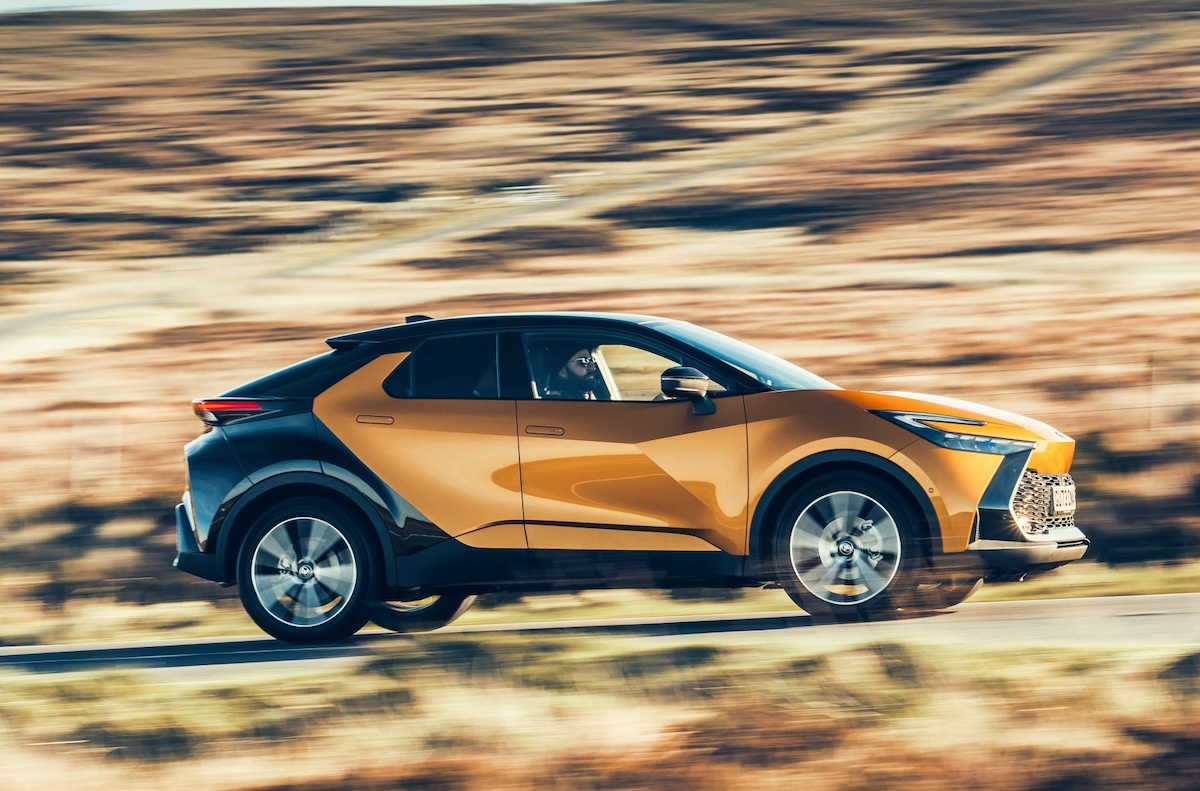
In terms of ride and handling, the C-HR strikes a decent balance between being entertaining enough on twisty roads, without resorting to a rock-hard ride. In fact, there’s enough give in the suspension to ensure that around town the C-HR takes the edge off bumps and cracks in the road surface, and at higher speeds it also feels nicely settled. The steering has meanginful weight to it, which helps the C-HR feel reassuring to drive. Brake feel is consistent, and the drivetrain’s B-mode (selectable via the gearlever) allows the driver to toggle to a higher level of engine braking if desired.
Where the C-HR feels arguably most frustrating is in its active driver assist systems. Among other things, these monitor what the road and traffic is doing and will either beep and bong warnings at you, or proactively slow or steer the car. Whether this is helpful or annoying will come down to personal preference, and while the systems can be disabled via an (overly fiddly) menu within the digital dials, you first need to learn a dozen or so different acronyms to determine what systems you are actually turning on or off.

Technology, equipment & infotainment
As with so many cars in its class, The C-HR uses a combination of digital dials and a central touchscreen infotainment system. The size of these screens varies by trim. In the entry-level Icon trim the screen to complement the dials measures seven inches and the central infotainment screen is eight inches. Upgrade one level to Design trim or above and the dial arrangement becomes a 12.3-inch screen, as does the central infotainment screen. The system itself represents a quantum leap from Toyota’s older touchscreens. Not only does it respond briskly to commands, but the menus are logically laid out and the graphics are crisp and clear. All C-HRs comes with Apple CarPlay and Android Auto as standard.
The C-HR range kicks off with Icon trim, which includes the smaller screens, single-zone climate control, 17-inch alloy wheels, a reversing camera and keyless entry and start.
Next up is Design trim, which adds the larger screens, plus dual-zone climate control, heated seats, a wireless phone charger, 18-inch wheels, a powered tailgate and front parking sensors.
Excel and Premiere Edition trims include 19-inch wheels, LED headlights, 64-colour ambient lighting and a head-up display. Premiere Edition also includes a panoramic roof as standard (it's also an option on Design and GR Sport trims), and a digital rear-view mirror that can project a feed from a rear-facing camera.
The sportier GR Sport offering has more aggressive styling that includes 20-inch wheels, plus a similar level of equipment to the Excel.
All C-HRs come with Toyota's Safety Sense active safety kit, which includes a pre-collision warning system, lane departure warning and road sign assist.

Toyota C-HR running costs
Even allowing for its standard hybrid drivetrain, the way Toyota has set C-HR prices makes it look expensive next to similarly sized crossovers. Notably, several models cost more than £40,000 and so fall into the premium rate of VED (road tax).
Countering this is Toyota’s enviable reputation for producing extremely reliable cars (more of which in the next section), as well as the fact that the C-HR looks like nothing else in its class.
Beyond purchase price, running costs stack up well. Opt for either the 1.8- or 2.0-litre self-charging hybrid, and you can expect to see upwards of 50mpg in mixed driving (against official claimed figures of 60mpg for the 1.8 or 58mpg for the 2.0-litre). The plug-in hybrid’s official economy figure is 353mpg, but you’ll need to be charging on a very regular basis to achieve that.
For insurance, the C-HR sits in groups 20 and above, which is fairly high for this class of car, particularly next to non-hybrid rivals.

Toyota C-HR reliability
The second-generation C-HR is too new to have been included in any reliability studies. However, the previous model finished 10th in its class (which included 23 cars) in the 2024 What Car? Reliability Survey, and Toyota as a brand came fifth of the 31 manufacturers included.
All of which is to say that reliability shouldn’t be a concern - in fact, Toyota is so confident in the long-term durability of its cars that it will increase the standard three-year, 60,000-mile warranty to up to 10 years and 100,000 miles so long as you have the car serviced within its dealer network. We rate this as the best manufacturer-backed car warranty on the market.
- This generation of C-HR is the first that’s available as both a self-charging hybrid and a plug-in hybrid. The latter uses a 13.6kWh battery combined with a 2.0-litre petrol engine to give 220 horsepower and a range of up to 41 miles on EV power. To buy new it carries a premium of approximately £3,000 over a 2.0-litre self-charging C-HR, but it might make sense as a company car due to its lower Benefit-in-Kind (BIK) liability.
- Among the many gadgets on offer to C-HR owners is a rear-view mirror that can display a feed from a camera that’s mounted by the car’s rear numberplate. It’s designed to allow you to see what’s going on behind even when there are three people sitting in the back, but our testers found it unnatural to use.
- If you like the idea of a stylish Toyota but would rather have a more conventional hatchback, the latest Prius takes much of what is good about the C-HR and presents it in a more conventional package.
- The best all-rounder: The C-HR is a strong performer in many different ways, but price isn’t one of them. As such - and given the long list of standard equipment - we think Design trim (that's one-up-from-entry-level) with the 1.8-litre self-charging hybrid is a good buy. You might miss out on the snazzy two-tone paintwork and the extra power of the 2.0-litre powertrain, but the styling is so bold that it still stands out, and even the base hybrid system gives a sensible balance of performance and economy.
- If you’re a company car driver: company car rules are structured to incentivise the purchase of low-emission models. With their being no fully electric C-HR, that leaves the plug-in hybrid as the most tax-efficient choice.
- If you want all the bells and whistles: Look out for a Premier Edition model with either the self-charging or plug-in system. It has more than enough tech to impress, although it still won’t trouble a BMW or Audi for interior ambeince.


