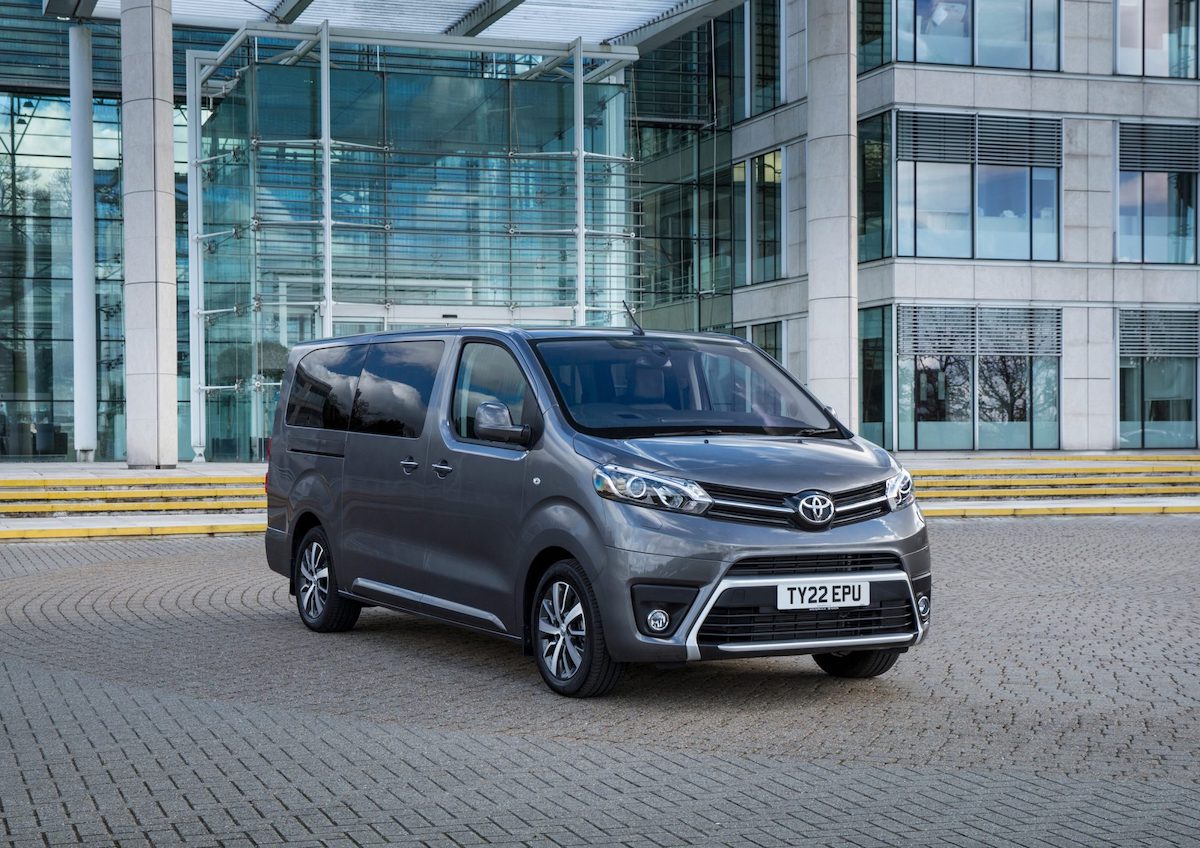
Toyota Proace Verso Review (2016-present)
Pros and cons
What we like
Enormously practical
Very solidly built
Comfortable and easy to drive
What to consider
Infotainment feels very out of date
Not cheap
Entry model misses some important safety kit
The CarGurus verdict
Practicality and versatility are the two areas in which any MPV needs to dazzle, and the Toyota Proace does just that. It’s also solidly made, pleasant to drive and comes with a cracking warranty, and being powered by diesel engines, it has an interesting USP against the equivalent all-electric offerings from Citroen, Peugeot and Vauxhall.
It’s close on price to most of its rivals, although arguably a bit too close to some that will probably be deemed more desirable, which is even less forgivable given that the basic versions of the Verso miss out on some very important equipment. However, choose wisely, and drive a hard bargain, and you’ll be getting yourself a very capable carry-all.
out of 5 expert review
What is the Toyota Proace Verso?
A quick glance might have you convinced that the vehicle in front of you should be loaded up to the gunwales with Amazon packages, but the Proace Verso is in fact a vehicle designed to carry people rather than parcels.
It’s based on the Proace panel van, but the Verso gets seats and windows to turn it from cargo-carrier into people-pleaser.
The minimum seat count in this huge people-carrier is seven while the maximum is nine, making it an interesting solution for folk who often have a large family - or a small football team - in tow. And the boxy shape means the seats are surrounded by more space than any SUV can muster, too.

Practicality
How practical is it?
Precisely how practical your Proace will be depends on the specification of the car you buy – there’s a great deal of choice, after all – but whatever you do, you’ll be getting a very roomy and versatile car.
Once upon a time, you chose from one of three body lengths, but the shortest of these has since been discontinued to leave only the medium and the long versions. The amount of seats you get depends on which of the three trims you buy. The entry-level Shuttle version - which is available in both length formats and is aimed mainly at airport taxi and minibus firms rather than family car buyers - has nine seats (three rows of three).
Family trim is offered in the shorter format and drops the middle-front seat to offer a total of eight, most of which are rail-mounted and can be slid backwards and forwards for best use of space. You also get more in the way of helpful touches, such as sunblinds and folding tray tables.
VIP-spec cars, meanwhile, are offered exclusively in the longer format, and come with seven leather-bound seats: two up front, a 60/40 split three-seater bench at the back, and two luxurious captain’s chairs in the middle that can face towards the front or the rear of the car, depending on how sociable you’re feeling.
We’ve only sampled the VIP so far, which with the most length and fewest seats, is obviously the roomiest model, and sure enough, there’s so much headroom and legroom on offer that even the tallest adults will travel comfortably with room to stretch out. There’s so much room to spare, in fact, that although we’ve not experienced the other two versions, we can’t imagine that anyone will struggle for space in those, either, given that there’s only 35cm difference between the two length options (the extra length can be found in the car’s rear overhang, rather than the wheelbase).
Obviously, the precise amount of boot space available will depend on where the sliding seats are set to, but whatever you do, there should be plenty. Even the worst-case scenario in the least capacious version will give you more than 600 litres for bags, which is more than many estate cars, while most other configurations in most other versions will give you more space than you’ll know what to do with. And, remove all of the seats, and you’ll literally have a van-load of cargo space; underneath, this is a Proace panel van, after all.
Other useful touches include a rear window that can be opened independently of the massive tailgate for access to the boot in tight parking spaces (standard on the top two trims), and the sliding rear doors that make it easier to get in and out in tight spots. On the VIP model, these are also powered.

Driving
What’s it like to drive?
The driving experience you get in the Proace is entirely appropriate for the type of car it is. Any vehicle tasked with carrying lots of people must major on comfort above all else, and that’s precisely what the big Toyota does.
The soft suspension, long wheelbase and balloon-like tyres all conspire to soak up lumps and bumps in an impressively sophisticated way. You do feel hints of that characteristic tremor through the floorpan that you feel in pretty much any vehicle derived from a commercial vehicle, but even that is pretty well suppressed by class standards.
The steering also feels appropriate: it’s slow – no surprises there - so a fair amount of arm-twirling is required during low-speed manoeuvres, but it’s nicely weighted and the turning circle is tighter than you might expect. Obviously, sharp direction changes aren’t this car’s party piece, and that will be underlined by the amount of body roll you feel if you accidentally arrive at a corner too quickly. There should be enough grip to get you out of trouble if that happens, but your journey – and those of your passengers – will be much more pleasant if you keep a close eye on your entry speeds and generally take things slow and steady.
Power comes from one of two 2.0-litre turbodiesel engines, one with 148bhp and a six-speed manual gearbox, and one with 174bhp and an eight-speed automatic. We’ve tried the latter, and it does a sterling job. There’s plenty of low-down pull for an eager feel, the gearbox slushes between changes quickly and smoothly, and the car feels muscular and settled at higher speeds, too.
However, we’d exercise some caution if you’re considering the lower-powered version. We haven’t tried it yet, but this kind of vehicle shows up a power/torque deficit like few others do, and according to the official figures, there’s quite a difference in pace against the stopwatch. We’d definitely recommend a test drive to make sure you can live with the more limited pace.

Tech and equipment
Technology, equipment & infotainment
The entry-level Shuttle version of the Proace Verso is a bit sparse when it comes to standard equipment, but you do get items such as electric windows, cruise control, automatic lights and wipers, air-conditioning, stability control, hill-start assist, tyre-pressure monitoring, DAB radio, Bluetooth connectivity and built-in sat-nav.
Upgrade to the Family model and you get useful extra features we mentioned earlier such as the rail-mounted seats, picnic-style tables, sunblinds and the opening tailgate window, as well as keyless entry and start, and rear parking sensors, which is incredibly useful with such a large vehicle.
If you want all the bells and whistles, though, you need to plump for the VIP model, which gets full leather upholstery, a fancy centre console that offers extra storage and even more tables, electrically operated side doors and heated, powered and massaging front seats.
All versions get the Toyota Pro-Touch touchscreen multimedia system, but the 7.0-inch screen looked a bit on the small side when the Proace was launched back in 2016, and by contemporary standards, it looks absolutely tiny, especially considering that the Verso is by no means a cheap car. The dated graphics and less-than-intuitive operating system don’t help it’s case, either, and if you go for the entry-level Shuttle trim, you don’t get standard Apple Carplay/Android Auto with which to circumnavigate the shoddy software.
Another reason to avoid the Shuttle is that, unless you pay extra, it doesn’t get the Toyota Safety Sense pack, which includes emergency brake assist, adaptive cruise control, head-up display and – crucially – autonomous emergency braking.

Running costs
Toyota Proace Verso running costs
If you thought that taking a van and chucking some seats and windows in it would result in a cheap car, then think again. Even the cheapest Verso costs more than £43,000, while the range-topping VIP version checks in more than £56,000. Granted, that’s quite a bit less than you’d pay for a Mercedes V-Class, but it’s very close on price to most other rivals such as the Renault Trafic Passenger and the VW Multivan.
In the case of the Volkswagen specifically, it’s arguably a more desirable car, and comes with better standard equipment. The Volkswagen is likely to have stronger residual values, too, meaning it’ll provide better protection for your initial investment, which will get you more cash back at resale time, or lower monthly finance rates. If you’re not buying new, however, the that would make a used Toyota Proace Verso more affordable in comparison.
The Verso won’t make much sense as a company car, as you’ll pay tax on the maximum 37% of the car’s value, so monthly benefit-in-kind bills will be ruinously expensive. Fleet drivers will be much better off with one of the Toyota’s electric siblings from Citroen, Peugeot or Vauxhall, provided they can live with the limited range.
Official WLTP figures suggest you should be able to average fuel efficiency of somewhere between 36mpg and 39mpg from the two diesel engines, but reckon on around 30mpg in the real world, maybe slightly more if you do lots of motorway miles.

Toyota Proace Verso reliability
Whenever you read the reliability section of any Toyota review, you always seem to get a sense of déjà vu. That’s because there’s only one thing to say on the subject: Toyota is about as reliable as it gets when it comes to car brands. We almost get bored of saying it.
We’ve forgotten how many times the brand has finished on or near the top of the various reliability surveys that do the rounds. The 2022 What Car? Reliability Survey was a case in point. The only surprise was that Toyota didn’t finish top of the pile, being beaten into second place. But who was it that did the beating? Well, it was Lexus, Toyota’s own luxury brand.
The water is slightly murkier with the Proace, though, because underneath, it’s more Citroen and Peugeot than it is Toyota, and in the same study mentioned earlier, those brands placed 11th and 28th out of 32 carmakers. Rather less dazzling.
However, you can take solace in the fact that Toyota has decided to apply the same potentially peerless warranty to the Proace as it does to every other new Toyota, so the firm must have at least some confidence that the car will be reliable enough that they can honour that agreement without bankrupting the company.


What owners say
Three things to know
- As is the case with most commercial vehicles – not to mention many passenger cars – the Proace is the result of a joint development project undertaken with other manufacturers, designed to reduce research, development and production costs. As such, the Proace is mechanically very similar to the Citroen Spacetourer, Peugeot Traveller and Vauxhall Vivaro Life. However, the Toyota version has one important difference. With the other three vehicles, the combustion engine choices that were once offered have since been dropped, leaving only electric versions that have less-than-stellar ranges. So, if you’re a high-mileage minicabber, the Toyota is the obvious choice.
- Like all Toyotas, the Proace Verso potentially comes with one of the best warranty packages in the automotive business. We say ‘potentially’, because it comes with rather a large caveat. If you’re not careful about where you get your car serviced, then you have very run-of-the-mill three-year, 60,000-mile cover, which is the bare minimum you should expect on any new car. If, however, you get your car serviced according to schedule at a Toyota main dealer, then your warranty is automatically extended by a year each time, up to a maximum of 10 years or 100,000 miles.
- Talking of the servicing schedule, your Proace Verso will need maintenance every two years or 25,000 miles, which is pretty good. However, if you choose a version with the higher-powered 174bhp 2.0-litre engine, those intervals reduce to every year or 20,000 miles.
Which one to buy
- If you want the sensible one: The Toyota is certainly the van-based MPV you buy if you’re choosing with your head. It’s a very impressive all-rounder in terms of practicality and driving manners, it’s very solidly made, as we’ve heard it comes with a tremendous warranty programme, and as we will find out in a moment, cars don’t get much more reliable than Toyotas. It’s enormously difficult to argue with.
- If you want the funky one: Even though the ID.Buzz has come along to properly recapture the nostalgia and sentimentality left behind by the original Volkswagen camper van, the VW Multivan also manages to retain an element of that residual coolness, and it’s a much more direct rival for the Proace. Definitely the image-conscious choice in the sector.
- If you want the posh one: The Mercedes V-Class may be based on a commercial vehicle like the rest, but this van-based MPV feels almost as posh inside as any other Mercedes when you’re ensconced in your cushy leatherbound chair. No wonder they’re used to shuttle VIPs and celebs from gala, to premiere, to afterparty.
- If you want the electric one: Like we’ve said, courtesy of the joint development project that spawned the Proace Verso, there are several all-but-identical alternatives that now run solely on electric power, those being the Citroen Spacetourer, Peugeot Traveller and Vauxhall Vivaro Life.