Volkswagen ID.3 Review (2020-present)
Volkswagen ID.3 cars for sale
4.0
Expert review
Pros
Futuristic looks meet family-friendly space
Good range of battery and engine options
Well equipped
Cons
Not as energy-efficient as some rivals
Not quite as premium-feeling as you'd hope
Infotainment system glitchy and flawed
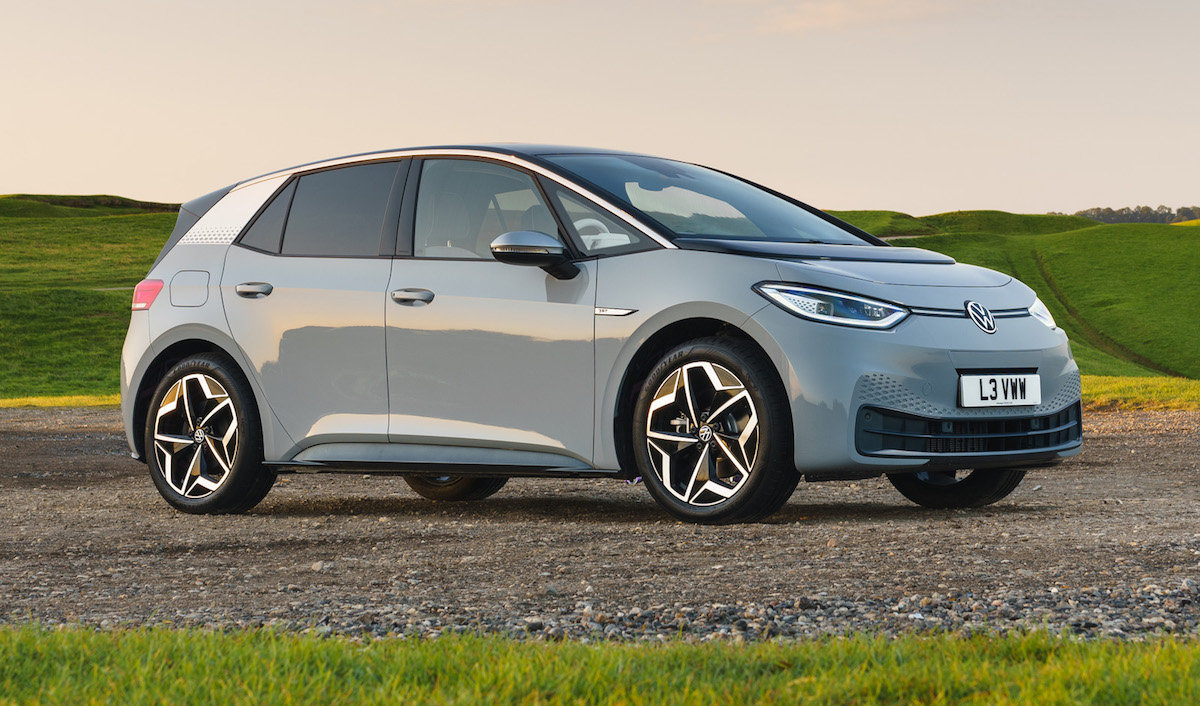
The CarGurus verdict
The Volkswagen ID.3 is a well-rounded family car. It’s comfortable, spacious and feels well built, even if there are some cheaper-feeling plastics lower down in the cabin. We’d like to see better efficiency, proper cable storage and a more intuitive touchscreen interface, but otherwise there’s a lot to like and appreciate about the sleek, futuristic yet friendly feeling ID.3.
It’s not without flaws, then, and it’s not without rivals that actually do certain things better, but as an overall prospect the Volkswagen ID.3 sets a high standard for the family car of the future.
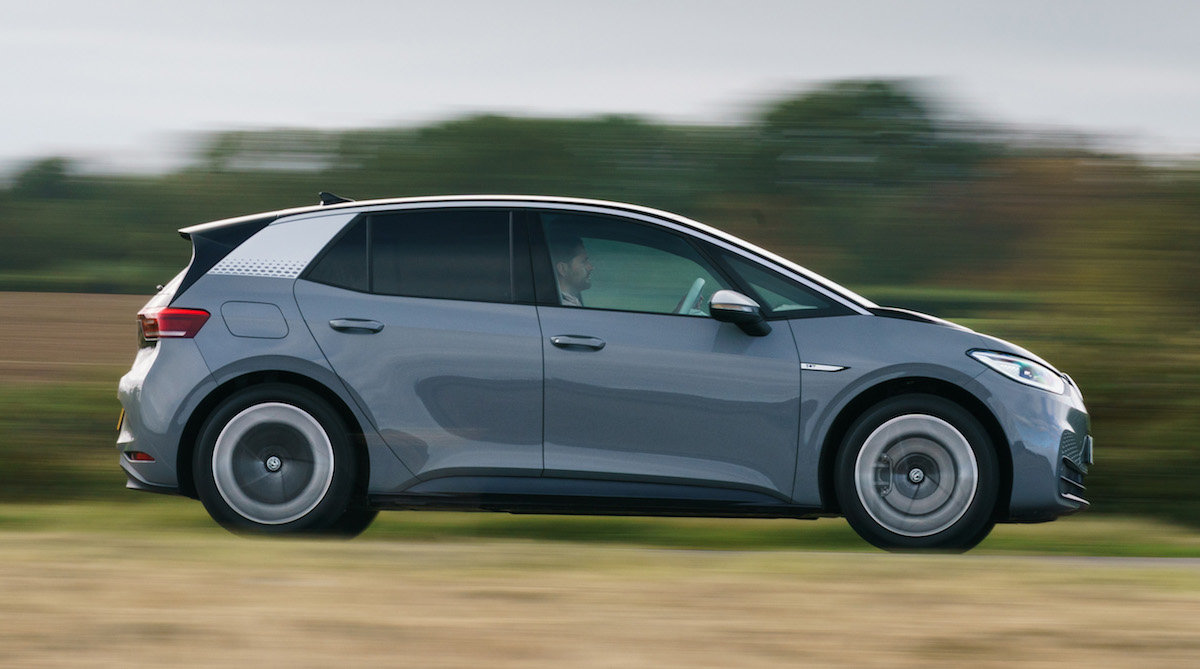
What is the Volkswagen ID.3?
Think of the Volkswagen ID.3 almost as the next evolution of the Volkswagen Golf, or further back, the VW Beetle. The new ‘people’s car’ if you will. It is, after all, the German marque’s offering to those after a practical family hatchback with a pure-electric powertrain, but rather than just stack some lithium-ion cells into the familiar Golf (which is much the same size as the ID.3), Volkswagen uses a bespoke platform and design language for its battery vehicles.
When it was first launched in 2020, the ID.3 offered a choice of 45, 58 and 77kWh batteries, with most powerful offering a claimed range of nearly 350 miles. By the time the car's midlife facelift rolled around in 2023, only the two larger battery sizes were available, with official ranges of up to 266 miles for the 58kWh model, or up to 347 miles for the 77kWh. Both models feature the same single electric motor that powers the rear wheels
Rivals for the ID.3 includes cars like the Kia Niro EV and MG4, as well as the mechanically identical Cupra Born and crossover type electric vehicles such as the Jeep Avenger and Fiat 600e.

How practical is it?
This ID.3's rear-wheel-drive layout allows for a more spacious cabin. There’s more rear head- and legroom for all passengers than you get in the Golf, and the 385-litre boot is a good size that's comparable with most family hatchbacks or compact SUVs. Mind you, there is no dedicated cable storage; you can have a variable-height boot floor that would create a convenient hidden space for that purpose, but we’d still expect better of a dedicated electric car platform. Family motorists should also be aware that the 77kWh ID.3 Tour can only seat four, rather than the five seats offered in the other ID.3 variants; it loses its middle rear seat space in order to accommodate more batteries.
The driving position is very good in the ID.3. You’re inclined to sit quite high due to the high windowline, but you can sit low if you prefer thanks to the broad range of seat adjustment, and there's plenty for the steering column, too.
Of course, the battery size affects charging time as well as range. Plug into a 7kW home charger and you’ll be able to fully charge the iD.3 in between eight and 12 hours depending on which battery you’ve gone for. As an example, the 58kWh battery will take just over nine hours from empty to full.
Rapid charging times vary, too, not only because of battery size but because the pre-facelift 45kWh ID.3 charges at a maximum rate of 50kW, while the mid-range ID.3 peaks at 100kW and the 77kWh ID.3 Tour tops out at 125kW. When it comes to post-facelift models, the smaller battery 'Pro' car can charge up to 120kW, while the larger battery 'Pro S' can charge at up to 170kW.
All ID.3s feature a CCS rapid charging port that is compatible with the vast majority of DC rapid chargers in UK and Europe, and will deliver a 100-mile top-up in between 15–30 minutes depending on the maximum charging rate of the car and/or charging station you’ve plugged into.
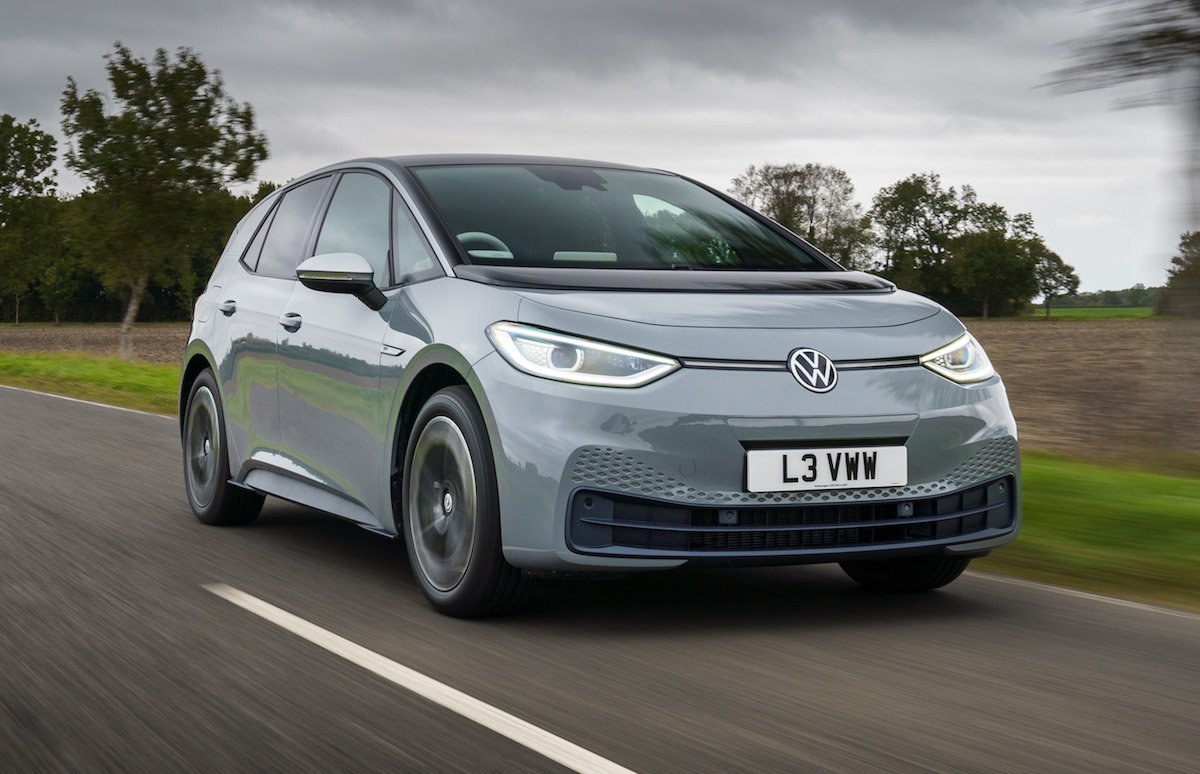
What's it like to drive?
Power from the ID.3’s single electric motor is sent to the rear wheels, and with 201bhp you might expect something of a sporty, GTI-like drive. In practice, the ID.3 feels calm, predictable and surefooted but certainly not performance-oriented, while a tight turning circle and smooth ride quality make it great around town and on the motorway. It's a driving experience that'll suit lots and lots of potential buyers.
VW briefly offered a 148bhp model alongside an even lower powered 143bhp version, but with so little difference in terms of performance it quickly dropped the former. Yet even these entry-level motors feel brisk, with instant torque and good refinement. Only on faster roads do you notice any shortfall in acceleration, with progress slowing quickly above 60mph.
Light and accurate steering makes the ID.3 easy to place on the road, while the combination of a wide track and the battery pack being mounted under the floor for a low centre of gravity means the VW scoots through corners precisely and with very little body roll. It’s not exactly engaging, but the car feels safe and predictable, while the high-set driving position and good visibility makes it confidence-inspiring in heavy traffic or when parking.
Of course, the near silent electric motor means the refinement is good, with very little disturbance from wind and road noise. Yet the relatively stiff suspension means a firm low speed ride, while bigger bumps can result in the odd noisy thump being heard in the cabin.
As the 0-62mph times of between 7.3 and 7.9sec suggest, performance is usefully punchy without being so potent as to be in any way alarming.
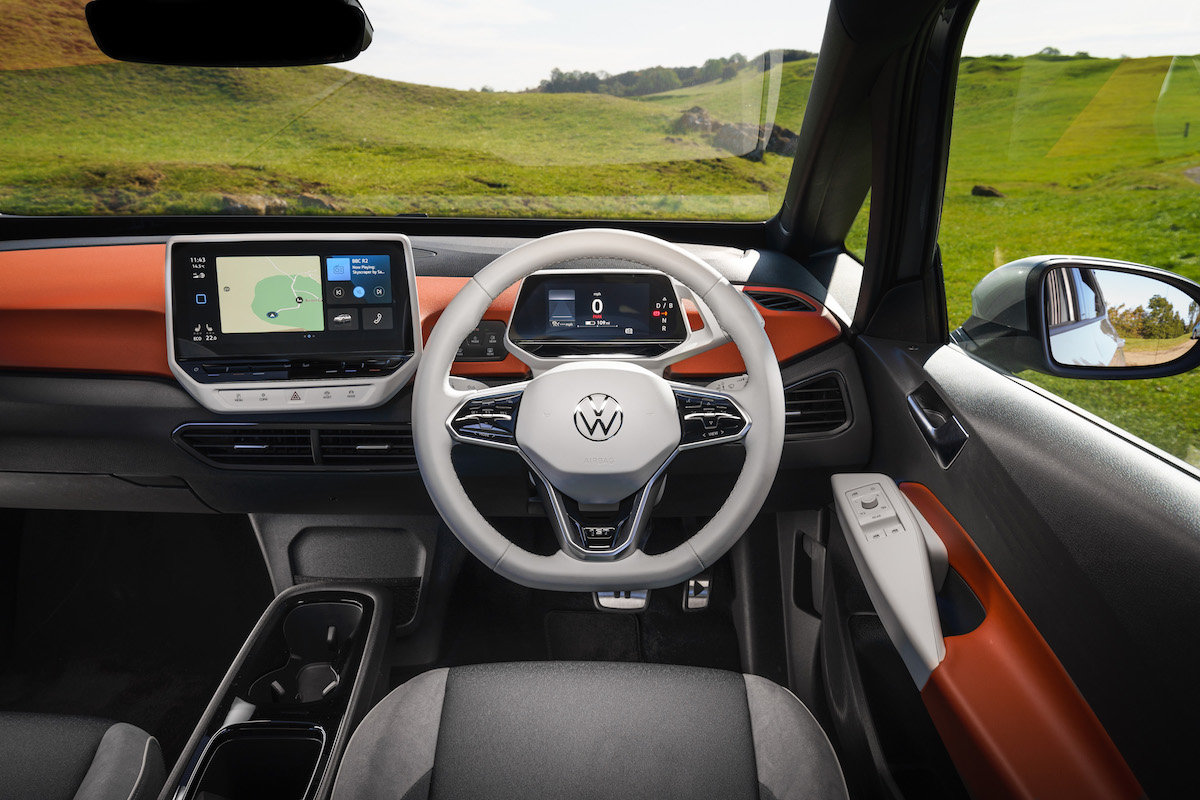
Technology, equipment & infotainment
Given the car’s hi-tech image, it’s no surprise VW has loaded the ID.3 with plenty of standard kit. All versions get LED headlamps, front and rear parking sensors, adaptive cruise control , keyless start, reversing camera and a swanky looking TFT instrument cluster.
In pre-facelift models, the Family trim included all of the above plus added a Comfort Pack that comprises dual-zone climate control and a variable boot floor and the Design Pack that adds a panoramic glass roof. Both these packs could be added to the lower-spec Style trim at extra cost.
At the top of the range was the Tour, which boasts augmented reality satnav (where directions are overlaid on a live feed from a front facing camera) and an enhanced hi-fi set-up.
As part of the 2023 facelift, trim levels where revised to Pro and Pro S. The main difference between the two is the battery size (the Pro being the smaller of the two options), although upgrading to Pro S also gets you 19-inch alloy wheels rather than 18s, and electrically adjustable leather-effect seats.
All ID.3s feature the same glossy touchscreen infotainment system that controls most of the car’s major functions. Yet while it looks slick, it’s not quite as easy to operate as the best systems, with too many functions requiring you to scroll through multiple menus. It’s also annoying that the touch-sensitive climate control buttons (which aren't even backlit) are quite easy to hit by accident. Apple CarPlay and Android Auto are included, but that aside this is a pretty disappointing infotainment offering from VW.
One neat touch, however, is the ‘ID Light’ – a thin LED light running the width of the cabin beneath the windscreen that gives light signals to help warn when you need to turn according to your nav route, to show charging status or let you know when there’s an incoming call on your phone. It’s a feature that helps make the ID.3 feel novel and fresh, certainly more so than more conventional-feeling electric or internal combustion alternatives like the Nissan Leaf, BMW i3, Peugeot e-2008 or Toyota Corolla.

VW ID.3 running costs
The ID.3 isn't as efficient as we’d originally hoped. Over a few days of mostly motorway miles, and with some faster country roads and free-flowing urban driving, we averaged just 3.1 miles/kWh. This was mostly due to our fairly underwhelming motorway efficiency of 2.8m/kWh, and while all electric cars are least efficient at motorway speeds, experience in rivals like the Hyundai Kona Electric, Kia Niro EV and Jeep Avenger tells us that you could expect more like 3.8-4.0 miles/kWh in similar conditions.
Even with middling efficiency the ID.3 is cheap to run if you can charge it on an affordably priced home electricity tariff. In this scenario it can cost about half of what you’ll pay to fuel a petrol car doing 40mpg. Using off-peak electricity tariffs to charge the ID.3 could save you even more, and it’s easy to use these cheaper overnight tariffs via the timed charging schedule in the VW’s screen menus, and there’s a phone app that also allows control and monitoring of the car’s charging and pre-set cabin temperature.
Servicing is cheaper than on a petrol or diesel rival, too, since the ID.3 only needs a minor checkup after the first two years, and then a service every two years or 20,000 miles thereafter; usefully longer intervals than on most rivals, including the electric Kia Niro EV and Hyundai Kona, as well as combustion-engine alternatives such as VW’s own Golf.
Electric cars are currently free of VED road tax and also get free access into London's congestion zone.

Is the VW ID.3 reliable?
The VW ID.3 finished 7th of the 20 electric cars featured in the 2022 What Car? Reliability Index, while the mechanically similar Cupra Born was fifth. It comes with a three-year, 60,000-mile warranty on the car, and an eight-year, 100,000-mile warranty on the battery. That battery cover also ensures against loss of performance, so if the battery drops below 70% of its as-new performance within that warranty period, VW will refurbish or replace it for free.
Most modern EV batteries are proving to last just as long as the car itself, with today’s lithium-ion battery cars typically losing around 10-20% of their maximum range potential over the first 100,000 miles. So, while it’s good peace of mind to know that the battery warranty is present, the general fear over battery longevity in EVs is proving to be unfounded.
Early VW ID.3 1st Edition models, which were released from October 2020, came without a few of the software features – including Apple CarPlay – that were standard from early 2021. Buyers were made aware of this, and some chose to wait to receive their cars with the fully completed software update from later in 2020 as a result. Software updates for the ID.3 are done remotely, so when a new upgrade or feature is available you can simply choose to accept the upgrade or new feature and the system will do the rest via its standard, onboard internet connection.
- The ID.3 was originally offered in seven different trims. However, by mid 2021 the range had been rationalised to the Style, Family and Tour models. Then, in 2023 these were replaced by the Pro and Pro S.
- Don’t worry about the ID.3's rear-wheel-drive layout. Some drivers may fret about traction issues, but we've driven the ID.3 briskly over wet and grimy autumnal country roads, as well as in town and on the motorway, and it has never felt anything less than stable and composed. Despite that healthy 201bhp and plenty of torque, the ID.3 has lots of grip.
- Electric cars use lithium-ion battery packs, all of which are made up of many battery cells. Some of these cells will be kept ‘dormant’, i.e. they’re in your car’s battery pack but they never charge or discharge. They’re actually there because keeping a small portion of a lithium-ion battery idle like this significantly improves the life and performance of the active cells. Sounds odd, but that’s just how battery chemistry works. Confusingly, some manufacturers include these non-functioning cells in the stated battery size, and others don’t. VW is one of the former, so you know that whether you buy the 45-, 58- or 77kWh ID.3, the battery size stated is the number of cells you are actually using (also known as the net, or usable battery capacity). Good to know, since knowing the usable battery capacity helps if you’re calculating range or efficiency, although the car’s range readout is generally very accurate and changes depending on the conditions and driving style. Other than that, you need never worry about those few dormant cells lurking in the battery pack.
- If you’re a retail buyer looking for the best balance of cost, comfort and range, we’d suggest going for the ID.3 Family as a used buy, or a Pro if buying new. This gets a happy balance of equipment without having to fork out for a top-spec model.
- If you do a lot of motorway miles and expect to regularly rely on a rapid top-up at the motorway services in order to cover your routine mileage, the ID.3 Tour is the one for you. It gets the 77kWh Pro S battery with its 340-mile range, and gets the same luxury features as the 58kWh Max, but does without the sports suspension and adaptive dampers. We’d be remiss here not to mention that alternatives like the Tesla Model 3 are, ultimately, better long distance EVs.
- Those who only expect to do shorter journeys in your ID.3, consider seeking out a used 45kWh model. Certainly, the official WLTP range of 205 miles seems low next to the bigger battery models, but that’ll be enough for the vast majority of suburban or city-based motorists.


