Volkswagen ID.4 Review (2021-present)
Volkswagen ID.4 cars for sale
4.0
Expert review
Pros
Good battery range
Roomy interior
Comfortable to drive
Cons
Frustrating infotainment and controls
Expensive to buy
A Tesla Model Y is more fun to drive

The CarGurus verdict
The VW ID.4 is a seriously appealing family SUV. It’s composed and unflappable to drive, easy to wield around town despite its size, yet stable and relaxing at motorway speeds, while the spacious and high-tech interior is practical and classy. We even think it looks good, although we’ll leave you to decide whether you prefer this or the sharper-edged Skoda Enyaq iV. The Skoda is really the only big problem for the VW, as it offers much the same prospects for less cash. The excellent Ford Mustang Mach-E can be had with a longer range and is also more fun to drive if you like a slightly more enthusiastic-feeling experience.
Even so, the VW’s polish and poise is impressive, and it’s very easy to see why you’d opt for one, despite the increasing amount of competition.

What is the Volkswagen ID.4?
Think of the ID.4 as a Volkswagen Tiguan for the electric era, and you’re spot on. This all-electric SUV sits on the same mechanical underpinnings as the smaller ID.3 hatchback and the ID.4's chief nemesis, the Skoda Enyaq iV (it's known as the MEB platform, fact fans).
The ID.4 is actually a bit longer than a standard Tiguan, and it’s similar in length to cars such as the Skoda Kodiaq and – yet another German SUV from within the VE Group camp – the Audi Q7. However, the VW ID.4 doesn’t have a seven-seat option.

How practical is it?
The VW ID.4 has a big 543-litre boot, which will easily take a chunky double buggy and a dog if you use a boot separator, and there’s storage for your cables underneath the boot floor.
There’s also more space for those using the rear seats than you get in most other big SUVs; legroom back there is limo-like, and the flat floor also makes the ID.4 fairly comfy even with three people sat across the rear bench. It’s a shame that the 60/40 split rear seats don’t fold totally flat, that the variable height boot floor is optional, and that there’s no storage under the bonnet of the car, unlike in the Ford Mustang Mach-E and Tesla Model 3. Even so, the VW ID.4 is a spacious and practical car, with plenty of cubbies and space to make family life easy and convenient.
The ID.4 is a luxurious feeling car for the driver, too. The materials around the cabin look and feel classy, and it’s easy to find a natural driving position, although we’d like the steering wheel to have a touch more height adjustment.

What's it like to drive?
Currently, VW only offers this big EV with a 77kWh lithium-ion 'Pro Performance' battery and a 201bhp electric motor that drives the rear wheels. Official figures vary from 310 to 323 miles of range depending on what version you go for. It’s exactly the same sized battery as that used in the 82kWh Skoda Enyaq; it’s only the marketing literature that’s different. Skoda quotes total capacity, rather than the ‘usable’ capacity that VW states, so don’t be fooled into thinking that the Skoda has a bigger battery.
On the road, the ID.4 delivers a cushy, rather serene driving experience. There’s very little wind- and tyre noise in the ID.4, while the seamless build of power, fairly soft suspension and light but intuitive steering weight makes it all feel unashamedly comfort-oriented. Great for a family SUV, then.
You can sling the ID.4 into a corner with surprising verve if you want to; just get the weight balanced nicely as otherwise it tends to understeer, but it’s not hard to take advantage of the VW ID.4’s decent mid-range performance and easy-to-judge throttle response. Even so, this is a car that feels as if it’s set up to relax rather than excite, so look to the usefully faster and slightly more engaging Ford Mustang Mach-E if you want a bit more zing to the way your electric SUV drives.
Our advice is to not bother upgrading to the optional adaptive dampers: they do bring a stiffer, sharper setting but in the other modes they actually bring sloppier body control and ultimately make the ID.4 feel less composed. If you avoid the really big alloy wheels, the standard suspension is just right.
The adaptive regenerative braking is easy to get used to. This is the system that slows the car down as you lift off the throttle, improving efficiency by gathering energy from the car’s forward motion. The car automatically increases brake regen' as you approach a junction or traffic up ahead, and is smooth and easy to predict. You can override it with a ‘B’ mode that brings heavier braking, but it’s not a one-pedal driving mode like you get in the Nissan Leaf.
Our biggest criticism with the 77kWh VW ID.4 is that we’d like better real-world efficiency. We saw around 230 miles in mixed driving and fairly mild temperatures, so you should expect to see under 200 miles on a wintery motorway run; EVs are always least efficient in cold weather and at motorway speeds. Summer temperatures and a lot of time in suburbia will see that real-world range creep up to over 300 miles, but we’d still like to see the ID.4 getting closer to its claimed range figure in normal everyday conditions.
Technology, equipment & infotainment
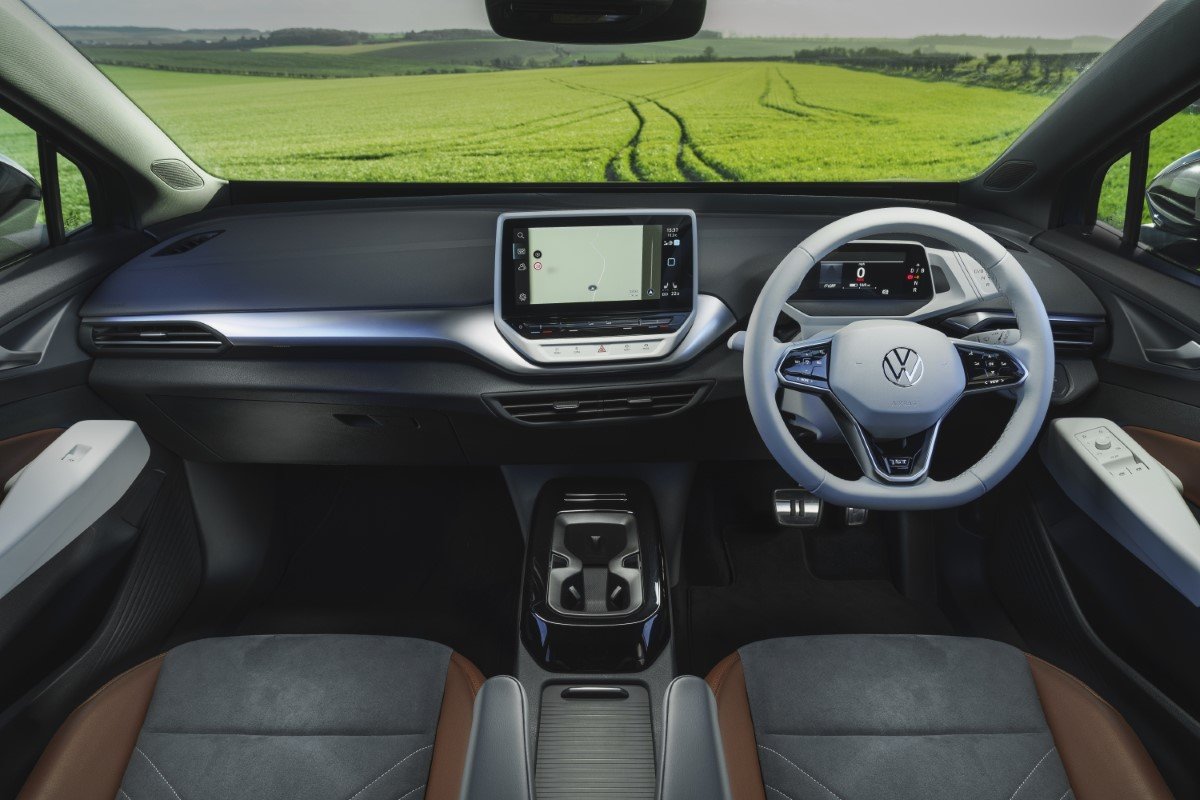
The biggest frustration with the ID.4 is that the climate control switches are integrated into the standard 10-inch infotainment touchscreen (top-spec ID.4 Max cars get a 12-inch upgrade). You don’t have to leave the main nav or media screen to make the change the temperature, thanks to the touch-sensitive switches just beneath the screen, but it’s annoying that those same switches are so easy to hit by accident.
In fact, even the touch-sensitive buttons on the steering wheel – while they look cool – are far too easy to hit by mistake. The physical buttons on the Skoda Enyaq’s wheel are more sensible.
The touchscreen itself is also irritating, as it doesn’t always respond quickly and it can be difficult to figure out where some settings are hidden. However, it does have all the features you’d want, including Android Auto, wireless Apple CarPlay, satnav, Bluetooth, digital radio and two USB-C inputs, and the graphics are sharp and bright.
Charging the ID.4 is done via a Type 2 or CCS socket, both of which are located in the car’s rear wing. A six-metre cable is provided, which will let you charge up at any home wallbox and most public AC charging stations. It will deliver a full battery in under 13 hours from a normal 7kW home charger. Rapid charging peaks at 125kW and will deliver a 100 miles top-up in around 20 minutes. A cable for plugging into a normal three-pin domestic socket is optional.

Volkswagen ID.4 running costs
When bought new, the ID.4 is reasonable value for a well equipped, big electric family SUV. It’s roughly on a par with the Ford Mustang Mach-E and the smaller Tesla Model 3, but the Skoda Enyaq iV is usefully cheaper, albeit not as well equipped. Monthly costs are also competitive, but you’re looking at well over £500 a month for the ID.4 Life, even after a £5,000 deposit on a traditional PCP finance program.
You can also opt for the VW ‘Lease and Care’ method of monthly payments. This is a subscription service, so you’ll pay as much as £644 per month for a VW ID.4 Life, but that includes all maintenance, such as servicing and tyres, roadside assistance, and even the use of a petrol or diesel VW model for seven days per year. You can’t buy the car at the end of the contract, but you can choose to exit the contract with only a few month’s notice. Think of it as a mobile phone contract-style method; Volvo offers a similar thing on the Volvo XC40 Pure Electric Recharge, which is way faster than the ID.4 if not as big, and is available on a subscription basis for not much more money.
We’d like to see better real-world efficiency from the VW ID.4, but it’s still going to be much cheaper to run than petrol or diesel alternatives. A full charge from a home charger will cost under £11, assuming a standard domestic electricity tariff of 14p. You can more than halve that by shopping around for a tariff that offers cheap overnight electricity, but even if you pay full whack the ID.4 is still going to cost around a third of what it’d cost to fuel a petrol alternative. There’s no Vehicle Excise Duty on pure electric cars, and insurance costs are comparable with those of other big SUVs.

Volkswagen ID.4 reliability
The VW ID.4 is too new for us to be able to judge its reliability with any accuracy, but it does come with a three-year, 60,000-mile warranty. The battery is covered by an eight-year, 100,000-mile warranty that also offers a performance guarantee, so that if the battery (and therefore the maximum range of the car) drops below 70% within that period, VW will refurbish or replace it.
It’s unlikely that you will have issues with battery longevity; evidence from the electric cars that have been in circulation for ten years and more shows that a modern lithium-ion battery will typically outlive the car itself, but you should expect to lose around 10 to 15% of the battery’s performance every 100,000 miles.
Volkswagen as a brand came a middling 20th out of 31 brands in the 2020 What Car? used car reliability survey. Electric vehicles are generally more reliable than petrol or diesel as they have far fewer moving parts.
- The VW ID.4 is offered in six trim levels: Life, Family, Max, GTX, GTX Max, and the limited ID.4 1st Edition that’s available for a short time from launch. If you can get hold of the 1st Edition it’s the best value way into a high-spec ID.4, but the others are well equipped, too. Even the cheapest Life version gets climate control, heated seats, parking sensors at the front and rear, and 19-inch alloy wheels. Family adds keyless entry and a reversing camera, as well as a panoramic sunroof, variable-height boot floor and climate control in the back seats. It's our pick of the range. The full-fat VW ID.4 Max adds adaptive dampers, a heat pump (which brings more efficient cabin heating and consequently better range in winter), a head-up display and 12-way electric front seat adjustment. Every ID.4 gets adaptive cruise control, autonomous emergency braking and lane-keep assist, and was awarded the full five stars in Euro NCAP safety tests.
- Rapid charging of up to 125kW is possible in the Volkswagen ID.4. It uses a CCS socket, which is the European standard and will be compatible with most rapid chargers in Western Europe. It’s worth mentioning that you will only get the full potential charging speed if you plug into a powerful enough charger, which in the UK means looking for an ultra-rapid station rated at 150kW. These stations are increasingly common on major roads, but you’ll often have to travel a short distance off the motorway to get to them. At the moment, most of the chargers in the motorway service stations can only manage 50kW charging speeds, which will deliver a 100-mile top-up in around 45 minutes, regardless of what charging speed the car is capable of. It's worth checking for convenient 150kW chargers before a long journey. Recent changes in the ownership of motorway network chargers means that ultra-rapid stations will be coming to service stations in the next couple of years.
- Want a bit more punch from your ID.4? Then opt for the hot GTX or GTX Max versions. Both come with the same 77kWh battery as the standard car, but add an asynchronous electric motor on the front axle (upgrading the GTX to four-wheel drive in the process) to boost output to 295bhp. A sportier suspension setup means both are more engaging to drive than the standard car, though the fact the standard GTX strikes a great balance between ride comfort and dynamic ability, even with its firmer damping, rather negates the need for the adaptive suspension that comes as standard on the GTX Max. The downside is a lower range – 301 miles for the GTX, and 291 for the GTX Max – and of course, the range will drop all the more rapidly if you actually use all that extra power.
- If you want the best value: Go for the VW ID.4 First Edition if you can get hold of it, as this limited launch version gets you more equipment for your money and costs less than the ID.4 Life, which is the cheapest of the standard models. The ID.4 Life is your best bet if that’s not possible. It’s still well enough equipped that you don’t need to add anything to have a car that feels high-tech and classy. You even get Moonstone grey metallic paint and contrasting black roof included, but for around £600, the Bi-colour style pack with black roof and silver roof trim and silver roof rails is likely to be a popular addition.
- If you’re a company car user: Benefit in Kind tax rates are comically low until April 2024 at least, so you may as well for the top-spec VW ID.4 Max if your company will foot the bill. The costs to the company car user are so tiny that there’s a negligible difference in salary sacrifice between the cheapest and the most expensive of the ID.4 models.
- If you want the longest range: The VW ID.4 Life has the longest official WLTP range, at 323 miles. The 1st Edition has the lowest, at 310, but the ID.4 Family is a good compromise if you want style and luxury with decent range in between charges, as it’ll do 318 miles.
- If you want the most high-tech: Go for the ID.4 Max, which gets an ‘augmented head-up display’ that shows you upcoming turns in the nav guidance and more. It also has an electrically operated tailgate, illuminated light band between the headlights and badge and dynamic, adaptive LED headlights. It also gets VW’s Travel Assist, which slows or speeds up the car relevant to speed limit changes or approaching corners and junctions.
- If you want a fast ID.4: choose the standard GTX over the GTX Max. Not only is it much cheaper, but the extra bits and bobs you get with the Max don’t really add to the experience. The standard GTX is plenty exciting enough to drive as it is, and its price tag is considerably lower.


