Volkswagen Taigo 2026 review | A reliable if unremarkable family car
Volkswagen Taigo cars for sale
3.0
Expert review
Pros
Top-spec engine impresses
Generous standard equipment levels
Spacious, with a particularly large boot
Cons
Some interior quality issues
Expensive compared with more practical T-Cross
Not that much fun to drive

The CarGurus verdict
So, is the Taigo a worthwhile alternative among the seemingly endless ranks of small crossover SUVs? Maybe. If you want a spacious and comfortable car with reasonably striking looks and the undoubted appeal of a Volkswagen badge, the Taigo has some appeal. Yet it’s also expensive, less fun to drive than a Ford Puma, and interior quality doesn’t feel quite up to scratch.
The problem, ultimately, is that the Taigo feels like a bit of a box-ticking exercise: a way for VW to conveniently fill an extra niche in its lineup without putting in much creative or engineering effort. It’s somehow a car that feels less than the sum of its parts and, frankly, our money would go on a Ford Puma. Especially when you consider that the brilliant high-performance Puma ST is about the same price as a top-spec Taigo.

What is the Volkswagen Taigo?
Launched in 2021, the Volkswagen Taigo is a small and stylish crossover. It takes on popular vehicles such as the Nissan Juke, Skoda Kamiq, Ford Puma and Seat Arona. The Taigo wasn’t a completely new car as, technically speaking, it’s a light redesign of the Brazilian-market VW Nivus that debuted in 2020 (but was never sold in the UK). Also, while the Nivus is built in Brazil, the Taigo is assembled in Spain.
Under its skin lies a familiar set of components, as the Taigo uses many mechanical parts from the Volkswagen Polo. For example, there is a pair of turbocharged 1.0-litre three-cylinder petrol engines, serving up either 94bhp or 114bhp. You can also have a top-spec 148bhp 1.5-litre turbocharged four-cylinder petrol that you won’t find in the Polo. This latter engine comes from the Golf or T-Cross SUV.
Gearbox options include a five-speed manual (for the lower-powered 1.0-litre car), a six-speed manual or a seven-speed dual-clutch DSG automatic (the 1.5-litre engine is only available with the auto option).
In terms of its physical size, the Taigo is a bit longer, taller and wider than a Polo. But if you called it basically Polo-sized, you wouldn’t be far wrong. It also has a lot in common with the boxy, more practical Volkswagen T-Cross, but the Taigo’s swoopy coupe styling means Volkswagen feels it can charge a bit more.

How practical is it?
Well, if you do a lot of four-up (or even five-up) driving, the legroom and general space in the rear seats is greater than you’ll find in a Ford Puma. Thanks to a roofline that doesn’t plunge too dramatically, there’s plenty of room for passengers in the back of the Taigo, with almost as much headroom as for those sitting up front, and more than enough for your knees and legs. You wouldn’t want to go three abreast for long, but that’s nothing unusual in a car of this size – and Volkswagen has plenty of other SUVs, from the Tiguan to the Touareg, that provide more cabin comfort if you need it. Compared to the Polo and T-Cross, the Taigo’s wheelbase is 2mm and 3mm longer respectively, so the difference is tiny. Yet the Taigo makes excellent use of the dimensions it has.
Front-seat occupants of any shape or size should feel content, as there is loads of adjustment in the seats and steering wheel position, along with ample shoulder room.
Boot space is equally impressive; the Taigo makes the most of its sliding rear seats to offer a useful 440 litres of luggage capacity. It’s not quite up there with the Ford Puma, the boot of which measures 456 litres, but the difference is small. Fold the rear seats down and you have 1,222 litres compared to the Puma’s 1,216 litres. Note, however, that there is no electric tailgate option with any Taigo trim level.
If you’re planning on towing a trailer or caravan, a removable tow bar is an £800 option. The 94bhp car can tow a maximum of 1,000kg braked, while the 114bhp car ups this figure to 1,100kg braked. The 1.5-litre, 148bhp Taigo can manage 1,200kg braked.
There is a range of accessories available to purchase too, including rubber floor mats, boot storage nets and luggage dividers, roof bars, bicycle carriers and a 340-litre roof box.
All versions of the Taigo also get Park Assist as part of the Driver’s Assistance Pack, which can automatically parallel park or reverse park into a space. All you do is press a button on the centre console to activate the system, then use the indicators to both tell other motorists and the car that you are looking for a space and on which side that space is.
Simply drive past the available spot and the car will confirm it knows where you want to go. From there, you take your hands off the wheel, put the car into reverse and use the throttle and brake to control the car’s speed, while the steering wheel spins in front of you. It may not be groundbreaking technology anymore, nor will every owner want to use it, but it’s still useful – and enough of a novelty to be noteworthy.

What's it like to drive?
Fitted with the top-of-the-range 1.5 TSI Evo engine (also found in various other Volkswagen products, although there is now an updated Evo2 version used elsewhere), the Taigo is immediately impressive. The engine is sweet and smooth-revving, with a linear delivery of power across its rev range. It also makes the Taigo genuinely quick. Combined with a standard seven-speed dual-clutch automatic transmission, it can sprint to 62mph in 8.3 seconds – and feels genuinely lively at any speed and in any gear.
Cars with the 1.0-litre three-cylinder engines will likely be a little less beguiling. We’re yet to try them in the Taigo, but experience of these engines in the Polo suggests they may feel a touch underpowered for anybody who wants a sportier drive. Ditto, joining a motorway with a slight uphill gradient on the slip road will likely have you revving the little engine’s heart out to get up to speed in good time. For reference, 0-62mph in the 114bhp Taigo takes 10.4 seconds with the six-speed manual ‘box, or 10.9 seconds with the seven-speed auto. The 94bhp car needs 11.1 seconds to hit the same speed.
Whichever engine your Taigo has, it should be comfortable. Even on the large 17-inch alloy wheels fitted to Match, Style and R Line models (16-inch wheels are available with entry-level Life trim, with 18s sold as optional extras), it rides smoothly, cushioning you well from lumps and bumps. The rear suspension can shudder through particularly challenging potholes, but overall this is a comfortable little car.
It’s not that much fun on a twisty road, though. The light steering means you don’t get much feedback about what the car is doing, which doesn’t inspire confidence. That won’t be surprising to anyone who’sexperience a Golf or a Polo, for example, which have always been slightly less interesting to drive compared to their respective rivals from Ford: the now-departed Focus and Fiesta. Yet it’s something to be aware of, as a Ford Puma will put a much bigger smile on your face. In the real world, though, aside from the rare empty country road, you’ll find a Taigo is a competent, comfortable and easygoing companion. A typical Volkswagen, really.
It should be noted that all Taigos are front-wheel drive, despite their SUV styling. So don’t put one on your potential shopping list if all-wheel drive is a necessity. Furthermore, the entry-level Life trim and the Match get drum brakes at the rear, while the Style and R-Line have discs. Drums are fine, and they’re often used at the rear on less expensive cars, but discs offer superior braking performance – a good reason to make the step up from a lesser trim level if you can.
Technology, equipment & infotainment
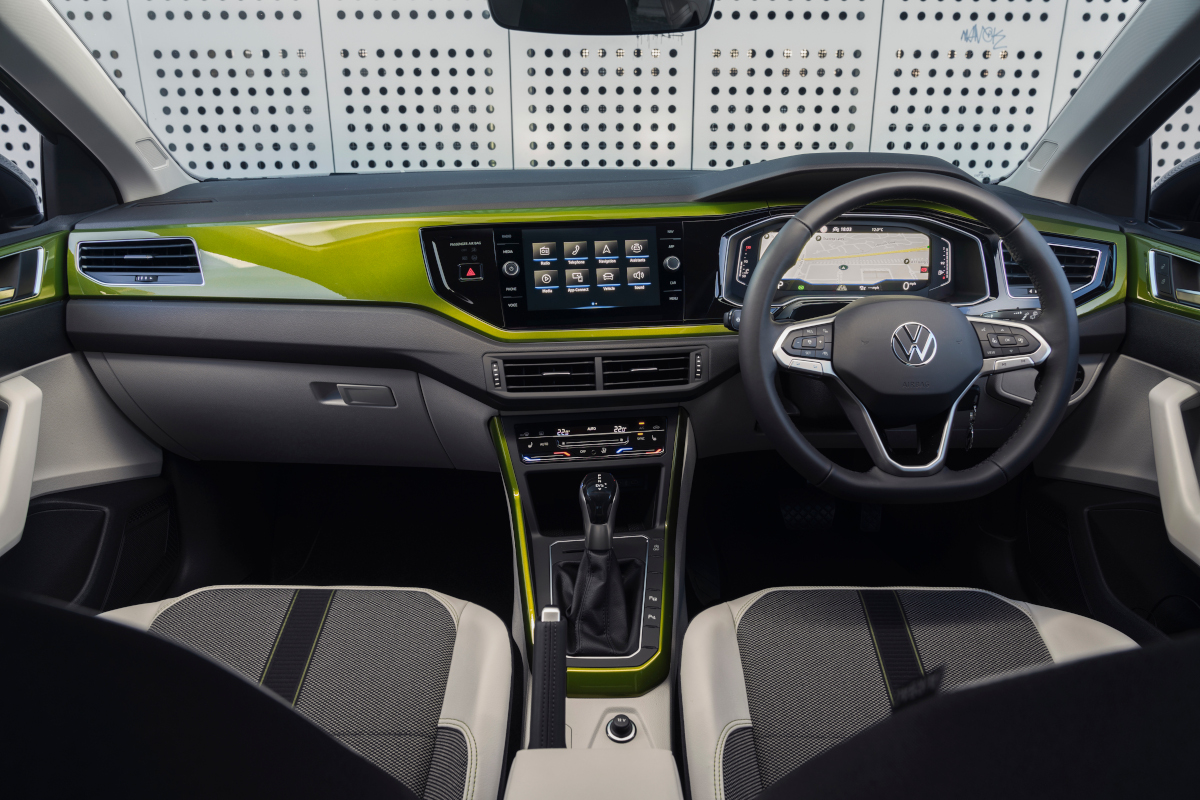
Volkswagen pretty much built its modern reputation on high-quality interiors. However, its latest batch of cabins aren’t quite as smart as those in VWs of old; poke around inside the Taigo you’ll find plenty of cheap, scratchy plastics and other low-rent materials. That’s OK in a Polo, which is around £3,000 cheaper, but in a top-spec Taigo costing £32,000, it’s a touch disappointing.
Aside from its less-than-ideal build quality, the Taigo’s cabin is otherwise very impressive. Its seats are comfortable and supportive, the driving position offers a broad range of adjustment, and the cabin layout is sensible. Fortunately for the Taigo, it also manages to avoid the touchpad-only controls that were so infuriating in the Mk8 Golf and ID range of electric VWs (which the company itself is now starting to phase out). That means you get proper buttons on the steering wheel and even a knob for adjusting the audio volume. Sadly, there are still fiddly and distracting touchpads for the climate control and heated seats.
At the most basic end of the spectrum, the Taigo Life offers air conditioning, LED lights, wireless phone charging, wireless Apple CarPlay and Android Auto connectivity, cruise control and an 8.0-inch central touchscreen, with other features such as LED matrix headlights, a reversing camera, adaptive cruise control and two-zone climate control available as options or within extra-cost packages. Taigo Match models, which cost around £200 more, get keyless entry and a rear-view camera, with everything else more or less the same as Life trim.
Step up to the Taigo Style and you get significantly more kit. For starters, where the Life and Style use an 8.0-inch driver display, the Style has an additional 10.25-inch ‘digital cockpit’ in front of the driver, as well as the central 8.0-inch display on the dashboard. There is two-zone climate control, ambient interior lighting, electronic dampers, adaptive cruise control, built-in navigation, matrix LED lights, a leather multi-function steering wheel with paddles (for cars with an automatic transmission), keyless entry and start, and much more. The R Line, meanwhile, gets different drive modes, an electronic locking differential for better handling, and a sportier looking exterior.
Heated front seats are a £345 option, while a panoramic sliding sunroof is £950. All cars have the capability of in-built navigation, but only the Style and R Line get it as standard – you’d need to spend £1,735 to have it in Life and Match models. We’d save the money and connect your phone instead.

Volkswagen Taigo running costs
Although the most powerful 1.5-litre four-cylinder engine is easily the best to drive, its fuel economy is a little disappointing. Officially, you’re supposed to get 46.3mpg, but unless you drive really carefully, you’ll likely see around 40mpg in the real world. The three-cylinder engines should be capable of close to 50mpg.
In terms of pricing, the Taigo sits part-way between the T-Cross and larger T-Roc SUVs. It costs about the same as a Ford Puma, Skoda Kamiq or Toyota Yaris Cross. However, it is notably more expensive than a Polo, with which it shares so much, even if you do get more space for passengers and luggage.
Despite its relatively high prices, you can expect a Taigo to hold onto its value relatively well. That’s good news if you’re a cash buyer when it comes to resale time, as well as if you’re buying your car via PCP finance, as it should lead to more attractive monthly payments. This is partly because the small SUV segment is a popular one, but also because – paradoxically – VW is unlikely to sell all many Taigos in the UK, so the used market won’t be flooded with examples.
When it comes to maintenance, you can opt for ‘fixed’ or ‘flexible’ cover. The fixed option effectively means a service every 10,000 miles or 12 months, while the flexible alternative – designed for higher daily mileages – can mean up to two years and 20,000 miles between garage visits. A word of warning, however: regardless of what the manufacturer says, an oil, oil filter and air filter change every 20,000 miles isn’t good for a car long-term compared to more frequent care and maintenance. Yes, cars can run for 20,000 miles with no issues, but the more often you change your oil, for example, the healthier your engine will be. Regular maintenance also gives mechanics the opportunity to spot potential issues before they get worse. Long story short: service your car regularly!
Volkswagen offers a fixed servicing plan at the time of purchase, where you can pay £449 upfront or spread the cost over monthly payments for two years in return for your first two consecutive services. Dealers only use genuine Volkswagen parts, all of which are covered by a two-year warranty.

Volkswagen Taigo reliability
As a brand, Volkswagen fared poorly in the 2025 What Car? Reliability Survey, placing joint 24th alongside Ford out of 30 manufacturers – down from 18th place out of 31 brands in 2024. However, the Taigo itself did rather well, ranking joint eighth alongside the Mazda MX-30 out of 38 small SUVs up to five years old. The T-Cross, meanwhile, placed sixth, and the T-Roc was second. The Ford Puma was 32nd, and the Nissan Juke 38th. The Taigo is most likely to suffer electrical niggles or software glitches with its infotainment system.
As for a warranty, you get three years of cover, limited to 60,000 miles. That’s nothing exceptional, especially as Hyundai offers a five-year warranty, while you can get seven years from the likes of Kia and MG. You do receive a 12-month breakdown cover policy as standard, though, which includes European travel cover.
- If you want your Taigo to stand out, there are various personalisation options, such as a choice of seven alloy wheel designs (although the rims you can specify depend on the trim level chosen) and eight exterior colours, including one – the oddly named Visual Green – that is unique to the Taigo. It’s quite something to behold, but we like it.
- The Taigo is fitted with a full suite of high-tech safety equipment, including automatic emergency braking. As well as detecting potential collisions with cars, the system also looks out for pedestrians and cyclists. It is operational between 3mph and 53mph. There is also a driver alert system, which will sound a warning bong if it thinks you’re not paying attention to the road, or that you need a break.
- As well as safety systems designed to avoid a crash, the Taigo has some innovative stuff to help you should one happen. One example is the innovative centre airbag, which is located in the side of the driver’s seat backrest. In the event of an impact, it helps prevent the shoulders of the driver and front passenger from colliding with one another. There is also a post-crash braking system, where the car will apply the brakes after an impact to prevent you rolling into another car or off the road, should you be unable to use the brakes yourself. Given how easy it would be for shock to stop you from braking, let alone a potential injury, this is a really sensible system.
- If you want the least expensive model: That’ll be the Taigo Life. You can only have the 95bhp engine and a five-speed manual gearbox, but there’s just about enough equipment that you won’t feel like you are slumming it.
- If you want value: The Taigo Match may be around £200 more expensive, but you get access to the more powerful 114bhp engine and six-speed manual gearbox. Adding these costs an additional £800 on top, but having six gears is much nicer on the motorway – and you’ll enjoy more power and torque. Without going all the way up to Style-spec for another £5,000, this is a really good option.
- If you want the best all-rounder: That said, Style offers the best package overall. You get disc brakes at the rear, and they’re just better, frankly, plus the car has much more standard technology. The greater expense will prove worth it day-to-day.
- If you want performance: in the absence of a full-blooded ‘R’ performance model (as the larger Volkswagen T-Roc offers) or a GTI model (as you’ll find in the Polo), the fastest and sportiest Taigo is the 148bhp 1.5-litre version, with its standard seven-speed twin-clutch automatic transmission. It’s neither as fast nor as involving as a Ford Puma ST, which really does feel like a hot hatchback, but it is reasonably swift, with very flexible performance.
- If you want all the bells and whistles on your Taigo: It’s a straight coin-toss between the Style model and R-Line trim, since the VW Taigo trim range is set up in a ‘Y’ shape. This means Style is the one to go for if your taste is more comfort-oriented, while the R-Line offers a sportier aesthetic and the clever electronic front differential.


