Volvo V40 Review (2012-2019)
Volvo V40 cars for sale
3.0
Expert review
Pros
Interesting alternative to Audi A3 or BMW 1 Series
Fuel-efficient diesel models
Impressive safety equipment
Cons
Cramped interior and poor luggage capacity
Not great to drive
No hybrid or electric option

The CarGurus verdict
If safety is an absolute priority for you, you’ll find few better used family cars than the Volvo V40. Further benefits include a plush interior, generous equipment, smart styling, and an excellent engine range.
However, do keep in mind that the V40 is pretty average to drive, with uninspiring handling and an unsettled ride, especially if you choose larger-wheeled models. It’s also quite cramped in the back. With that in mind, the Volkswagen Golf is a more talented all-rounder, if perhaps not quite as interesting.
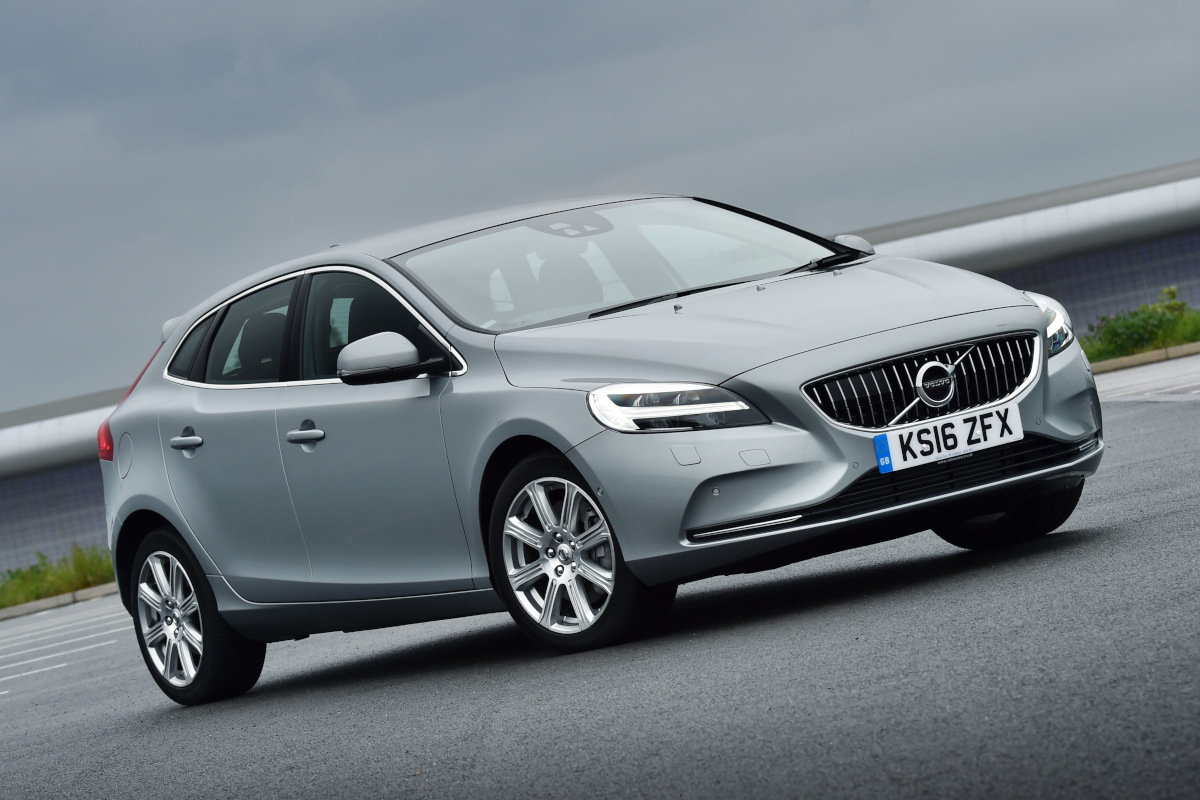
What is the Volvo V40?
The Volvo V40 went on sale in 2012 as a five-door hatchback to compete with the Audi A3, BMW 1 Series and Mercedes-Benz A-Class.
Broadly speaking, both inside and out the Volvo V40 looks and feels upmarket; perhaps not quite to the level of the Audi A3, but it certainly feels plusher than your average family hatchback.
Launched in 2012 with a mid-life facelift in 2016, it is available in a range of trim levels, from basic ES to sporty looking R-Design and even a more rugged Cross-Country model.
V40 production ended in 2019 and there was no direct replacement, as Volvo subsequently focussed on larger cars.

How practical is it?
The V40 is based on the same platform as the Ford Focus, but looks and feels distinctly different. Rear seat space and the 335-litre boot are a little on the average side (if space is a priority, a Skoda Octavia is a much better bet), and the narrow rear windows make the back seats feel rather claustrophobic.
You do, however, get a trio of three-point seat belts in the rear, rather than having a lap belt in the middle.
Up front there’s a decent amount of space, but even so, you’ll find an Audi A3 feels roomier still.

What's it like to drive?
To drive the V40 is a little less inspiring, with slightly inert handling and a ride that, while not entirely uncomfortable, still isn’t quite as smooth as you'll find in the V40’s best rivals. Expect a safe, solid and steady approach that is entirely reassuring on long journeys, but a world away from a Ford Focus of the same vintage when it comes to fun.
If you want a fast V40, there's a five-cylinder turbocharged petrol in the pre-2014 T5 model, which was later replaced with a 2.0-litre turbo T5. Either will be something a sleeper in terms of performance, but they also drink fuel like it’s going out of fashion. For most people therefore, one of the smaller petrol engines, badged T2, T3 or T4, would be a better bet.
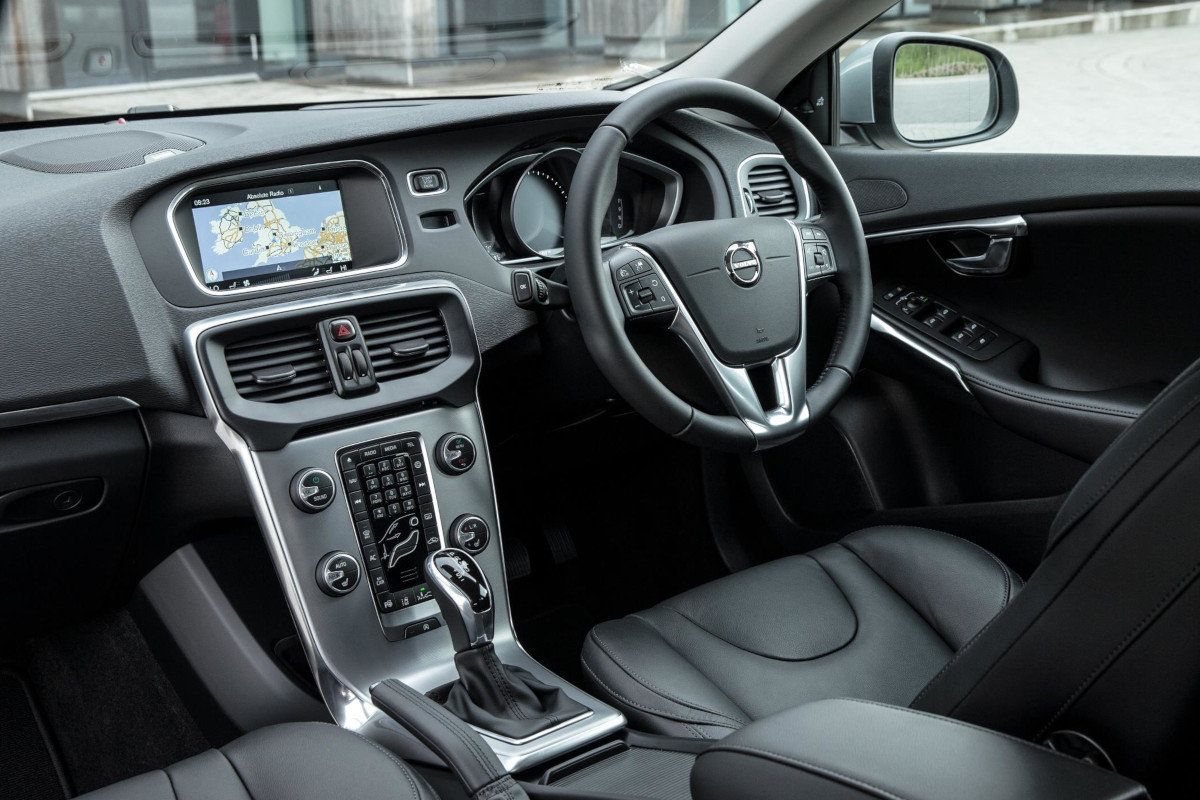
Technology, equipment & infotainment
From its launch until a mid-life facelift in 2016, you could buy your V40 in basic ES, plusher SE and SE Lux, or sporty-looking R-Design and R-Design Lux variants.
You could also choose a more rugged Cross-Country version, which gained a raised ride height and optional four-wheel drive, in SE or Lux form. From 2016 onwards, ES and most Lux versions were dropped; SE and SE Lux versions, meanwhile, became Momentum and Inscription, and equipment was boosted on every model.
If you want a family car that’s more affordable than those with premium badges, but feels like it’s a cut above the rest, the Volvo V40 is worth a look. Here’s what you need to know if you want to buy one.

Volvo V40 running costs
If fuel consumption is a factor in your buying decision, you’ll want to avoid the 2.5-litre T5 version, with its combined fuel economy figure of 35.8mpg. The later 2.0 T5 is a little more economical, but not by much. Lesser petrol versions are rather more economical, and our favourite T2 should achieve around 45mpg on the road.
If that’s not enough, go for a diesel – the D2 with a manual gearbox can achieve extraordinary fuel consumption of around 60-65mpg on average, though it is quite lethargic; even the perkier D3, however, should achieve somewhere in the region of 55mpg.
Volvo’s service prices aren’t the cheapest around, and lean more towards those of its premium, rather than its more mainstream, rivals. You don’t get a discount at Volvo dealers once your car’s warranty has expired as you do with some manufacturers, either, so you might want to take your car to an independent specialist instead. However, if you do want to service your car at a Volvo dealership, you can at least take advantage of one of Volvo’s service plans, which offer useful discounts if you pre-pay for several services at once.
Most V40s need servicing every year or 18,000 miles, whichever comes up soonest; the D2, however, needs to be serviced every year or 12,500 miles. However, to keep your engine in tip-top condition, we’d recommend getting the oil and oil filter changed at least every 10,000 miles.
All V40 engines are fitted with a timing belt, and this will need changing at least every six years or 87,500 miles, though different engines have different intervals so you’ll need to double check which applies to your car.

Volvo V40 reliability
Electrical faults and problems with the clutch and flywheel seem to beset the V40 more than most. Therefore it pays to check all of the car’s electrical systems out to make sure they all work. You’ll want especially to look out for any dashboard lights that are on, to make sure all the doors lock and unlock with the central locking, and to ensure the ventilation and infotainment systems all do what they should.
You’ll also want to make sure the clutch in manual cars bites smoothly without juddering, and that there are no clonks, rattles or whirring noises when it does. Any odd noises when you’re engaging the clutch could be a sign of a costly repair in waiting.
With those two exceptions, there are relatively few issues that beset the V40, but it’s worth doing the usual checks to make sure you’re aware of any damage on the car, particularly given its frequent use as a family vehicle. Quite a few V40 diesels have high mileages, too, so if you’re looking at a car with lots of miles on it, make sure it’s always been serviced on time.
- Volvo didn’t badge its engines using traditional litre denominators; instead, it used arbitrary levels, and denoted diesels with a ‘D’ and petrols with a ‘T’. So petrol engines are badged T2, T3, T4, while diesels are badged D2, D3 and D4. Top of the range is the potent T5 which, before 2014, came with a 251bhp 2.5-litre five-cylinder turbo, and thereafter, a 242bhp 2.0-litre.
- The V40 comes with a host of safety equipment and is consequently one of the safest cars you can buy. Autonomous emergency braking, three-point seatbelts for all five seats, and airbags all round – including one for the driver’s knees – all come as standard on every model. As you might expect, the V40 scored five stars in its 2012 Euro NCAP test.
- The V40 is based on the same platform as the 2012-2018 Ford Focus, and shares many parts in common with that car, including several of its engines. That means you might find parts and servicing to be cheaper at a Ford dealership.
- If your budget is tight: The D2 SE is not only good value, but it’s also seriously economical. Expect upwards of 60mpg if you are happy driving at a gentle pace.
- If you need an automatic: The D3 SE Geartronic combines diesel economy with a smooth automatic gearbox. As with all V40s, it favours a steady approach, but it’s precisely this kind of driving style that makes Volvos such calming cars to drive.
- If you need four-wheel drive: It might not be a proper off-roader, but the T4 Cross Country AWD adds all-wheel drive, more rugged styling and a slightly elevated ride height to the V40 formula.

