Volvo XC90 2026 review | Luxurious SUV with a dash of Swedish style
Volvo XC90 cars for sale
4.0
Expert review
Pros
Tastefully designed interior
Hugely comfortable over long distances
Practical, spacious and safe
Cons
Slightly noisy engines
Infotainment system not the best
Audi, Mercedes or BMW rivals feel better built

The CarGurus verdict
The XC90 has always been a great option for those after a comfortable, relaxing and practical SUV, and the second-generation model continues that good work. Even though it’s now a decade old, there’s a lot to like with the XC90, whether you go for the B5 petrol or the T8 hybrid powertrain.
While the most recent updates have improved the car, though, a facelift will never be able to match what might have been possible had there been an all-new, third generation XC90. As a result, rivals from BMW, Audi, Mercedes are all worth inspecting, as the X7, Q7 and GLE are all fundamentally much newer than the Volvo. A seven-seat Land Rover Discovery 130 would be worth checking out, too. It may not have the same level of discreet luxury as the XC90, with a much more bold personality, it is also jam-packed with tech and benefits from over-the-air software updates.
There’s a charm and level of quality to the XC90 that has been present since the very first example landed on UK shores more than two decades ago. It’s an expensive machine, whichever powertrain you choose, but it’ll be a lovely car to live with on a daily basis, whether for short journeys or a long-distance cruise.

What is the Volvo XC90?
When Volvo introduced its first generation of XC90 in 2002, few probably expected it to still be sold over a decade later. It was a popular car, thanks in part thanks to its remarkable practicality and comfort, so its continued existence made sense.
Production of the first-generation XC90 finally drew to a close in July 2014, after countless awards and more than 636,000 had been built. The flagship position in Volvo’s range was quickly filled, however, by the introduction of the second-generation XC90 – as reviewed here – in 2015.
The car had big shoes to fill but Volvo delivered another very desirable, capable and practical all-wheel-drive SUV. Underneath its familiar yet modernised and more attractive exterior sat Volvo’s new Scalable Product Architecture (SPA) platform, which was coupled with a new range of efficient Drive-E engines.
The second generation XC90 underwent a big overhaul in 2024, followed by some smaller updates in 2025, all aimed at keeping this premium-badged family favourite as fresh as possible compared to more modern rivals from Mercedes-Benz, BMW and Audi. With more choices than ever before across the Volvo range, including the comparable but fundamentally much newer electric EX90, there’s still plenty to like about the XC90.
How practical is it?
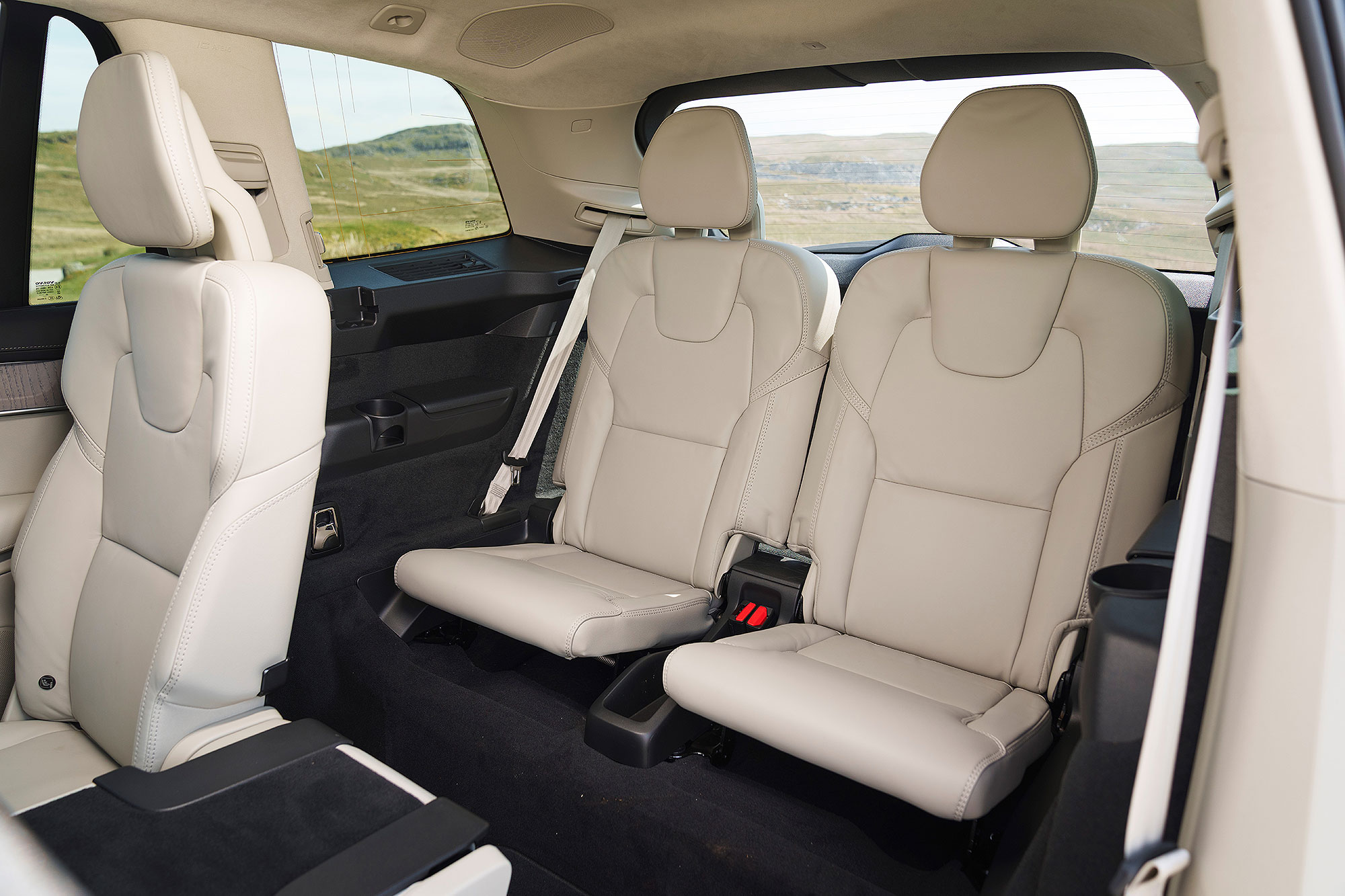
Brilliantly so. The XC90 has always felt as though it was designed and built by people who understood what customers needed from a large, seven-seat, premium SUV. That feeling remains.
The three seats in the middle row can be slid forwards and backwards separately, thus enabling you to make the best use of the space on offer and tailor it to your needs. Meanwhile, the rearmost row offers more space than you’ll find in most rivals. Even average-sized adults can sit back there, though taller occupants might struggle.
You get a big boot, too. With all the seats in place there’s a respectable 301 litres of capacity, but fold the third-row seats flat and the boot expands to 980 litres. With the second row folded as well, you have more space than you’ll know what to do with: a colossal 1,950 litres. What’s more, with the exception of the entry-level Core specification, air suspension is standard across the range. This allows the ride height to be dropped by 20mm to make getting in and out, or loading the car easier.
What's it like to drive?
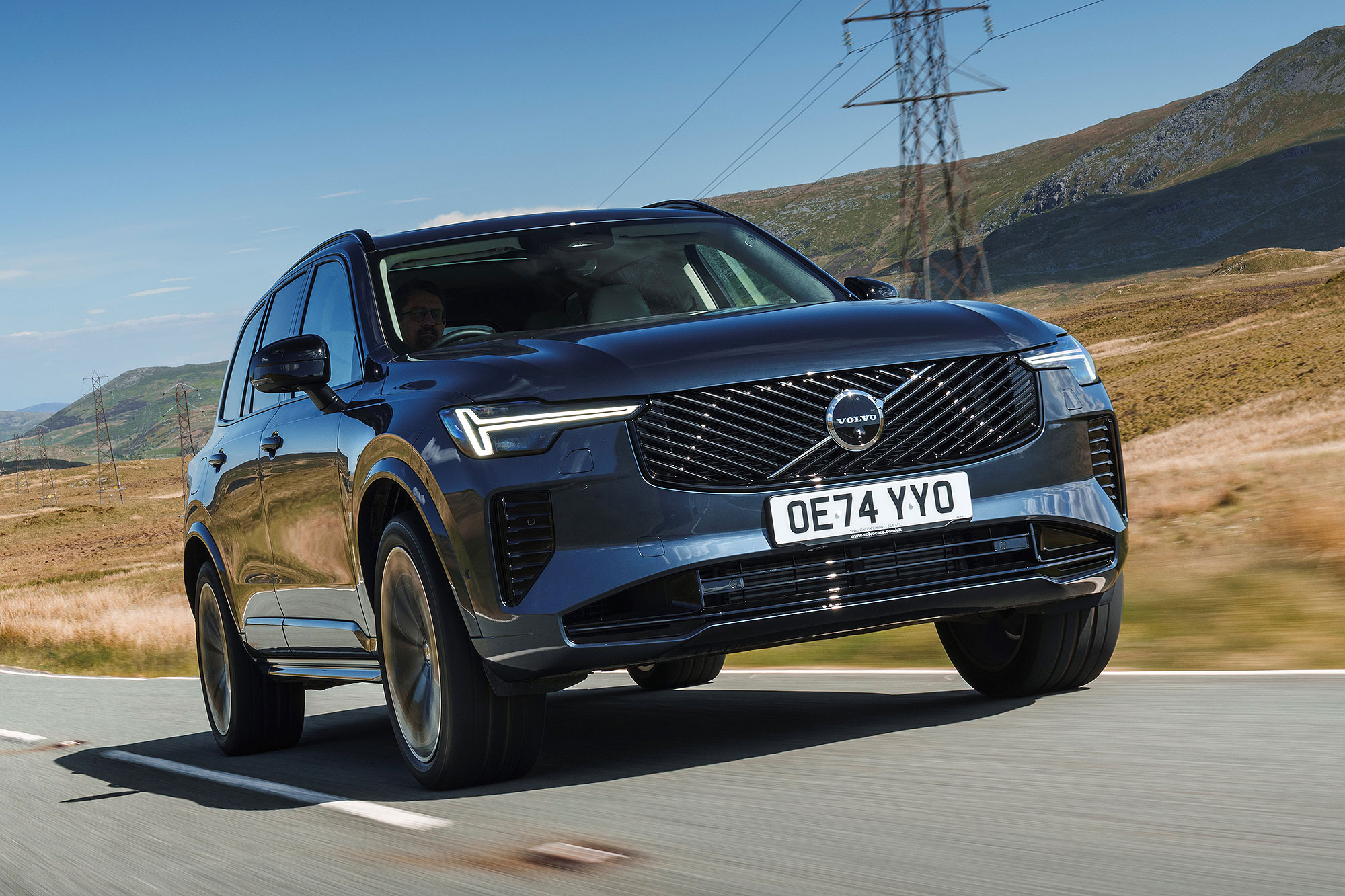
Diesel fans will be left disappointed, as this latest XC90 uses mild-hybrid or plug-in hybrid petrol power only. The days of models such as the punchy D5 diesel have sadly come to an end. However, the petrol options aren’t bad at all.
The two powertrains on offer are the B5 mild hybrid and the T8 plug-in hybrid, both of which use all-wheel drive and an eight-speed automatic gearbox. Both are also 2.0-litre petrol engines, but where the B5 has a 246bhp, 48V mild-hybrid system, the T8 has 306bhp, plus a 143bhp electric motor powering its rear axle. The B5 will therefore dash to 62mph in a respectable 7.7 seconds, while the T8 completes the same sprint in only 5.4 seconds.
The XC90 T8’s electric motor is powered by a 14.7kWh battery (18.8kWh gross), which means a claimed electric driving range of 44.1 miles. That’s decent enough, but there are other, admittedly less premium, seven-seat cars out there with larger batteries and better EV ranges.
Whichever version of the XC90 you go for, you’ll enjoy a cosseting and relaxing driving experience. Neither the XC90 B5 or the XC90 T8 are as compelling to drive as, say, a Porsche Cayenne or BMW X5,. However, the Volvo handles well and doesn’t lean to an uncomfortable degree when cornering. That’s especially so when fitted with active air suspension, which monitors the road and driver inputs 500 times per second to give the car as much support or comfort as needed.
Its finely finished and plush cabin, combined with a refined ride, make the XC90 a great car to travel long distances in. Predictably, though, its big footprint can make it tricky to deal with in tighter spaces and on narrower roads.

Technology, equipment & infotainment
Trim levels for early second-generation XC90 models included Momentum, R Design and Inscription. Every version, however, came with plenty of standard equipment, including cruise control, leather upholstery and an infotainment system with satnav. Apple CarPlay connectivity was subsequently added in January 2016, followed by Android Auto from December 2016.
The current XC90 line-up has a slightly more straightforward range structure, namely Core, Plus, Plus Pro and Ultra. A lot of equipment comes as standard, including a lovely 11.2-inch central infotainment display (with a 21% greater pixel density than previous screens for greater clarity), wireless phone charging, Google Assistant, keyless entry, matrix LED headlights and Volvo’s vast array of safety systems. The standard Volvo 220W sound system is very good, but music lovers are treated to a 600W, 14-speaker Harman Kardon system in the Plus and Plus Pro models, or an epic 1,100W, 19-speaker Bowers & Wilkins setup in the XC90 Ultra.
It’s worth noting that every XC90 now also benefits from over-the-air software updates, meaning new features and fixes will appear without needing to visit a Volvo dealership. For example, new features across Apple and Android devices will be accessible via updates to the Android Auto and Apple CarPlay systems, helping to keep everything feeling fresher for longer, whenever you bought your car.
Those with families will be particularly pleased to hear that the second-generation XC90 remains a safe option, scoring 97% for adult occupants and 87% for child passengers in Euro NCAP crash tests. Altogether, it netted the maximum five-star rating.
Volvo XC90 running costs
The first generation of XC90 was quite expensive to run, even in diesel guises, but advances in technology make the second-generation car far more manageable on this front.
Early on, cleaner versions of the second-gen XC90, such as the diesel D5 and hybrid T8, benefitted by slotting into lower tax bands. But changes to UK taxation bands from 1 April 2017 meant all XC90s registered after that date are liable for the same annual rate. At the time of writing, this stands at £195.
With a new XC90, whether you opt for the B5 or the T8, be mindful you will be liable for standard CO2 emission-based road tax, as well as an annual fee of £425 for the first five years. Any new car with a list price of £40,000 or more is liable for this surcharge, the only exception being vehicles that are zero-emissions and were registered before 1 April 2025.
When it comes to day-to-day running costs, we must remember the XC90 is a heavy beast, not a frugal city dweller. That being said, both the B5 and T8 versions are relatively economical, certainly compared to a similarly large and heavy SUV from even 10 years earlier.
The T8 is quoted as managing 188-235mpg on the official WLTP test cycle. Its battery and electric motor will help support the petrol engine at the most fuel-intensive moments, and will take over altogether when the engine would otherwise be switched on but doing very little. You’re unlikely to see a magic 235mpg figure on the dashboard, but the T8 is still the best XC90 of the bunch. With the all-electric driving range of just over 44 miles, you might even get away with using no fuel at all if you nip out for short trips and have a light right foot. The B5’s 48V mild-hybrid system, meanwhile, also reduces the strain on the petrol engine, and in turn reduces fuel consumption. But it is ultimately a petrol-powered car, so the official WLTP figure is 30.7-32.8mpg.
Servicing shouldn’t prove expensive, and is required every year or 18,000 miles. Service plans start at approximately £369, for which you’ll get an oil and oil filter change, a new air filter, new spark plugs, and the technician will check all your over-the-air software updates are installed and operating correctly. They’ll also inspect parts such as brake pads and discs, wiper blades and tyres. In some plans servicing plans, these items are covered and will be replaced at no extra cost.
Interestingly, with Volvo committed to reducing waste, if a part such as an alternator is removed from your car to be replaced, it will be sent back to Volvo, tested and repaired to full working order, then used again as a guaranteed part.
Before buying an XC90, do remember to get an insurance quote or three beforehand – as many variants sit in insurance group 40 and beyond.

Volvo XC90 reliability
Buy a new XC90 and it will come with a three-year, 60,000-mile warranty. It also comes with a three-year, unlimited-mileage warranty for paint and a 12-year warranty against rust perforation. High voltage batteries, like those in Volvo EVs or the XC90 T8 plug-in hybrid, are covered under warranty for eight years or 100,000 miles, whichever comes first. Batteries will also be replaced if their state of health (SoH) drops below 70% capacity.
The warranty offering isn’t exceptional, but it’s on a par with the Volvo’s German rivals. More mainstream offerings from the likes of Kia, for example, offer seven-seat vehicles such as the Sorento and electric EV9 with a seven-year, 100,000 mile warranty. Not many will cross-shop between a Sorento and an XC90, but it’s always good to be aware of what’s out there.
Volvo generally performs very well in customer satisfaction and reliability surveys. Having said that, the brand has taken a dip more recently as the V90 and V60 estate models have caused a few issues for customers, as covered by the most recent What Car? Reliability Survey. Many issues have been quickly resolved and for free, however, and with the advanced years of this generation of XC90 you’re unlikely to face many issues when buying a new one.
Every new Volvo comes with three years of roadside assistance, and extended warranty options are available for those who are considering long-term ownership of a new XC90. If you purchase a service plan with a used Volvo, you will also gain roadside cover.
If you’re buying a used XC90, however, you do need to check out the government’s recall website, as early cars in particular were the subject of several recalls. These included issues with cooling systems, intake manifolds and airbag deployment. If you can’t ascertain if a car has been updated, get in touch with a dealer for further advice.
Buying a used XC90 is made easier by the official Volvo Selekt scheme, which offers an array of carefully prepared used cars from authorised retailers. You’ll get a two-year warranty and, depending on the age of the car and its value, you can get reduced rates on service packages and tailored finance plans.
Older cars are available as well, up to a maximum age of seven years and a mileage limit of 100,000 miles. Cars over five years old will come with a six-month warranty, but extensions are available.
- One option potential buyers have today that they didn’t when the second generation XC90 was launched in 2015 is a fully electric equivalent. The EX90, unveiled right at the end of 2022, is a true seven-seater, just like the XC90. However, it isn’t simply an XC90 with a bigger battery and an electric motor or two – the EV is based on a different platform, known as Scalable Product Architecture 2, which is for electric vehicles only. The EX90 is heavier and ever so slightly bigger than the XC90, and it’s filled with more sophisticated tech (mostly the tech you can’t see). That said, it’s also more expensive. Prices start at around £80,000, compared to the cheapest XC90 at just over £65,000.
- 2020 model-year cars had a series of upgrades, as Volvo facelifted the exterior, added restyled wheels, a new grille, more equipment, safety system upgrades and a new mild-hybrid diesel model called the B5. Sadly that engine is no more, along with every other Volvo diesel, as the company produced its last diesel vehicle in March 2024, an XC90 at a plant in Sweden, fitted with a V6 from a factory in Belgium.
- Unlike in the original XC90, the base diesel engine in the second-generation car offered up stout performance. With more power and more torque, the D5 engine, combined with the Geartronic automatic transmission and all-wheel drive, could accelerate the car from 0-62mph in 7.8 seconds. Volvo also claimed an average of 49mpg. For ultimate pace, though, petrol was always the fuel of choice. The T6 petrol needed 6.9 seconds to reach the same speed, while T8 was even quicker; its combined 401bhp from a petrol engine and electric motor meant a 0-62mph time of 5.6 seconds. It could cover 28 miles on pure electric power, too.
- The cheapest new buy: The least costly new XC90 is the mild-hybrid B5 Core. It’s quick, accelerating to 62mph in 7.7 seconds, and Volvo claims fuel economy of 33.6mpg and CO2 emissions of 191g/km. Don’t be too worried about having the ‘basic’ specification, as you still get a lot of car for your money. Modest (by SUV standards) 20-inch wheels are standard, but if you’re looking for something a little flashier you can upgrade to the same 21-inch wheels as higher-spec versions without moving an entire trim grade.
- The best all-rounder: It has to be the B5 in Plus trim. You’ll be paying an extra £5,000 overall, but features like a panoramic roof, Harman Kardon sound system, 360-degree camera and air suspension make the extra outlay worth it. You even get a jazzy crystal-effect gear shifter.
- The best used buy: To keep costs sensible, go for one of the diesel versions of the XC90 sold before March 2024. You’ll be buying a car that still feels fairly new, and all of the 2.0-litre diesel units are Euro6B emissions-compliant, so you won’t need to pay anything extra for the privilege of driving in low-emission zones. Go for an example hat’s been looked after and properly maintained to avoid any problems later down the line. Stick to cars with smaller wheels as well, if you want the best ride quality.
- For the eco-minded: The most economical choice is the T8 plug-in hybrid. On paper it will manage 188-235mpg, with CO2 emissions of 30-32g/km. You can also travel 44.1 miles on electric power alone. It’s quick, too, blasting to 62mph in 5.4 seconds – although doing so will obviously ruin the fuel economy. Volvo giveth and Volvo taketh away…


