When the original Cayenne arrived in 2002, it was a world away from what we’d come to expect of Porsche, and that was precisely what was so clever about it. Until the Cayenne made its debut, Porsche had only ever built dedicated sports cars. It had been doing so for more than 50 years, long enough for it to become recognised around the world as a maker of some of the best such machines ever produced.
But seemingly from out of nowhere, Porsche announced it was getting into the sports utility market. It was a bold move for a sports car company, and one that didn’t exactly meet with widespread approval, at least not to begin with. But as the idea of a four-wheel drive Porsche SUV grew more familiar, it also seemed less daft.
The enormous, convention-busting leap that the Porsche Cayenne SUV was, it effectively gave the company licence to manufacture whatever kind of passenger vehicle it wanted to. In the years that followed, the Macan compact SUV, the Panamera executive car and the all-electric Taycan saloon all slotted into the Porsche model line-up alongside the conventional sports cars, almost without friction.
But the really clever thing about the Cayenne was what it ultimately meant for Porsche’s bottom line. Nowadays almost 70% of the company’s output is made up of SUVs; the Cayenne and Macan comprehensively outsell even the most iconic and enduring Porsche of them all, the 911. Shifting 280,000 units globally in 2019, Porsche generated more than €20bn in revenue, while recording some of the highest profit margins in the entire automotive sector.
Business is booming, largely thanks to the Cayenne models. And to think, many of us reckoned Porsche was mad to get involved in the SUV game in the first place. Here’s our potted history of the various Porsche Cayenne models, and their evolution through the years.
Porsche Cayenne Generations
Frequently Asked Questions
Which Porsche Cayenne years are the best?
As is usually the case, each generation of the Porsche Cayenne was an improvement on the last, with the car's technology evolving in all areas. With that being said, buy the latest example you can afford, while also making sure that the version you choose has the right blend of power, performance and fuel consumption for you.
Which Porsche Cayenne years are the worst?
Using the same logic as before, you'd have to say that the first-generation Cayenne was inferior to the ones that succeeded it, but it was still the finest car of its type in its day, and is still a lovely thing now. It is a bit ugly, mind...
Is a used Porsche Cayenne a good deal?
Absolutely. Regardless of which generation of Cayenne you choose, there isn't a bad choice to be made, although some did have their reliability issues, so make sure the example you buy has been looked after. Demand a full service history and as many receipts as you can lay your hands on.
Porsche Cayenne Pros and Cons
Pros:
- Class-leading handling and comfortable ride
- Stunning interior quality
- Huge desirability
Cons:
- Far from cheap
- Most have very high running costs
- Some had expensive reliability issues
Porsche Cayenne mk4 (2026-)
Bodystyles:
- Five-door SUV
- Five-door coupe-SUV
Notable features and facelifts of the Porsche Cayenne mk4:
- New all-electric Cayenne, and petrol-powered mk3 continues to be sold alongside it
- Built on the same PPE (Premium Platform Electric) architecture as the latest Macan
- Power outputs range from 436bhp to a staggering 1,140bhp
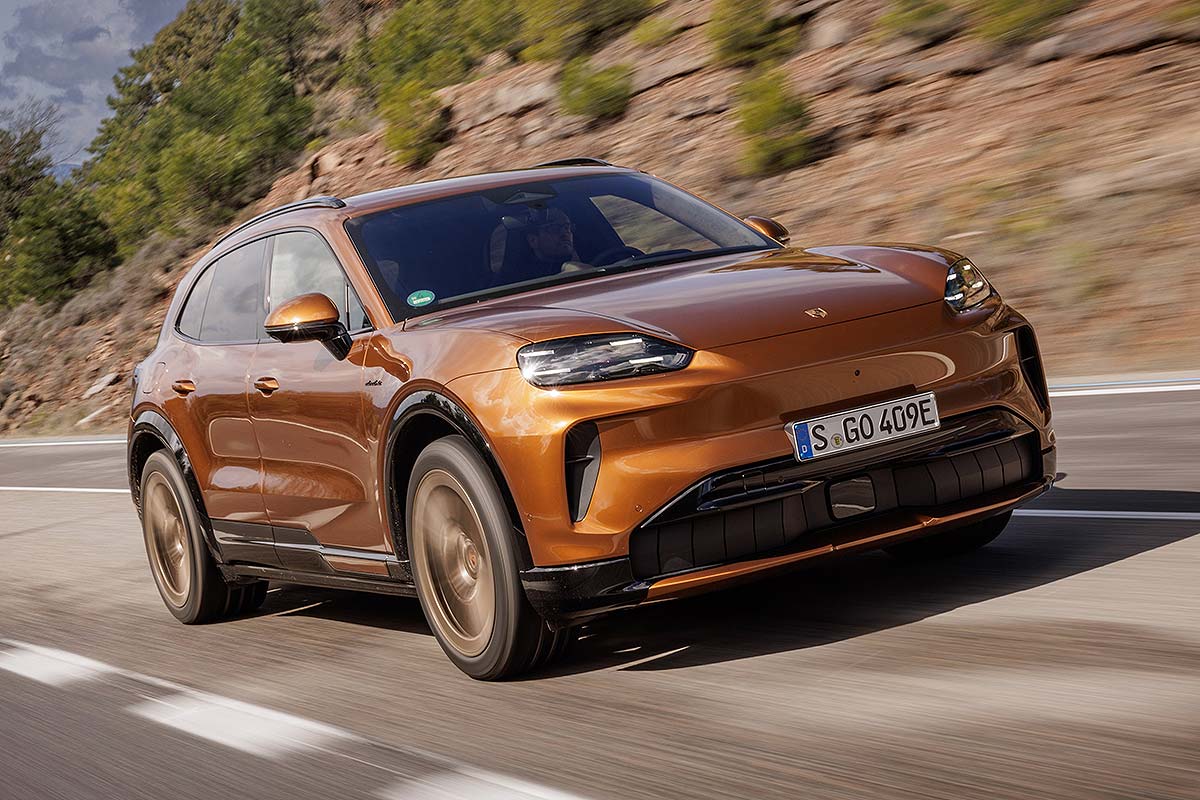
The mk4 Porsche Cayenne arguably had the potential to be as much of a shock to the system for Porsche purists as the original one. Remember, this is a group of people who went absolutely off their heads with rage at the water-cooled engines of the 996-generation 911 and the turbocharged four-cylinder engines of the 718 Boxster/Cayman. And so, to have an all-electric Cayenne without a combustion engine at all would surely cause uproar, wouldn't it?
In truth, no. The electric Cayenne's entrance was likely being eased by the all-electric version of the Macan (with which the Cqyenne shares its underpinnings), which arrived a wee while before its bigger brethren, getting people used to the idea of a previously-petrol-powered Porsche with an all-electric powertrain. It would seem that, these days, even the most pernickety of Porsche purists can't ignore the way the world is going.
Besides, with numbers such as those posted by the electric Cayenne, why on earth would anyone object? Take the range-topping version, the Cayenne Turbo Electric (a confoundingly contradictory name if ever there was one): with overboost and launch control engaged, this car has a staggering power output of 1,140bhp, making it the most powerful Porsche ever made, (some feat, that) and making it capable of dashing from 0-62mph in just 2.5 seconds.
But of course, like any Porsche, it's about much more than just the headline figures, however impressive those might be. Predictably, it's sensational to drive, providing fun, comfort and refinement in equal measure, it's really practical, it's beautifully finished and it comes with some really impressive tech. Of course, it's laugh-out-loud expensive, but did you ever really doubt that?
Porsche Cayenne mk4 Electric review
Porsche Cayenne mk3 (2017-)
Bodystyles:
- Five-door SUV
- Five-door coupe-SUV
Notable features and facelifts of the Porsche Cayenne mk3:
- Handling and comfort upgraded to all-new levels
- Diesel models dropped, as was manual gearbox option
- Petrol and plug-in hybrid models available
- Rakish Cayenne Coupe model introduced in 2019
- Innovative HD Matrix LED headlights introduced in 2023
- From 2025, menacing-looking Cayenne Black Edition model offered with Porsche Cayenne E-Hybrid and S E-Hybrid powertrains
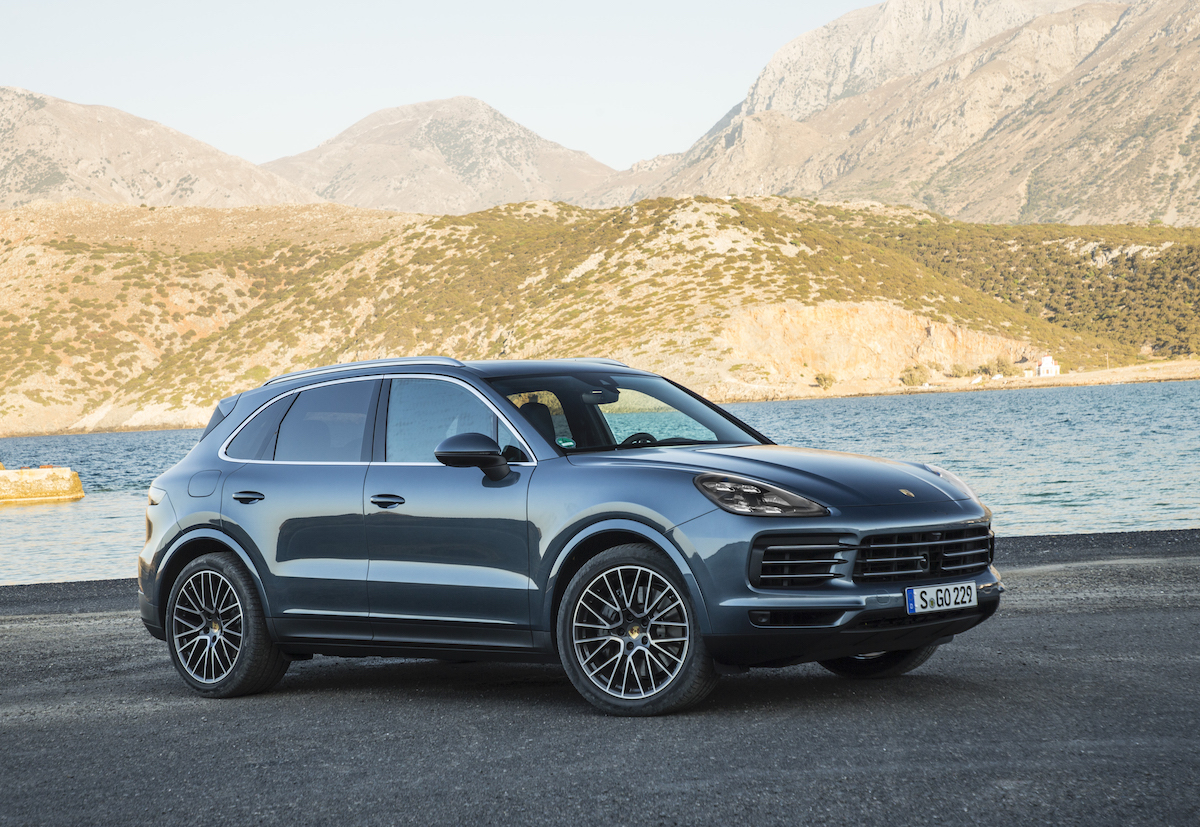
If you've got a Porsche badge on your bonnet, you'd better be outstanding to drive. The original Cayenne was remarkably athletic for such a large, high vehicle, and that’s what characterises the third-generation model even now.
Its handling capability is class-leading; steering response, body control and agility remain a step ahead even of the likes of the BMW X6, giving Porsche’s full-size SUV a very compelling USP. Throughout its life, the Cayenne has shared a mechanical platform with the Volkswagen Touareg, and while that remains the case with this model, its underpinnings are now also shared by the Bentley Bentayga, Lamborghini Urus and Audi Q8.
As well as being unusually agile, the Cayenne also has supreme ride comfort. Its cabin is exceptional, with high-grade materials and a sense of solidity about the build quality. The diesel variants went the way of the second-generation Cayenne, meaning that this model is petrol- or petrol-electric-hybrid only. The Cayenne Turbo S E-Hybrid uses both a twin-turbo petrol V8 engine and a sizeable electric motor to generate a total power output of 671bhp. That’s enough to shove the Cayenne to 62mph from a standstill in just 3.8 seconds. It can also run on electric power only, which has the potential to bring dramatic reductions in both real-world MPG and WLTP emissions figures.
Fans of manual gearboxes were out of luck with this generation of Cayenne, though, as you could only specify it with an eight-speed Tiptronic automatic.
The Porsche Cayenne Coupe – so-called because it has a more rakish roofline, although the door count remains at five – arrived in 2019 as Porsche’s response to sportier-looking SUVs like the BMW X6 and Mercedes-Benz GLE Coupe. There are some mechanical changes beneath the skin, such as a slightly wider rear track, but the Cayenne Coupe fundamentally adheres to the same blueprint that proved so popular back in 2002: space for the family, that desirable Porsche crest on the nose, a fine interior, plenty of performance and best-in-class handling.
Yes, this version has since been succeeded but the new, all-electric mk4 Cayenne, but there's still enough customer interest in large combustion-engined SUVs that Porsche has taken the decision to soldier-on with the mk3, giving it a stay of execution, and sell it alongside its shiny new stablemate for the foreseeable future. And despite its age, the mk3 Cayenne is still plenty good enough to convince as a brand new buy.
Porsche Cayenne mk3 review
Porsche Cayenne mk2 (2010-2017)
Bodystyles:
Notable features and facelifts of the Porsche Cayenne mk2:
- New Porsche Cayenne was lighter than before, and better to drive
- Petrol, diesel, hybrid and plug-in hybrid models all available
- Facelifted in 2014 with tweaked looks and plug-in hybrid model
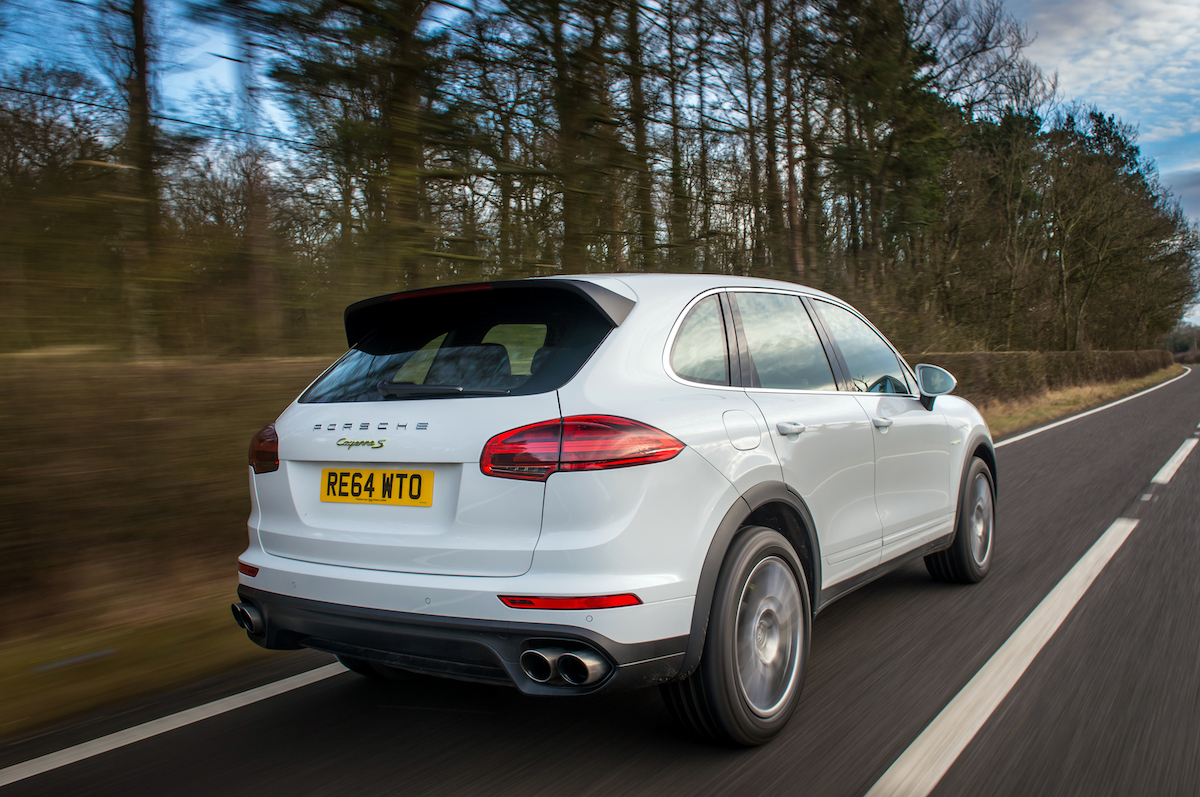
As well as more power across the board than the original Cayenne, the second-generation model was also lighter. Significant mechanical changes beneath the skin, as well as the use of lightweight materials, meant certain versions were 180kg lighter than their predecessors. It was on the second-generation Cayenne, too, that Porsche introduced the likes of Porsche Dynamic Chassis Control and adaptive air suspension with Porsche Active Suspension Management (PASM), chassis hardware that made the Cayenne even more athletic to drive.
Very soon after the launch of the second-generation Cayenne, Porsche added a hybrid version to the line-up, and this was Porsche’s first production hybrid. The Cayenne S Hybrid combined a V6 engine with an electric motor to achieve better fuel economy with lower carbon dioxide emissions.
It wasn’t until 2014, however, that Porsche introduced a plug-in hybrid (PHEV) version of the Cayenne. The S E-Hybrid superseded the S Hybrid, its plug-in capability and much larger battery enabling an electric range of around 20 miles (the earlier hybrid could be driven in electric mode only a short distance, and even then only at low speeds). This reduced the official carbon dioxide figures by more than half, making the S E-Hybrid a surefire hit among company car drivers who paid benefit-in-kind tax based on emissions.
Meanwhile, the non-hybrid engine line-up was expanding. For the second-generation Cayenne, Porsche introduced a second diesel variant, a V8 to sit above the diesel V6. The base model was still powered by a petrol V6 while the top-of-the-line model, the Porsche Cayenne Turbo S, was treated to a horsepower increase from 542bhp to 562bhp.
Porsche Cayenne mk2 review
Porsche Cayenne mk1 (2002-2010)
Bodystyles:
Notable features and facelifts of the Porsche Cayenne mk1:
- Styling lifted from the contemporary 911 and Boxster
- New model was instantly better to drive than its rivals
- Facelifted in 2007 with slimmer headlights and new engines with more power
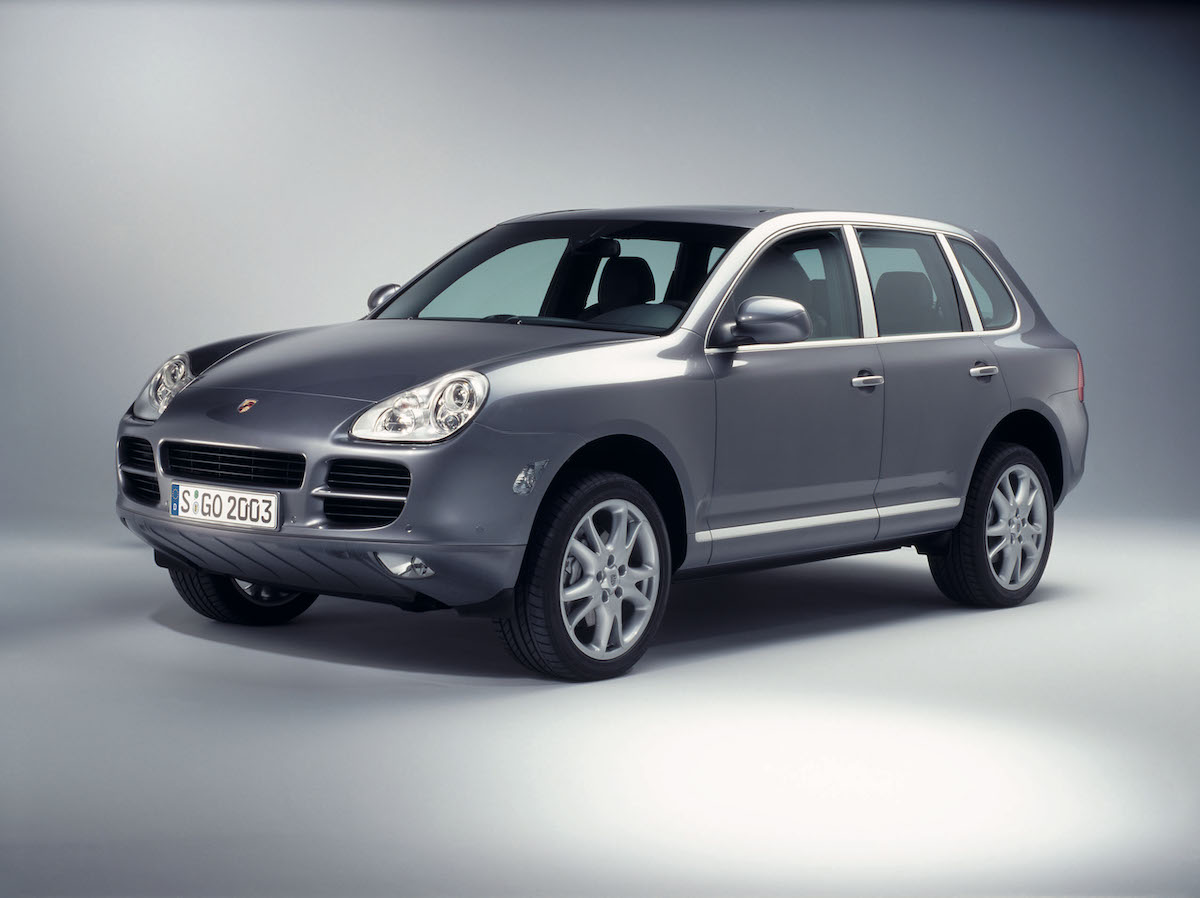
Only marginally less controversial than the first Cayenne’s very existence was the way it looked. Porsche’s stylists set out to graft the company’s then-new design language, familiar from the 911 and Boxster of the time, onto the nose of the new SUV. The results won few admirers.
Regardless of the aesthetic outcome, buyers were tripping over one another to get their names down for a new Cayenne. The Porsche brand was one of the most revered in the entire car sector, just as it is today, and for the very first time you could park a Porsche on your driveway without having to put up with the impracticalities of a sports car. To add to the comfortable front seats, it also had proper rear seats, and a big boot beneath the tailgate, yet scintillating acceleration and bonkers top speeds were still on the menu. What’s more, the Cayenne proved to be the very best car of its type.
Porsche didn’t invent the luxury 4x4 sector with the Cayenne; BMW had brought the X5 to market three years earlier and Mercedes the original ML two years before that. Land Rover had been selling the Range Rover for three whole decades before Porsche latched on to the emerging SUV trend. But what the Cayenne proved was that a tall vehicle with the ground clearance of an off-roader could still handle with much of the precision of a sporty saloon car. As of 2002, luxury SUV drivers had to put up with wallowy, roly-poly handling no longer. The Cayenne was a genuine joy from behind the steering wheel.
The basis of the Cayenne model range was the VW Group’s PL71 platform, which it shared with the Touareg that was launched around the same time. While the base model Cayenne was powered by a 3.2-litre V6 with 247bhp, the mid-range Cayenne S had a 4.5-litre V8 with an additional 100bhp. But those who really wanted their Porsche SUV to perform like a true Porsche would have preferred the Cayenne Turbo with 444bhp, or better still, the Cayenne Turbo S that arrived in 2006. That version, its twin-turbo V8 rated at 513bhp, could hit 62mph in just 5.2 seconds.
A year later, Porsche facelifted the Cayenne with slimmer and far more attractive headlights included in the standard equipment. The engine line-up was revised as well, with more power for all versions – the range-topping Turbo S now produced a mighty 542bhp – and in came both the Cayenne GTS and diesel variants. The former was billed as the sportiest Cayenne of the lot, its 4.8-litre naturally-aspirated petrol V8 good for 399bhp and combined, if you so wanted, with a six-speed manual gearbox. The diesel model, meanwhile, was Porsche’s very first and paved the way for the Stuttgart company to explore a variety of alternative powertrains.
Porsche Cayenne mk1 review


