The BMW 3 Series hardly needs an introduction. For more than three decades it’s been the go-to ‘compact executive’ car – a mid-size saloon and estate with a pretty much unbeatable blend of style, quality and driving appeal. If you’re in the market for one there are thousands to choose from, offering a huge variety in price, spec and performance.
Scan the listings, though, and one version soon stands out: the 330e. It’s the plug-in hybrid (PHEV) version of the 3 Series and, at the time of writing (August 2026), it accounted for 44% of all CarGurus listings for 3 Series models up to six years old. Petrol and diesel models made up 38% and 18% respectively. Study the specs and you’ll notice that the 330e is cheaper than most petrol or diesel 3 Series models, yet also more powerful and more fuel-efficient. So what’s going on? Is it all too good to be true, or is the BMW 330e genuinely the pick of the range?
In this guide we’ll give you the full lowdown, focusing on the second-generation (G20) 330e that’s been on sale since 2019. For more info on the first-generation 330e, check out the buying guide at the bottom of the page.
Why is the BMW 330e so affordable, and should you buy one?
- How cheap is the BMW 330e?
- How does the 330e compare with other 3 Series models?
- Why is the BMW 330e so cheap?
- What are the ownership costs for a BMW 330e?
- Should I buy a 330e?
- BMW 330e: brief buying guide
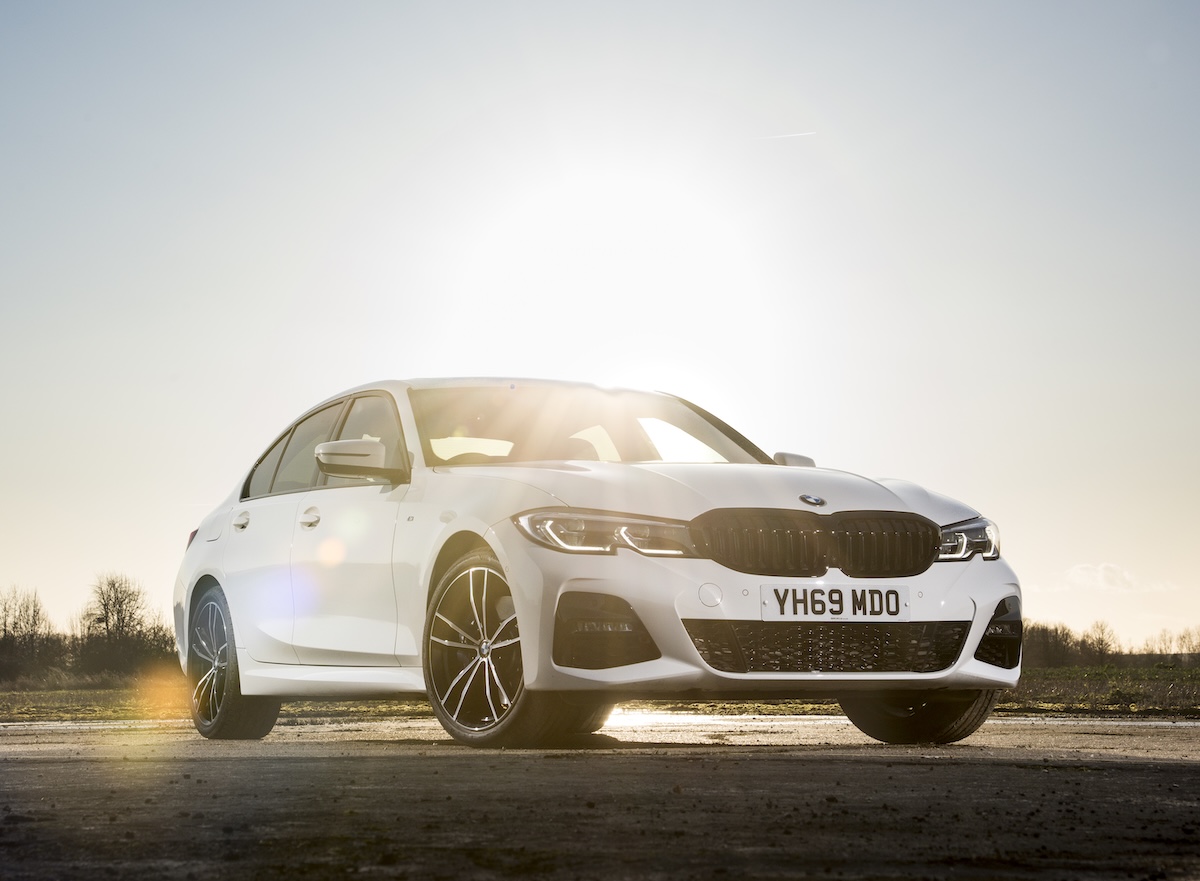
How cheap is the BMW 330e?
‘Cheap’ is relative when it comes to BMWs, but the 330e costs less than equivalent pure-petrol or diesel models. In fact, you could end up paying almost a fifth less, according to our price research.
We analysed CarGurus listings for 3 Series models from 2020 or 2021, looking at the lowest-priced models that had been on the market for less than 50 days and had a ‘Great Deal’, ‘Good Deal’ or ‘Fair Deal’ CarGurus Instant Market Value (IMV) rating. This is a snapshot, of course, but it gives a good idea of the prices you can expect to pay.
Used 330e prices: 40-60k mileage
| Model | 330e (40k–60k mileage) | Petrol (40k–60k mileage) | Diesel (40k–60k mileage) |
|---|---|---|---|
| Average price | £17,861 | £18,750 | £21,307 |
| Price difference vs 330e | na | +5% | +19% |
| Sample size | 20 | 20 | 12 |
Used 330e prices: 60-80k mileage
| Model | 330e (60k–80k mileage) | Petrol (60k–80k mileage) | Diesel (60k–80k mileage) |
|---|---|---|---|
| Average price | £15,878 | £17,637 | £18,401 |
| Price difference vs 330e | na | +11% | +16% |
| Sample size | 20 | 17 | 11 |
As you can see, the 330e isn’t just a bit cheaper. For cars with 40k-60k mileage, average prices are 5% lower than those of equivalent petrol models and 19% lower than those of diesel models. For higher-mileage (60k-80k) cars, the 330e is 11% and 16% cheaper respectively.
Bear in mind that the 330e cost about £4,500 more than an equivalent 320i when new and it looks even better value as a used buy.
How does the 330e compare with other 3 Series models?
So are you paying less for the 330e because you’re getting less? In most respects, no. As we’ve alluded to, the 330e is actually quicker, more powerful and more fuel-efficient than comparable petrol or diesel models.
Here are some comparison stats using examples from the 2020 model year* (since specs vary slightly over time):
BMW 3 Series saloon model comparison
| Model | 330e | 318i/320i petrol | 318d (auto)/320d diesel |
|---|---|---|---|
| Power | 288bhp | 154bhp/181bhp | 148bhp/187bhp |
| 0–60 mph (seconds) | 5.8 | 8.4/7.1 | 8.2/6.8 |
| Combined fuel economy (WLTP) | 157–217mpg | 39.2–44.8mpg | 53.3–64.2mpg |
| CO2 Emissions (WLTP) (varies by year/spec) | 30–41 g/km | 142–163 g/km | 116–139 g/km |
| Starting price when new | £38,595 | £30,960/£33,300 | £34,780/£36,100 |
So, yes, the 330e beats its petrol or diesel counterparts in key areas. You do need to take the official fuel economy figures with a pinch – or perhaps a handful – of salt, of course. As with any PHEV, what you get in real-world driving is likely to fall short of the lab tests used to calculate the WLTP numbers.
The optimum use case is that you have a home charger and most of your driving is short, local trips. That scenario allows you to make the most of the 330e’s pure-electric range, which is a maximum of 37 miles for 2019-2024 models and up to 63 miles for post-2024 cars.
Considering the battery pack and related hybrid gubbins add more than 200kg in weight over a petrol or diesel model, you might be concerned that the 330e doesn’t have the responsive feel you expect of a 3 Series. In truth, there’s little to worry about because the 330e feels just as well-balanced (especially with optional adaptive suspension) and has more power to compensate.

Why is the BMW 330e so cheap?
All of this begs the question: “What’s the catch?” If the 330e outdoes petrol and diesel 3 Series models in many respects, why does it cost less? The answer is a combination of market dynamics and the fact that the 330e does have some specific downsides.
A lot of those downsides apply to any plug-in hybrid and relate more to your lifestyle and driving habits than the car itself. The most obvious is that the 330e might not be a great choice if you don’t have a home or workplace charger. Once you’ve used up the pure-electric range, the 330e will operate as a hybrid, with the amount of electrical assistance dependent on factors including the driving mode selected, the way you drive and the length of your journey. Fuel economy could be worse than with an equivalent petrol or diesel model, with owner reports suggesting anything between 25mpg and 40mpg without charging the battery at all.
There’s also the hassle of having two power sources to top up regularly, compounded by the fact the 330e’s fuel tank has a 40-litre capacity to the 320i’s 59 litres. And, like many (but not all) PHEVs, the 330e doesn’t offer rapid charging. Regardless of age or spec, topping up the battery to 100% from empty takes more than two hours, so it’s not something you can fit in around a quick coffee stop or supermarket visit.
Practicality takes a hit with the 330e, too. That bulky battery pack means a higher load floor and less space in the boot. The saloon model’s capacity drops from 480 litres to 375 litres, so you go from family saloon-level space to something on a par with a VW Golf. In the case of the Touring, where load space is probably a bigger concern, it drops from 500 litres to 410 litres.
Then there are concerns around the extra complexity of a PHEV, because you’ve potentially got more to go wrong. Finding robust reliability data is tricky, but in the What Car? Reliability Survey 2025, current petrol 3 Series models finished second out of 22 cars in the executive cars category and diesel models were 10th. The first-generation 330e was 17th, with hybrid battery pack issues listed most frequently as a problem.
One thing to bear in mind is warranty cover. From new, all G20 3 Series models came with a three-year/unlimited-mileage manufacturer warranty. There’s a separate warranty for the PHEV battery, which provides cover for six years or 62,000 miles for 2019-2024 models and eight years/100,000 miles for those with the newer, post-2024 battery pack.
While all those concerns contribute to the 330e’s low prices, the simple mechanics of supply and demand also play a part. Because it’s a car aimed squarely at the fleet market, large numbers tend to be sold off in one go when business leases end. Lots of similar cars hitting the market at the same time, on top of buyer concerns over longevity, practicality and charging, equals lower prices.

What are the ownership costs for a BMW 330e?
In terms of fuel and energy, the cost of running a 330e will depend on your charging and driving habits. If you use a home charger and much of your driving is short trips you could end up paying very little per mile. If you rarely – or never – charge the battery you could end up paying more to fuel the 330e than you would a petrol or diesel model. If you rely on public chargers and only plug in sporadically, your costs will be somewhere in the middle. You get the picture.
Assuming that you do plug in regularly (otherwise why would you buy a used PHEV?), user forums such as PistonHeads suggest that real-world, long-term fuel economy could be anywhere between 50mpg and 70mpg.
Insurance costs for the 330e are likely to be higher. While the majority of 320i and 320d models have a group 28-30 rating, 330e models have a group 33-36 rating.
As a new car, the 330e’s extremely low CO2 emissions are central to its appeal as a company car because they result in a BIK (benefit in kind) tax rate that saves business users thousands per year. Those low emissions make little difference to ownership costs if you’re buying used, though. In terms of VED (vehicle excise duty, better known as road tax), any 3 Series (including the 330e) that’s two or more years older is subject to a flat rate of £200 per year. The first-year VED rate isn’t likely to be a concern if you’re buying used, but for the record the 330e’s lower emissions mean a figure of £115 (£135 for post-April 2026 cars), which is less than the £425 you pay for a petrol or diesel equivalent.
There is the expensive car supplement to consider, though. This is an extra £440 per year in VED that’s payable for cars between two and six years old that cost more than £40,000 (including options) when new. That applies to all but the earliest 330e models (and every new 3 Series model), but not older, lower-spec petrol or diesel models.
BMW 330e: which trims are available?
The second-generation BMW 330e is available in the same trim levels as the 318i/320i petrol and 318d/320d diesels. Initially, that was a choice of SE Pro, Sport, M Sport or M Sport Plus Edition. Sport Pro and M Sport Pro trims were added later, but as part of the 3 Series’ update in 2022 the range was slimmed down to Sport, M Sport or M Sport Pro.
Even the entry-level SE Pro gives you lots of kit, including LED headlights, three-zone climate control, electrically folding door mirrors, automatic headlights and wipers, front and rear parking sensors, a reversing camera and 17-inch alloy wheels. Sport trim adds extras such as 18-inch alloy wheels, heated front seats and sportier exterior details.
The most popular trim level is M Sport: at the time of writing it accounted for 72% of all second-generation 330e models for sale on CarGurus. It gives the 330e a familiar BMW ‘M’ makeover, with stiffer ‘M Sport’ suspension and an even sportier look inside and out, with more aggressive bumpers, ‘M’ badging and a range of cosmetic upgrades. M Sport Plus Edition adds features such as adaptive suspension, upgraded brakes, Variable Sport Steering and 19-inch alloy wheels.
The exact specification you get with each trim level has changed over time, but hasn’t strayed too far from this template.
Should I buy a 330e?
There’s no doubt that the BMW 330e looks like a serious bargain in the current market. In fact, the numbers look like they shouldn’t stack up at all. But the 330e’s low prices are an anomaly created largely by market forces, rather than any inherent flaws in the car itself.
Reliability is something to watch for, and an out-of-warranty issue with the battery pack could wipe out its lower purchase price and potentially lower running costs. If a 330e fits your lifestyle, driving habits and charging setup, however, and you can live with its reduced boot capacity and higher insurance costs, it could well be the pick of the range.

BMW 330e history
The 330e was introduced to the UK in 2016, as a new addition to the sixth-generation 3 Series (often referred to as the F30) range that went on sale in 2012. An all-new 330e followed in 2019, as part of the ‘G20’ seventh-generation 3 Series line-up. The post-2019 model is available as a saloon or ‘Touring’ estate, with rear-wheel drive as standard. BMW's ‘xDrive’ all-wheel drive was a cost option until the upgraded battery was introduced in 2024. The earlier F30 330e was only sold as a rear-wheel-drive saloon.
All versions combine a 2.0-litre petrol engine and automatic gearbox with an electric motor and a rechargeable battery pack. The first-generation 330e has a 7.6kWh battery and a maximum pure-electric range of up to 25 miles. The second-generation model was introduced with a 12.0kWh battery and an electric range of up to 37 miles. An updated version was introduced in 2024, featuring a 22.3kWh battery and a maximum range of 63 miles.
BMW 330e model history
| Model | 330e first generation (F30) | 330e second generation (G20) | 330e second generation (G20) update |
|---|---|---|---|
| Introduced | 2016 | 2019 | 2024 |
| Battery capacity | 7.6 kWh | 12.0 kWh | 22.3 kWh |
| Electric range | Up to 25 miles | Up to 37 miles | Up to 63 miles |
| Body styles | Saloon | Saloon, estate (Touring) | Saloon, estate (Touring) |
| Layout | Rear-wheel drive | Rear-wheel drive, optional four-wheel drive (xDrive) | Rear-wheel drive, optional four-wheel drive (xDrive) |
Figures based on 2021 saloon models with standard rear-wheel drive. 318d figures are for cars with optional automatic gearbox – all other models have an automatic gearbox as standard.