Honda Jazz Review (2007-2014)
Honda Jazz cars for sale
4.0
Expert review
Pros
Innovative and roomy interior
Expect mile after mile of hassle-free reliability
Inexpensive to buy and run
Cons
Noisy on the motorway
Doesn't ride and handle with the polish of a Ford Fiesta
Some low-rent materials in the cabin
The CarGurus verdict
It’s easy to snub the Jazz because of its dowdy looks and unremarkable performance. It is a marked improvement over its predecessor, but alternatives such as the Ford Fiesta and the Seat Ibiza are certainly more interesting. And if you plan to spend lots of time on the motorway, an alternative such as a Volkswagen Polo or a Skoda Fabia would be a more relaxed option.
However, those conventional small hatchbacks offer nowhere near the level of practicality as the Jazz, which rivals larger cars with its boot and storage space. Honda’s excellent reputation for reliability and customer satisfaction also counts very much in its favour, as do neat touches such as its wide-opening rear doors. Couple that with its longevity, and the Jazz makes a smart used buy for those who want an inexpensive, straightforward, and capable small car.

What is the Honda Jazz?
Honda’s compact hatchback, the Jazz, has long been a popular choice with those after a small city car that majors on practicality.
The original Jazz launched in the UK in 2002. It married Honda’s robust and reliable engineering with economical engines and a roomy, flexible interior, resulting in a small, five-door supermini that won countless awards.
This second-generation model arrived in 2008. It took the strengths of its predecessor and added a more stylish exterior, more space and visibility, new, cleaner engines, and the option of an automated manual transmission.

How practical is it?
Known as the GE generation, the second-generation Jazz retained the ‘Magic Seats’ that made the original model’s interior so flexible. As with most cars, these fold flat to increase boot space, but you can also flip the seat bases up against the backrests and lock them in place, which allows you to carry really tall items in the rear footwells. It's an ingenious feature which we're surprised more manufacturers haven't copied.
Of course, cleverness is no substitute for space, even in a small car, and thankfully, the Jazz has plenty of that, too. The high roofline gives plenty of headroom, and legroom is also surprisingly generous.
The boot is also among the biggest in the small car class, too, with a whopping 399 litres of space on offer: That's a good slice more that many cars from the class above. Do bear in mind, though, that the hybrid version's boot shrinks to 303 litres, which is part of the reason why is wasn't all that popular.
Safety was improved with the second-gen Jazz, too, with the addition of dual front- and side airbags on all models, and features such as seat belt reminders and active headrests.
The cabin is of a higher quality than that of the original Jazz, while Honda also made the A-pillars on either side of the windscreen narrower, and the quarter windows larger, which improved visibility. This, coupled with light controls and compact footprint, makes the Jazz a breeze to drive around town.

What's it like to drive?
Engines initially comprised an 88bhp 1.2 and a 99bhp 1.4 – both petrol – and both were claimed to deliver an average mpg figure north of 50, while CO2 emissions were 125g/km and 128g/km, respectively. A five-speed manual transmission was standard, but a six-speed automated manual, known as i-SHIFT – which you operate like an automatic – was also available.
The Jazz isn’t what you’d call a quick car, but that isn’t the point of it. The 1.2 takes 12.5 seconds to reach 62mph and the 1.4 shaves that to 11.5 seconds. The i-SHIFT automated manual drags it out to 13.9 seconds.
In 2011, a hybrid version of the Jazz was added to the range, which used the same electrified 1.3-litre powertrain as the contemporary Honda Insight. Pace wasn't too much of a problem, but the powertrain was noisy and unrefined, so didn't prove very popular.
In comparison to its predecessor, Honda updated the chassis of the Jazz, lengthening its wheelbase and widening its track. It also revised the brakes, steering and suspension, which created a car that rides and handles much better than the car it succeeded. It still isn’t much fun to drive, but the emphasis is on ease of use. Rivals of the same era, such as the Ford Fiesta or Vauxhall Corsa, are more comfortable, though, and they’re also better on the motorway, because the Jazz can get noisy at higher speeds.

Technology, equipment and infotainment
Trim grades initially consisted of S, SE, ES, and EX. SE is the minimum that you'll want to live with, because it includes air-conditioning and 15-inch alloy wheels (the S is very basic). The ES trim level includes a double-trunk boot floor, a refrigerated glovebox, and stability control.
The range-topping EX adds 16-inch alloys, automatic lights and wipers, cruise control, climate control, and a panoramic sunroof. A sporty Si version was launched in 2010, too.
These were the days before touchscreens were widespread at this end of the market, so the infotainment looks basic by today's standards. However, the fact that most functions are controlled by physical buttons and switches on the dashboard makes those functions easier to use on the move.

Honda Jazz running costs
The Honda Jazz is a small, light, and economical car, so it doesn’t cost much to run, nor does it chew through consumables, such as tyres, at a rapid rate.
Go for an early 1.2-litre S or SE, for example, and you’ll get a car with a claimed average fuel economy of 53.3mpg. That’s not an unfeasible figure, either, with north of 45mpg possible in the real world from both 1.2- and 1.4-litre engines.
The Hybrid’s low official CO2 emissions mean it’s cheap to tax. You’d pay just £20 a year for VED, while later 1.2-litre models fitted with Honda’s Idle Stop start-stop system cost £30. Other versions aren’t as clean, though, so you’ll pay more than £100 per year for road tax.
The Hybrid’s official average mpg figure is 62.8mpg and most owners report more than 50mpg in daily use, so savings are possible if you’re doing lots of miles. It’s more expensive to buy than the conventional models, though, so you’ll need to balance its additional purchase price with any potential savings.
Servicing shouldn’t break the bank, either. Honda has an extensive dealer network, and the Jazz is a simple car, so it can easily be serviced by independent garages.
A Jazz will generally need servicing every 12 months or 12,500 miles but check the handbook for additional guidance on age- and mileage-related servicing, because you’ll want to keep the coolant, brake fluid, transmission fluid and the rest in good condition to ensure a trouble-free life.

Honda Jazz reliability
Practicality aside, one of the real advantages of buying a Jazz is that it’s a reliable and durable car. It has won countless awards and achieved top spots in numerous customer satisfaction surveys, all because of its dependability.
Its copybook isn’t entirely unblotted, mind, as there are occasionally some minor issues, such as water ingress in the boot. These faults are often fixed easily and inexpensively, and should be easy to spot when you inspect a used example.
Because of the lack of timing belts (all versions have a metal chain designed to last the lifetime of the car), and general mechanical durability, there’s otherwise not a great deal to look out for. Do try to find an example that’s been regularly serviced, and early models are now getting on a bit, so keep an eye out for any age-related issues. There have also been several recalls, many of which are related to a Takata airbag issue. Fortunately, you can use the government’s online recall checking website to see if there are any outstanding issues with a vehicle before you buy it.
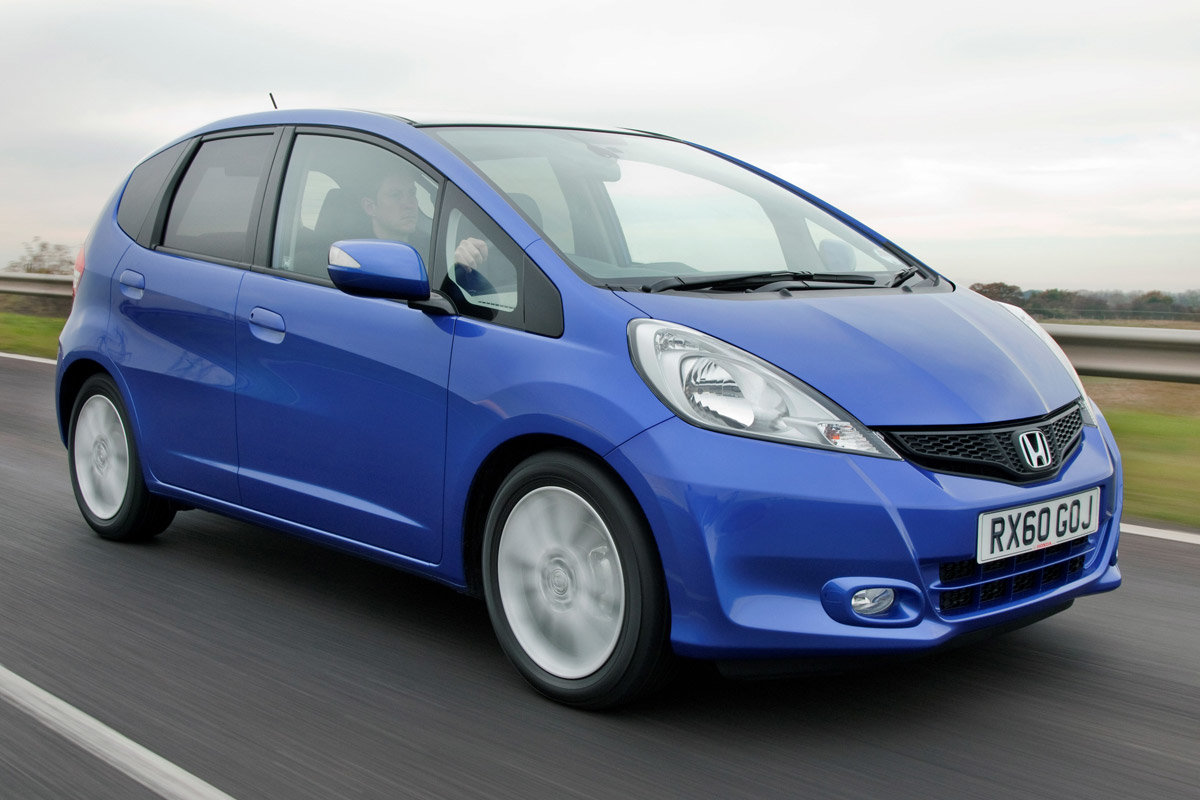
- The Jazz was substantially overhauled in 2011. Externally, the facelifted model received new front-end styling and new colours, while upgraded rear seats that could recline were added inside. Honda also introduced a new CVT option – Continuously Variable Transmission, basically a smoother automatic gearbox – and tweaked the suspension to improve handling.
- A Hybrid Jazz was added to the range in the same year, which combined a 1.3-litre i-VTEC petrol engine with Honda’s IMA hybrid technology and a CVT transmission. It was claimed to be capable 62.8mpg, while CO2 emissions were reputed to be just 104g/km, which were impressive at the time.
- The Jazz scored the maximum five-star rating in Euro NCAP’s crash test when it was assessed in 2009. It scored 78% for adult occupant protection and 79% for child occupant protection, which wasn’t bad considering its compact size. Alternatives such as the Volkswagen Polo of the same era did fare better, though, scoring 90% and 86%, respectively.
- The best all-rounder: If you intend to use your Jazz a lot, including for longer trips, we’d recommend the 1.4-litre version. The 1.2 isn’t a bad option, but the larger engine is that bit more capable, and there’s not much of an economy penalty. We’d skip the entry-level S grade and aim for an ES-specification model as a minimum, because it comes with stability control and some other neat features. Shop around, and you might find a high-specification EX model for similar money.
- If you need an automatic: The i-SHIFT automated manual gearbox, is a bit clunky so, if your budget permits, go for the later CVT option that was introduced in 2011. It’s a continuously variable automatic transmission and much smoother. Do try before you buy, though, because they do drive differently to conventional automatics, and not everyone likes them.
- For maximum efficiency: The Jazz Hybrid has the highest claimed mpg figure, clocking in at 62.8mpg when new (it was tested under the old and unrealistic NEDC regime) and Honda claimed CO2 emissions of 104g/km of CO2. Its CVT transmission means it’s best reserved for those driving predominantly around town, because it can get noisy and harsh on cross-country drives or on the motorway.


