Toyota Yaris Review (2006-2010)
Toyota Yaris cars for sale
4.0
Expert review
Pros
Very reliable if you choose a manual car
Good safety standards for a small car of this age
Roomy and practical cabin
Cons
Some problems with the MultiMode automatic transmission
Uninspiring to look at and to drive
Odd centrally positioned dials

The CarGurus verdict
The Yaris makes a very good used car. It's the kind of sensible purchase it's hard to argue against.
Apart from some trouble with MMT gearboxes, the Yaris is a very reliable car. Find a good example and look after it, and the Yaris should look after you well into six-figure mileages. It's right up with the Honda Jazz and Hyundai i20 as a dependable, no-nonsense supermini.
The Yaris is very safe for a car of this age and size, and the roomy cabin, clever rear seats and decent boot make it a practical choice as well as a safe one.
Low running costs add to the Toyota's appeal. All engines are economical, and seem to get closer to the official combined mpg figures than most. Insurance premiums should also be affordable, making the Yaris a good choice for anyone looking for a budget first car.
Okay, it's not particularly fun to drive or look at. But if you view the Yaris with rational eyes, it's a fine used buy.

What is the Toyota Yaris?
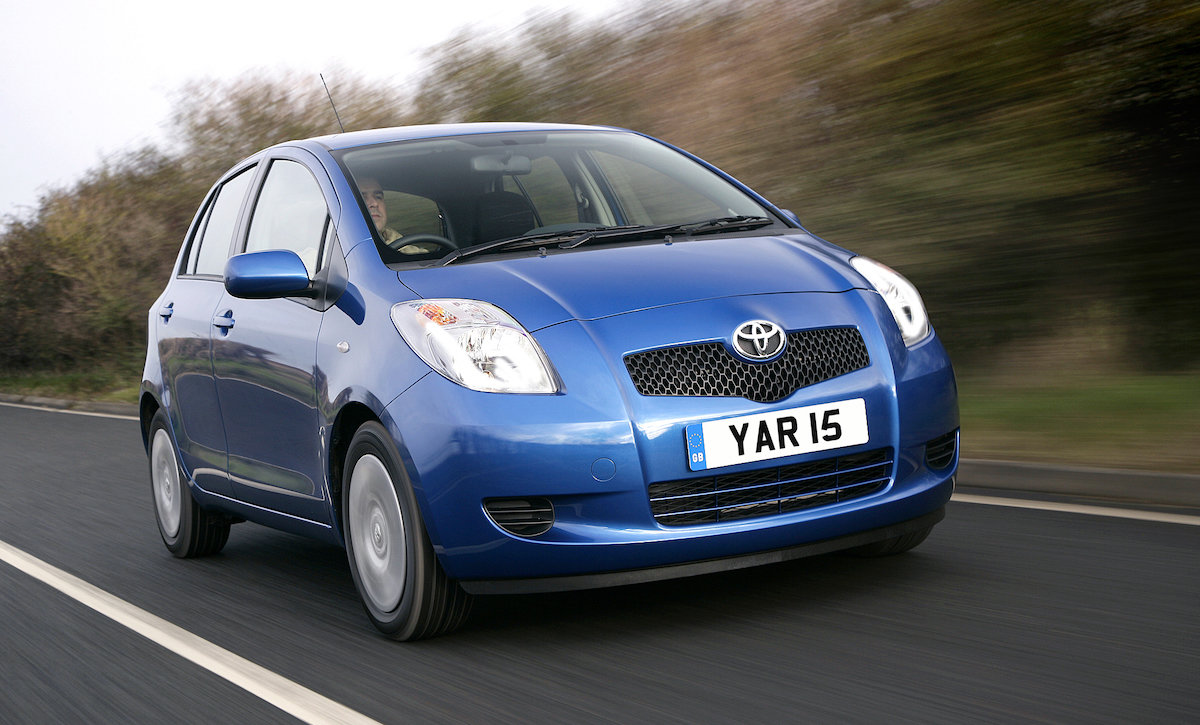
The second-generation Toyota Yaris may not have had the cute looks of the original and it also wasn't as stylish as a contemporary Renault Clio. However, it improved on the first generation car with greater space, better safety, and a more modern interior.
As has always been the case with the Yaris, this version was no less of a sturdy and reliable supermini, and Toyota's reputation for producing dependable cars, while main dealers are known for good customer service.
If you're after a later used Yaris, check out our review of the third-generation model, which arrived in 2011.

How practical is it?
The Toyota Yaris mk2 was sold in three-door and five-door body styles, but as a new car the more practical five-door sold in much greater numbers. The extra set of doors helps owners make most of the Yaris's clever cabin.
The smartest interior feature are the sliding seats, which back and forth to free up more boot space or legroom. That means the amount of boot space with the rear seats upright varies from 272 to 363 litres, both of which are impressive figures for a supermini of the time.
The rear seats also split and fold as you'd expect, and there's plenty of luggage space for such a small car.
What's it like to drive?
From launch, the Yaris was offered with a 68bhp 1.0-litre VVT-i petrol, an 87bhp 1.3 VVT-i petrol, and a 90bhp 1.4-litre D-4D diesel. Towards the end of the car's life in 2009, the 1.3 was upgraded to a 1.33-litre engine with 101bhp. A 131bhp 1.8-litre Dual VVT-i petrol engine was the sportiest option, fitted to the short-lived SR 'warm' hatchback.
To drive, the Yaris is inoffensive and ordinary. Don't expect the perky handling of a Ford Fiesta, or the plush ride of a Volkswagen Polo. The suspension is on the firm side, which compromises comfort without making the Yaris fun or sporty.
If you're in no hurry or mostly drive around town, the 1.0-litre petrol is all you really need. It's a bit stretched on A-roads and motorways, but not completely out of its depth.
For drivers who regular travel longer distances, the 1.3 has a bit more life to it. For really high-mileage drivers, however, the 1.4-litre diesel has the fuel economy and legs for motorway driving, with punchy in-gear acceleration. The downside is that the diesel isn't the quietest engine.
If the budget stretches far enough, the pick of the engine line-up is the 1.33 petrol. It was only briefly part of the second-gen range after a late-life facelift before the third-generation Yaris went on sale, but it offers a better blend of performance, refinement and fuel economy than the other engines.

Technology, equipment & infotainment
All versions of the Yaris are well equipped. The entry-level T2 had a CD player, electric front windows, anti-lock brakes and driver and passenger airbags. As a used car, we think the T3 and the later TR models are better value, as they add air conditioning, side airbags, remote locking and steering wheel reach adjustment to make it easier to find a comfortable driving position.
While the Yaris is ageing gracefully, some of its interior features haven't dated so well, like the centrally mounted instruments. They looked quite hi-tech in 2005, and you do get you used to them, but we'd rather have the dials straight in front of the driver.
When tested by the safety gurus at Euro NCAP in 2005, the Yaris scored five stars out of five for adult occupant protection. So it's a very safe supermini by the standards of the time, although safety and driver aids have moved on considerably since then.

Toyota Yaris running costs
Buy a used Toyota Yaris, and you can expect very low running costs.
We've touched on fuel economy already. The later versions of the 1.4 diesel lead the way with official figures in the high 60s mpg. As you'd expect, it takes a gentle driving style to match such efficiency in practice. However, owners report that close to 60mpg is a reasonable expectation.
While not reaching those heights, the petrols are also fuel-efficient cars. Official economy figures are in the 50s, and owners generally achieve mpg figures in the high 40s.
The thirstiest model is the SR warm hatchback. This has an official combined figure of 39.2mpg, and as long as your right foot isn't too weighty you should get quite close to that in day-to-day driving.
As you'd expect, the SR will be the most expensive Yaris to insure. But in this case, the adjective 'expensive' isn't really warranted, as even the SR falls in group 13 of 50.
At the opposite end of the Yaris range, the little 1.0 petrol will cost peanuts to cover. Depending on the exact specification, it's in group two to three. Step up to the 1.3 and the Yaris sits in group six or seven. The later 1.33-litre engine is in group seven, while the diesel is in group 10. These compare well with insurance group ratings for the Yaris's rivals, and contribute further to the Toyota's low running costs.
Servicing is needed every 10,000 miles, and all parts used by Toyota franchised dealers come with a 12-month warranty. Toyota offers a 20% discount on the cost of servicing to owners of cars that are five years old or more, to encourage drivers to have their cars serviced within the franchised network. The same 20% discount applies to the MOT test at participating Toyota dealers.
Despite these measures to appeal to owners of older vehicles, having a used Yaris serviced at an independent dealer is likely to work out cheaper than using a Toyota franchisee.

Toyota Yaris reliability
Reliability is usually a given with Toyota, and with some provisos the Yaris makes an extremely reliable used car.
Let's get the bad points out of the way first. Toyota's engineers had an off day when they developed the MultiMode automatic transmission (MMT). Some owners report expensive failures, mostly due to faulty actuators. Others complain that the gearbox sometimes selects first gear on steep hills, sending engine revs soaring.
Unfortunately there is no conventional torque-convertor auto to choose instead, so if you really must give your left leg a rest, it's the MMT or nothing.
Otherwise there's not a lot to worry about. Manual gearboxes are much less likely to be troublesome. Reliability reports and owner satisfaction surveys generally give the Yaris a clean bill of health, and show that owners are happy with their cars.
As for recalls, a fault was identified in cars built before mid-April 2007 which could lead to a fire after a collision, due to the high gas temperature generated by the seatbelt pre-tensioner setting fire to sound insulation material.
Toyota has a useful section on its website which allows owners and prospective owners to check if a car has any outstanding recalls. You just need the VIN or registration number.
- Ever wondered what the Yaris name means, and how Toyota came up with it? Toyota explains that it's an amalgam of two words; one Greek, one German. In Greek myth, 'Charis' is one of the Graces or Charites, and embodies grace, kindness and life. The German word 'Ya' means yes. Toyota swapped out the 'Ch' for a 'Y' to symbolise the perceived positive reaction of European markets to the car's styling, hence 'Yaris'. Perhaps that was rather optimistic given the second generation Yaris's dull looks...
- The Toyota Yaris's petrol engines use VVT-i technology. VVT-i stands for 'Variable Valve Timing with Intelligence'. First introduced by Toyota in 1996, VVT-i varies the timing of the intake valves by altering the relationship between the cambelt drive and the intake camshaft. If that all sounds a bit too technical, the important thing to remember is this: the purpose of the adjustment is to make the engines more fuel efficient throughout the rev range. Although it adds complexity to the engines, VVT-i is a very reliable system; the Yaris is a Toyota after all.
- The second generation Toyota Yaris was a much safer car than the first. The structure of the car was stronger, using the Minimal Intrusion Cabin System to improve collision performance by up to 30%, according to Toyota. The Yaris was also ahead of the curve in terms of safety equipment, with up to nine airbags available including the supermini sector's first driver's knee airbag. The Toyota's five-star adult occupant rating was backed up by a three -out-of-five score for child occupant protection and a two-out-of-four score for pedestrian protection.
- If you want an all-rounder: choose the 1.33-litre VVT-i. This engine joined the Toyota Yaris hatchback range in 2009, and was a significant improvement on the earlier engines. There's a lot more urgency to the Yaris's acceleration with this engine fitted, and fuel economy is still very impressive, achieving 55.4mpg on the combined cycle.
- If you want a warm hatchback: pick the 1.8 SR. It's easy to be a bit sniffy about a performance model with just 131bhp. And in fairness, the 1.8 SR's 0-60mph time of 9.3 seconds is rather tame compared with what a proper hot hatch can do. However, fuel and insurance costs will be a lot lower than for a more powerful hatchback, so there's still a place for warm hatches like the Yaris SR.
- If you want a small car for long journeys: go for the 1.4 D-4D diesel. For such a small engine, its mid-range pull is plentiful. It's also extremely economical, with early cars returning 62.8mpg on the combined cycle. As part of the 2009 revisions to the Yaris, economy improved to 68.9mpg with a manual gearbox or 67.3mpg with the MultiMode automatic. No hybrid was offered with the second generation Yaris, so the diesel is the engine of choice if fuel economy is your top priority.
- If you are on a tight budget: choose the 1.0-litre VVT-i. You won't be going anywhere in a hurry if you choose the entry-level petrol engine. But what it lacks in performance it makes up for in fuel efficiency and reliability. According to the official figures, it can achieve up to 52.3mpg.


