
Pinpointing the very first high-performance estate car is a lot like asking a roomful of theologians to agree on which is the one true religion: it can’t possibly result in any kind of accord (and that isn’t a joke about Hondas).
Somebody will put forward a considered and well-reasoned argument, only for it to be blasted away by a deafening chorus of dissent. There’ll be factions and splinter cells, and before too long devotees of one particular fast estate car and supporters of another will turn their backs on each other.
Best Fast Estate Cars: From BMW M5 Touring to Porsche Taycan Sport Turismo
- Origins of the Fast Estate Car
- E34 BMW M5 Touring
- Audi RS2 Avant
- Mercedes AMG C43, E55 and C63
- BMW M5 Touring and Audi RS6
- Mercedes-AMG E63 S
- Audi RS6 (again)
- Porsche Taycan Sport Turismo
- Honourable Mentions

Origins of the Fast Estate Car
There have been cars with long roofs, hatchback boots and bundles of power for several decades, but true performance estate cars have been around for no more than three. As far back as the 1930s, coach builders were dropping estate-type bodies on to Bentley and Rolls-Royce chassis, which were driven along by far more powerful engines than you’d have found in a typical production car. But they were never intended to be at all sporty to drive.
The same applies to several American station wagons from the 1950s and 1960s, cars that used thunderous V8 engines but were about as athletic in the bends as they were frugal at the fuel pump. And so it is with models such as the Subaru Legacy GT and Audi 200 Avant from the 1980s: both were reasonably quick and certainly both were estate cars, but in no way was either one truly a performance car.

E34 BMW M5 Touring
The very first high-performance estate car, then? That’ll be 1992’s BMW M5, in only its second generation and offered for the first time with what BMW referred to as a Touring body. Or to you and me, an estate. Before the model was put out to pasture in 1995 some 891 M5 Tourings had been built, all by hand. Any M-car is by definition a performance model and there can be no doubting its speed, because with a 3.8-litre straight-six engine that developed 335bhp, it’d be considered plenty brisk enough even today.

Audi RS2 Avant
Another car more commonly reckoned to be the originator of the breed is the Audi RS2 Avant. Yet it arrived in 1994 and so trailed the M5 by two full years. But while it trailed the M5 Touring to market, the RS2 did more to further the performance estate than any other.
This is because the RS2 was designed and built in collaboration with Porsche – at the time still a dedicated sports car manufacturer – and it boasted the kind of go-faster hardware no estate car ever had before, such as lowered and stiffened sports suspension, uprated Brembo brakes (complete with PORSCHE lettering on the callipers), the same wheels you’d have found on a 911 Turbo and sticky Dunlop tyres. Within the cabin there was even a pair of heavily bolstered Recaro seats.
The RS2 was actually a little less powerful than the M5, its turbocharged 2.2-litre five-cylinder engine good for no more than 311bhp. With four-wheel drive, however, the RS2 was far quicker off the line than the rear-driven M5 (and quicker to 30mph even than the game-changing McLaren F1 hypercar, according to Autocar magazine’s road test data).

Mercedes AMG C43, E55 and C63
Within three years Mercedes-Benz, the third corner in Germany’s upmarket triangle alongside Audi and BMW, had begun to play the performance estate car game. Rumbling V8 engines found their way into models like the C43, E55 and C63 – all created by then partly independent tuning firm AMG – and the matrimony was deemed to be so holy it’s been imitated countless times since.
Perhaps the crowning glory of this era of Mercedes AMG estates was the C63 of 2007, which paired an involving and surprisingly agile rear-drive chassis with a gloriously rev-happy 6.2-litre V8 that put out between 451bhp and 503bhp. The only fly in the ointment from an enthusiast’s perspective was the fact that the fastest C-class was only available with a seven-speed automatic gearbox.
If you wanted the more involving driving experience that comes from a manual gearbox, you would have to go for the C63’s main rival, the Audi RS4 Avant. This had first been offered with a twin-turbo V6, but by the time the B7 version arrived in 2006, Audi had switched to a naturally aspirated V8. This was almost as fabulous as the one fitted to the Mercedes, albeit not quite as powerful, delivering just 414bhp. It did have the advantage of a four-wheel-drive system, however.

BMW M5 Touring and Audi RS6
During the 2000s, the high performance estate flirted with the V8’s bigger and more exotic brethren: the V10. First was the 2005 BMW M5 Touring, an estate car with more than 500bhp and enough racing car technology to mount a credible bid on the 24 Hours of Le Mans. But these cars were so fiendishly complicated and so highly specified – and with it so potentially fragile – that they're rather a brave choice as a used car.
In 2008 Audi went even further, fitting the Lamborghini-derived V10 in the S6 with a pair of turbos, boosting power to 573bhp and creating the fearsome RS6. It was such a bold horsepower escalation at the time that the likes of BMW and Mercedes-Benz must have considered giving up the performance estate thing altogether.

Mercedes-AMG E63 S
Naturally, they did no such thing. Mercedes' response in 2017 was the Mercedes-AMG E63 S. This iteration of the fastest E-class didn’t have a V10 engine, but with a twin-turbocharged V8 that developed in excess of 600bhp, it moved the power arms race on once again.
Given all that twin-turbo V8 power, Mercedes finally switched the AMG E-class to all-wheel drive, with that 603bhp going through a nine-speed automatic gearbox. And with the capability to sprint from 0-62mph in just 3.5 seconds, the era of the fastest estates achieving supercar speeds had firmly arrived – even if the E63’s top speed was still electronically limited to 155mph.
Audi RS6 (again)
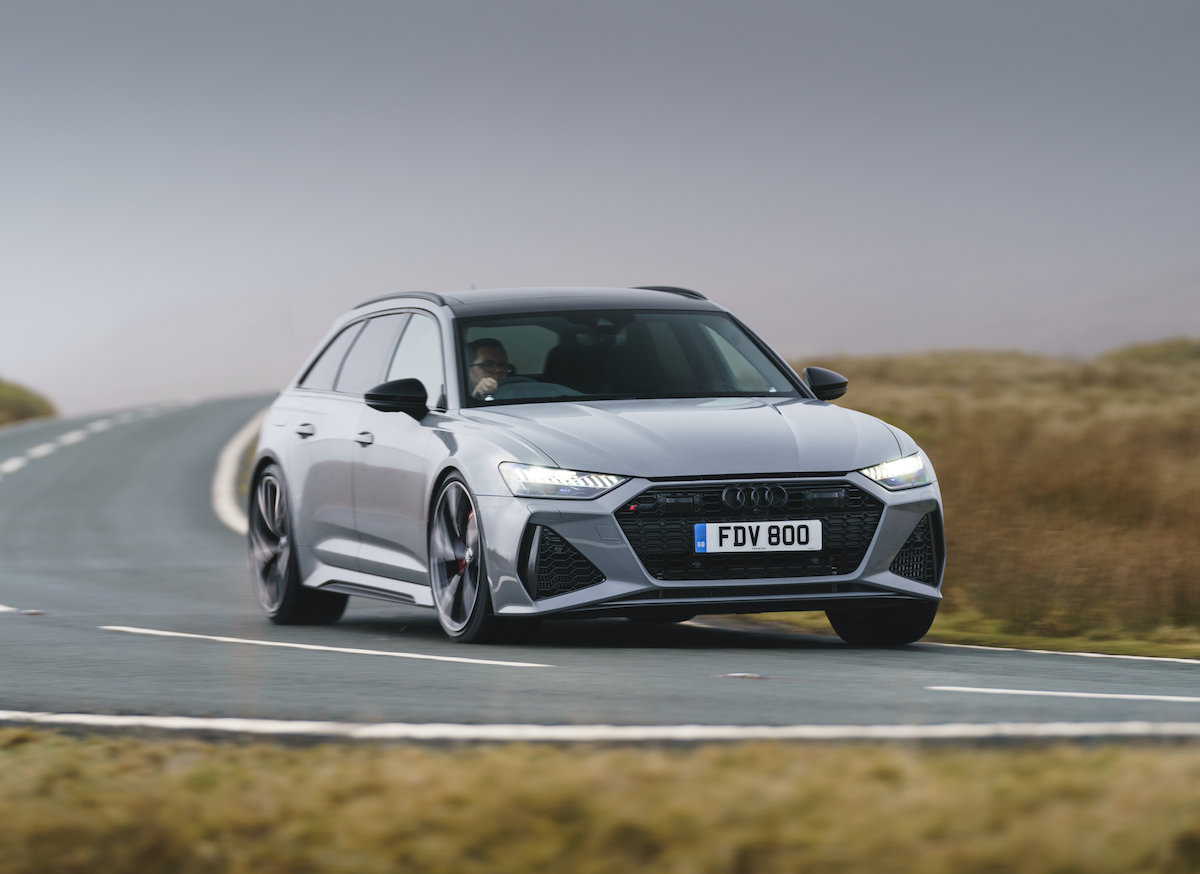
Audi's response to this was 2020's 600bhp Audi RS6 Avant and its 4.0-litre twin-turbo V8, which delivered ballistic performance and prodigious cornering grip. Like their German colleagues down the road at Mercedes, rear-wheel drive was out of the question, so Quattro four-wheel drive and an eight-speed gearbox helped propel this petrol-engine missile to 62mph from a standstill in 3.6 seconds. Top speed was up to 189mph if you paid to have the electronic limiter removed.
If that wasn’t enough, a Performance version was also available that raised power to 621bhp and cut the sprint to 62mph down to 3.4 seconds.

Porsche Taycan Sport Turismo
In 2022 came perhaps the biggest change to the formula of the fast estate – and its instigator was Porsche, whose engineering was so instrumental in the creation of the Audi RS2 right back at the birth of the performance estate genre. This was the arrival of the Porsche Taycan Sport Turismo – the first performance estate that was also an electric car.
Porsche's sleek design wasn't the most spacious in estate terms, but with 750bhp available in the Turbo S model courtesy of powerful twin electric motors, 0-62mph was achievable in less than three seconds for the first time in an estate car. So perhaps rear-seat space, boot space and overall practicality wasn’t really the point of this car.

Honourable Mentions
While this article is largely about fast estates from the upper end of the performance spectrum, we should also spare a thought for the Volvo 850 T5, which – partially off the back of a well-publicised season in the British Touring Car Championship – kicked off a long line of fast Volvo estates. Equipped with a turbocharged inline five-cylinder engine, these were as rapid as they were spacious.
We mustn’t forget, too, the Skoda Octavia vRS, which arrived in 2001, and the Volkswagen Golf R Estate (from 2015 onwards) which both offered a genuine estate car alternative to the hot hatches of the day.
And while BMW gets its due credit here for kick-starting the fast estate genre, it should also perhaps have the last word: enthusiasts had been calling for an estate version of the iconic M3 pretty much since the car’s creation in the 1980s, it wasn’t until 2022 that we actually got a full-on BMW M3 Touring version of the BMW 3 Series. This was the BMW M Division’s 50th birthday present to itself, a searing performance estate with a 503bhp straight-six engine, four-wheel drive and the ability to reach 02mph from rest in just 3.6 seconds. A fitting tribute then to its ancestor the original M5 Touring...