The rise and rise of the Hyundai Motor brand itself can almost be charted through the evolution and success of the Tucson. From humble crossover beginnings to an accomplished premium family SUV showcasing bold styling and cutting-edge tech, the transformation is remarkable. The Tucson is also the marque's biggest-selling model, with over 7 million units shifted, and 1.4 million of those in Europe.
It was hard to spot that trajectory when the original launched back in 2004. Cheap, reliable, safe: yet hardly an inspiring offering in the fast-growing niche of the family SUV. But the second generation, although named ix35 in the UK, represented a massive step forward for the brand. Its combination of high spec, family-friendly practicality, much improved interiors and modern, eye-catching design catapulted the car into contention, especially with the excellent unlimited-mileage five-year warranty that Hyundai offered across the board.
The Tucson name returned for the mk3 in 2015 and its popularity continued to soar. Sharper styling, better quality interiors and family-friendly pricing made it a firm favourite in its class.
The latest iteration, the mk4, is bigger and better than ever. We rate it as a great all-round family SUV. It looks sensational and the interior is now a much more premium affair that is starting to challenge the best of the German marques. It features a broad array of hybrid powertrains and class-leading passive and active safety tech such as Forward Collision Avoidance (FCA).
Every single iteration of the Tucson has a solid reputation for reliability, which makes them all worthy of consideration for the savvy used buyer. And the car's enduring popularity means there are plenty of options out there, whatever your budget.
Hyundai Tucson Models Over the Years and Best Years to Buy
Frequently asked questions
Which Hyundai Tucson years are the best?
The mk4 scores extremely well in reliability surveys, plus you might well also have the benefit of any remainder of the original five-year unlimited-mileage warranty cover (do always check this by contacting a Hyundai dealer). It is also the most premium Tucson to date and features an array of hybrid powertrain options from self-charging hybrid to mild-hybrid to plug-in hybrid (PHEV). If your budget doesn't stretch that far then fear not, the mk3 is a modern, versatile and very capable family car, if not dripping with flair.
Which Hyundai Tucson years are the worst?
The first-generation cars are probably best avoided as they didn't tend to fare as well in tests as contemporary rivals. There were a few potential concerns around the ix35 later in its lifecycle with a couple of recalls to be aware of. Although these models represent a lot of car for the money these days.
Is a used Hyundai Tucson a good buy?
Yes, absolutely. Especially in mk3 or mk4 guise. These cars have an impressive reliability record, and Hyundai's excellent five-year unlimited-mileage warranty ensured that the cars were well maintained for that key period. Although never what you'd call thrilling from the driver's seat, the Tucson has evolved into a really well-rounded, versatile family SUV with superb equipment levels, and represents a savvy new-car buy. A well-cared for used example, meanwhile, should provide excellent value and many years of low-cost ownership.
Hyundai Tucson pros and cons
Pros:
- Superb warranty and strong reliability record
- Very well equipped as standard
- Excellent safety ratings
Cons:
- Not the best car in class to drive
- Pre-mk4 interiors were a bit dull
- Larger alloy wheels can unsettle the ride
Hyundai Tucson Generations
Hyundai Tucson mk4 (2021-2025)
Bodystyle: Five-door SUV
The launch of the latest mk4 Tucson in 2021 saw another significant evolution in design and a big step forward in terms of quality. Now based on a shortened version of the Santa Fe platform, it is a strikingly modern piece of design. The combination of curves and angles teamed to a distinctive 'jewel-like' grille with geometric daytime running lights helps it to stand out from the crowd.
The fixtures and fittings are also a step up in terms of interior quality, to the extent that the new Hyundai Tucson is giving premium contenders such as the BMW X1 and Audi Q3 something to think about, with plenty of leather and silver trim lines that extend out from the centre console to wrap around the front of the cabin.
Interior space is generous for all occupants, front- and rear, while a 620-litre boot is up with the best-in-class. You do lose some boot capacity with the Tucson Hybrid models, but they are still very practical cars.
Twin curved 10.3-inch screens for the infotainment and instrument cluster look striking (these both became 12.3-inch units in the 2024 facelift) and accommodate one of the most intuitive and effective control interfaces on the market. Kit levels are very strong, a signature of the model. Entry-level cars get DAB radio, satnav, cruise control and dual-zone climate control as well as the usual Apple CarPlay/Android Auto connectivity. Tucson Ultimate trim features a panoramic sunroof, Surround View Monitor, wireless charging pad and adaptive cruise control, as well as a premium Krell sound system.
There are no diesel engines in the Tucson range here in the UK any more. The core unit is a 1.6-litre petrol turbo. This comes in a 148bhp base model 1.6 T-GDi (later upped to 158bhp), which is the only model still offering a six-speed manual transmission. There are then a variety of hybrid versions from a mild hybrid to a self-charging hybrid (capable of over 50 mpg) to the most powerful in the range, the plug-in hybrid (PHEV), which can travel for up to 43 miles on electric power alone. Transmissions include a seven-speed dual clutch or the intelligent manual transmission (iMT) that features a fly-by-wire clutch that automatically disengages when you lift off the throttle.
The Tucson mk4 gets a top five-star rating from Euro NCAP thanks to a plethora of cutting-edge safety features. Lane keep assistant, blind spot collision avoidance assist and autonomous braking are relatively commonplace nowadays, but the Tucson also includes Rear Occupant Alert to stop you leaving children in the car, and Safe Exit Warning to check for passing traffic before you open the door to get out.
The latest Tucson comes with a five-year, unlimited-mileage warranty from new, and came third in the large SUV category in What Car?'s 2024 Reliability Survey. Other brands have upped their game in terms of warranty support to compete with Hyundai, but the mk4 Tucson still promises to deliver many years of hassle-free ownership.
Hyundai Tucson mk4 review
Search for a Hyundai Tucson mk4 on CarGurus
Hyundai Tucson mk3 (2015-2020)
Bodystyle: Five-door SUV
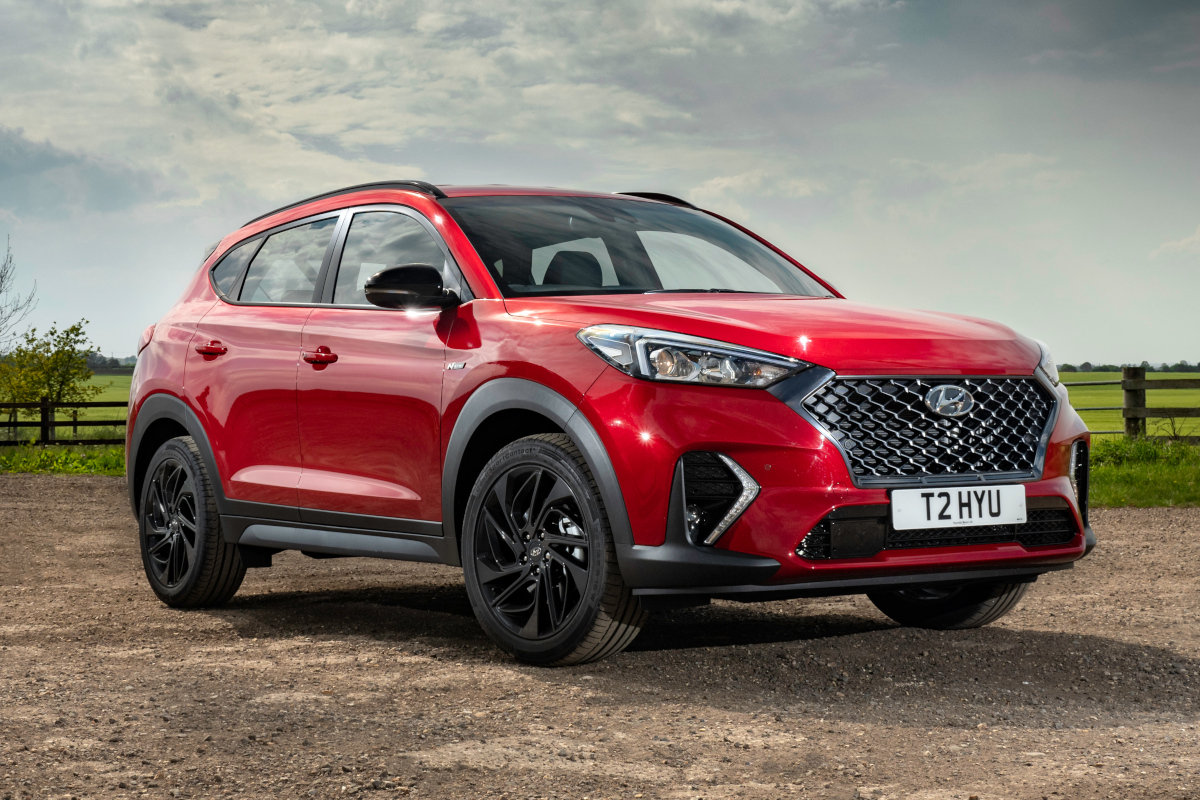
The Tucson mk3 made its debut at the Geneva Motor Show in early 2015 ahead of its launch later that year. This third-generation model was a significant 65mm longer, 30mm wider and rode on a 30mm longer wheelbase than its predecessor, with corresponding improvements in both luggage capacity and occupant space.
A robust but uninspiring interior featured 60/40 split-folding rear seats that could be reclined for comfort or moved upright for additional boot space. A large, easy-to-use touchscreen took centre-stage on the dashboard.
As before, the mk3 Tucson came well-equipped compared to rivals, with even the entry level S Connect trim featuring dual-zone climate control, a quality audio system, automatic headlights, Bluetooth connectivity, a reversing camera and Apple CarPlay and Android Auto. SE Nav models had integrated navigation as the name suggests. Move up through the trim levels to Premium SE and you'll get rain-sensing wipers, premium audio, leather upholstery, heated front seats and adaptive cruise control. The 19-inch alloy wheels were best avoided as they did nothing for ride comfort.
Engine offerings included 1.6-litre turbocharged- and naturally-aspirated petrols, the latter available only with a manual gearbox. Diesels came in 1.7-litre and 2.0-litre options. These could be specified as two- or four-wheel drive, although the top-spec 2.0-litre diesel was four-wheel drive only.
Later diesel models featured mild hybrid tech to help boost economy without adding too much complexity: but if you wanted a full hybrid you'd need to look at rivals like Honda's CR-V or Toyota's RAV4. Transmission options also increased for this generation to offer a seven-speed dual-clutch automatic, as well as six-speed manual and auto options.
Safety continued to be a strong point for the Tucson, and this generation added in more technology to support the model's excellent occupant safety record. This included lane departure warning, blind spot detection and automatic braking for both pedestrians and cars. All in all, this was enough to secure a continued five-star Euro NCAP safety rating despite ever-more-stringent tests.
The Tucson underwent a minor facelift in 2018 with different LED headlight designs, new alloys, a reshaped bonnet and tailgate, and a slightly redesigned dashboard. A sporty N Line trim added a bit of visual flair inside and out.
Reliability remained an important facet of Tucson ownership as well. This generation scored 96.6% in the What Car? Reliability Survey back in 2019 and even several years later it still ranks well in the class. That durability is certainly appealing for buyers in the used market.
Hyundai Tucson mk3 review
Search for a Hyundai Tucson mk3 on CarGurus
Hyundai Tucson mk2 - ix35 (2010-2015)
Bodystyle: Five-door SUV
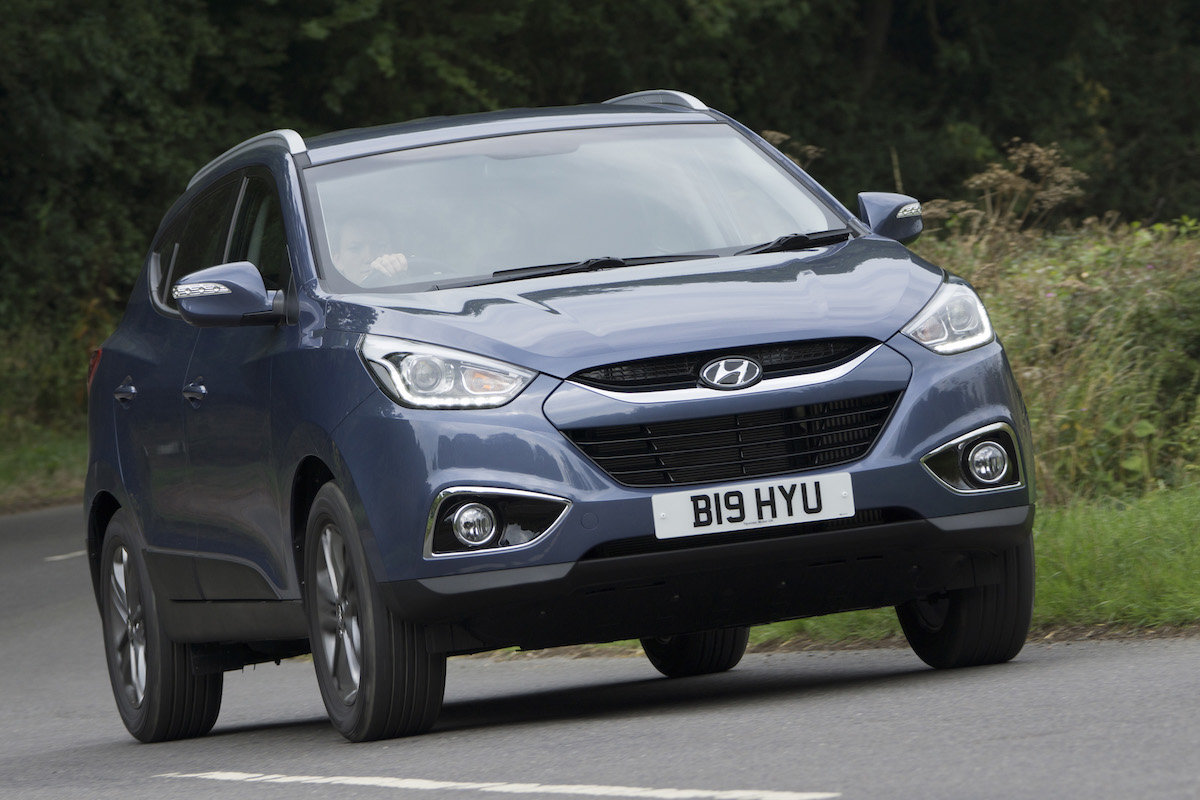
When is a Tucson not a Tucson? When it's an ix35, of course. This generation is an example of Hyundai's short-lived decision to swap model names for a letter/number combo. Although the Tucson name remained in some international markets (such as the US), in the UK, we got the ix35.
The ix35 was something of a game-changer for Hyundai, too. It represented a significant shift upmarket and was suddenly seen as a true competitor to established mainstream rivals. Whereas previously customers might have bought a Tucson because it was low in cost and had a long warranty, they wanted the ix35 because it was a real alternative to the likes of the Ford Kuga, the Skoda Yeti and the Nissan Qashqai.
The line-up in the UK was very simple: you chose from either the Style or the Premium trims, and both came laden with kit. The Style had alloys, air-conditioning, Bluetooth, heated seats, a leather steering wheel, rear parking sensors and MP3 connectivity. The Tucson Premium added a full-length glass sunroof, automatic headlights, cruise control, dual-zone climate control, folding door mirrors, keyless entry, rain-sensing wipers and more.
Practicality was a key attribute for the ix35 and it was lauded for its big boot and versatile interior, although it was still a little cramped for rear-seat passengers compared with some rivals.
Performance and driving verve weren't top of the agenda, however, and that was reflected in the engine line-up. Drivetrain options included a 1.6-litre petrol with 133bhp and a 0-62mph time of 11.1 seconds. Diesels were more popular for UK buyers, though, with the most popular of all being the 1.7-litre CRDi. It was a little slower than the petrol but offered a very respectable fuel economy figure of 53mpg, making it cheaper to run. Top of the pile was a more powerful 2.0-litre diesel, which could just about crack 10 seconds for the benchmark sprint in two-wheel-drive guise. There was also a four-wheel-drive option. Gearbox options consisted of six-speed manual and automatics.
Safety went up another notch in the ix35, with seat-belt pre-tensioners and an extensive suite of airbags. It scored very well for its era in the Euro NCAP ratings, achieving 90% adult occupant and 88% child occupant scores: enough for a maximum five-star rating.
The 2013 facelift saw very minor design tweaks in Europe, with new headlights and tail lights, and a refreshed trim lineup.
The ix35 is also notable because it was available with hydrogen fuel-cell technology. Called the FCV, this very clever Hyundai SUV offered a 350-mile range and emitted only water. But with a £50,000 price tag and limited fuelling infrastructure, it never caught on. These days, ix35 FCVs are rarer than unicorn horns.
Hyundai ix35 review
Search for a Hyundai ix35 on CarGurus
Hyundai Tucson mk1 (2004-2009)
Bodystyle: Five-door SUV
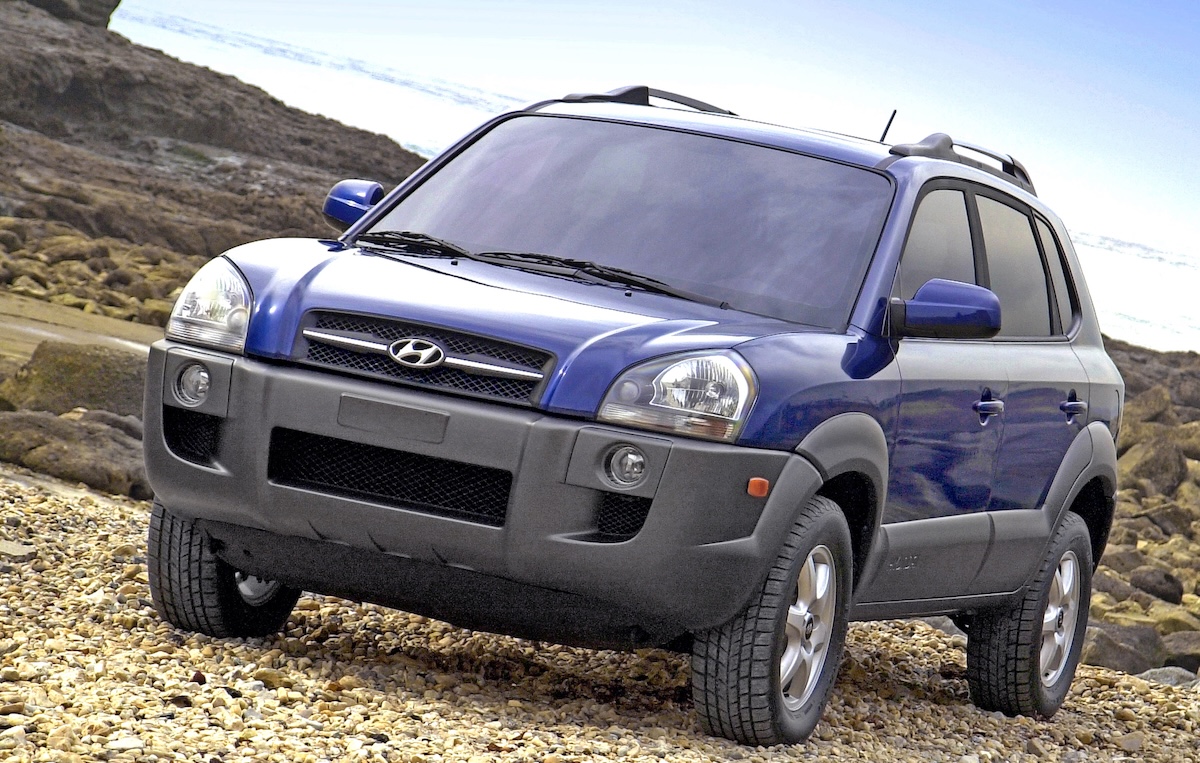
Initially launched in 2004 as a smaller, cheaper alternative to its Santa Fe sibling, the Tucson compact SUV was based on the Elantra saloon platform, which it also shared with the second-generation Kia Sportage. Construction was of monocoque design, like rivals such as the Honda CR-V and the Land Rover Freelander.
The Tucson featured relatively modest external dimensions but versatile folding seats, chunky styling and a selection of three petrol and diesel engines in the UK. It was available with either front-wheel drive (FWD) or all-wheel drive (AWD), the latter using a torque-on-demand system to shuffle power between axles (it could also be locked into a full-time four-wheel-drive mode at lower speeds).
Prices started from under £15,000 for the entry level 2.0-litre petrol. In the middle of the range was a 2.0-litre diesel that could manage almost 40mpg with its five-speed manual gearbox, while a 2.7-litre V6 petrol topped the range. A four-speed automatic gearbox was also available, and late in the lifecycle, a six-speed manual was offered for the top-spec diesel. Optional equipment included satellite navigation, leather upholstery and privacy glass.
The Limited trim launched in 2006 and was based on the CRTD CDX. It included climate control, a CD player, body coloured mouldings and other extras.
Late-model revisions included body-coloured bumpers. Two-wheel-drive versions with efficient petrol engines were also introduced to do battle with the hugely popular Nissan Qashqai crossover. Like the Kia Sportage, the Hyundai Tucson was decent to drive for its class, especially in diesel guise.
Strong occupant safety has always been a feature of the Tucson, and the mk1 featured no fewer than six airbags, offering front-, side- and curtain protection. It also had ABS brakes as standard across the range.
One quirky offering was the FCEV concept car designed to test Hyundai's second-generation hydrogen fuel cell technology. It had a range of 300km (186 miles) and a top speed of around 90mph. It completed a 4,300-mile journey as part of a publicity campaign in 2008.
Related Topics:


