Audi Q7 (2015-2025) review | Perhaps the perfect used family car
Audi Q7 cars for sale
5.0
Expert review
Pros
Serene ride on air suspension
Beautifully made and practical interior
SQ7 is very fast indeed
Cons
Strong resale values make used examples expensive
Third row not as roomy as a Land Rover Discovery's
Styling looks a bit awkward
The CarGurus verdict
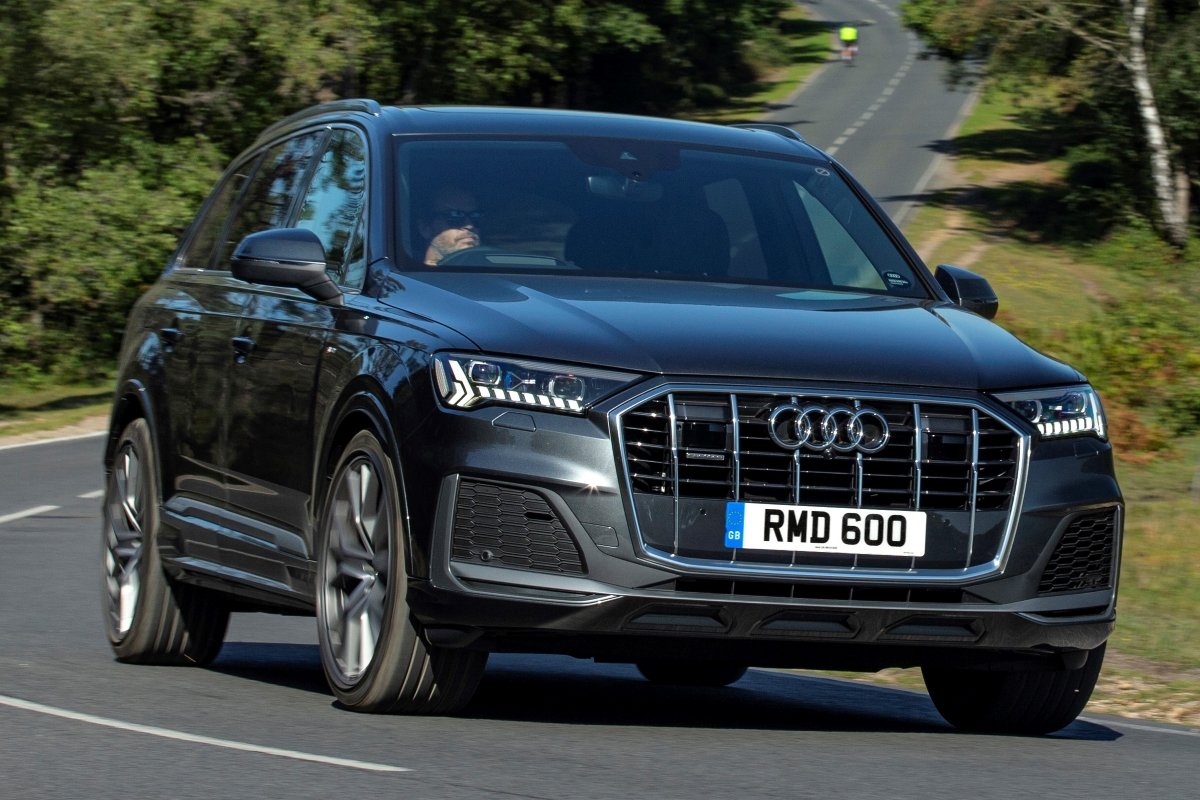
The mk2 Audi Q7 was for many years a class-leader when it was new, and even though it has now been replaced by a new mk3 model, the mk2 remains a very desirable and talented used car. It has a desirable image, its seven-seater cabin is roomy enough and versatile enough for most large families, it's beautifully made from lustrous materials, it's brimming with luxury kit, and it's a wonderfully comfortable and relaxing car to drive, especially if you hunt down an example with air suspension fitted. For us, used family cars don't get much better.
Yes, it's not perfect. Its reliability record leaves a bit to be desired, the petrol versions are pricey to run (seriously, stick with diesel), and even as a used car, prices are comparatively high (although you'll pay a lot less than you will for a new Q7). Even so, the most sensible versions still represent solid value given the broad set of abilities you're getting.

What is the Audi Q7?
The second-generation version of Audi’s big, seven-seat SUV, the Q7, arrived in 2015 and remained on sale as a new car all the way up until 2025. That's some innings. It improved upon the first car to wear the Q7 badge in just about every way, with the arguable exception of the its slightly awkward styling.
The cabin was roomier, plusher and more modern, making it an even better and more desirable family car. It also packed in more up-to-date tech and luxury gadgets, which hiked its desirability even further. The fact that it was also fabulous to drive, especially when fitted with air suspension, was another massive bonus.
One of the key areas Audi worked on with the second Q7 was saving weight, lopping around 240kg from the car. That's the equivalent of taking out three burly adult passengers. This not only helped Audi to improve the car's ride and handling, but also to coax surprisingly good fuel economy from this big 4x4.
It's now been replaced by the mk3 Audi Q7, so it's only available as a used car these days. However, we can't think of many more appealing used family cars than one of these.

How practical is it?
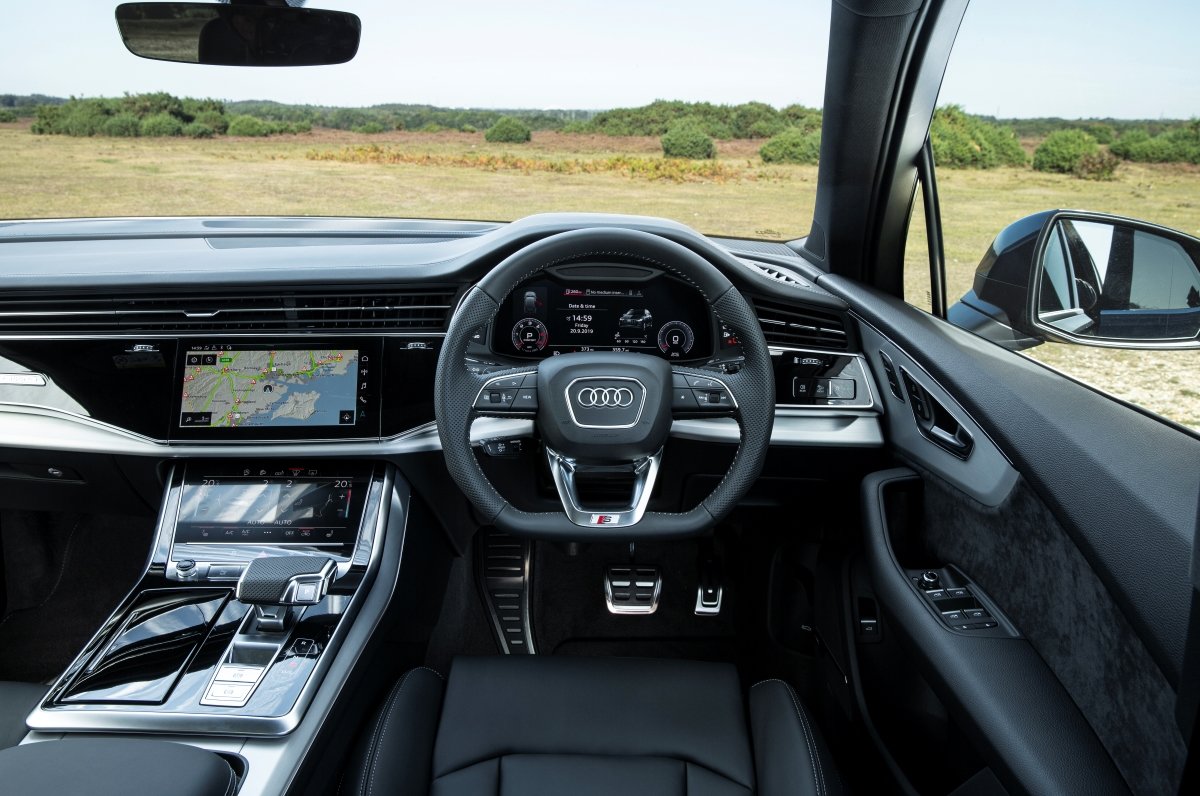
Inside, the Q7 is superbly made. It feels really luxurious, with a standard of finish that properly embarrassed the contemporary Land Rover Discovery 4, and could easily stand comparison with the Volvo XC90. The materials are plush and the assembly is flawless.
There's lots of space in the first two rows of seats, so even tall adults can stretch out. The middle-row seats can also slide backwards and forwards individually, and their back rests can be reclined for comfort.
Seats six and seven don't offer quite as much headroom and legroom as those in a Land Rover Discovery, but there's still a good amount, and even grown-ups will be happy enough on short trips.
When the rearmost seats are up, your boot space stands at 295 litres. That's a little bit more than you get in a Toyota Yaris supermini, and there's no load lip to negotiate when loading items, either, while the huge opening makes things even easier.
Drop those third-row seats into the floor, and you get a large 780-litre boot, which is a larger loadspace than most rivals when used in five-seat mode. That extends to more than 1,900 litres when you fold all the rear seats down, and they all lie flush, giving you a flat and level load area with no steps or slopes.

What's it like to drive?
From launch, the mainstay of the engine line-up was a 3.0-litre six-cylinder diesel. Initially this engine produced 268bhp, and it was joined by a 215bhp version soon after. Over time, these outputs crept up to 282bhp and 228bhp, respectively.
Either way, even the lower-powered version feels swift, but the beefier diesel is noticeably punchier. It accelerates with the vigour of a hot hatch, despite the car weighing in at over two tonnes. Both diesels, like all Audi Q7 models, come with quattro four-wheel drive, and both have plenty of pulling power for towing a caravan or trailer.
There was also a 335bhp 3.0-litre TFSI petrol engine that dropped the 0-62mph to less than six seconds for genuinely searing pace, but that version is rare on the used market because it cost so much to run. The same applies also to the SQ7, which initially had a 4.0-litre V8 diesel engine producing 429bhp, but this was later swapped for a 4.0-litre petrol with 500bhp. Either way, it was even more searing, but even more thirsty, and the original purchase price was pretty bonkers to boot.
A plug-in hybrid version - originally named e-tron, but later renamed as the TFSIe - was also offered. The electric-only range of this version increased over time, and was up to around 50 miles by the time the car went off sale, but it was only ever a niche choice as the packaging of the batteries meant it could only be had with five seats.
Buyers had the choice of steel springs or adaptive air suspension. It was a pricey option, but air-suspended cars have a much more serene low-speed ride than cars with the standard set-up, which had a tendency to feel a bit knobbly on broken-up urban surfaces. The ride in the air-sprung cars, meanwhile, is wonderfully plush and serene at all speeds, so it's definitely worth seeking out a car with it fitted.
Either way, the Q7 has the Audi Drive Select system. This allows drivers to choose between 'efficiency', 'dynamic', 'comfort' and 'individual' modes. These alter the steering weight, throttle response and gearbox settings. In air sprung cars, Drive Select also changes the suspension to make the car more supple over bumps or more taut and responsive. In 'dynamic' mode the Q7 has excellent body control, although it doesn't match a Porsche Cayenne and Range Rover Sport for driver appeal.
Technology, equipment & infotainment
The Q7's performance in this area depends on the age of the car you buy. Early examples of the mk2 had a brilliant system, that was controlled by buttons and a rotary dial, which you used to navigate through menus on an 8.3-inch screen that rose electrically out of the top of the dashboard. There were also physical switches and knobs for operating the air-conditioning system. It all worked exceptionally well and was a doddle to find your way around.
However, that changed during the facelift in late 2019, which saw this system replaced by a pair of touchscreens plonked on top of one other on the centre console, the upper one taking care of the infotainment features, and the lower one handling the air-con and a few other bits and pieces. These gave the cabin a more high-tech feel, but in practice, the new system was a lot more fiddly and confusing to use than the one it replaced. In fairness, though, it's still more user-friendly than many of the wildly overcomplicated touchscreen systems you see in many brand new cars these days.
Over its vast amount of time on sale, the Q7 has been offered in a wide variety of different trim levels, with the trim structure changing on a few occasions. What's more, the precise amount of kit that came with each trim level changed on a fairly regular basis, too. It's fair to say, however, that whichever version of the Q7 you pick, it'll have all the luxury trappings you'd expect of a prestige SUV of the time.

Audi Q7 running costs
For such a big, heavy and luxurious car, the Audi Q7 has relatively affordable running costs.
So long as you avoid the high-performance SQ7, the big Audi is quite fuel efficient. With early Q7s, the 215bhp version of the Audi Q7 3.0 TDI achieves 52.3mpg on the combined cycle, while the 268bhp 3.0 TDI returns 47.9mpg. Mid 30s mpg is a more realistic expectation, possibly less if you use all the available performance.
The later mild hybrid diesels, introduced as part of the facelift in 2019, deliver even better economy on paper, and should in the real world, too. It's not a night-and day-difference, but it's one worth having.
The plug-in hybrid's real-world fuel economy is harder to estimate, as it will depend so much on how often it is recharged. Owners with a short commute and a home charger could conceivably go weeks without using any fuel, but on a long journey expect economy to fall short of the numbers returned by the conventional diesels.
It's no surprise that the SQ7 is a lot more expensive to run than the rest of the range. We reckon you'll be looking at around high-twenties with the earlier diesel version, while if you go the the later petrol version, you'll be doing well to get above the high-teens. And as soon as you give in to the temptation of all that potential performance underneath your right foot, you'll feel it financially.
Insurance premiums will reflect the big Audi's value and performance. Group 35 out of 50 is the lowest offered by the Q7 range, although the vast majority of versions sit between groups 45 and 50, the latter being the most expensive group there is.
Resale values are strong. That means a used Audi Q7 is expensive to buy, but should continue to hold its value well for years to come.

Audi Q7 reliability
Like all Audis, the mk2 Q7 came with a three-year, 60,000-mile warranty from new. Whether your used example has any left will depend on whether it continues to fall within those parameters. Audi's rather disappointing cover compares with three years' cover and unlimited mileage for a BMW X5, an arrangement that also applies to the Mercedes GLE.
Audi Q7 buyers can upgrade to four- or five- years of cover at extra cost, though.
It's fair to say the mk2 Audi Q7 doesn't perform awfully well in the What Car? Reliability Survey. For example, it the Seven-seater category of the 2026 instalment, which featured 14 model, the mk2 Q7 finished-stone-dead last. Electrical gremlins accounted for the majority of problems, but engines, exhausts and infotainments systems experience their fair share of issues, too. Not only that, but owner reported that repair costs were uncommonly high, too.
As a manufacturer, Audi placed a fairly underwhelming joint-22nd (tied with arch-rival Mercedes, with both being way behind BMW in 6th) out of 30 carmakers considered. And the Q7 was a big part of why that performance wasn't better.
The Q7 has been subject to a handful of recalls during its life. Once you have the registration number of any Q7 you are thinking of buying, it's a quick and easy job to look up the car on the recall checker section of the gov.uk website. That way you'll know if any recall work is outstanding.
- Since the 2019 facelift, mild hybrid technology is used to make all Audi Q7s more efficient. The Q7 uses a 48-volt electrical system, a lithium-ion battery, and a belt alternator starter (BAS). While braking, the BAS can recover up to 8kW of power and return it to the battery. If the driver eases off the accelerator at speeds of between 34mph and 99mph, the BAS reclaims energy. The system also allows the car to coast for up to 40 seconds with the engine switched off, and restarts the engine the next time the driver presses the accelerator.
- Part-way through the Q7's long life, Audi started to use numbers to signify the different engine variants. The 45 TDI was the entry-level diesel, which delivered 228bhp. Bigger numbers meant greater brawn, so the 55 TDI was the 282bhp version of the 3.0-litre diesel. The 55 TFSI, meanwhile, was the petrol model powered by the 335bhp 3.0-litre V6. There was also the 55 TFSIe, the 'e' on the end of the model name signifying that this was a plug-in hybrid.
- The mk2 Audi Q7 we're talking about here was replaced by a new version of the Q7 in 2026, and we'd urge you to read our full review of that car here. If you do, you'll notice that it has a four-star rating, while this mk2 version has five stars. So is the mk2 really a better car? Well, the mk3 is obviously more advanced, and it's also roomier and slightly better to drive, but in some ways, yes, the mk2 is better. Its infotainment is easier to use - especially if you go for a car from before 2019 - and a used mk2 will also be a sight cheaper to buy.
- If you want an SUV that thinks its a sports car: Choose the SQ7, becuase the most powerful version of the Q7 is a hoot to drive. It's been offered with both diesel power and petrol power in the past, but either way, it monumentally rapid in a straight line. Well judged suspension copes well with the SQ7's epic performance, and this model is just as practical as any other in the range.
- If you want a car that can run on electricity: pick the plug-in hybrid. The Q7 e-tron was introduced in 2017, and had an official combined figure of 156.9mpg and an electric range of up to 34 miles. It was later renamed as the TSFIe, and technical tweaks saw the electric-only range creep up to around 50 miles.
- If you want a Q7 but you are on a tight budget: go for an early 215bhp 3.0 TDI. More buyers choose the 268bhp version, but the least powerful diesel is still strong enough for respectable performance. As a used buy it will cost less than the more powerful diesel, but you still enjoy the Q7's excellent cabin and poised ride and handling.
- If you want the best all-rounder: choose the 268bhp 3.0 TDI Quattro, or the 55 TDI Quattro if you are shopping for a younger example. These diesels are the pick of the range for most buyers, combining excellent performance and economy. The Q7 isn't a cheap car, but these models represent solid value compared with the big Audi's rivals.


