Citroen e-C3 Review 2025 | Affordable small car from France
Citroen e-C3 cars for sale
4.0
Expert review
Pros
Cool styling inside and out
Comfy ride
Relatively affordable
Cons
Entry-level engine not great on pace or refinement
Some ergonomic frustrations
Bare-minimum warranty arrangement
The CarGurus verdict
The Citroen e-C3 is a charming, cute and comfortable little electric car that’s also one of the best-value EVs on the market. It’s really pleasant to drive and sit in, has decent equipment levels and a useful range.
Our only concern is that we haven’t seen Euro NCAP crash ratings for any cars based on this platform yet, so we’ll have to wait and see how the C3 fares in those critical safety tests. Assuming it does OK, though, we reckon that the Citroen e-C3 is one of the most likeable and capable budget EVs you can buy.

What is the Citroen e-C3?
The Citroen e-C3 is one of the most affordable electric cars on sale, with prices starting from a little over £20,000 for the e-C3 Plus model. It sits on the Smart Car platform, which is a global, value-based platform that also underpins the Vauxhall Frontera and Citroen C3 Aircross.
The Citroen C3 is also available with 1.0-litre petrol and 1.2 mild hybrid petrol powertrains, which are even cheaper, but we’re focussing purely on the electric version in this review.
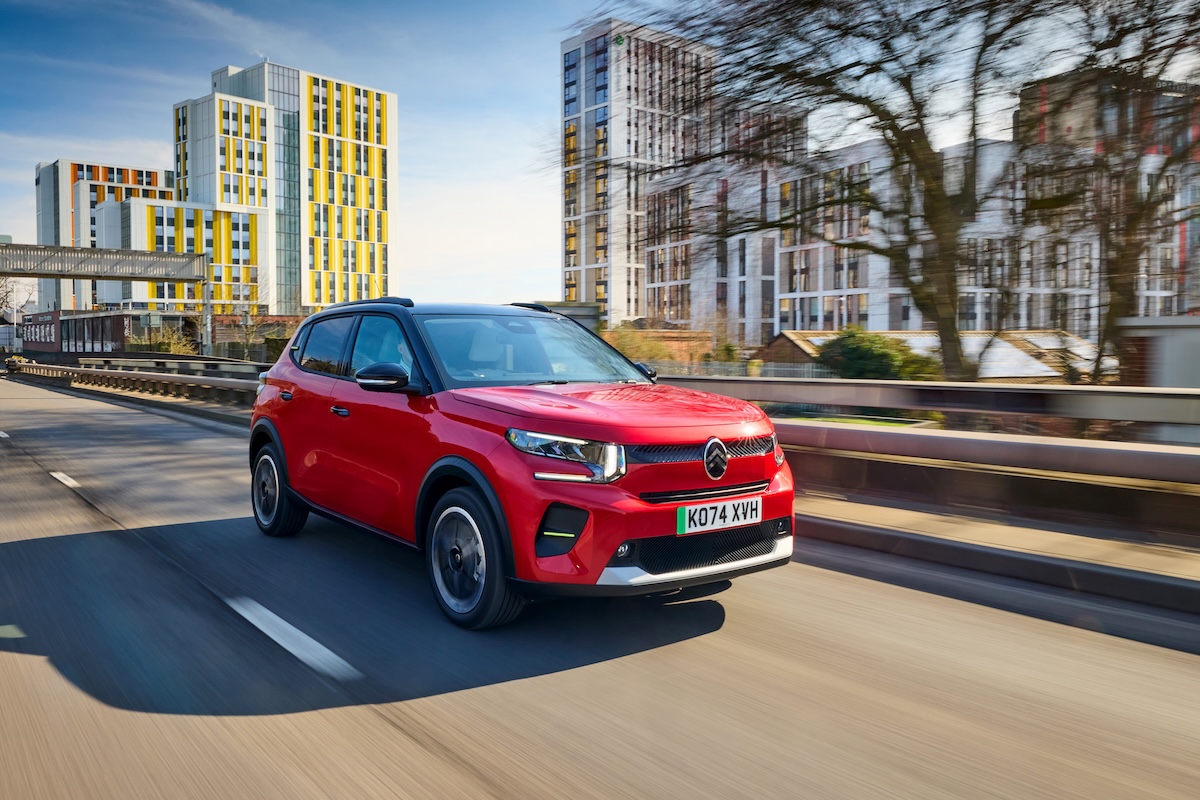
Citroen’s small e-C3 electric crossover looks neat, with chunky SUV-esque styling, and some neat touches such as colourful inserts in the rear window pillars and front grille that can be switched out and personalised. You can even choose inserts in the colours of the French flag, if you wish. Despite its low price, the e-C3 certainly doesn’t scream ‘cheap car’.
Underneath is a lithium-iron phosphate (LFP) battery that powers a 111bhp electric motor to drive the front wheels for a rather sedate 0-62mph time of less than 11 seconds. There are two battery options, a smaller 30kWh one with an official WLTP range from a full charge of 130 miles, and a 44kWh with a range of around 200 miles.

How practical is it?
The e-C3 gets a 310-litre boot, which is very similar in size to the Peugeot e-208 and Dacia Spring, and will be good enough for a lightweight buggy or medium-sized dog. Mind you, the aperture is fairly small and has a high load lip that drops down to a recessed boot floor, so it’s not ideal if you do have bulky items or less-agile hounds to contend with. There’s also no underfloor storage (nor any ‘frunk’ storage under the bonnet) for your charging cables, so if you want to take those with you, they’ll be rattling around in the boot. As one last moan, the 60/40 split rear seats also leave a step up from the boot floor when you fold them down. That’s plenty of niggles, then, but we’d point out that the C3’s boot will still be just fine for the average small family.
Not only that, but the e-C3 has more rear leg- and headroom than most of its rivals, so you’ll get a couple of adults in the back seats with no problem at all, even if they’re sat behind a taller driver. Their knees might touch the seats in front, but they won't be pressing into them uncomfortably. You get charging ports and pockets for smart phones, plus two pairs of Isofix fittings back there, too. There’s no centre rear armrest, though, and getting in and out of the rear seats is made tricky by narrow door openings, made even narrower by a protruding piece of bodywork in the door frame next to the rear-seat backrest. Squeezing past it and through the door opening is a real chore, even for more dextrous passengers, and those with limited mobility - such as the elderly - might struggle to get in at all.
Up front, the Citroen e-C3 has a remarkably smart-looking dashboard, with nice textile finishes, and even stitched leatherette on the doors, complete with slightly gimmicky labels reading ‘Be Happy’ or ‘Have Fun’. While that kind of forced motivational messaging may elicit eye-rolling from the cynics among us, this remains a neat interior that doesn’t feel cheap despite the car’s budget placement.
It's also easy to use, with ‘proper’ physical air-con buttons, and even a physical button to turn the lane-keep assist off or on. The driving position is comfortable, with good visibility, a refreshingly straightforward layout, and an interesting, modern-looking design.

What’s it like to drive?
The e-C3 is comfy, quiet and wieldy to drive. It’s very fit for purpose, basically, and even rather fun if you like a car that’s softly sprung and grippy. Citroen has included its ‘Advanced Comfort’ suspension on the e-C3, which is boardroom lingo for hydraulic bump stops that cushion the suspension travel when it’s at its extremes, meaning that you get a nice, soft, pillowy ride comfort. There is a bit of reverberation and noise from the rear axle, which can be quite noticeable over the patchwork surfaces around the UK's towns, but generally the e-C3 is lovely and comfortable. We don’t even mind the noticeable body lean, as the pillowy ride comfort is more than justification.
The steering has a good bite to it, and although the steering wheel is unusually small, this actually makes the car feel darty without being nervous.
While not a quick car, the e-C3 does feel punchy enough up to about 50mph. Basically, the performance on offer feels perfectly well suited to a small, urban-focussed car like the e-C3, even though it’s also more than stable and refined enough to make light work of the odd motorway journey. Overall, it’s really quite a pleasant car to drive and spend time in.

Technology, equipment & infotainment
The Citroen e-C3 is available in two trims: Plus or Max. The cheaper e-C3 Plus still gets a 10.25-inch colour touchscreen infotainment with wireless Apple CarPlay and Android Auto, Bluetooth and digital radio, USB-C charging ports in the front and rear seats, air-con, 17-inch alloy wheels, two-tone roof, automatic wipers, LED headlights, heated electric mirrors and a six-speaker sound system.
Stepping up to the Citroen e-C3 Max adds satnav with charger search function, wireless phone charging, climate control and partial leatherette upholstery.
Every C3 gets what Citroen (rather confusingly) calls a Head Up Display, or HUD. This isn’t what you’d traditionally know as an HUD, where the speedo is beamed onto the windscreen. Rather, it looks like a normal screen that’s recessed into a cubby of the dash, just above the small, slightly squared-off steering wheel. Actually, it’s just a mirror in that dashboard recess and the speedo and other info – including regenerative braking gauge and the usual warning lights – are projected onto it. It’s cheaper than a traditional digital screen readout, saving Citroen money, yet giving the driver a very effective, simple, easy-to-read speedo. Clever stuff.
Lane-keep assist and autonomous emergency braking are standard on every e-C3.

Citroen C3 running costs
The Citroen e-C3 is brilliantly priced, starting at around £20,000 for the 'urban range' car with the 30kWh battery with a 130-mile range, and around £22,000 for a car equipped with the larger 44kWh battery for a 200-mile range.
Charge your car at home on a 7kW wallbox charger, and a full charge of the smaller battery will cost around £8, and take around three hours. With the larger battery, you're looking at more like £12 and a little over four hours. That's assuming that your domestic electricity is billed at the UK's national average rate. Do the smart thing and get yourself onto a domestic power tariff that allows you to charge your car overnight on heavily discounted off-peak power, and you'll likely pay a third of the quoted costs, making your motoring even cheaper.
Avoid using public DC rapid charging stations unless it's an emergency, because the power that comes out of these is extremely expensive. Think three times the costs already quoted, and you'll be about right.
EVs are no longer exempt from paying VED road tax, so you'll pay the same annual flat rate of £195 as petrol and diesel cars at this price point. At least the e-C3's affordability means you won't be clouted by the expensive luxury car supplement.
The e-C3 falls into group 24 for insurance, which makes it one of the cheaper electric cars to insure.

Citroen C3 reliability
Citroen used to provide the same bog-standard three-year, 60,000-mile warranty as numerous other manufacturers, but in recent times, the firm has followed the precedent set by the likes of Toyota and Suzuki, and introduced a service-activated scheme. Basically, your cover is automatically extended by a year when you have your car serviced within the Citroen dealer network, up to a maximum of eight years or 100,000 miles. That's not as good as Toyota's ten years, but it's much better than before.
The high voltage LFP battery is also covered for eight years or 100,000 miles, regardless of where you get your car serviced. This guarantee means that Citroen will refurbish or replace the battery if it drops below 70% performance in that period.
The e-C3 is still too new to have been involved in any of our normal go-to reliability surveys, so cast-iron reliability data for this particular model is still rather sparse. However, Citroen placed a creditable 10th out of 30 carmakers considered in the latest What Car? Reliability Survey, putting it ahead of Skoda, Ford, Volkswagen, Peugeot and Renault.
- Charging speeds are up to 100kW, which is pretty good for an affordable, small EV like this. However, Citroen’s stated charging time of 26 minutes for a 20-80% charge of this relatively small battery suggests that average charging speeds will be a fairly modest 50kW at best, so don’t expect it to stay up near 100kW charging speeds for long, no matter how powerful the rapid charger may be. This 100kW charging is standard with the larger battery but is an optional extra with the smaller battery, and expect to get a maximum of 30kW (which is rubbish) if you don't spend the extra. The CCS and Type 2 sockets are compatible with almost all public chargers, and are located on the car’s rear wing, where you’d expect to find a fuel-filler cap on a petrol car.
- We’ve only driven the e-C3 in warm weather, and with the larger battery, where we saw over 4.0 miles/kWh, which is good for a very decent real-world range of 174 miles from the usable battery capacity of 43.7kWh. However, these were fairly ideal conditions for electric car efficiency, and the e-C3 doesn’t get a heat pump, so we’d make a rough estimate that cold weather real-world range will be more like 130-150 miles, especially if you’re on the motorway (sustained high speed journeys will always see the range in an electric car drop more quickly).
- The Citroen e-C3 is built on the same Smart Car platform that underpins a variety of Stellantis-built models such as the Fiat Grande Panda, Vauxhall Frontera, Citroen C3 Aircross and more. No car on this platform has yet been subjected to Euro NCAP crash testing, so there's a slight unknown on that score, but out fingers are well and truly crossed for a good result, and we'll update this review as soon as one becomes available.
- If you want the best value: Stick with the e-C3 Plus, as it’s brilliant value and has all the equipment you probably need. Or, if you don’t need the range of the 44kWh e-C3, go for the 33kWh Citroen e-C3, which costs even less.
- If you want the best company car: Electric vehicles remain comically cheap as company cars and, even though Benefit-in-Kind (BIK) is gradually starting to creep up, the e-C3 Max will still cost under tens of per month in company car tax, rather than hundreds. So you might as well go for the higher spec one, really, as you’re saving a negligible few pennies by going for the lower-spec Plus.
- If you want the best family car: Either of the e-C3 models should work well, or you could go for the slightly bigger and more spacious e-C3 Aircross, which is even available as a seven-seater.


