Dacia Jogger 2026 review | A bargain seven-seat family car
Dacia Jogger cars for sale
3.0
Expert review
Pros
Outstanding value
Willing engine
Seven seats as standard
Cons
Seats lack support
Lots of engine and tyre noise
Poor safety rating

The CarGurus verdict
Given its low price, the Dacia Jogger would find an audience even if it wasn’t very good. The fact it actually performs well in terms of practicality, engine performance, equipment and running costs could make it a hit with families who had previously thought a used seven-seater was the only option. There's also a hybrid model for those who want the lowest possible running costs.
The Jogger is far from perfect, but even bearing in mind its flaws (primarily that it’s noisy, there are some rough edges inside, and the outer rear seats are fairly narrow) its value for money is still very impressive. Keep in mind, however, that this is not the safest seven-seat car on the market. And if family safety is a priority, you really do need to weigh that up against the appealingly low price.
What is the Dacia Jogger?
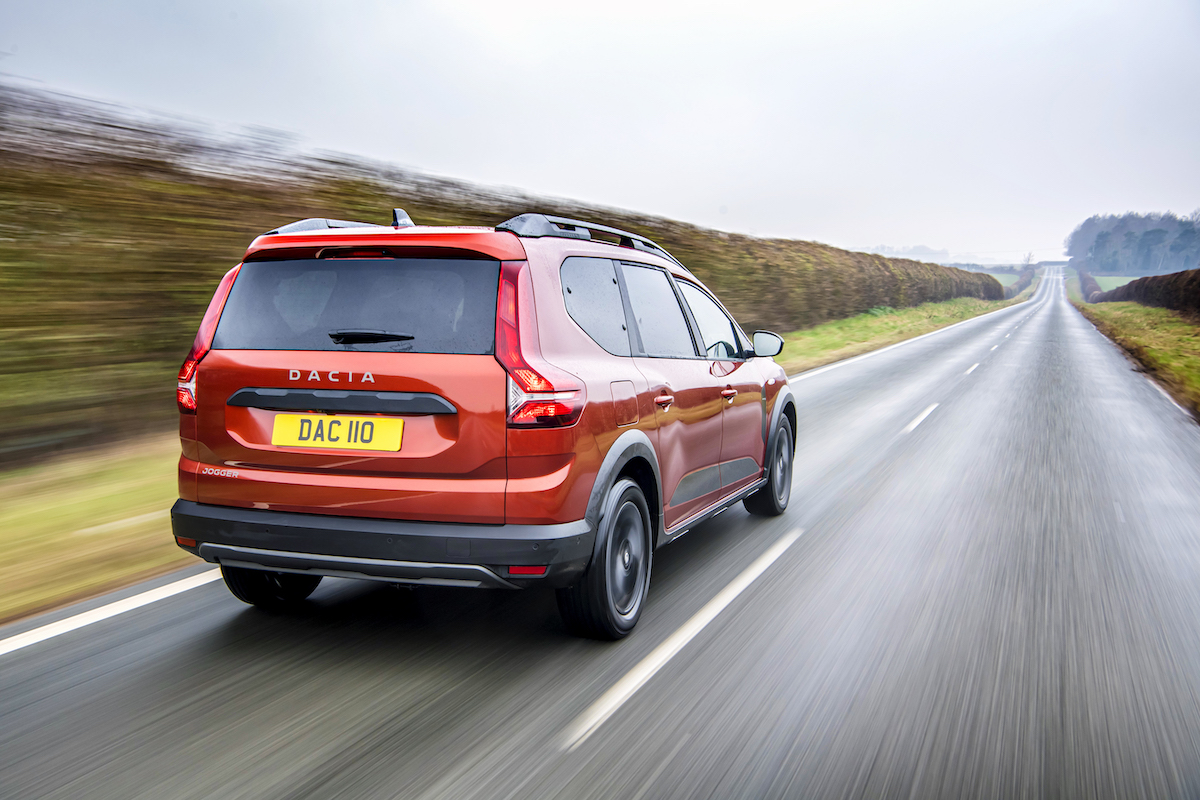
The Jogger is the most practical vehicle from what is already a very practical brand: the Romanian-born and Renault-owned Dacia. It is based on the same platform as the Renault Clio and Dacia Sandero superminis, but with a stretched wheelbase, additional ground clearance and a longer body that allows it to pull off a dash of SUV style – and accommodate seven people. In fact, from the front bumper up to the windscreen pillars it’s essentially a Dacia Sandero, but then the roof line kicks upwards by 4cm and the wheelbase is extended, creating the interior space to make it a Jogger.
The Jogger has two unique selling points. The first is that for a seven-seater its external dimensions are relatively compact, particularly in terms of width. This helps to make it easy to drive. The second is its price tag. Dacia is known for offering cars (including the Sandero and Duster) that provide excellent value for money, and the Jogger is no different.
The range starts from £18,995 at the time of writing, and even a top-spec model comes in at less than £25,000. Sure, that’s a lot more than the £6,000 a base Dacia Sandero cost around 15 years ago, but it’s still very reasonable given what is on offer – and relative to the prices of rivals. Pay on finance and Dacia will potentially charge you less than £300 per month, with a similar amount required as a deposit. Thus, the Jogger is a seven-seater for supermini money.

How practical is it?
When it comes to the practicality and versatility, the Jogger is neither as good as the best MPVs, nor as bad as you might expect given its low price.
All models come with seven seats as standard. With all those seats in place, boot capacity measures just 212 litres. That’s a little less than you’d get in a city car, but it will hold a few shopping bags or a couple of kids’ scooters. To extend the boot space, you can fold the two rearmost seats. Unlike in the best MPVs, these do not drop flat into the floor, but instead the backrests fold onto the base and then the whole seat topples forwards. The levers to operate the seats are basic but functional. At this point, the Jogger’s boot space rivals that of a typical estate car, with 699 litres of storage. To extend it further, you can undo four more clips and remove the two rearmost seats entirely, blessing you with 820 litres of space. At only 10kg each, the seats are surprisingly wieldy, but don’t forget you will need somewhere to store them.
For even larger loads, the second-row seats fold in a 60:40 split and then – as with the third row – their bases topple forwards. The result is not far off becoming a small van, with a whopping 2,085 litres of cargo capacity.
To complement this storage space, there are big bins on all four doors and a large glovebox, plus a few cupholders scattered around the car (including for the rearmost two seats). There are three trim levels offered: Essential, Expression and Extreme. With the latter two, you get a driver’s armrest with a built-in cubby.
Moving on to passenger space, the Jogger’s third row of seats are both easy to access (you simply topple the second row forwards) and surprisingly roomy. Wide seat bases, excellent headroom and decent legroom mean kids or adults can travel in the third row without feeling short-changed. Little wonder thousands of Dacia Joggers all over Europe are being used as taxis. There are no Isofix child seat attachment points in seats six or seven, but you do get access to a 12V power outlet and the option of clicking open the rearmost windows.
In the second row, the outer two seats do feature Isofix. However, they are also unusually narrow, so if your child seat is one where you have to click in the car’s seatbelt, you might struggle. The upside is that the middle seat is surprisingly wide, so sitting three older kids (once out of car seats) or adults across the back is very possible – helped by an almost flat floor and plenty of space for feet beneath the front seats. The second-row seats do not slide on runners or have adjustable backrests, but there is lots of headroom and legroom. The trays on the back of the front seats on mid- and high-spec cars look neat, although there’s barely enough room to fold them out. The Jogger is more EasyJet than Virgin Atlantic in this regard.
In the front, there’s a generous amount of room so that even tall adults will feel comfortable, along with lots of useful in-car storage, as detailed previously.
A host of accessories are available to Jogger buyers, too. From side steps and style packs, to pet protection, boot mats, cool packs, bike racks and awnings. There’s even a 12V-powered Handpresso in-car espresso machine. Sadly it isn’t a true espresso maker, as it uses a pod system and can only produce two bar of pressure (coffee nerds will know you need nine bar for true espresso), but it’s a fun idea. If you can’t get hold of a kettle and an Aeropress, might we point you towards the Outin Nano or the amusingly named Bripe, both of which allow you to brew your own ground coffee.
What's it like to drive?
The steering wheel in the Jogger adjusts for reach and height, as does the driver’s seat. Combined with excellent all-round visibility and light controls, it makes the Jogger an easy car to get used to driving.
Just two engines are available, both of which are relatively new. There's a 1.0-litre, three-cylinder turbocharged petrol called the TCe 110, or a 1.6-litre petrol hybrid with two electric motors, which is badged Hybrid 155.
The TCe 110 is an upgrade over the previous TCe 100 engine. The ‘e’ in TCe doesn’t mean ‘electric’, it’s simply Dacia’s nomenclature, but the ‘110’ communicates the engine’s power output: 110 metric horsepower (hp), which equates to 108 brake horsepower (bhp).
While a seven-seater with a 1.0-litre, three-cylinder petrol engine might sound a little puny on paper, the TCe 110 unit delivers perfectly adequate performance. The 0-62mph dash is accomplished in 11.2 seconds and top speed is 111mph, but really it’s the responsiveness of this engine that surprises. The three-cylinder petrol unit is turbocharged and feels usefully strong from around 2,000rpm. It helps that the Jogger weighs just 1,200kg, which is remarkably light for a seven-seat modern car. Its six-speed manual gearbox has a slightly notchy feel, but is not unpleasant to use. And with so many cars today available with automatic transmissions only, it’s refreshing to be offered a manual.
The Hybrid 155, meanwhile, combines a naturally aspirated, 1.8-litre four-cylinder engine with two electric motors, a 1.4kWh battery and an automatic electric gearbox (with four gears for the petrol engine and two for the electric motor). Replacing the old Hybrid 140, it has more power, more torque and is said to deliver a 10 percent reduction in emissions and fuel consumption. Dacia quotes 61mpg for the combined test cycle, and says the car can remain in EV mode for 80 percent of the time spent driving around a town or city. Top speed is the same as the TCe 110, but the 0-62mph time is down to 9.0 seconds (a 1.1-second improvement over its predecessor).
Both engines deliver decent pulling power, but with the three-cylinder unit in particular, you'll notice that it's very vocal and sends numerous vibrations through the car’s controls, particularly when idling. In order to cut weight and costs, Dacia has gone light on sound deadening, and you certainly notice that in terms of engine noise, as well as drone from the tyres and the rustling of wind around the car’s door mirrors. Even running the air-conditioning emits an audible hiss from within the engine compartment. Not necessarily what you expect from a new car. While the hybrid model is quieter when running in electric mode, its petrol engine is still quite noisy when it does kick in.
Ride comfort is fine. The Jogger is not terribly sophisticated in the way it negotiates imperfections in the road surface, but nor is it terrible. What’s more, it’s able to cushion occupants from bumps and potholes without resorting to overly soft suspension that causes the car’s body to lean excessively when cornering (thank the car’s relative lightness compared to so many of its competitors). Easy and reasonably accurate steering, along with the Jogger’s narrow body, make it a straightforward car to guide down a road. Push harder and things will start to get ragged, but within the boundaries of this type of car and the kind of duties it is designed to undertake – not to mention the low asking price – the Jogger is a perfectly accomplished performer.

Technology equipment and infotainment
One way Dacia achieves the Jogger’s low starting price is to leave out sophisticated technology. So, while there is air conditioning, you can’t have dual-zone climate control. There’s a trip computer, but it’s a black and white screen, rather than colour. There’s even a reversing camera on higher-spec models, but it has a very low resolution. And where other seven seaters might offer numerous USB-C chargers for those sitting in the back, the Jogger makes do with a simple 12v socket on the Essential trim.
However, Dacia treated the Jogger to a mild update at the end of 2025, so there’s certainly more bang for your buck now compared to when the car was first launched.
All Joggers get a seven-inch TFT driver display screen, just like before. On the entry-level Essential trim there isn’t a touchscreen at all, but a DAB radio and a phone holder (you then download a Dacia Media Control app to your phone to access various third-party apps for music and navigation.) On Expression and Extreme trims, the old 8.0-inch touchscreen has been replaced by a 10.1-inch unit with wireless phone mirroring, plus wireless charging on the Extreme version. It’s quick to respond, easy to navigate, and includes Bluetooth, Apple CarPlay and Android Auto connectivity. In addition, the Extreme trim’s infotainment includes the Media Nav Live system, with connected navigation and real-time traffic information, map updates for eight years and an Arkamys six-speaker sound system.
All cars also get traffic sign recognition, cruise control and a speed limiter, rear parking sensors, lane-keep assist, LED daytime running lights and LED headlights. The Essential trim has manual wind-up windows at the rear: quite a novelty in this day and age.

Dacia Jogger running costs
Beyond the Jogger’s low starting prices, Dacia offers just two options: metallic paint and a spare wheel. The company says its customers like this simplicity, and we can see why.
It’s not just the Jogger’s purchase price that impresses, however. Its 1.0-litre, three-cylinder turbocharged petrol engine delivers a real-world 45-50mpg in mixed driving conditions, helped because the Jogger weighs so little. Go for the hybrid and you can expect to realise 55-60mpg, while CO2 emissions are 104g/km (down from 112g/km with the previous Hybrid 140) versus the petrol model's 136g/km. As a hybrid, you'll get a £10 discount on the annual rate of VED once the car is more than a year old: better than nothing, but plainly not worth the more than £3,000 uplift in purchase price associated with the Jogger Hybrid.
The Jogger should have impressive residual values. As with the Sandero, it’s predicted to hold onto around 55-60 percent of its value after three years and 60,000 miles. So depreciation (loss in the car’s value over time) isn’t as much of a concern as it could be with other cars.

Dacia Jogger reliability
It would appear that the low price of a Dacia doesn't mean you have to forgo mechanical dependability. The 2025 edition of the What Car? Reliability survey places the Dacia brand in 11th place of the 30 car marques ranked for reliability, a drop from sixth place in 2024. The Jogger itself, meanwhile, ranked joint eighth in the seven-seat car category, just on the wrong side of the half-way mark, with 14 vehicles included.
The standard warranty lasts for three years and 60,000 miles, which is well behind the likes of Toyota, Kia and Hyundai. In April 2024, however, Dacia introduced its ‘Dacia Zen’ extended warranty programme. This means each time you have your car serviced at one of its dealers, Dacia will add another 12 months or 18,000 miles of warranty cover. You can keep doing this until the car is seven years old or has covered 75,000 miles.
- Dacias traditionally haven’t fared well in Euro NCAP’s industry-standard crash tests. Why? The kind of active safety equipment that is needed to secure a five-star rating is expensive, and Dacia says its customers don’t necessarily want to pay for it. The latest Sandero (with which the Jogger shares its platform, known as CMF-B) scored just two out of five stars when tested by Euro NCAP. The Jogger, meanwhile, managed only one star. So, it’s less expensive than many rivals, but there are reasons for this.
- When the Jogger first went on sale in the UK, it came with a starting price of £15,000. It didn't take long for that to rise, to the point that you'll now pay more for an entry-level model than a top-spec Jogger would have cost you when it was first launched. Monthly PCP prices are still compelling, at around £220 depending on your mileage and the length of your deal, but do remember to check the final ‘balloon’ payment when considering if a finance deal is right for you.
- The Jogger now gets wheelarches made from something called ‘Starkle’. It contains 20 percent recycled plastic and is fully recyclable, with its composition giving a speckled look. Dacia claims the untreated and unpainted material has a reduced carbon footprint from its production process and is less vulnerable to everyday scratches.
- For the lowest price: There’s a lot to be said for sticking with the entry-level version of the Jogger. After all, it still gets seven seats, the same engine available with more expensive trims, and a reasonable amount of equipment. This includes air conditioning, cruise control, rear parking sensors and a DAB radio.
- If you want more comforts: The mid-spec Expression (previously Comfort) is probably the sweet spot in the range for a lot of buyers. It adds keyless entry, an electronic parking brake, electric rear windows, the media display touchscreen with Apple CarPlay and Android Auto, electric and heated door mirrors, roof rails and a centre armrest.
- For a touch more style: Thanks to the Jogger’s SUV-inspired body cladding, all models generally look the part. However, Extreme trim is the one to choose if you want visual upgrades. These include alloy wheels and various graphics to liven up the Jogger’s exterior.
- For company car drivers: While the Hybrid 155 will cost company car drivers a similar amount to the 1.0-litre engine in benefit-in-kind tax, you should still benefit from lower running costs by opting for this model.


