Skoda Kodiaq Review (2024-present)
Skoda Kodiaq cars for sale
4.0
Expert review
Pros
Exceptional interior space and practicality
Available in petrol, diesel, and plug-in hybrid configurations
Competitive pricing for a seven-seater SUV
Cons
Interior quality feels less premium than the previous model
Ride comfort is compromised at low speeds, especially on larger wheels
Plug-in hybrid not available with seven seats
The CarGurus verdict
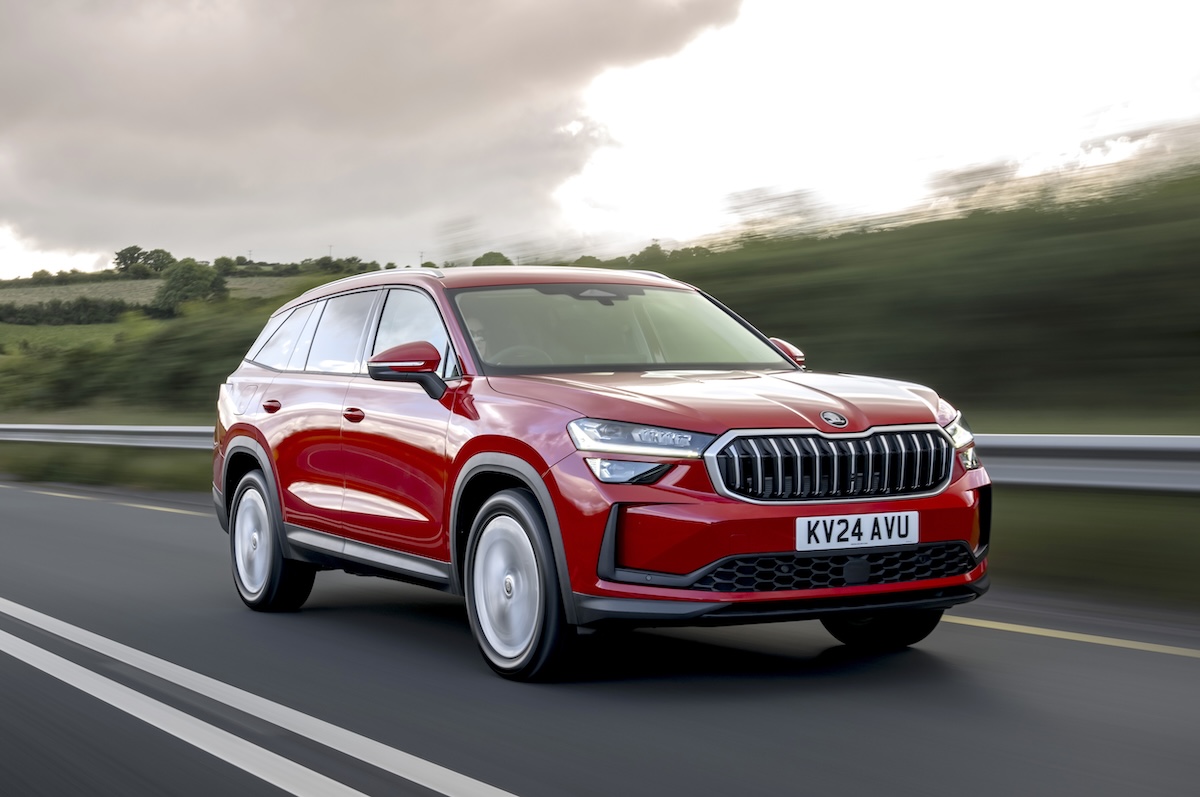
The new model of Skoda Kodiaq remains a highly practical, spacious, and well-equipped large family SUV. While it may not quite offer the premium feel of rivals such as the Volkswagen Tiguan or Hyundai Santa Fe, or the dynamic edge of sportier alternatives from BMW, it excels in delivering comfort, value, and versatility.
Whether you need a roomy seven-seater or a five-seater plug-in hybrid SUV with real-world usability, the Kodiaq is a really good option.

What is the Skoda Kodiaq?
The Skoda Kodiaq is a large family SUV that has been a popular choice since its debut. Now in its second generation, the new Skoda Kodiaq continues to offer petrol and diesel engines, as well as front-wheel drive and all-wheel drive and either five or seven seats. New for the latest generation is a plug-in hybrid powertrain that can travel up to 75 miles (official range, think more like 60 miles in real world driving) before falling back to petrol power. A sporty Kodiaq vRS completes the lineup with a 2.0-litre, 261bhp turbocharged petrol engine, four-wheel drive and a starting price north of £53,000.
While entry-level SE Kodiaqs (and all versions of the PHEV plug-in hybrid model) come with five seats as standard, you can specify adding a couple of extra rear seats at cost to turn it into a seven-seat SUV, or go for an SE L spec model, which gets seven seats as standard.
As you’d hope with Skoda, Kodiaq pricing is competitive, and the brand offers a good spread of well equipped trims, from SE through to the sportier SportLine models. Rivals include the Peugeot 5008, Nissan X-Trail, Hyundai Santa Fe and Kia Sorento, as well as premium badged models such as the Land Rover Discovery Sport and Mercedes GLB.

How practical is it?
The Skoda Kodiaq is a standout in terms of practicality. Boot space is generous across all configurations, with five-seater petrol and diesel models offering up to 910 litres of luggage space. Choose the plug-in hybrid model (also a five-seater) and that drops to a still impressive 745 litres to make room to accommodate the electric parts of the hybrid system.
As far as seven-seater versions of the Kodiaq go, with five seats in place the boot space stands at 845 litres, while with the two rear-most seats also in place, that drops to 340 litres, which is similar to what you get in a supermini-sized car such as the Ford Fiesta.
Clearly the seven-seat model is going to be the most practical choice for larger families, or even for those who occasionally need the flexibility of those extra two seats. Folding these third-row seats up and down is easy, and when stowed away they leave a flat load bay. The middle row of seats also folds flat to leave an enormous cargo space, although the folded backrests sit a couple of centimetres lower than those behind, so there is s small step in the extended load area. Other thoughtful touches include bag hooks, levers for folding second row of seats (again leaving a flat floor), and storage for the parcel shelf under the boot floor.
Rear passengers in the second row enjoy ample legroom and headroom, sliding and reclining seats, and a nearly flat floor that improves comfort for middle-seat occupants. Access to the third row is straightforward, although these rearmost seats are better suited for children or smaller adults. Those in the front seats, meanwhile, benefit from ample space and lots of storage, too. All in all, then, the Kodiaq is an excellent family car.
When it comes to Isofix points, the Kodiaq offers two sets in the second row (on the outer seats), plus an extra set on the front passenger seat.

What’s it like to drive?
The Kodiaq offers a variety of powertrains. The first is a 1.5-litre TSI petrol complete with a mild hybrid system. This produces 148bhp, is front-wheel drive, and uses a seven-speed DSG automatic gearbox. While it might sound a touch underpowered on paper, the petrol engine has a broad spread of pulling power that makes it quite flexible in everyday use, and its 0-62mph time of 9.9 seconds is perfectly adequate for a large family SUV. For most people buying the Kodiaq privately rather than as a company car, this will be the engine of choice.
Those who need to tow, or who regularly cover a lot of motorway miles, should consider the 2.0-litre TDI diesel, which is available in 148bhp front-wheel-drive form or as a 190bhp all-wheel-drive variant. Both deliver good mid-range pull and a real-world 46mpg, which makes 500 miles on a full tank entirely possible. Just be aware that this engine sounds a bit gruff and noisy at low speeds.
Of particular interest to company car drivers will be the plug-in hybrid, which combines a 1.5-litre petrol engine with an electric motor and a 25.7kWh battery. Altogether, the powertrain produces 201bhp, offers an electric-only range of around 60 miles, and is also one of only a few PHEVs to support 50kW rapid charging. Just be aware that once the electric-only range runs out, your mpg will plummet to less than what you’d achieve in the standard petrol Kodiaq and so, as with any PHEV, regular charging is essential.
When your battery is charged up, the electric motor pulls you up to speed with a sufficient amount of urgency, but it doesn't feel particularly quick. That remains the case even when you ask for maximum power and the petrol engine chimes in to help out, and when your battery is depleted, the petrol engine is left to fend for itself, and can get a little rowdy if you're not careful to keep your accelerator inputs modest.
In normal form, the Kodiaq is generally comfortable on the road, particularly at higher speeds, where it feels stable and refined. The steering is light and predictable, making the Kodiaq easy to place on the road, but this is no BMW SUV in terms of driver engagement. The steering wheel does gain a bit of weight as your corner, but even in the Kodiaq’s Sport driving mode (only on SE L models an up) it feels built for comfort rather than speed. The automatic gearbox works well for the most part, but can occasionally feel a bit too hesitant to change down. You'll find that all versions feel rather heavy on the brakes, too: you'll often find yourself slowing as you approach a junction, only for the brakes to need a more forceful shove once you reach it because you're not slowing down as much as you intended.
And yet, while the ride will be comfortable enough for most drivers, we do think that it could be a wee bit more polished and cosseting. There are noticeable thumps from the suspension over imperfections in the road, especially at low-speed, and especially in SE L-spec Kodiaqs equipped with the larger 19-inch wheels. Opting for the SE’s 18-inch wheels could help improve ride comfort (although we haven't yet tried one to prove/disprove our theory), plus Skoda offers adaptive suspension (called DCC or Dynamic Chassis Control) as an option, or as standard on Sportline and vRS trims.
In many cars, these systems often aren't worth having because they don't improve the driving experience enough to justify the amount you pay. In the case of the Kodiaq, though, the DCC is a canny addition. In its cushier modes, the suspension does a really nice job of smoothing out scruffy road surfaces, and you waft along in comfort, but without bouncing around too much. The sportier modes bring the body under tighter control, although you're never under the illusion that you're driving anything other than a vast family SUV, even in the sportiest vRS model.
And speaking of the range-topping vRS, this standalone model comes with a 2.0-litre turbocharged petrol engine sending 261bhp to all four wheels. It's undeniably quick for a large SUV, completing the 0-62mph dash in 6.4 seconds, but the build-up of speed feels brisk and effortless rather than kick-you-in-the-kidneys fast. This shortage of drama as your velocity increases also has the side-effect that it's very easy to drive faster than you intended, so remember to keep a watchful eye on your speedo.
Technology, equipment and infotainment
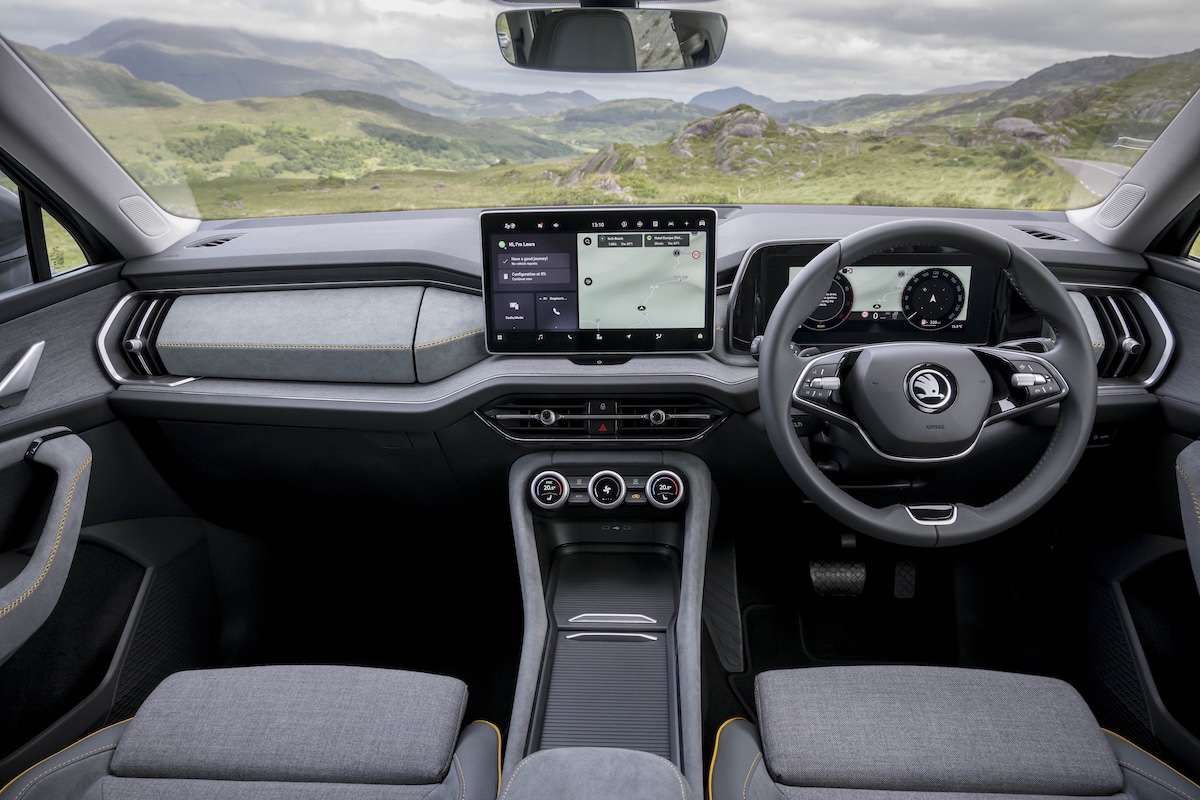
Skoda has equipped the Kodiaq with the expected range of modern technology, including a 13.0-inch infotainment screen and 10.25-inch 'digital driver’s display as standard. Wireless Apple CarPlay and Android Auto come included, which in turn means you can have sat-nav once your smartphone is connected (there’s also a wireless charger to keep the battery topped up). The infotainment system is easy to navigate, though some functions are buried in menus, which can be distracting while driving.
Entry-level SE models are well equipped as standard, with 18-inch alloy wheels, LED headlights, three-zone climate control (operated via clever physical Smart Dials that adjust to control different functions when pressed), keyless go, heated driver- and front passenger seats, and ambient lighting.
The SE L trim adds a host of upgrades, such as Matrix LED headlights, powered driver’s seat adjustment, and a powered tailgate, as well as third-row seats as standard.
SportLine models have metallic paint and a host of racy-looking visual upgrades inside and out, plus adaptive cruise control and the adaptive suspension system. The vRS versions gets more visual upgrades still, plus an upgraded Canton sound system and the more powerful engine.
Interior storage in all models is a strong point, with dual gloveboxes, large door bins, and a covered compartment under the armrest housing two wireless phone chargers. There’s even a clever touchscreen cleaning device to keep fingerprints at bay.
However, regardless of trim level, some materials in the interior feel less premium than in the previous-generation Kodiaq, particularly in areas like the door trims and centre console.
Skoda Kodiaq running costs
The Kodiaq’s pricing starts at under £40,000, which is less than you’ll pay for a Kia Sorento. However, all but a couple of low-end versions cost more than that threshold, which in turn would mean that your car qualifies for the additional rate of premium car tax, adding hundreds of pounds to its running costs each year.
Fuel economy varies by powertrain. The 1.5-litre petrol delivers decent efficiency for a large SUV with a petrol engine (think around 40mpg in mixed driving), while the 2.0-litre diesel is the most frugal for those who do lots of longer motorway journeys, achieving real-world 46mpg in our tests. The plug-in hybrid, with its electric range of 60 real-world miles or so, is ideal for those who can charge regularly and want to minimise fuel costs.
Of course, for those who want a fully electric SUV, Skoda’s own Enyaq fits that bill very well indeed.
Skoda recommends servicing annually or every 10,000 miles, whichever comes first. Condition-based servicing is an option for higher-mileage drivers, and is best suited for those who do a lot of motorway driving, which put less strain on the car's major components.

Skoda Kodiaq reliability
While the second-generation Kodiaq is too new for comprehensive reliability data to be available, Skoda’s reputation for durable and well-built vehicles suggests it should be a dependable choice. It finished 13th out of the 31 brands in the 2024 What Car? Reliability Survey (ahead of Volkswagen, no less). What’s more, in the previous iteration of the same survey, the first-generation Kodiaq diesel finished 4th out of 12 models in the seven-seater class, while the petrol model was 8th.
Skoda’s comprehensive dealer network provides additional peace of mind, although the three-year, 60,000-mile warranty is lacking compared to rivals such as Hyundai (five years, unlimited-mileage) and Kia (seven years, 100,000 miles).
- The Kodiaq plug-in hybrid offers up to 75 miles of electric range and supports 50kW rapid charging, making it a practical choice for both short commutes and longer journeys.
- With up to 910 litres of boot space in five-seat petrol and diesel models, the Kodiaq is one of the most practical SUVs in its class, while a five-out-of-five-star Euro NCAP rating demonstrates its safety credentials, too.
- For those requiring towing capacity, the 193bhp diesel with all-wheel drive is the best choice thanks to its 2,400kg towing limit, though it comes at a significant price premium. Opt for the front-wheel-drive diesel, and that drops to 2,000kg, while petrol models manage 1,800kg.
- For value-conscious buyers: The SE trim with the 1.5-litre petrol engine and optional seven seats offers a great balance of affordability and practicality for less than £40,000.
- For long-distance drivers: The 2.0-litre diesel is ideal for frequent motorway journeys, thanks to its excellent fuel economy and a range of 500 miles or more from a tank of fuel.
- For efficiency: The plug-in hybrid is the most eco-friendly option, combining a long electric-only range with lower running costs and company car tax benefits.
- For the ultimate Kodiaq: The vRS model sits at the top of the Kodiaq line-up, and combines a powerful petrol engine with lots of equipment and sportier styling.


