Ford Fiesta Mk7 Review (2018-2023)
Ford Fiesta cars for sale
4.0
Expert review
Pros
Fun to drive
Affordable running costs
Impressive Ecoboost engines
Cons
Very patchy reliability record
Not as roomy inside as some rivals
ST-Line models have a stiffer ride than the rest of the range

The CarGurus verdict
The Ford Fiesta fully deserves its reputation as one of the best superminis you can buy. It’s a really well engineered machine that comes in a variety of flavours to suit different tastes. It’s affordable to run, too, and it’s hands-down the best car of its type to drive, even compared to rivals that are still sold brand new, which as we've said, the Fiesta no longer is.
However, it’s not the cheapest of small hatchbacks, nor the most practical. What’s more, its reliability record isn't brilliant, and it doesn’t come with as much safety equipment as you might expect. Given it sits in a marketplace that’s almost overflowing with excellent rivals, we would recommend checking out the opposition before you buy a used car, particularly the Volkswagen Polo and Renault Clio, and make sure that the Ford Fiesta’s strengths match your requirements.

What is the Ford Fiesta?
The Ford Fiesta is one of the best-loved small cars – and indeed, cars full-stop – in Britain, and spent many years sitting at the top of the list of best-selling cars. That’s no surprise, because it’s a brilliantly thought-out and well-executed supermini that does just what potential customers need it to do. It’s smart to look at, comes with plenty of equipment, and is engaging and fun to drive. It has been all those things for several years, and the seventh-generation version that we're talking about here is arguably the best yet.
And yet despite this immense success, Ford took the decision in 2023 to stop making the nation's most successful car due to a shift in focus (if you'll pardon the pun) to building and selling SUV instead of traditional hatchbacks and saloons. This means that any Fiesta you buy today will be a used one, but thankfully for Fiesta fans, the model's immense popularity means it's in plentiful supply on the used car market.
Other options if you’re in the market for this type of car include the Peugeot 208, Vauxhall Corsa, Hyundai i20 and Renault Clio, as well as the Skoda Fabia, Toyota Yaris, Nissan Micra and Kia Rio, all of which have plenty going for them.

How practical is it?
Both three-door and five-door models were available until 2022, when the three-door was discontinued. That’s no bad thing; the five-door is more practical when it comes to getting in and out of the back seats, and it’s available in far more versions than the three-door, so ask yourself how important that slightly sleeker look is to you.
Space-wise, you should easily fit two adults in the back, but three will be a tight squeeze, and none of them should expect loads of legroom. Several rivals have more passenger space, and larger boots, too, so they’re worth checking out if practicality is a massive priority – the Fiesta can offer 292 litres of boot space while the Renault Clio musters a much more generous 391 litres. The Fiesta’s boot isn’t tiny, but the step between rear seat backs and boot floor when the seats are folded down is a bit annoying. Some rivals have a height adjustable floor as standard to provide a flat loading area, which the Fiesta does not.
The interior quality is slightly better on some rivals; some parts of the Fiesta’s insides can feel a bit more plasticky than we’d like.

What’s it like to drive?
The choice of Ford Fiestas is wide, ranging from happy little runabouts to sporty ST performance models, with just about everything in between. You can even get a couple of Active models, which have jacked up SUV-style suspension for mild off-roading capabilities. The emphasis is on the mild – don’t expect to go rock-crawling in it – but it’ll tackle gravelly paths with little effort, and the higher centre of gravity makes relatively little difference to the handling. The extra 18mm of lift also makes for a slightly more comfortable ride than the rest of the range.
ST-Line models have stiffer, sporty suspension, which can impact a bit on ride comfort but sharpens up the already nimble chassis still further, and the Fiesta ST is a proper hot hatch with handling to match. It should be noted, however, that even the basic cars have excellent control and poise through the corners, and with the slick, precise manual gearboxes and accurate, feelsome steering, they’re all very enjoyable to drive. The Fiesta is undoubtedly the sweetest-driving small car there is, even compared with newer rivals.
Early on in its life, the Fiesta was available with a choice of petrol or diesel engines. We’d point you towards the petrols if possible, as the diesels are relatively pricey and not particularly impressive in comparison. Unless you’re doing lots of long motorway journeys, where the better fuel economy will start to pay dividends, it’s not worth it.
The turbocharged Ecoboost engines are the most pleasant ones in practice, mixing good fuel efficiency with impressively punchy performance. Ecoboost engines have experienced some reliability issues, though. In later models, a mild hybrid engine option was made available, which wasn’t as efficient as the diesel engines it replaced, but was slightly more economical (and a touch more punchy) than the standard petrol engine.
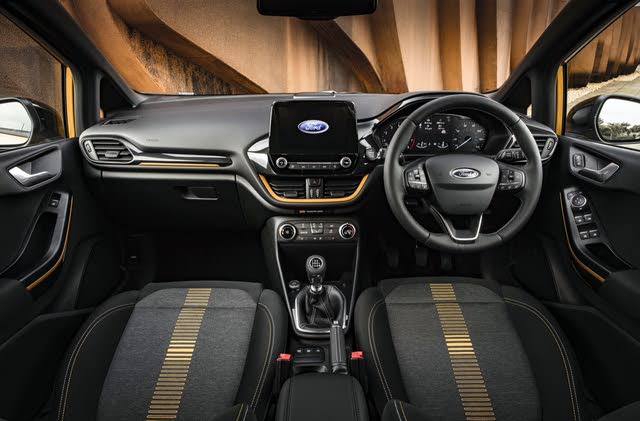
Technology, equipment and infotainment
The Ford Fiesta was offered in a vast variety of trim levels over the years, especially once you factor in special editions and name changes: at last count, we believe there have been 18 different versions .
Initially, the range started with Style trim, which came with steel wheels, manual air-conditioning and electric front windows, but not a great deal else. It also came with an AM/FM radio with a 4.2-inch TFT screen, Bluetooth, device dock and six speakers.
Zetec trim (later replaced by Trend) added alloy wheels, LED daytime running lights, front fog lights, leather trims for the steering wheel and handbrake, and the genius heated windscreen that means you'll never need an ice scraper again. The infotainment is upgraded to the Sync 3 system,, which has a 6.5-inch touchscreen, DAB radio, Apple CarPlay and Android Auto.
On top of that, Titanium adds LED rear lights, rear privacy glass, climate control, cruise control, keyless start, and more driver assistance features.
Titanium X then added a heated steering wheel, part-leather upholstery, and an upgraded B&O audio system (the B&O Play limited editions also got this system, along with some lairy colour schemes).
The Active models had a raised ride height and other SUV-inspired styling touches, while the ST-Line versions had racier looks inside and out due to a variety of sporty visual upgrades, plus a stiffer sports suspension. Upgrade further to ST-Line X trim, and you get similar additions to those you get with Titanium X trim over Titanium, except that the B&O stereo is exchanged for a different infotainment system with a larger 8.0-inch touchscreen.
Vignale was the properly luxurious trim, with a panoramic roof, quilted leather seats, a reversing camera, and cornering foglamps.
The sporty ST versions were offered in ST-1, ST-2, and ST-3 trims, which broadly mirrored the other versions in terms of luxury kit, but all had sporty styling and the powerful engine.
The car was facelifted in 2022, with trim levels at that time including Trend, Titanium, ST-Line and Active. There were a few enhancements across the board, but basic kit levels remained broadly similar.

Ford Fiesta running costs
Ford might have a car-of-the-people reputation, but the Fiesta wasn’t quite as cheap as you might expect when new. These higher prices are passed onto the examples you'll find on the used market. The car's popularity means that there's lots of choice on the used market, which usually drives prices down, but demand is still high, especially now that the Fiesta has been discontinued as a new car, so prices haven't fallen as much as they might. Depending on the deal you find, it could well be more expensive to buy than a Volkswagen Polo or Seat Ibiza of the same vintage.
Fuel economy varies by model, but the popular 94bhp 1.0-litre Ecoboost turbo gives an official mpg figure of 51.4, which is pretty good compared with other similar cars. What’s even more impressive, though, is that the 123bhp version of that engine returned exactly the same figure, and even the 138bhp version gets close in official tests. The later mild hybrid model, with 123bhp, boosted fuel economy to 56.5mpg, while the entry-level, 74bhp 1.1-litre petrol will give 53.3mpg. If you really want the best fuel economy possible, the diesel promises 65.7mpg but you’ll need to cover a lot of miles for that to justify the higher purchase price.
The performance ST models claim a fuel economy of 40.4mpg pre-facelift and 42.2mpg thereafter, but you’re unlikely to get too near those official figures if you’re driving as the engineers intended.
Servicing shouldn’t be particularly pricey on a Fiesta, and is broadly in line with its rivals. Intervals vary by model, but most are due every two years or 18,000 miles. The ST needs checking over every year or 12,500 miles. Ford offers a service plan with new cars that can cover scheduled services for up to three years for a one-off payment. You can also take out additional cover to protect against wear and tear, and there’s the option to pay for servicing monthly.

Ford Fiesta Reliability
Reliability is not the Fiesta’s strong point; in the 2024 What Car? Reliability Survey, it placed 10th out of 15 models in the Small Car class, which is not terribly impressive, while Ford placed a middling 14th out oof 31 carmakers in the manufacturer standings.
Ford offered a three-year, 60,000-mile warranty on the Ford Fiesta, which is pretty standard for the industry but below those offered by some rivals. If you buy a Kia Rio, you’ll get a seven-year, 100,000-mile warranty, and the Hyundai i20 offers five years and unlimited miles.
Around 90 cars made in the middle of 2019 were fitted with an incorrect steering column, which will need to be replaced under recall, so if you’re buying a used one, make sure any necessary work has been done. We’ve read some reports of issues with the Ford Fiesta’s keyless entry system failing when the car’s battery gets low, which can usually be fixed with a full battery charge. The auto start/stop can also be a bit temperamental in some cars, but owners have found that resetting the battery monitoring system often helps.
There have also been numerous reports of problems with the Ecoboost petrol engines, particularly the 1.0-litre ones. It is said that the rubber timing belts fail, blocking the oil system and starving large part of the engine of the essential sticking stuff, causing catastrophic damage. Ford issued a recall for a similar issue in the US, but not in Europe, so tread carefully when buying one of those.
Around 90 cars made in the middle of 2019 were fitted with an incorrect steering column, which will need to be replaced under recall, so if you’re buying a used one, make sure any necessary work has been done. We’ve read some reports of issues with the Ford Fiesta’s keyless entry system failing when the car’s battery gets low, which can usually be fixed with a full battery charge. The auto start/stop can also be a bit temperamental in some cars, but owners have found that resetting the battery monitoring system often helps.
The Ford Fiesta tends to be popular with new and learner drivers, so if you’re looking at used examples, make sure any alloy wheel damage or paintwork scuffs have been fixed. ST models, due to their nature, may have been driven hard, so make sure any potential buy has been well looked after.
- The size of engine doesn’t necessarily equate to proportionate power figures; the 74bhp 1.1-litre petrol engine isn’t as powerful as the 1.0-litre Ecoboost models, thanks to a turbocharger on the latter, which is available in three different power configurations (99bhp, 123bhp or 138bhp). We wouldn’t particularly recommend the 1.1, as while it’s cheap, it lacks grunt compared with other engines in the range. For our money, the 123bhp version is the happy medium between price and performance.
- Be careful about the potential impact of big wheels. While the 18-inch alloys on the ST-Line X and ST-3 models look good, they do nothing for ride comfort or noise, especially in models on stiffer suspension. The ST-Line and ST-2 models both have 17-inch wheels, and give a more comfortable experience for driver and passengers.
- A facelifted version of the Fiesta was introduced in 2022, which brought with it mildly updated styling and a change in the way the more luxurious versions were marketed. The Vignale model name was axed, and in its place, X packages were added to Titanium, ST-Line and Active models, allowing buyers to upgrade to add more equipment and more upmarket interior finishes (though none of these was quite as generously equipped as the stand-alone Vignale model). Meanwhile, adaptive LED headlights were made available for the first time, as was a 12.3-inch digital dial cluster, and the ST hot hatch gained a slight boost in torque. On the downside, automatic emergency braking, which had come as standard on the old Vignale model, was made available only as an option, and even then, you couldn’t specify it on the Trend or ST-3 versions.
- If you want fuel economy: The diesel-powered 1.5 TDCi three-door Trend model is the most frugal Ford Fiesta to run on paper, but keep in mind that it’s not the cheapest to buy, and the engine isn’t as refined as the Ecoboost petrol models.
- If you want performance: The ST models have a turbocharged 1.5-litre, three-cylinder petrol engine that makes 197bhp, putting it at the top of the Ford Fiesta range. It’s a proper hoot to drive, with a limited-slip differential to further improve handling, and even a launch control mode.
- If you live down a gravel path: The Fiesta Active has a ride height that’s raised by 18mm over the standard suspension, giving it extra ground clearance. There’s no option of all-wheel drive, so it’s hardly a proper off-roader, but it’ll dramatically reduce the risk of catching the underside of the car on something undesirable.
- If you want absolutely all the toys: Try and find yourself a Vignale version. These were better equipped than the Titanium X models that replaced them.


