Ford Mondeo Mk3 Review (2007-2013)
Ford Mondeo cars for sale
5.0
Expert review
Pros
A lot of car for not much money
Fun to drive and comfortable too
Roomy cabin and big boot
Cons
Some rivals look and feel more upmarket inside
Fiddly stereo controls
Reliability glitches with the central locking

The CarGurus verdict
If you want a whole heap of family car for not a lot of cash, we can’t think of many better options than the third-generation Ford Mondeo. Whether you go for the hatchback, the saloon or the estate, you get masses of interior space and a huge boot, along with decent equipment levels and a very presentable safety record. And, thanks to the combination of affordable new-car prices and comparatively weak resale values, these cars are an absolute steal on the used market.
Best of all, the Mondeo was head-and-shoulders above its contemporaries for how good it was to drive, with a comfortable ride and genuinely entertaining handling, while the best engines delivered a tempting mix of performance and economy.
Granted, some rivals of the same vintage feel posher inside, and there were one or two ergonomic foibles, but otherwise, the Mondeo is a fabulous all-rounder that can be had for a snip. Thoroughly recommended.
Ah, the good old Mondeo. Not all that long ago, you’d find every street in the country absolutely littered with these things, such was their popularity. However, now that so many family car buyers have switched their allegiance to super-popular SUVs, the traditional family car is a rather rare sight on British roads.
However, just because this type of car happens to be a bit out of fashion right now, it doesn’t mean there’s not still a lot to like. Especially so in the case of the third-generation Mondeo, sold between 2007 and 2013, because this was hands-down the best car of its type.
Not only is it comfortable and good to drive, it’s roomy and versatile, with a choice of four-door saloon, five-door hatchback and five-door estate body styles. It’s cost effective to buy and run and robustly built, so assuming it’s been serviced on the button the Mondeo should be reliable.
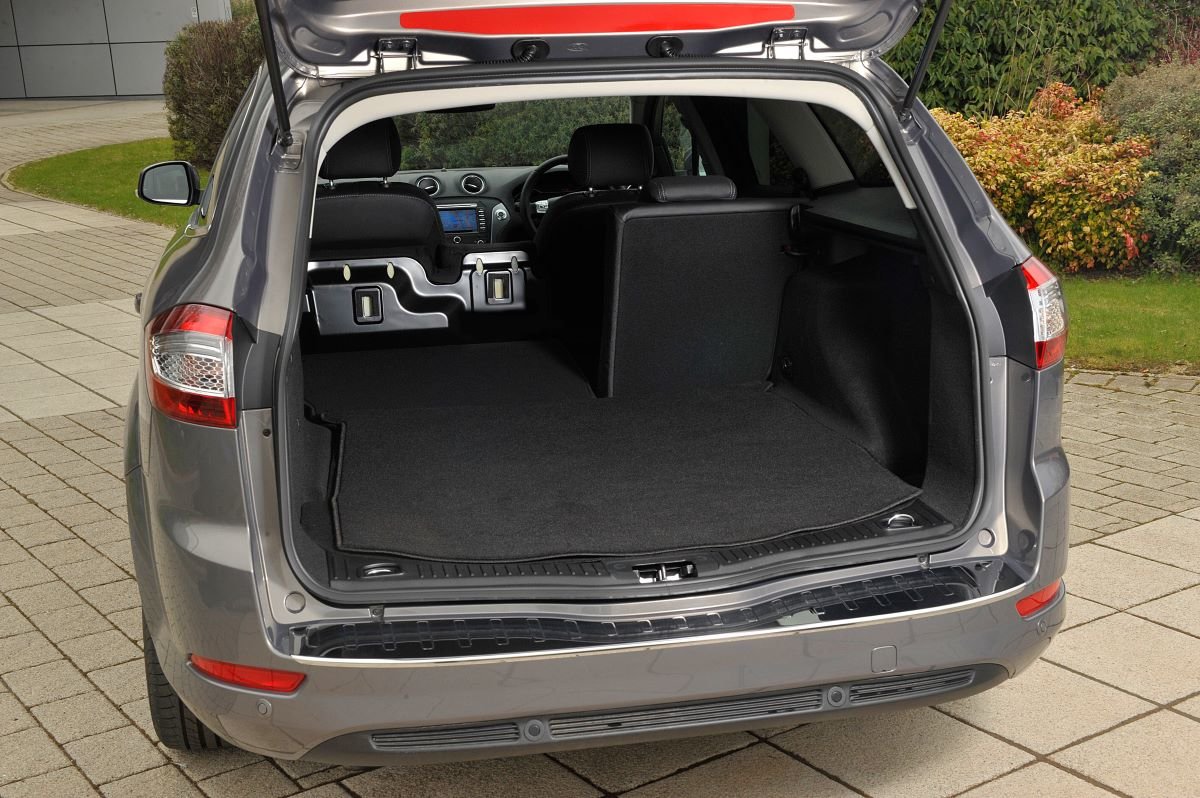
In a word, yes. If you thought you needed an SUV to accommodate a growing family, then the Ford made you think again. First of all, the Mondeo was massive. All of the five seats were surrounded by loads of space, meaning even families that contained the gangliest of teenagers would be comfortable in the back. There was just as much space up front, where the big Ford had the feel of a car from the class above. A wide range of adjustment for the supportive seats also meant that it was easy to nail the perfect driving position.
Given that the Mondeo was aimed at the high-mileage company car user, it’s no surprise its interior is crammed with useful storage for all those nine-to-five nick-nacks, including multiple cup holders, roomy door bins and a vast lidded cubby between the front seats.
Then there was the boot, which was absolutely huge. And that’s if you went for the five-door hatchback or four-door saloon versions, which packed carrying capacities of 538 and 535 litres respectively. Lower the 60/40 split/fold rear bench of the former and the usable space jumps to 1,448 litres. Plump for the estate, meanwhile, and the loadbay was even more enormous, with 542 litres with the rear seats up and a cavernous 1,733 litres with them lowered.

As with the previous two generations, this Mondeo was by far and away the best car in its class to drive. The ride was sensationally smooth, mopping up every blemish on the road surface without any fuss whatsoever, yet the handling was also sensationally sharp. The strong grip, tight body control and sharp steering gave the Mondeo a level of agility that was previously unheard of in cars of this size. So, not only was it comfortable, it was also great fun. Decent refinement also helped make the Mondeo a fairly relaxed motorway cruiser.
One thing that changed pretty much constantly throughout the car’s life was the engine range, with regular updates to existing power units, and regular releases of new ones. The best – and the most popular – one, though, was available throughout, and that was the 140hp 2.0-litre TDCi diesel. This was easily the best compromise between performance and economy.
For more poke but almost as much parsimony, there was the larger 2.2-litre diesel, which delivered 175hp in its earliest guise before being boosted to 200hp. It’s quite a rare unit, however, and in day-to-day driving the differences between it and the 2.0-litre were hard to detect. There were also smaller 1.6-litre and 1.8-litre TDCi units, the former feeling a little underpowered in a car as big as the Mondeo.
Petrol fans were originally offered Mazda-sourced 1.6-litre, 1.8-litre, 2.0-litre and 2.3-litre four-cylinder engines, as well as the characterful but thirsty 225hp turbocharged 2.5-litre five-cylinder from the Focus ST. When the Mondeo was facelifted in 2010, these were replaced by turbocharged EcoBoost units in the form of the 160hp 1.6-litre and 240hp 2.0-litre.
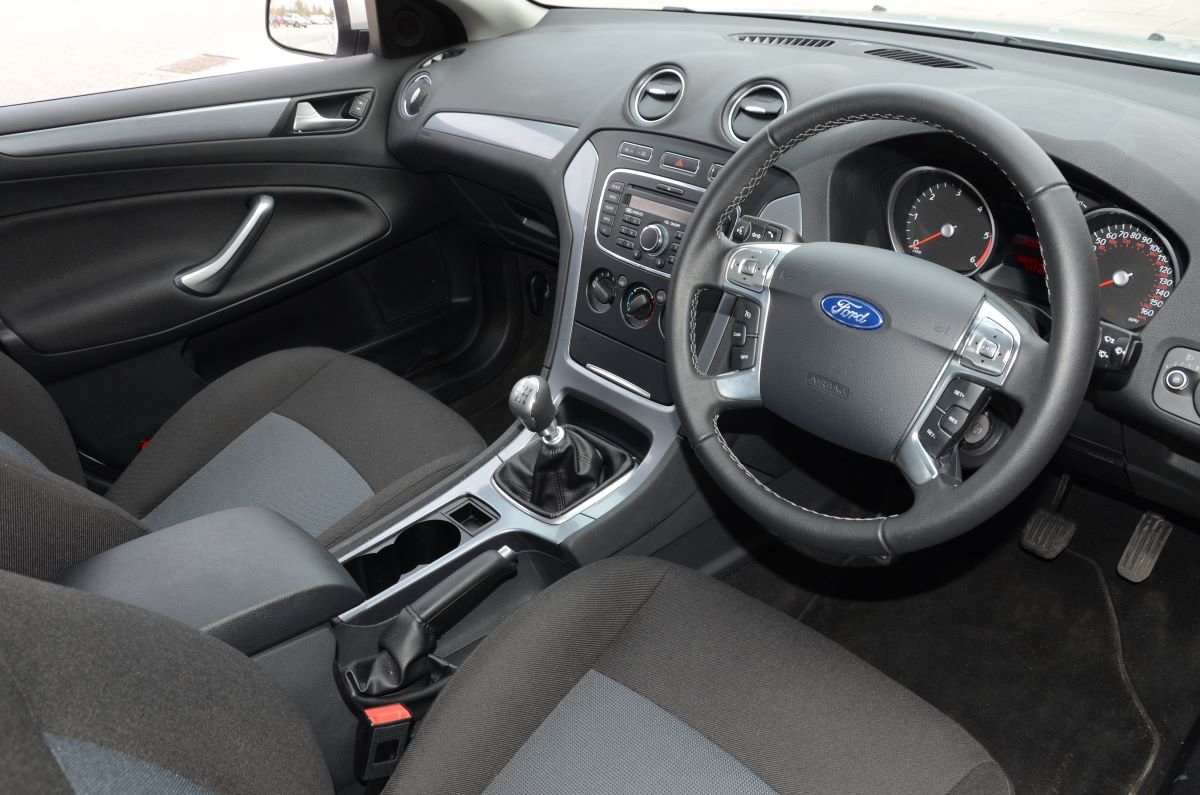
Five trim levels were available in the Mondeo’s early days. The entry-level Edge came with most of the equipment you really need, including air-conditioning, cruise control, electric front windows, a leather steering wheel, powered door mirrors, a single-slot CD stereo, electronic stability control and seven airbags. However, we reckon it’s worth upgrading to Zetec trim if you can for its alloy wheels, two-zone climate control, electric rear windows and body-coloured door handles.
Then came the Ghia, which had automatic lights and wipers, rear air-con vents, a six-disc CD autochanger and extra exterior chrome elements, along with a less-than-plausible wooden-effect interior trim. Titanium trim was pretty much the same but without the faux-wood (mercifully) and the automatic lights and wipers, while Titanium X trim reinstated the latter and added heated front seats and part-leather upholstery.
A 2010 facelift brought about some tweaks to the car’s trim structure. Entry-level Edge cars were given four powered windows and a Bluetooth phone connection as standard, and while Zetec trim stayed pretty much the same, Titanium trim added automatic lights and wipers and Ghia trim was dropped altogether.
Titanium X cars were given front and rear parking sensors and front seats that were both heated and cooled, while above that, a new Titanium X Sport trim added racier exterior styling, lashings of red stitching inside the cabin, a sports suspension and Bi-Xenon headlamps. On top of all that, various high-value special editions also came and went throughout the Mondeo’s life.
Most Mondeos were fitted with a fairly bog-standard infotainment system that ran to a radio and CD player, with Bluetooth connectivity tacked on. An upgraded Sony system delivered greater sound quality and the option of DAB radio. A touchscreen sat-nav system was also added, but today it’s fiddly to use and looks dated.
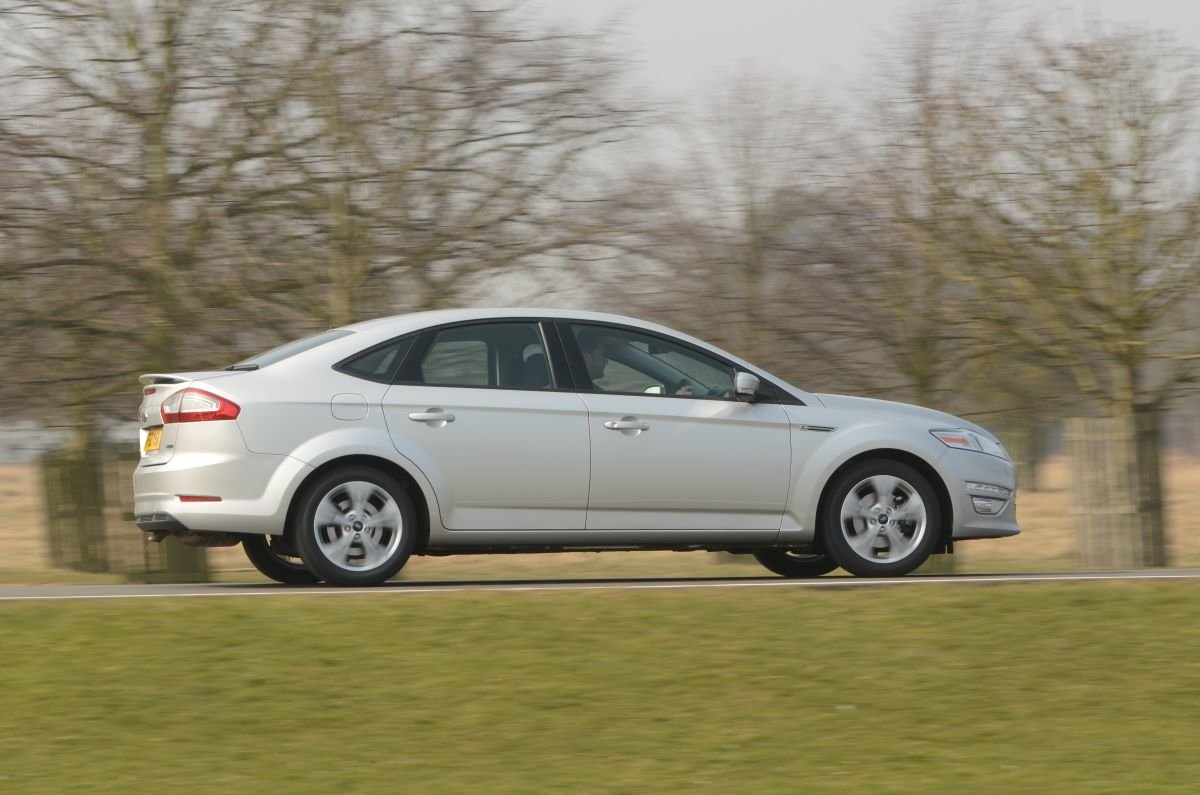
The Mondeo was a fairly affordable option even when it was new, and although the car’s comparatively weak residual values were a thorn in the side for the original buyer, they’re great news for used car buyers. You certainly won’t have to pay anywhere near top-dollar to get a very tidy example, and the huge amount of these cars on the used market mean you shouldn’t have any problem finding a car to suit your taste and budget.
We’d recommend avoiding the petrol-powered cars unless absolutely necessary, as they’re all pretty thirsty. According to official figures, even the best of them only achieved high thirties in the miles-per-gallon stakes, while the worst only return around 30mpg, and that’s likely to be even worse in the real world. As we’ve said, the diesels were the most popular choices due to their superior fuel economy, and if you go for an early car, all of them (except those fitted with an automatic gearbox) should return between 45mpg and 50mpg according to official figures. Bear in mind, too, that the engines were constantly tweaked throughout the car’’s life, so the later your car, the cleaner it's likely to be. For instance, the popular 138bhp 2.0-litre diesel started life with an official combined figure of 49mpg, but by the time the car was facelifted in 2010, this had risen to above 53mpg. The cleanest version you can get is the later 1.6-litre Econetic diesel, which had an official figure of more than 65mpg.
Due to their super-low CO2 emissions, these versions also qualify for super-low annual VED payments of £20 or £30. Earlier Econetics, though, along with the rest of the diesels, face annual bills of between £125 and £205, with most of them sitting on or around the £150 mark. Of the petrol, the cheapest VED bill you’ll face is £165, while the most expensive stands at £330. Insurance groupings range between 12 and 28 on the Mondeo, meaning premiums on most versions should be fairly affordable.
Fords generally do pretty well in this area. Most reliability surveys doing the rounds - including both the Warranty Direct Reliability Index and the JD Power Vehicle Dependability Survey - put the brand firmly in the top half of the table in their respective manufacturer rankings, and where applicable, this generation of Mondeo also does a pretty solid job when considered as an individual model.
The Warranty Direct study reports that if something does go wrong with this generation of Mondeo, then it’s likely to be either an electrical problem or an engine issue. In regards to the former, take the time to make sure all the various switches and gizmos are working as they should, with no intermittent behaviour. The central locking is a well-known source of glitches, so make sure you lock and unlock the car several times over, and make sure that all the doors do as expected each and every time. In regards to the latter, it’s been reported that some 2.0-litre diesels have cut out for no apparent reason, but this is a glitch that can be fixed with a simple ECU update.
Because the Mondeo was such a popular car with company car drivers, you’ll find lots of high-mileage examples on the used market. This shouldn’t be a major cause of concern in itself, but do make sure that the car you’re considering has been looked after properly with a thorough inspection of the service history, and we’d always advise insisting on a comprehensive one.
- Five trim levels were available in the Mondeo’s early days. The entry-level Edge came with most of the equipment you really need, including air-conditioning, cruise control, electric front windows, a leather steering wheel, powered door mirrors, a single-slot CD stereo, electronic stability control and seven airbags. However, we reckon it’s worth upgrading to Zetec trim if you can for its alloy wheels, two-zone climate control, electric rear windows and body-coloured door handles. Then came the Ghia, which had automatic lights and wipers, rear air-con vents, a six-disc CD autochanger and extra exterior chrome elements, along with a less-than-plausible wooden-effect interior trim. Titanium trim was pretty much the same but without the faux-wood (mercifully) and the automatic lights and wipers, while Titanium X trim reinstated the latter and added heated front seats and part-leather upholstery.
- A 2010 facelift brought about some tweaks to the car’s trim structure. Entry-level Edge cars were given four powered windows and a Bluetooth phone connection as standard, and while Zetec trim stayed pretty much the same, Titanium trim added automatic lights and wipers and Ghia trim was dropped altogether. Titanium X cars were given front and rear parking sensors and front seats that were both heated and cooled, while above that, a new Titanium X Sport trim added racier exterior styling, lashings of red stitching inside the cabin, a sports suspension and Bi-Xenon headlamps. On top of all that, various high-value special editions also came and went throughout the Mondeo’s life.
- That 2010 facelift brought much more than revised equipment levels, though. Updated exterior styling gave the Mondeo a slightly more aggressive look, along with new LED lighting front and back, and there were also slight tweaks to interior design, with some new colour schemes on offer. More driver assistance systems - such as lane departure warning, high-beam assistance and blind spot monitoring - were made available, along with a number of new and revised engines. What’s more, the saloon bodystyle was dropped, leaving only the five-door hatchback and the estate.
– If you’re after ultimate economy, you’ll want to hunt out a version with an Econetic badge. The precise engine that your Econetic model is packing will depend much on the age of your car. The first Econetic was a 1.8-litre unit, but it was later swapped for a much better – and even cleaner – 2.0-litre unit. Then, towards the end of the Mondeo’s life, this was switched out for a 1.6-litre engine. Regardless of which you’ll go for, you’ll get the same power output of 115hp, but it’s worth noting that the early 1.8 is nowhere near as flexible as the later options. – For most people, we reckon the 140hp 2.0-litre diesel is the pick of the range. It has all the go that most drivers will ever need or want (in fact, it’s actually pretty difficult to even detect the extra pace you get from most of the more powerful diesels), and it does a cracking job on economy and refinement, too. And, because this was by far and away the most popular engine, there are absolutely shedloads of examples on the used market. – If you simply must have a petrol engine in your Mondeo rather than a diesel, ignore early examples of the car. Neither the 1.8 or 2.0-litre versions were really up to the job of hauling this enormous car around, and while the 2.3 and 2.5 were quicker, they were also thirsty. During the car’s facelift in 2010, though, a turbocharged 1.6 petrol was introduced, and that’s the one you want because it’s perky, smooth and refined. – If you want the most powerful Mondeo you can possibly get, then again, you’ll want to ignore the early 2.3s and 2.5s. The 2010 facelift also brought with it a more powerful version of the existing turbocharged 2.0-litre petrol engine, but hiked the power output up from 200hp to 240hp. For our money, it doesn’t actually suit the car as well as the diesels do, but there’s no denying how strong the performance is. Won’t be cheap to run, though.

