Ford Tourneo Connect 2025 review | Spacious and practical MPV
Ford Tourneo Connect cars for sale
3.0
Expert review
Pros
Hugely spacious
Economical diesels great for high-mileage drivers
Well equipped
Cons
Not as good to drive as most Fords
Interior feels a bit utilitarian
No hybrid or electric version as yet
The CarGurus verdict
The practical, boxy Tourneo Connect is family motoring in thoroughly sensible shoes: it does a great job of hauling a family and all its stuff around effectively and without fuss. And if you can’t afford – or don’t want – a more style-led SUV, then it’s a great antidote to that sort of car. However, we also reckon that, thanks to its Volkswagen underpinnings, the Tourneo isn’t quite as engaging to drive as the very best Fords, which is a slight disappointment.
That being said, the fact that the Tourneo is cheaper and better-equipped than its VW cousin very much plays in its favour. We would definitely recommend it over the Caddy, unless you want that extra bit of cachet that the Volkswagen brand brings. In the end, though, buyers looking at this class of car should also consider alternatives such as the Citroen e-Berlingo for EV motoring, or the Dacia Jogger as a cheaper, non-electric option.

What is the Ford Tourneo Connect?
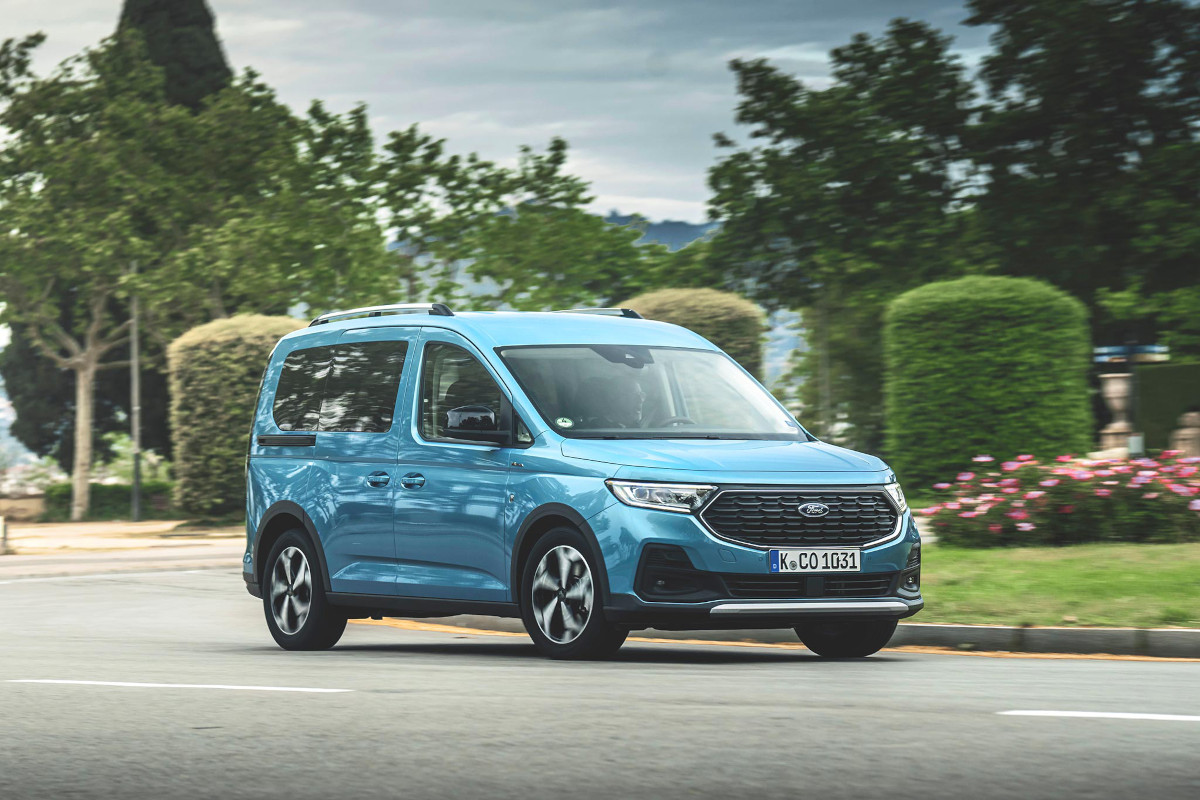
The Ford Tourneo Connect – or Ford Grand Tourneo Connect in seven-seat form – is Ford’s practical, van-based MPV, although that description doesn’t quite do it justice. It’s the result of a collaboration with Volkswagen and is closely related to the Volkswagen Caddy, sharing much of its engineering beneath the boxy bodywork. Despite its commercial roots, the underpinnings share much in common with the Volkswagen Golf, which gives it far more car-like handling and a more conventional driving position than you might expect from an MPV with sliding doors.
Engine choices include a 1.5-litre EcoBoost petrol with 113bhp, a 2.0-litre EcoBlue turbodiesel producing 121bhp, and a plug-in hybrid (PHEV), which pairs the 1.5-litre petrol engine with an electric motor to deliver a total of 148bhp. Both the standard petrol and diesel engines come with a seven-speed dual-clutch automatic transmission, while the plug-in hybrid gets a six-speed dual-clutch auto. There’s also a choice of two body styles: the standard five-seat Tourneo Connect, or the longer-wheelbase and more spacious seven-seat Grand Tourneo Connect.
It may not have the appeal of a large family SUV, but the Ford Tourneo Connect is significantly more practical – and usually cheaper – than most seven-seat crossovers, making it an appealing choice for growing families with active lifestyles who value practicality, space and flexibility over style and badge appeal.

How practical is it?
Practicality is the trump card for this sort of car. Van-based MPVs are rarely the most stylish of vehicles, but a boxy shape lends itself to maximising interior space while minimising exterior dimensions.
That very much holds true in the case of the Tourneo Connect. Its boot space is simply cavernous, especially in the seven-seat version. Even with all seven seats in place, there’s more boot space than you’ll get in a regular family hatchback such as a Volkswagen Golf or Ford Focus, while if you fold down seats six and seven you’re faced with 1,720 litres of luggage capacity – perfect for that trip to Ikea you’ve been promising yourself. Even a large SUV like the Skoda Kodiaq can muster a mere 720 litres of space. Fold the second row in the Grand Tourneo Connect, and this increases to a warehouse-rivalling 3,105 litres. Your friends will be calling you when they move house.
Thanks to the acres of headroom, the third-row seats can actually accommodate adults, although the fact that the seats are set low to the floor means that you’ll find there’s a lack of under-thigh support. But, for children or occasional use, they’re great.
Second-row passengers fare better, with decent legroom to go along with the headroom, while access is aided by rear sliding doors on both sides of the car. There are three equal-sized seats, so the middle passenger won’t get a raw deal, although the consequence of this is that the outermost seats aren’t aligned with the two front seats, so if you want to sit with your feet underneath the seat in front, you’ll have to skew your legs a bit.
Up front, the two seats are comfortable and supportive, with lumbar adjustment as standard (not the case in the Volkswagen Caddy version).
It’s broadly good news when it comes to practicality, then, but a key part of the appeal of this sort of car is generally ingenious storage solutions and cubbies – and the Tourneo falls a bit flat here. There are picnic tray tables on the rear seats, a useful overhead storage space above the front seats, and the door bins and glovebox are generous, but the cupholders are a bit average, and the centre armrest storage is positively small. That said, the armrest slides back and forth and can be adjusted up and down. It’s very welcome on longer journeys.

What's it like to drive?
A virtue of many Fords is that they are genuinely enjoyable to drive. This even applies to cars that you might not expect to be fun, such as the Ford S-Max MPV or Kuga SUV. Sadly, since the Tourneo Connect’s DNA is actually from Volkswagen rather than Ford, it doesn’t sparkle on a twisty road in the way the best Fords do. It delivers reasonable amounts of grip and the brakes are reassuringly solid, but there’s a lot of body-roll, and the weight transfer feels very pronounced as you change direction.
When it comes to the ride, it’s pretty supple most of the time, although potholes do send a bit of a shudder through the cabin, especially from the rear suspension. On smoother roads it’s very comfortable indeed, so it’s a shame that the large windscreen and big door mirrors generate rather a lot of wind noise. They do make the Tourneo impressively easy to park, however.
You’ll find the 121bhp 2.0-litre turbodiesel engine that we’ve tried to be reasonably gutsy, although do bear in mind that the larger seven-seat version weighs over 1,700kg, so that blunts performance a little. You’ll get from 0-62mph in a leisurely 11.4 seconds, while the 1.5-litre petrol is even slower at 11.9 seconds. Only the plug-in hybrid gets close to the 10-second mark, completing the ‘sprint’ in 10.5 seconds. You can also look forward to 70 miles of electric range from a fully charged battery, according to official figures.
Pulling away from junctions, the automatic gearbox can feel a little hesitant, which can be avoided if you put it into ‘sport’ mode. However, it then hangs onto gears in a way that feels odd in a family car, especially one with a slightly raucous diesel engine.

Technology, equipment & infotainment
There is a bit of a spartan, commercial vehicle vibe to the Tourneo Connect’s interior, and cheap-feeling scratchy plastics are in plentiful supply. However, this is a car that’s about utility rather than luxury, so maybe that’s a bit forgivable.
Actually, once you look past the utilitarian atmosphere, there’s a pretty generous amount of standard equipment. There are two trim levels available – Titanium and Active – with the old Sport model no longer available.
To be honest, it’s hard to see why you’d want anything more than you get in the Titanium. The list includes a heated windscreen, air conditioning, powered door mirrors, front and rear parking sensors, and a full suite of driver assistance systems. Basically, everything you need, and a couple of luxuries. The Active model gets a cosmetic overhaul for a more SUV-inspired look, plus LED headlights, LED rear lights, a panoramic sunroof and a wireless charging pad. Either way, we’d recommend the Heated Pack. For £180, this adds heated front seats and a heated steering wheel.
All models also get a 10.0-inch touchscreen infotainment system. Unfortunately, this is a VW unit, even though it features fonts and colours that will be familiar to drivers of other Ford models. This means that the user experience and menu layout is confusing and – most annoying of all – the heating and volume controls are unlit touchpads, making adjusting the radio or the cabin temperature a faff, especially at night.

Ford Tourneo Connect running costs
When you take a look at fuel economy figures, you can see that the petrol models have to work much harder. In the Grand Tourneo Connect, the EcoBoost petrol model can officially manage just over 40mpg, while the EcoBlue diesel engine is capable of around 51mpg. Mind you, in the real world, that promise doesn’t quite come true; we’ve seen much closer to 40mpg in our time with the 121bhp diesel model in Active trim. That’s still not too bad, though, when you consider this is quite a tall and heavy car.
With an electric-only range of 70 miles and an official 148.4mpg to 158.8mpg, the plug-in hybrid should deliver the lowest running costs overall, especially if you have access to charging at home or at work. Thanks to its low CO2 emissions, the plug-in hybrid is also much cheaper to tax (VED) in the first year than the petrol or diesel versions. By contrast, the petrol model sits in one of the highest first-year tax bands. Do bear in mind, however, that the higher list price of the plug-in hybrid means it’s likely to be subject to the premium rate of VED from year two onwards.
Crucially, key rivals such as the Peugeot Rifter and Vauxhall Combo Life are now only available as electric models (e-Rifter and Combo Life Electric) and so attract a much lower company car tax rate.
As for the Volkswagen Caddy, well, it’s priced noticeably higher than the Tourneo, and offers a little less in the way of standard equipment, so the Tourneo offers better value for money there.

Ford Tourneo Connect reliability
For peace of mind, you get a standard three-year, 100,000-mile warranty with the Tourneo Connect. As for general expectations around the car’s reliability, Ford finished a disappointing 24th out of 30 brands in the 2025 What Car? Reliability Survey.
We can’t even offer any positivity from the fact that the Tourneo Connect is actually built at a Volkswagen plant, as VW also finished in 24th place. Only Land Rover, Jaguar, Fiat, Nissan and MG finished lower.
There have also been reports of glitches with the infotainment system similar to the one used in the Tourneo – although not, it has to be said, in the Tourneo itself.
- It’s possible to buy the longer Ford Grand Tourneo Connect without the sixth and seventh seats. Simply tick the box marked ‘3rd row seat delete’ and it’ll be delivered without the third row. Ideal if you’re after the maximum luggage capacity but don’t intend to carry extra people.
- The Tourneo Connect gets the same Euro NCAP five-star safety rating as the Caddy, largely because it features the same impressive set of safety technology, including automatic emergency braking that can detect cyclists and pedestrians, plus standard lane-keep assist.
- It isn’t possible to order a Tourneo Connect or Grand Tourneo Connect with the 1.5-litre petrol engine if you want Active trim. This engine is limited to Titanium trim only.
- For maximum space, the Ford Grand Tourneo Connect in Titanium trim is an outstanding choice for carrying a large family. Even with all seven seats in use, there’s still a genuinely usable boot, and despite its van-like proportions it takes up far less road space than a typical seven-seat SUV, so it’s easier to park. It’s a long car at around 4.8 metres, but that means excellent passenger space and practicality.
- For fuel economy, you have a choice between the plug-in hybrid and the diesel. Choose the former if you have access to a battery charger and can take advantage of the impressive 70 or so miles of electric range. If not, you’re simply paying to carry the expensive battery pack around, so consider the diesel for around 50mpg.
- The standard 1.5-litre petrol version only really makes sense if you spend most of your time in towns and cities, and are unable to charge the battery in the plug-in hybrid version.


