Honda Super-N 2026 review | Bargain electric car fun
Honda Super N cars for sale
4.0
Expert review
Pros
Fun to look at and to drive
Bargain price
Really well-equipped
Cons
Range
Small boot
Performance is genteel when not in Boost mode

The CarGurus verdict
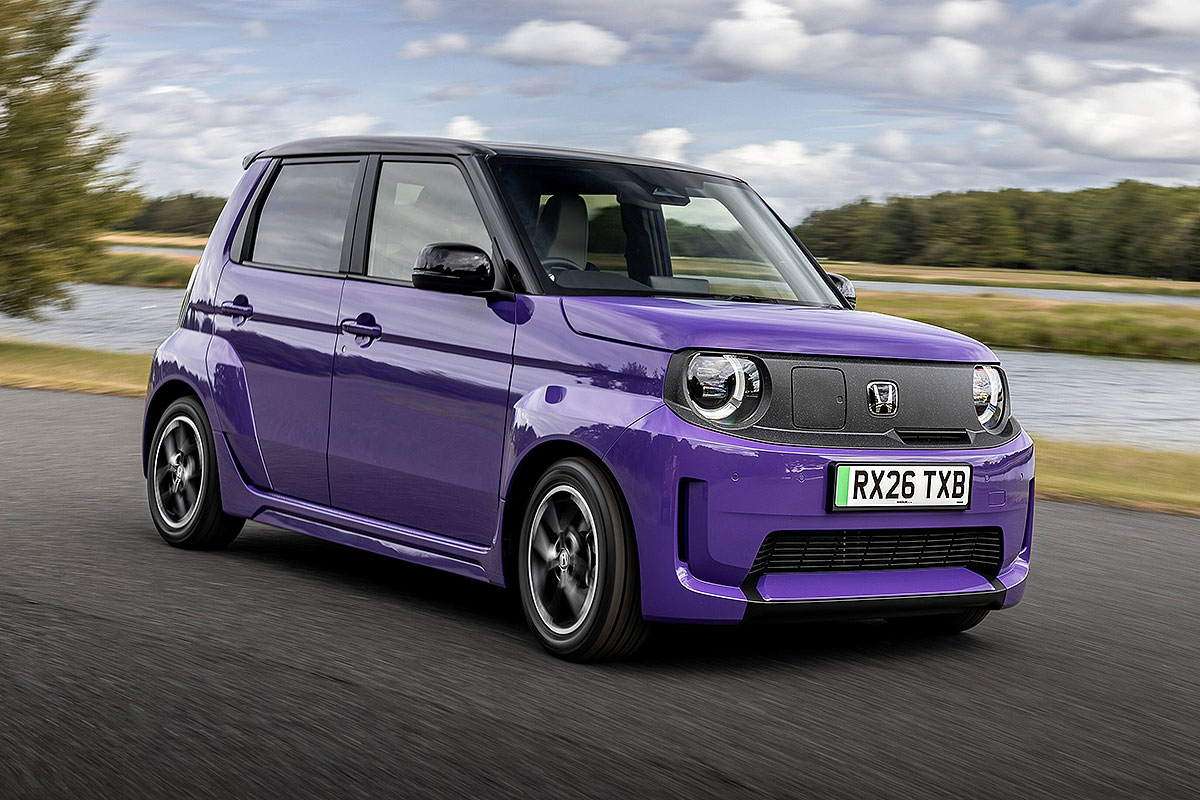
The Honda Super-N is a real charmer. It looks super-cute, and is guaranteed to turn heads, particularly in Boost Violet Pearl. And it’s an ultra-compact, easy-to-park car that’s surprisingly spacious inside too, particularly for those in the front. The large car levels of equipment will embarrass pricier rivals as well – Bose sound systems are normally associated with cars costing three times the price.
The drive is engaging, enhanced by that snazzy engine note synthesiser, which is more fun than it sounds. OK, the handling is ultimately more Volkswagen Up GTI rather than Golf GTI, but it’s a hoot all the same, and the associated firm ride is generally tolerable too. Ultimately, it’s the sub-130-mile range that will put some people off, particularly as it doesn’t have especially speedy DC rapid charging. But if you’re mainly going to use it in town, or as a second car, this needn’t be a hurdle. And you’ll be getting a really likeable electric car at a bargain price in the process.

What is the Honda Super-N?
The Honda Super-N is one of the most affordable new electric cars on sale – and certainly one of the most charismatic. It’s tiny, just 3.6 metres long and under 1.6 metres wide, making it smaller than even the Dacia Spring, another budget electric car. But because it’s derived from one of those ingenious Japanese ‘kei’ cars, it’s still roomy enough for four adults inside – and is packed with large car levels of equipment, too.
These roots also mean the Honda Super-N has an exceptionally affordable price tag of just £18,995. This makes it a very relevant new electric car for those seeking to capitalise on its city-focused strengths. Honda also hopes this will make its official WLTP electric car range of 128 miles less of an issue.
The Honda Super-N is derived from the Japanese-market Honda N, a very popular car over there. Due to strict kei car rules, it measures just 3.4 metres long and 1.48 metres wide. ‘Europeanising’ it has stretched both width and height – and also inspired its name, ‘Super-N’.
Honda has capitaised on the boxy little car’s layout to install the city-sized 29.6kWh battery, which is located centrally in the chassis, where the petrol Honda N’s fuel tank would normally reside. This means the cavernous interior space is retained, as are the ingenious folding rear ‘Magic Seats’ we know and love from the Honda Jazz. It’s also fitted wider, tuned-up suspension, grippier tyres and stiffer springs, all to give it more of a driver-focused feel. Sounds very much like our kind of car.
It looks terrific. The flared arches, rear spoiler and larger 15-inch alloy wheels make it looks like a micro-sized high-performance hatch, and it comes in an array of cool colours including this brilliant Boost Violet Pearl hue – which is actually the ‘free’ colour for the Honda Super-N.
This design definitely makes it a more exciting proposition than its obvious alternative, the Dacia Spring. It means it’s well placed to take on the formidable challenge of the upcoming Renault Twingo, too. Other alternatives to the spiritual successor to the Honda e include the Hyundai Inster – looking even pricier with the arrival of the Honda Super-N – the Leapmotor T03, Fiat 500e and BYD Dolphin Surf.
Honda also reckons that the Super-N’s characterful design will also help it take on more affordable versions of another boldly-designed EV, the Renault 5 E-Tech. It’s certainly just as head-turning as the award-winning Renault – but what’s it like to drive?

How practical is it?
The Honda Super-N is remarkably practical for such a short, city-friendly car. It has a high-set driving position, not dissimilar to a small SUV, with loads of headroom and the deep, upright windscreen giving a panoramic view across the bonnet. While the doors are elbow-banging close (there are ‘elbow caves’ shaped into the trim for when you lean your elbow on the arm rest), they’re tall and vertically-shaped, with the deep, near-flat side glass again giving superb sideways visibility. Over-the-shoulder visibility is also brilliant, and because there’s so little beyond them, squeezing the little Honda through city traffic becomes a breeze. It’s refreshing to experience a car that’s so compact, yet so comfortable for passengers.
The front seats are proper hip-hugging chairs, with deep side bolsters to give it a sporty feel. They’re trimmed in premium-feeling hot hatch-like upholstery, which is partly made from Honda factory worker uniforms that have been recycled, and they’re nicely adjustable – if you can squeeze your hand in between the side of the seat and the door. There’s good all-round support, and they hold you in tightly, aided by the grippy seat material itself.
Because the doors are so tall, it’s really easy to step in and out of the Honda Super-N – you almost ‘walk’ in and out of it. There’s enough legroom for taller drivers to feel comfortable, although it’s a shame the steering wheel lacks reach adjustment.
Stowage space is less impressive. This is a factor of the Honda Super-N’s sheer size, which doesn’t leave much space for things such as useful door pockets (apart from a bottle holder section, they’re very slim) and ‘big gulp’ cupholders. Bottles will easily fall out if you corner eagerly – best instead to use the deeper, more useful cupholder on the dash to the right of the steering wheel. Oh, and the Honda Super-N doesn’t only lack wireless smartphone charging, it also lacks anywhere obvious to store your mobile: the shelf on the dash is far too plasticky and slippery to be useful (it really needs a rubber covering to make use of the USB charging sockets). Indeed, while impeccably well-built, the whole interior lacks the sort of posh plastics we’ve become used to these days.
What you do have are proper physical buttons and dials for the upscale climate control system, along with more buttons to shift gears, and a physical lever for the electric parking brake. There are more buttons on the steering wheel, all clearly labelled, and proper controls to adjust the door mirrors too. The Honda Super-N is very much a car you can simply get in and drive.
Rear seat space isn’t bad for such a small car, either. The tall door openings again make it easy to get in and out, and the two-seat rear bench is again nicely-trimmed. The rear seat does feel a little perched, and headroom isn’t great for taller adults, but it’s still more accommodating back there than you might expect.
This comes at the expense of boot space. Its headline 165-litre figure is absolutely tiny – a Dacia Spring’s boot is almost twice the size. However, Honda has made the compact space as practical as can be, thanks to plenty of depth; the tailgate itself is also ultra-deep, opening really low to make things nice and easy to load. There’s a bit of space below the boot floor for charging cables, and the rear seats fold easily to open up 967 litres of space.
The Honda Super-N also has the firm’s ingenious ‘Magic Seats’. The bases can easily be flipped up and secured alongside the backrests, liberating an open-plan rear area that’s really practical if you want to use it in two-seater mode. They fold flat in one extra move, and there’s even space below the rear seat in four-seat mode, a bit like you used to get with the original Mini. This is a brilliantly practical touch no rival can match.
For a city-sized car, overall refinement is pretty good. It’s serene and smooth around town, aided by the silent-running electric motor, and this helps you make the most of the premium Bose sound system (amazingly, fitted as standard). Noise levels inevitably increase as speeds rise, and you’ll start to notice wind noise caused by the boxy shape front around 65mph, but it’s impressive overall – and certainly more refined than a Dacia Spring.
What's it like to drive?
When it comes to driving the Honda Super-N, the star of the show is the vibrancy of its ‘Boost’ mode, accessed via a button on the steering wheel. It’s one of several modes, but not the default one, with more sensible ‘econ’, ‘city’, ‘normal’ and ‘sport’ modes being the default choices. In these modes, the Honda Super-N’s power output is capped to 63bhp, and while it has that smooth, premium-like electric car power delivery, acceleration is pretty meek.
However, press that anodised purple steering wheel button, and Boost mode transforms the Honda Super-N. Power is instantly upped to 94bhp, and 0-62mph acceleration plummets from 14.5 seconds to 10.0 seconds. It really does feel like it suddenly has twice the power, with much sharper accelerator pedal response and the ability to easily dispatch traffic and rocket out of junctions. If has the sort of of energy that makes you believe you could beat a Volkswagen Golf GTI away from the lights, even if the reality might be a little different.
Boost mode also comes with a fun fake engine note. This revs up and down through seven simulated gears controlled by paddles on the steering wheel, sounding a bit like a deep-throated turbo car combined with a higher-revving Honda VTEC hot hatch. It’s obviously artificial, but is quite pleasing all the same, particularly as the exhaust note is played through the rear speakers with the higher-pitched noises coming from the front ones, to better mimic a real petrol car. It will even hit the ‘rev limiter’ if you don’t change gear, with acceleration paused until you shift into the next gear. I loved it, with the gamer-like sensations suiting this charismatic car perfectly.
The Honda Super-N has beefed up suspension that includes a wider track, firmer springs and even exotic aluminium lower suspension arms. The engineers have also fitted grippy, performance-focused Yokohama tyres, rather than more eco-friendly rubber, to enhance cornering grip and response.
You’ll certainly feel this when you drive the Honda Super-N for the first time. The firmness is pronounced, and it can jump and joggle over city centre bumps. It’s not stiff, harsh or crashy, remaining on the right side of comfortable, but the sporty feel is obvious – it’s a bit like how the old Volkswagen Up GTI felt, when compared to a regular Up. This energetic feel continues as roads open up. It feels bouncy and energetic, always reminding you about its compact dimensions, without becoming too tiring or uncomfortable.
The pay-off is plenty of fun through the corners. The Honda Super-N is responsive and has loads of grip, enabling you to barrel into tight bends and roundabouts safe in the knowledge it won’t run wide. It traces your lines faithfully and serves up a nicely planted, confident feel that’s huge fun. Despite being so tall and slab-sided, body roll is well-controlled, too.
The one weakness is the steering, which isn’t as sporty as the rest of the Honda Super-N. It’s light and effortless in town, but lacks feel and feedback on the move. It’s rather slow just off-centre and has a mushy feel that means you have to trust in the grip of the tyres rather than feel it through the steering.

Technology, equipment & infotainment
The Honda Super-N has a very comprehensive standard specification, far more generous than the city car norm. This includes 15-inch forged alloy wheels with those premium Yokohama tyres, a premium Bose sound system including a subwoofer and central dashboard speaker, climate control, power-fold door mirrors, keyless entry, heated front seats and steering wheel plus a full suite of Honda Sensing safety assist tech (elements of which can be easily disabled by a scroller on the steering wheel).
It has a 9.0-inch central touchscreen combined with a 7.0-inch driver display. The touchscreen runs familiar Honda software, but has actually had an upgrade, so the menus are more logical and easier to use, even if it is still a bit basic. If you prefer to use your mobile, wireless Apple CarPlay and Android Auto are standard – and I noticed Google Maps sat nav directions show up in the driver’s display, if you don’t want to stare at the central map or rely on voice guidance. It’s just a shame about that lack of a place to keep your mobile (or, indeed, wireless charging).
The Boost mode tech is interesting, because of how the Honda Super-N’s character is transformed. It even switches into a dedicated driver display, showing battery temperature, power output and ‘revs’. Honda says the power boost isn’t time-limited either, so is there whenever you’re in Boost mode. Makes you wonder why it didn’t offer more power in some of the other modes…
Even though it was originally a Japanese-market car, the Honda Super-N has the full suite of European safety assist tech. It works well – lane-keep assist isn’t too annoying because it is so narrow – and it’s easily disabled. Other tech highlights include full LED lighting and the MyHonda+ smartphone app, helping you remotely monitor charging and other important details.

Honda Super-N running costs
The Honda Super-N has a 29.3kWh battery which, as we mentioned, gives a headline range figure that will deter many – just 128 miles. The reality is rather different. For starters, the official city-based figure is a much more impressive 199 miles, and this is the area in which the Honda Super-N lends itself.
‘My’ car was fully charged when I started out, and duly showed a 128-mile range. This was with it set in ‘econ’ mode, though; as soon as I switched into ‘normal’ mode, it dipped by six miles (presumably by altering the potency of the climate control on a hot summer afternoon). It proved extremely efficient in action, too – in the latter half of my mixed-roads test drive, I was averaging an excellent 5.6 miles per kWh, and when I got back to base, the range was showing 99 miles with 78% charge. This is all thanks to the Honda Super-N’s light weight and sheer efficiency, meaning it may well prove more useful in everyday driving than you might expect.
Of course, this also pays dividends in terms of running costs. Electric cars are cheap to fuel anyway, and the Honda Super-N will simply underline this money-saving potential. Other strengths include a predicted super-low insurance group 13, plus a highly competitive launch PCP finance deal that serves up monthly payments from just £199.
It does have DC rapid charging, but the rate is a yawningly slow 50kW. Even so, because the battery is so tiny, Honda says this is enough to take it from 15-80% in around half an hour. And, with running costs in mind, you may prefer to avoid expensive public rapid charging and keep it topped up using cheaper electricity from home…

Honda Super-N reliability
Honda’s reputation for reliability is second to none. The Japanese-market Honda N is one of the best-selling cars over there, and the Honda Super-N takes all that car’s integrity and adds on ultra-dependable electric car running gear to potentially make it even more fault-free.
Certainly, build quality felt exceptionally tight. There’s a lightweight feel to the Honda Super-N, perhaps inevitably so given its city car roots, but all the bits that matter feel like the have the same integrity as a Jazz, Civic or CR-V. It also displayed superbly tight panel gaps, and paint quality was excellent too.
For third-party reassurance, Honda was ranked the most reliable car brand of all in the latest What Car? reliability survey. There’s little doubt the Honda Super-N will continue this proud trend for dependability – especially as Honda is offering it with a free eight-year service-activated warranty.
- Honda reckons the Super-N’s bargain price will help bring new customers into the brand, as well as its usual loyal base. The aim is for 7 in 10 of them to be new to Honda, with the firm focusing on both younger people aged in their mid-20s to mid-40s, and those in their 50s.
- The Honda Super-N is a timely arrival. The firm expects the electric city car sector to grow rapidly in coming years; it’s already up nearly 300% year-on-year, and is on track to take more than 5% of the overall new car market by 2029.
- The Honda Super-N means the firm once again can offer an EV, following the withdrawal of the Honda e:NY1. Production of the radical Honda e stopped a few years ago: the Honda Super-N offers a similar range to that car, but at less than half the price…
- There is only one Honda Super-N model to buy, which makes choosing one easy: everything is fitted as standard, and you don’t have to worry about different motors, battery sizes or other details.
- The vibrant Boost Violet Pearl paint is also standard – this is the feature colour that appears in all the advertising. It’s a vivid, wonderful hue that really suits the character of the car.
- If you want an alternative colour, Honda offers four of them, all priced at £675. Pick from white, blue, grey or black. You can have a two-tone option, with a black roof, for an extra £300, and Honda also offers a body stripes kit.

