Renault Twingo 2026 review | Small French EV is dripping with appeal
Renault Twingo cars for sale
5.0
Expert review
Pros
Bags of character inside and out
Really fun to drive
Surprisingly practical for such a small car
Cons
A few ergonomic foibles
Limited driving range
Not quick. At all

The CarGurus verdict
It’s impossible not to be happy when you’re driving around in the Renault Twingo E-Tech. It's such a fun, cheerful little car, and yet it’s also a really sensible and affordable option for a lot of drivers who want a small car for local journeys, or as a second car in the household.
While a used Hyundai Inster could be a better option for some drivers who want a fun, compact car like this, but still want a bit more range, the Renault Twingo is one of the best affordable electric cars you can buy.
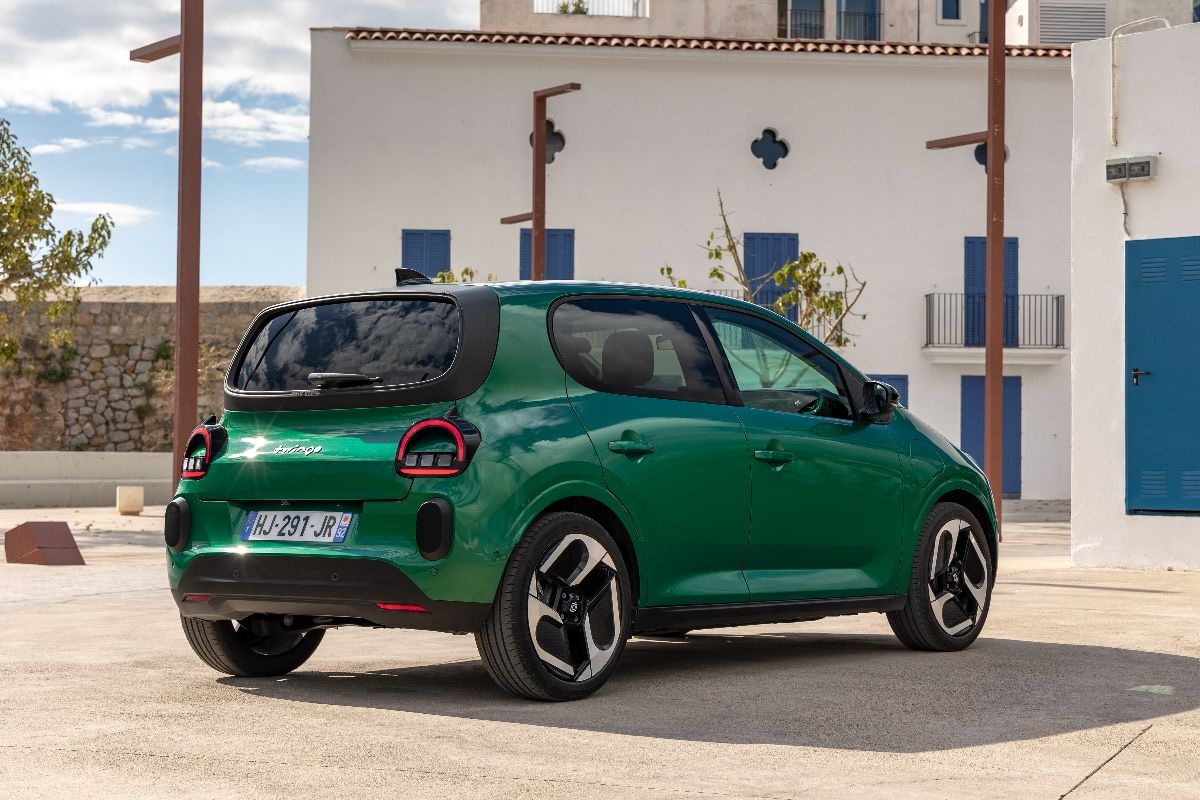
What is the Renault Twingo?
The Renault Twingo is a small electric car that – at 3.8 metres long and with a dinky 27.5kWh LFP battery – is designed to be a good option for those drivers who don’t often do longer journeys.
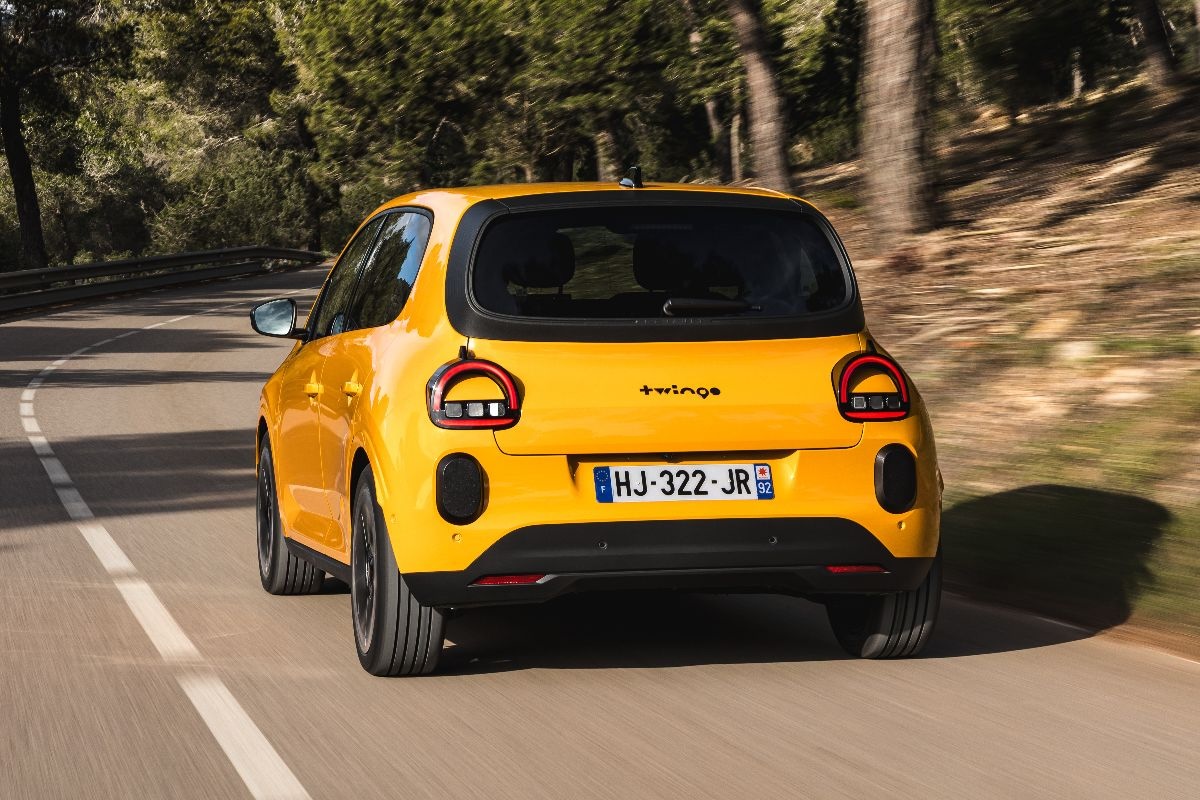
You can make your own mind up about the styling, but we’d say that this is a masterful modern reincarnation of the goggle-eyed original Mk1 Renault Twingo of the 1990s. Between this new Twingo and the Renault 5 and Renault 4, the French brand is on a huge winning streak when it comes to making small EVs that are sensible and yet also remarkably desirable. These are great value, well sorted little electric cars that you also really want because they just look so brilliant, and that’s a tricky thing to do. We’ll take our Twingo in Mango Yellow, thanks.
It’s a bit of an urban and suburban specialist, the Renault Twingo. It’s based on the same platform as the Renault 5, albeit with a rear axle from a Renault Captur and a few other tweaks. Built in Slovenia, this little, front-wheel drive EV manages a 163-mile WLTP range from its teeny battery, not least because the Twingo only weighs 1200kg. That helps it to make it one of the most efficient electric cars on sale, with a claimed efficiency of 5.9 miles/kWh. Our experience of driving the fun little Renault on the international launch tells us that it’s also very efficient in the real world, but read on to find out a bit more about the real-world range and running costs.
How practical is it?
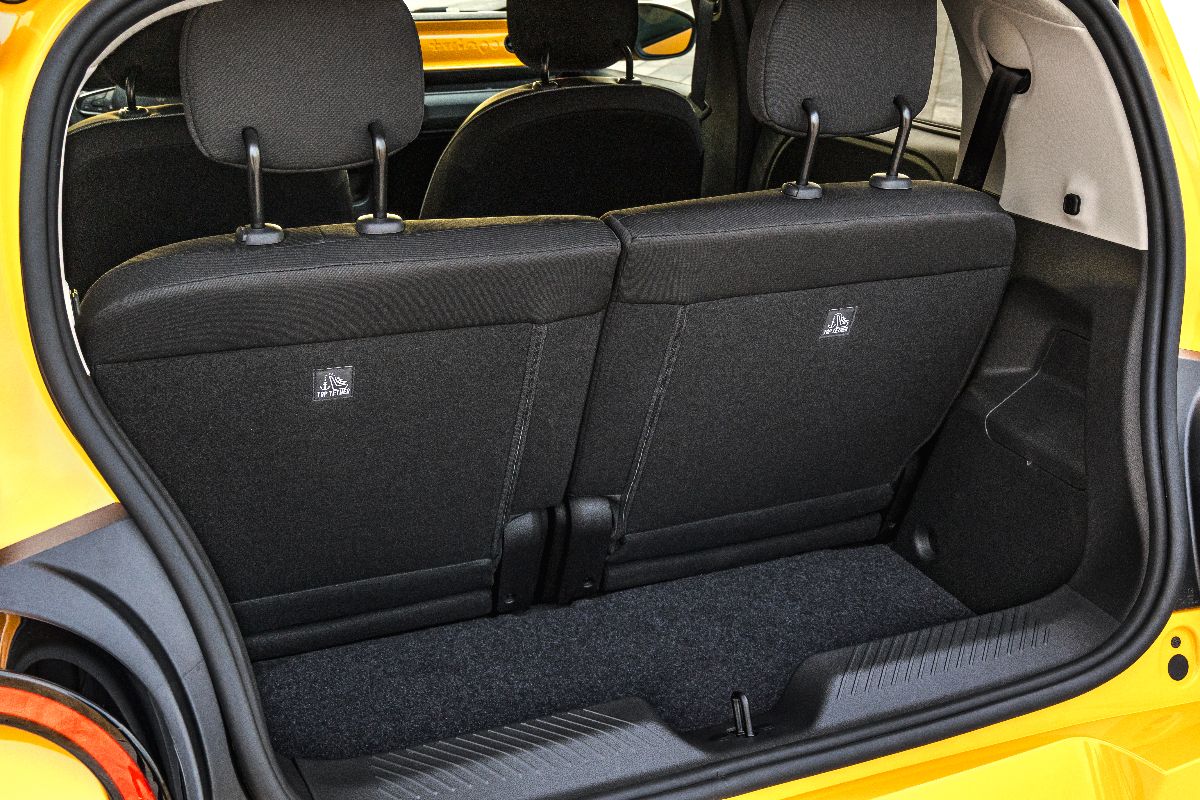
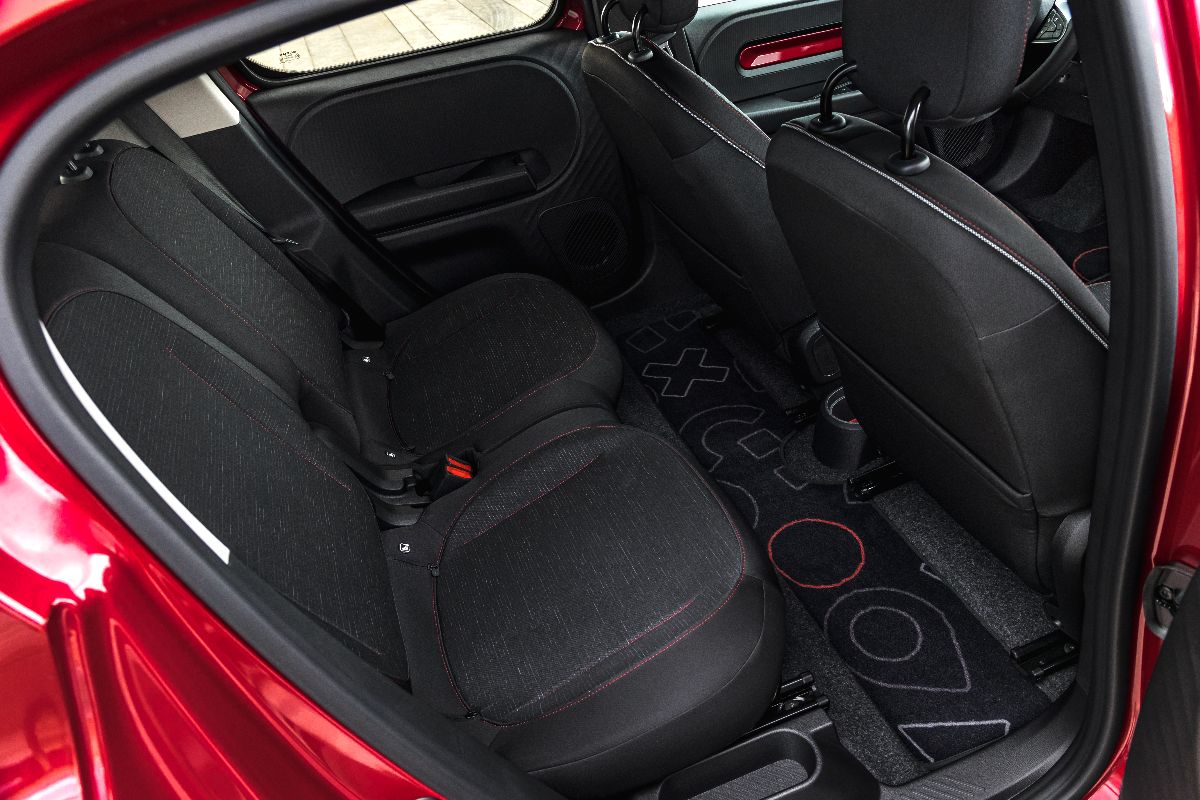
The Renault Twingo is a five-door hatchback, which immediately makes it much more practical than the three-door Fiat 500e. The rear seats in the Twingo slide for-and-aft by 17cm, and while you won’t have much legroom at all if you slide them forwards, being able to prioritise luggage or passengers is always a handy choice to be able to make.
With the seats slid back, there’s pretty good passenger space and even an average-sized adult will be fine back there for shorter journeys, and kids will be absolutely fine. Sadly, we don’t get the fold-flat front passenger seat in the UK; that’s reserved for left-hand drive markets.
Boot space is between 260- and 360 litres depending on where those seats are set, which is not bad at all by the standards of little city cars like this. There’s even some underfloor storage for your charging cable.
Up front, the driving position is okay: there’s rake- and reach adjustment for the steering wheel, and while the seats are quite flat, they’re more than comfortable enough even for longer journeys.
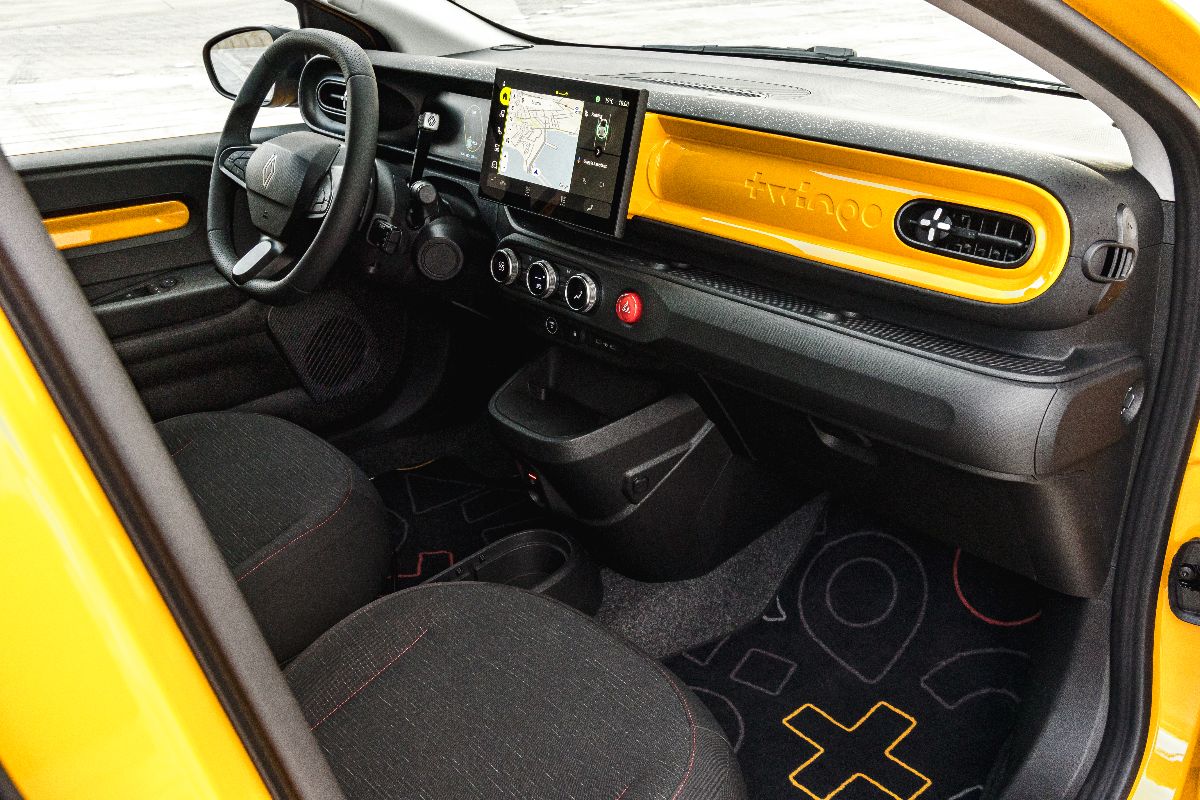
There are also some fantastic design details around the interior. The colourful carpets are fantastically ‘90s, and Renault has even designed an entire alphabet of new font for the Twingo, all based on modern iconic design features like the Google maps pin and Playstation controller. That alphabet is printed on the roof lining of the Twingo, and is used to spell out the model name on the boot. The body-coloured panels on the dashboard and doors look cool, too (the section on the door panel is actually just bare metal that would have been painted in manufacturing, anyway, so it saves Renault some money to have it exposed). A huge, red hazard warning lights button is very prominent on the dash and is also a nod back to the original Twingo.
Our only complaint is that the Twingo suffers the same issue as most Renaults, where there are too many stalks clustered around the right-hand side of the steering wheel. It makes it very easy to get the wrong stalk and end up wiping your windscreen when you were intending to engage reverse.
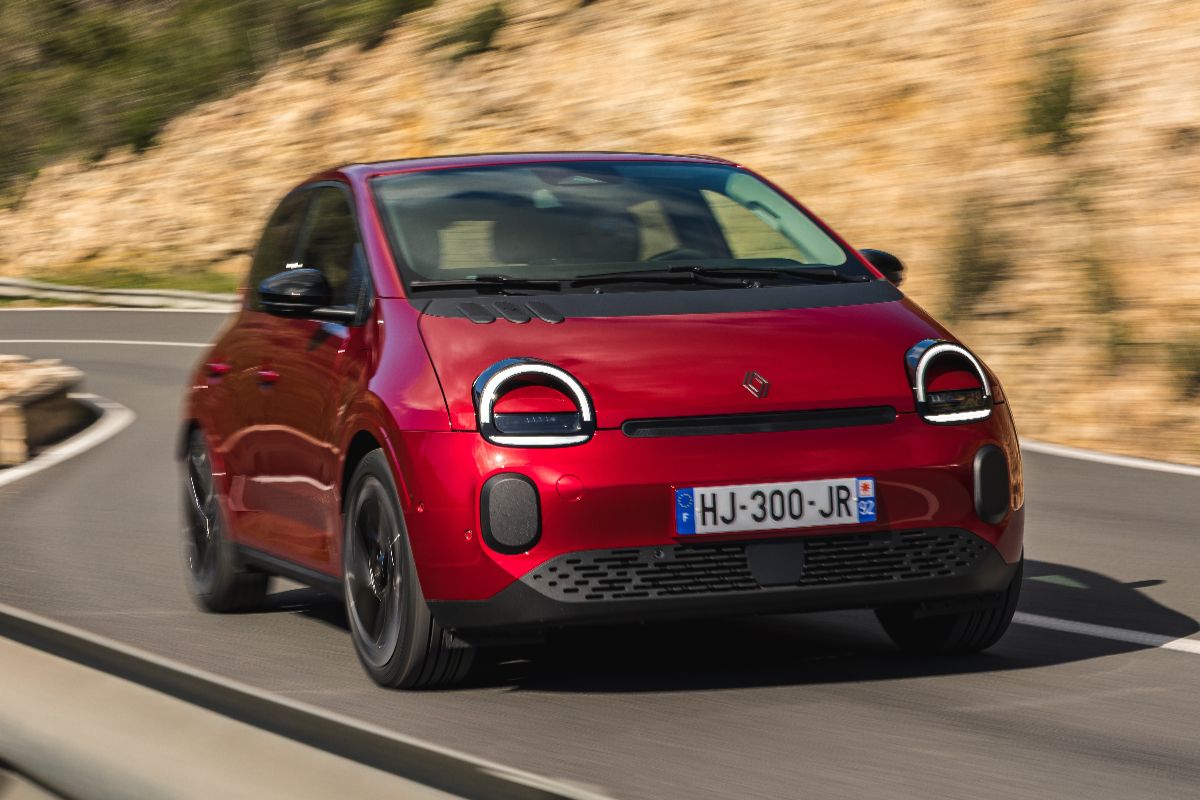
What’s it like to drive?
The Renault Twingo is an uncomplicated delight to drive. There are no drive modes, no variable steering, no adjustable dampers; it’s just a lightweight, well-judged small electric hatchback.
It’s not quick, of course. The electric motor that powers the front wheels only produces 80bhp and manages a 0-62mph time of 12.1sec. That’s a bit slower than rivals like the Fiat 500e, BYD Dolphin Surf, Citroen e-C3 and Hyundai Inster, but in practice it doesn’t feel too bad at all. At anything up to about 50mph the Twingo feels pretty perky and responsive, and only above that does it feel a bit wheezy.
In terms of how it handles, though, the Twingo feels secure and surprisingly solid for a small car, so while it’s not rapid, you’ll feel more than happy on the odd motorway journey. The steering feels nicely weight and intuitive, there’s plenty of front-end grip, and it’s actually really good fun to drive, even on a faster country road, or if you’re winding through town.
Good ride comfort also helps with that. Having a short wheelbase and being fairly lightweight, it’s no surprise that the Twingo can be a touch bouncy over harsher speedbumps and the like, but it rides brilliantly over most coarse surfaces and patched-up roads. It’s a very well-sorted little car that’s fun, comfortable and confident even at higher speeds. It’s what small hatchbacks should be, really!
Brake regeneration is controlled via paddles on the steering wheel, and it’s a nice, smooth system that offers three levels of fixed regen’ and a one-pedal mode, although you may get a more basic regen' system on the entry-level Twingo.
Technology, equipment & infotainment
Every Renault Twingo gets a big touchscreen infotainment system, although it’s likely that you’ll have to go for the top-spec car to get the Google maps and other apps that we’re familiar with from the Renault 5 and 4. The more basic-spec Twingo will probably just rely on wireless Apple CarPlay and Android Auto phone mirroring for nav, but UK specifications and pricing haven’t been confirmed at the time of writing, so we’ll have to wait and see.
If European specs are anything to go by, the entry-level Twingo in the UK will get air-con, sliding rear seats, the touchscreen system and digital readout, but you’ll have to step up to the higher spec model to get heated seats, a reversing camera and keyless entry. The variable brake-regen modes and one pedal drive could also be optional or only available on the higher spec Twingo, so it’s all stacking up that the top-spec car will probably be the one to go for, even if that sub-£20k entry-level car will be very tempting.
Renault Twingo running costs
We know that the Twingo is going to cost from under £20,000 when it goes on sale in the UK later in 2026, but we don’t have the specifics on pricing. Ultimately, the important thing will be the monthly finance and lease costs, which we’d hope would start from £200 per month with a reasonably low deposit. Much more than that and it’s straying into the monthly costs that you can have on a Renault 5, which might make the Twingo a little hard to justify.
Insurance costs should be very low, and the Twingo certainly won’t cost much to fuel. We managed close to 5.0 miles per kWh in warm weather and varied driving including a lot of faster roads. In the UK, that works out at as little as 2p per mile if you’re charging from home on a off-peak tariff costing under 10p per kWh. If you’re charging at a standard day rate of under 30p per kWh then it’s more like 6p per mile.
Public charging will cost more – and varies drastically depending on which charge provider you’re using - but the Twingo will likely still be cheaper than an equivalent efficient petrol car that’ll be costing around 15- to 18p per mile in petrol.
Renault Twingo reliability
The Twingo is too new to have been included in any owner surveys, but Renault as an overall brand was ranked 20th out of 30 brands surveyed in the 2025 What Car? Reliability survey.
You get a three-year, 60,000-mile warranty as standard on the electric Renault Twingo E-Tech, which is the same as you’ll get on the new VW ID.Polo, Fiat Grande Panda and Dacia Spring. Mind you, BYD, MG, Toyota, Kia, Hyundai and Peugeot all offer much longer warranties.
- In some markets, the Twingo won’t have 50kW DC rapid charging as standard, but we’re told that it’ll likely be included on all UK Renault Twingo cars. That’s still not a very fast maximum charging speed, but with such a small battery, it’ll do a 10-80% charge in around 40 minutes. AC charging is up to 6.6kW, so if you plug the Twingo into a standard 7kW home charger then it’ll be fully charged in around six hours.
- Those very cool colours – the metallic green and red, and the yellow that we particularly love – will also likely be optional on the Twingo, with basic white as the only standard colour.
- The Renault Twingo has a turning circle of 9.85m, which is useful for making it really manoeuvrable in tight spots.
- If you want the best value: We don’t have finalised UK specs and prices yet, but the higher of the two trim levels available on the Twingo adds some important stuff, particularly heated seats, and is likely to hold its value better and not cost a huge amount more if you’re paying on monthly finance. Don’t discount the entry-level car, but the better equipped trim may well cost a very similar amount over the life of ownership, and will be better to live with.
- If you want the best family car: Go for the top-spec car in a bright colour. The kids will love it. There’s no word of a sunroof just yet, but watch this space, as Renault has said that it plans to do various special editions that will take further inspiration from the original, and a Twingo with a glass roof – and maybe even a version with a scrolling fabric roof – could be possibilities.
- If you want the best model for a learner driver: The electric Twingo will be a great first car for a learner or new driver. It’s intuitive and unintimidating to drive, has good visibility and is equipped with air bags and autonomous emergency braking. It is likely to get additional safety features on the top-spec car, so that’ll likely be the one to go for. It hasn’t yet been crash tested by Euro NCAP.
- If you want one that isn’t electric: There is no petrol Renault Twingo: it’s only ever going to be an electric car. The bigger Renault Clio is as close as you’ll get to a petrol Twingo from the French brand, or we’d point you towards the Toyota Aygo or Kia Picanto as fun, compact, great-value petrol ‘A-segment’ cars that are closer to the Twingo in nature and price than the Clio.

