Jaguar XF Mk1 Review (2007-2015)
Jaguar XF cars for sale
4.0
Expert review
Pros
Fabulous handling
Great interior
Roomy as a saloon or an estate
Cons
Reliability might be a concern
R-Sport models have a firm ride
No plug-in hybrid option
The CarGurus verdict
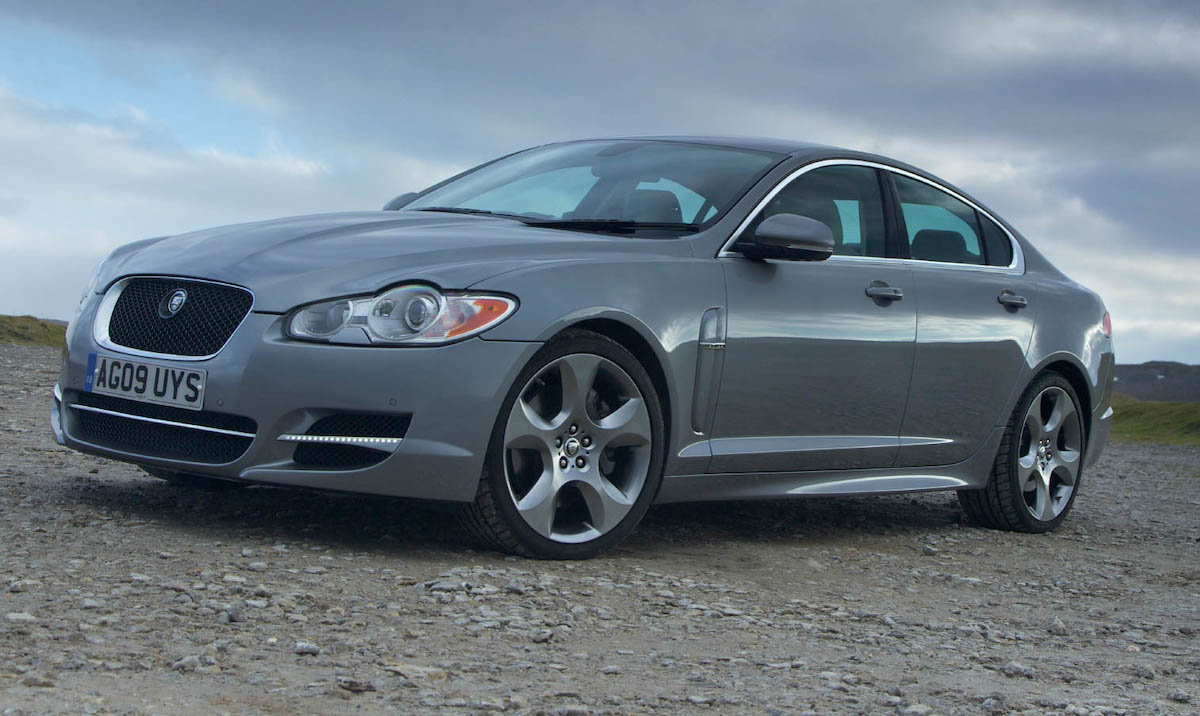
The Jaguar XF mk1 is a sophisticated and attractive executive car with a charm and ambience that sets it apart from more austere, German, rivals. If you were to conduct a ruthlessly objective group test against similar Audis, BMWs and Mercedes then the XF mk1 might not win it outright, but many owners have come from those marques and are very content now to be Jaguar drivers.
There isn’t a real duffer in the XF mk1’s diesel engine line-up – the petrol engines are better suited to enthusiasts – and the car’s overall reliability is on a par with rivals’.
Standard equipment levels were very high when the XF mk1 was new, and as most were originally company purchases, chances are you’ll find plenty on the used market bearing some very tasty options. So shop around and study the spec lists carefully – a well-kitted XF mk1 will make you feel very special.
Everyone knew what a Jaguar was before the XF arrived in 2007: traditional in outlook, devoted to wood and leather, and always a few paces behind the leaders in the executive car class. The mk1 XF blew apart those preconceptions and continues to do so. It’s sharply dressed, its cabin is chic and modern, its rear-wheel drive chassis transitions effortlessly between comfortable cruiser and back-road thriller, its steering is a delight, and most of its engines are punchy and smooth. While its contemporary German rivals are paragons of clinical efficiency, the XF proves that excellence doesn’t have to be at the expense of personality.
It underwent a facelift in April 2011, when its headlights were slimmed down, the front bumper and grille were redesigned, and the bonnet line lowered. At the rear, the taillights were refreshed and spilled onto the boot lid, and several improvements were made to the interior and equipment levels.
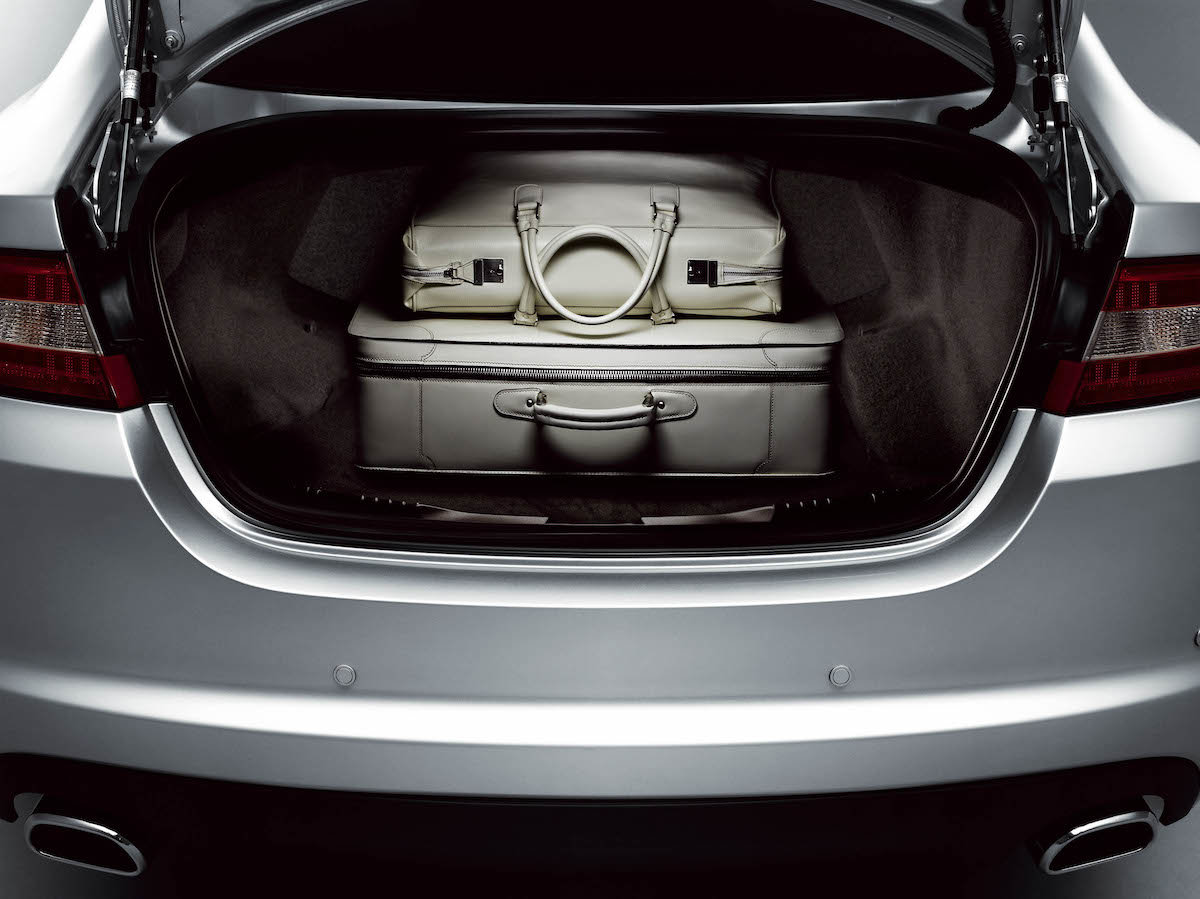
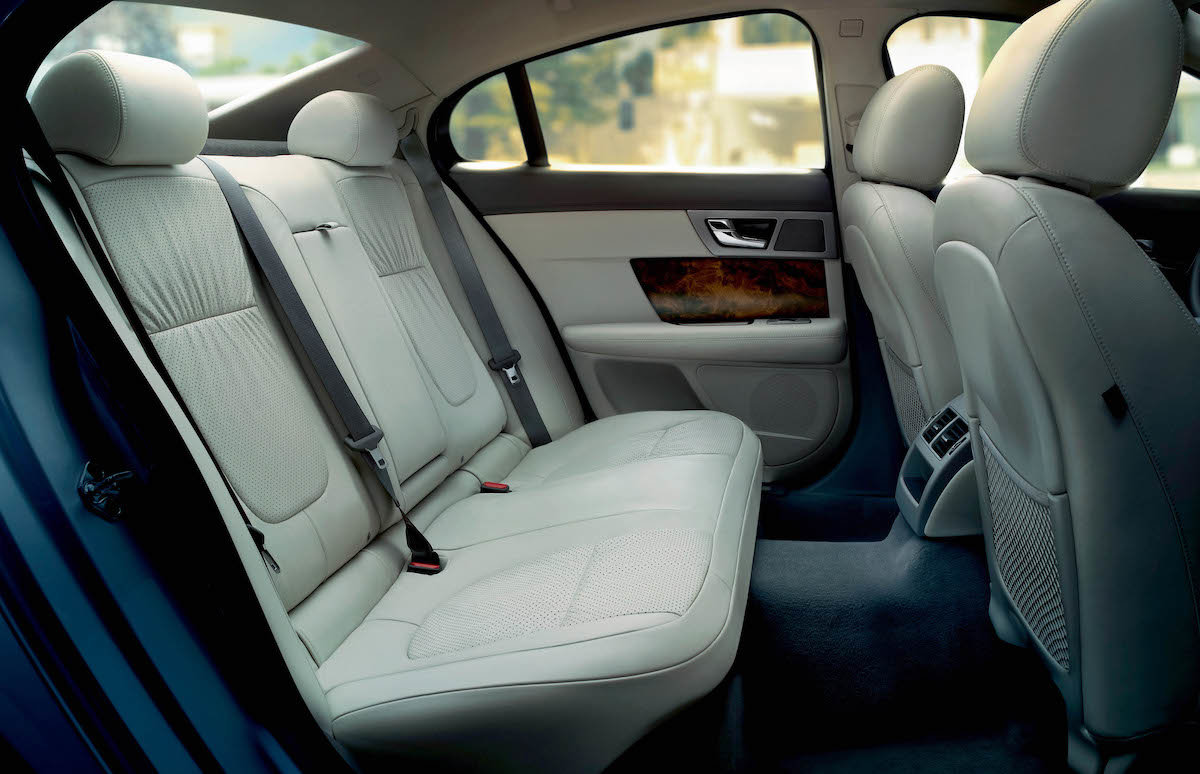
Front-seat passengers have plenty of room, along with the glory of the XF’s smart and hi-tech (for the time) interior. However, space is not so generous in the back; taller adults may find it cramped and rivals such as the Audi A6 and the Mercedes E-Class do a better job in this respect. The 500-litre boot is big and on par with the Jaguar’s main rivals, although there is less space in cars that were fitted with a full-sized spare wheel instead of a puncture repair kit.
If you need more space, then look for an XF Sportbrake (estate). That has a 550-litre boot which extends to 1,675 litres with the rear seats folded flat. The Mercedes E-Class estate of the time has a bigger boot (695/1,950 litres) but it isn’t anything like as good to drive as the Jag.

At launch, the mk1 XF’s engine range comprised a 2.7-litre V6 diesel with twin turbochargers, a 3.0-litre V6 petrol, and a pair of 4.2-litre V8 petrols, one of them with a supercharger and badged SV8. All were mated to an eight-speed automatic gearbox (the mk1 XF was never offered with a manual transmission).
A year or so later, the XF gained a powerful 271bhp twin-turbo 3.0-litre diesel, known as the XF S, while the supercharged V8 engine was uprated to 5.0 litres and 503bhp for the new XFR, which replaced the SV8.
A new 187bhp four-cylinder 2.2-litre turbodiesel engine also coincided with the facelift. It was cheaper to buy and had lower CO2 emissions (149g/km), which appealed to the fleet market, while a 161bhp version of this engine arrived in early 2012, initially with identical CO2 emissions, but that figure fell to 129g/km in 2013.
Also in 2012, the naturally aspirated V8 petrol engine was replaced with the supercharged 330bhp 3.0-litre V6, and the Sportbrake estate version of the XF mk1 was launched. In 2013 the range-topping 542bhp supercharged 5.0 V8 XFR-S made its debut.
The XF’s handling complements those powerful and refined engines beautifully. It’s just so much more agile than its chief rivals, and it was by far and away the driver’s choice in the executive sector of the time. The ride is not as comfortable as, say, that of an Audi A6, but it isn’t terrible, and Sportbrake estate models are more comfortable, because they have self-levelling rear suspension, designed to handle heavy loads.
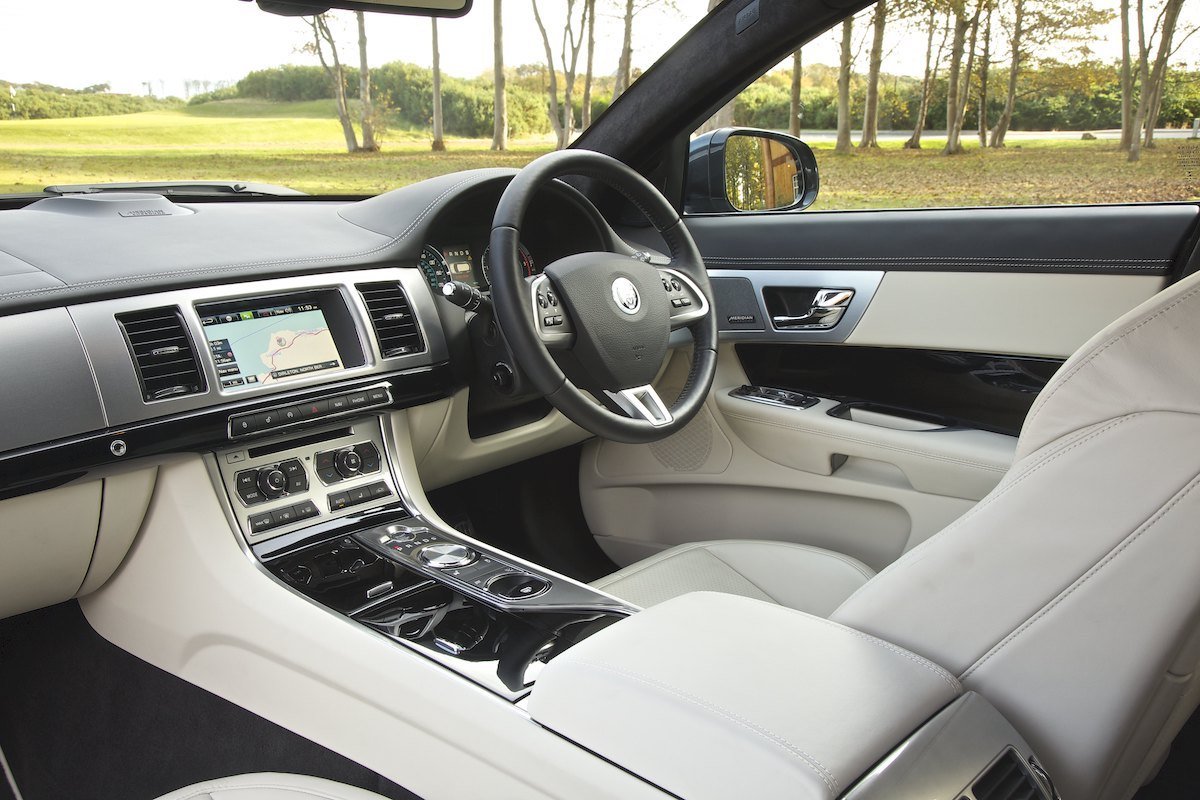
All first-generation XFs are very well equipped as standard, with alloy wheels, air conditioning, satnav, electrically adjustable front seats, and part-leather trim common to all, as is an eight-speed automatic transmission.
The top level trim – if you discount the sporty XFR – is known as Portfolio, which feels as though it’s a bespoke luxury package: original owners could choose from a range of wood veneer and leather options. Regardless of which trim you pick, you’re sure to marvel at the theatrical way the XF’s gear selector rises from the centre console and its air vents swivel open in their sockets every time you turn on the ignition.
Most XF mk1 owners understand that you can’t run an executive class car on a hatchback budget, and believe it’s a worthwhile trade-off for the quality of the driving experience. Jaguar recommends servicing your XF mk1 annually or every 15,000 miles for petrol models or 16,000 for the diesels – the services alternate between minor and major and cost roughly £365 for the former, £475 for the major. And, of course, you’ll do yourself a favour by ringing around the independent Jaguar specialists who are likely to save you £100 or more.
There are additional costs to consider beyond normal servicing. The XF mk1 needs a change of brake fluid every three years (£90 approx.), a change of engine coolant every five years (£115 approx.), and an annual recharge of the aircon (£95 approx.) isn’t a bad idea. The XF mk1 is also very heavy on rear brake pads and discs – the pads are deliberately soft to improve the performance of the electric parking brake – with some owners reporting that they need replacing every 20,000 miles or sooner at a cost of around £500. The XF mk1 is also an avid consumer of (£260 approx.) batteries.
While Jaguar advises that the timing belts on the 3.0 V6 diesel engines are good for 10 years or 112,000 miles, Jaguar specialists recommend that you replace the belts together with the associated belt tensioner, water pump and auxiliary belt every 60,000 miles and certainly no later than 80,000. The twin turbo 2.7-litre diesel is the only XF mk1 with a cam belt (rather than a chain) and it needs replacement every 10 years or 112,000 miles too, at a cost of approximately £800.
In terms of fuel economy the diesels can return as little as 37mpg and as much as 57mpg (although some owners claim to get 25% worse consumption than the claimed figures), with road tax ranging from £125 annually to £305. If you’re worried about fuel costs then the petrol models are perhaps best avoided – the 3.0-litre V6 can just about manage 30mpg, while the V8s struggle to get above 20mpg, and those are the claimed figures. Road tax for the 3.0 V6 ranges from £330 to £565, while the V8s are all £580. Insurance groups for the XF mk1 are generally between groups 33 and 45, but the V8 XFR-S is a whopping group 50.
Some XF mk1 owners report trouble-free motoring, others are plagued with persistent problems. And then there are owners who’ve had issues, but are prepared to forgive their XF mk1 for the inconvenience: it’s that sort of car.
In common with so many diesel cars used mainly around town, diesel particulate filters (PDFs) can be irksome in the XF mk1, clogging up with soot because they fail to self-regenerate and causing the diesel fuel that was supposed to do the cleaning to drip down into the sump and raise the oil level, making the car run poorly or stop altogether. In the XF mk1, however, this is sometimes just a faulty sensor in the PDF and it’s only that part that needs replacement.
Sticking with the diesels for a moment, the 2.7 and 3.0 engines aren’t fans of bio-diesel fuel with a bio content of more than 7%, and Jaguar recommends you avoid the 20% bio brew completely. And talking of fuel, the XF mk1 can suffer from what’s now know as ‘fuel tank slap’, where the tank makes a thudding noise during hard braking. Sometimes the approved remedy doesn’t sort it out, so in a test drive stamp on the brakes to make sure the car you’re contemplating isn’t affected.
Rust is starting to become a nuisance on some XF mk1’s, forming on the inside of the door where soundproofing has become sodden and then eating its way outwards. Given that a set of new doors can cost more than £4,500, it’s worth checking the underside of the bottom of the doors for signs of rust-coloured stains around the drain holes.
Trunking for the wiring loom in the boot can get trapped in the hinges and break wires to the tail-lights, while at the other end of the XF mk1 the sensors for the pedestrian safety system under the bonnet can be overly sensitive, triggering a deployment of the under-bonnet airbags when driving over sleeping policemen. And that’ll be maybe £3,000 or so for a new bonnet, hinges and airbags.
Electrical gremlins afflict the XF mk1 as they do all modern cars, so check everything in the car works as it should; make sure the electric parking brakes goes on and comes off without complaint, as replacing it requires dropping the rear suspension and a bill of about £800.
– The XF S, with its twin-turbo 271bhp 3.0-litre V6 diesel engine, was the darling of Jaguar’s marketing department who were keen to push it as a sporting saloon. Two options packs were introduced specially for the S in May 2010, the Dynamics Pack, which added adaptive suspension and 20-inch alloy wheels, and the Aerodynamic Pack that borrowed heavily from the XFR’s aero package. The diesel S’s interior was simultaneously upgraded with the sports seats and other elements from the XFR’s cabin. It’s worth hunting out an S thus equipped, as its performance is awesome and it costs far less to run than a petrol XFR. – If your budget stretches that far (and you don’t prefer the looks of the earlier car) then look for a facelifted model, from April 2011 onwards. The satnav and infotainment systems were upgraded, there was revised switchgear for the aircon and, more importantly, the profiles of the seats were improved for greater comfort. The front seats in pre-facelift Luxury models lacked lumbar support and some owners complained that the crossmember at the base of the backrest could be uncomfortable on long journeys. – As well as a long list of standard convenience and luxury features, the XF is fitted with several standard driver assistance systems, including Understeer Control Logic to assist you through corners, a Blind Spot Monitor, a rear parking aid, and a Pedestrian Contact Sensing System. If you reach the point of collision, the latter system uses airbags to push the bonnet up slightly, creating a gap between it and the hard and unyielding engine beneath. It’s a great idea, but some owners say the airbags have been triggered by sleeping policemen.
- If you want the best all-rounder: The mid-range strength of the XF mk1's diesel engines is a winner in everyday driving, and you also enjoy the benefits of lower running costs than the petrol models. The 2.2-litre diesel is the most efficient but feels a bit weedy: we'd recommend the gutsy 3.0-litre V6 twin turbo in either 236bhp or 271bhp guises. As for a trim level, go for the best you can afford from the Luxury, Premium Luxury and Portfolio line-up.
- If you need more boot space: The XF mk1 has a big boot. But if that's not enough, then it's the Sportbrake for you. It's not the most capacious estate car in the executive class, but it's as stylish as its four-door sibling, features a useful storage compartment under the boot floor, has a 'ski hatch' through the rear seat backs for long items, its seats fold flat, and it features a floor rail system for securing loose loads.
- If you want to tow a caravan: Despite what we say about the 2.2-litre diesel being short on puff, in 2014 an XF mk1 2.2 Luxury won its class in the Caravan Club Tow Car of the Year competition. Owners also praise the XF mk1's reversing camera (where fitted) as it gives a clear view of the tow hitch.
- If you want to go very fast and make a great noise: With your sensible head on the 271bhp XF mk1 3.0 V6 twin turbo diesel is more than quick enough for UK roads, but for drama and thrills it has to be the 542bhp supercharged V8 XFR-S. Just make sure to get a loyalty card from your local petrol station because you'll be there a lot.


