KGM Musso EV 2026 review | A quirky, but surprisingly likeable, electric pick-up
KGM Musso cars for sale
4.0
Expert review
Pros
Car-like driving experience
Smart, high-quality interior
Extraordinary value
Cons
Miniscule payload
Underwhelming towing capacity
Sluggish touchscreen

The CarGurus verdict
The KGM Musso EV might not have been at the top of your EV shopping list. But if it’s particularly an electric pick-up that suits your needs, perhaps it should be.
True, it won’t be much good if your use case requires you to haul or tow heavy loads. The Musso EV’s lacklustre payload and average towing capacity put paid to that.
But not everyone needs a pick-up that can do that. Indeed, if your payloads tend to be relatively light – gardening implements or lawnmowers, for example, or perhaps mountain bikes and paddleboards at the weekends – then the Musso EV is a pretty savvy choice.
As pick-ups go, it’s smooth, comfortable, well-equipped and good to drive. And while its range and charging speeds aren’t going to rival the best electric cars, they’re plenty for most commutes and weekend days out – and, crucially, enough to surpass all of the Musso EV’s pick-up peers.
All in all, then, this is a surprisingly likeable and – in the right circumstances – extremely useful little truck, backed up by a long warranty, and available for a low price. Write it off at your peril.
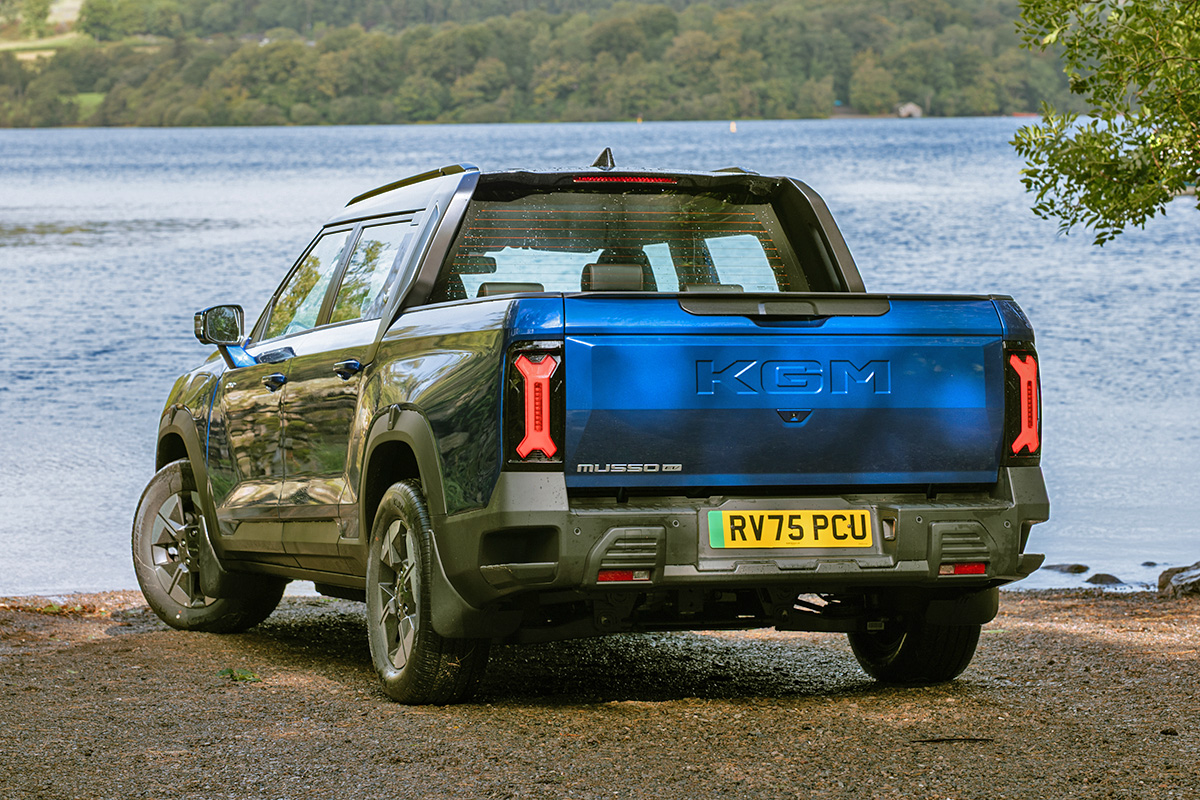
What is the KGM Musso EV
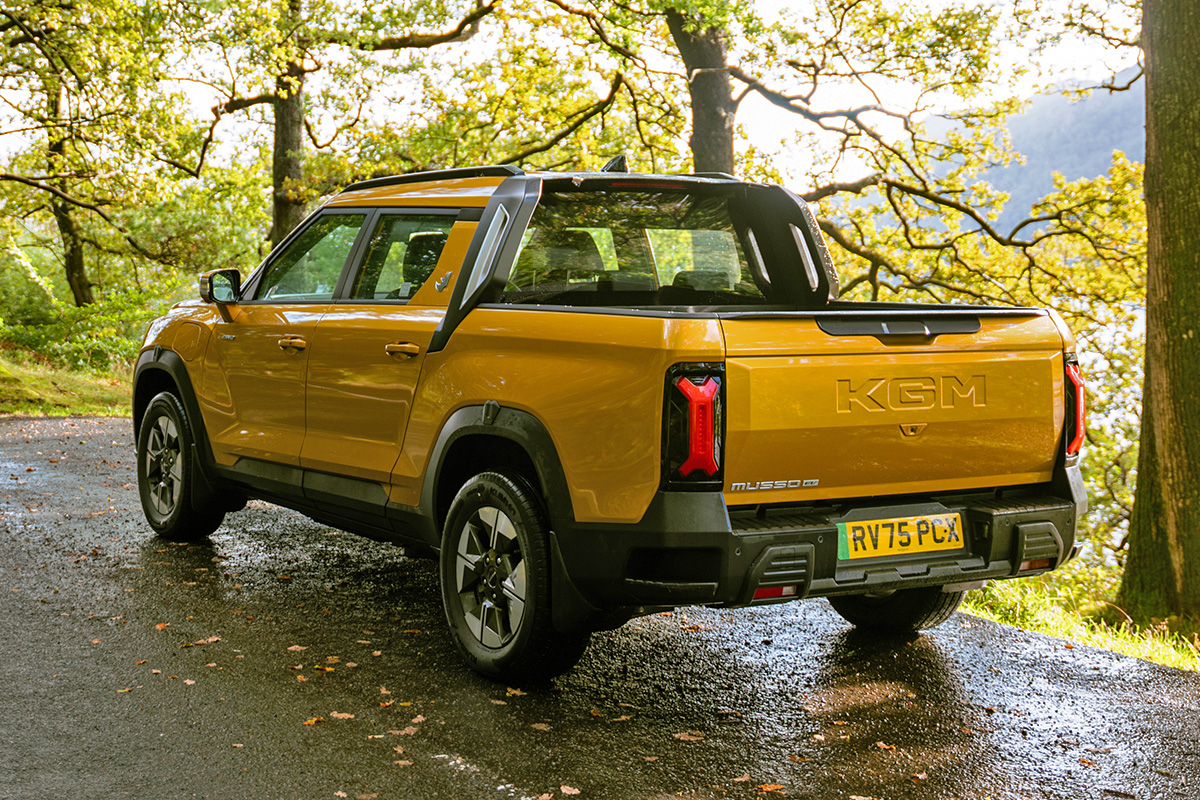
If you’re looking at the pictures, and thinking “Hang on – this pick-up doesn’t look particularly big and imposing, like so many other pick-up trucks do” – well, you’re not wrong.
This is the KGM Musso EV, and the name’s a little misleading. Because this car has much more in common with KGM’s latest electric family SUV, the Torres EVX, than it does with the body-on-frame Musso pick-up with which it shares its name.
Under the skin, it’s a monocoque, rather than a ladder-frame construction. Which means its body absorbs most of the stresses and strains of life on the road – rather than being bolted to a big, sturdy separate chassis that does the job instead. And what that means is that it isn’t as tough – or as useful – as some of its pick-up truck rivals. It’s more like an Australian ‘ute’ – which is to say, a car converted into a pick-up truck.
On the plus side, monocoque vehicles are usually much more pleasant to drive – and so it goes with the Musso EV, which is quieter and smoother than most pick-ups. That’ll help it to find favour among buyers who don’t need a huge amount of payload, but do want a useful bit of external space for carrying the sort of cumbersome loads that might be dirty or wet, and that you might not want to put in the boot of a normal car – mountain bikes or watersports kit, for example.
How practical is it?
For passengers, the Musso EV is a pretty decent place to be. In the back seats, it feels very much like any other five-seat family SUV, which means it comes with comfortable seats that aren’t too steeply inclined, as opposed to the slab-like benches you might find in some other double-cab pick-ups.
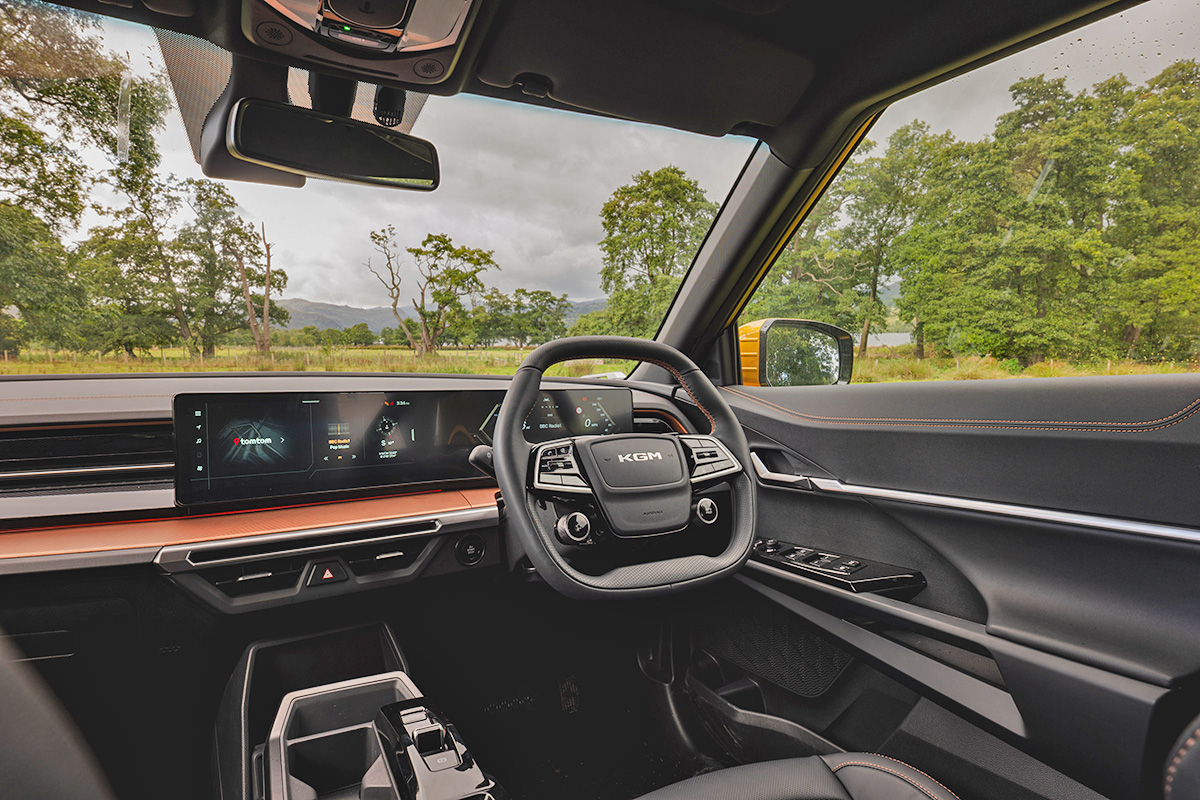
The front seats are plenty roomy enough, too, and there are a fair few neat little storage options dotted around the cockpit. And this is a nice place to sit by pick-up standards; the materials are of decent quality, and the copper-effect inlays are a nice touch, brightening the interior in a way that more ordinary aluminium-effect or piano black plastic might not.
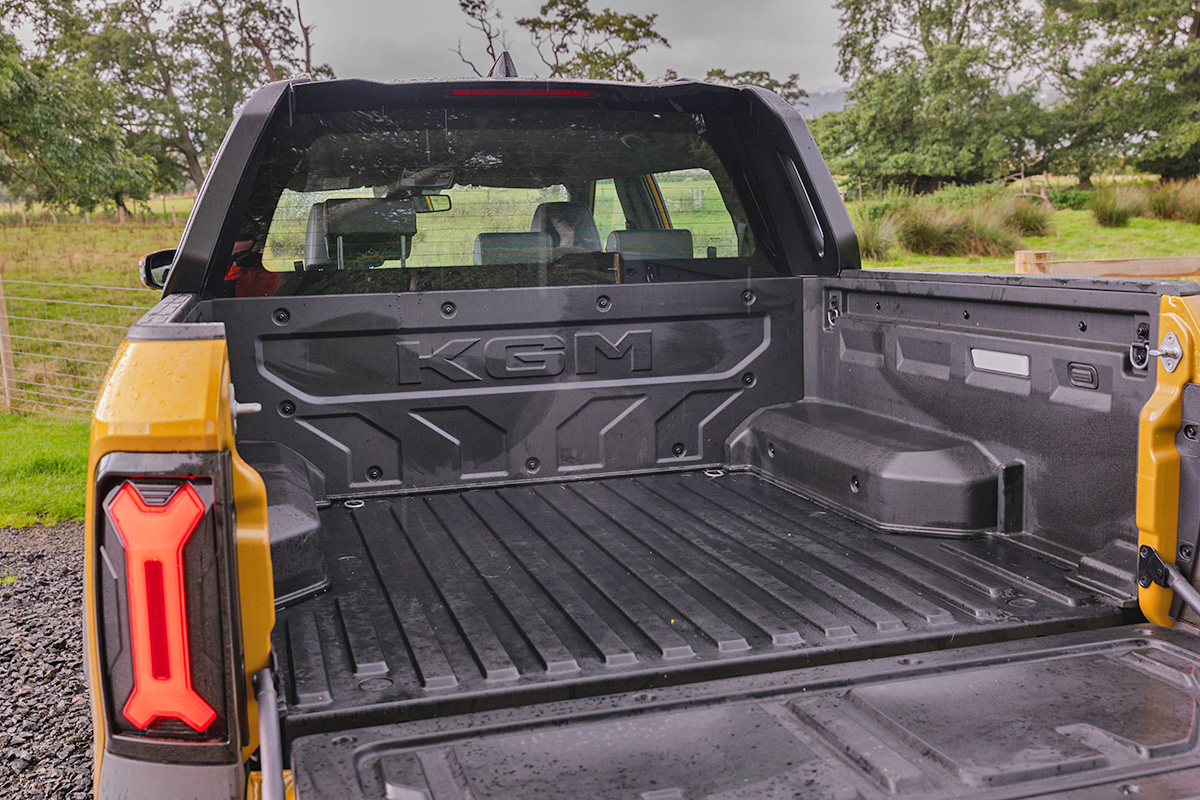
Trouble is, you get all that in any family SUV. The reason you buy a pick-up isn’t for the cab – it’s for the bit behind it. And this is where the Musso EV starts to look a bit shaky.
Firstly, the bed itself is rather small. It’s just 1.3 metres long, which will compromise what you can actually fit into it, and its overall volume of 1,039 litres is less than pretty much any other double-cab pick-up out there.
Worse news is to come when you look at the Musso EV’s payload. That comes in at just 690kg, which falls well below most of its rivals, even those powered by electricity. That means you’ll have to be really careful not to go over the maximum authorised mass (MAM) when loading the Musso EV with heavier cargo.
Finally, there’s the towing capacity. Hauling heavy loads is one big reason why people need a pick-up – and usually, the sturdy body-on-frame construction makes them ideal for the task.
But of course, the Musso EV doesn’t have that – and as a result, its towing capacity is a fairly meagre 2,300kg. Granted, that might not sound like a disastrous figure – a Musso EV can still haul a decent-sized caravan, after all – but it’s still some way short of the 3,500kg a proper full-sized pickup can pull.
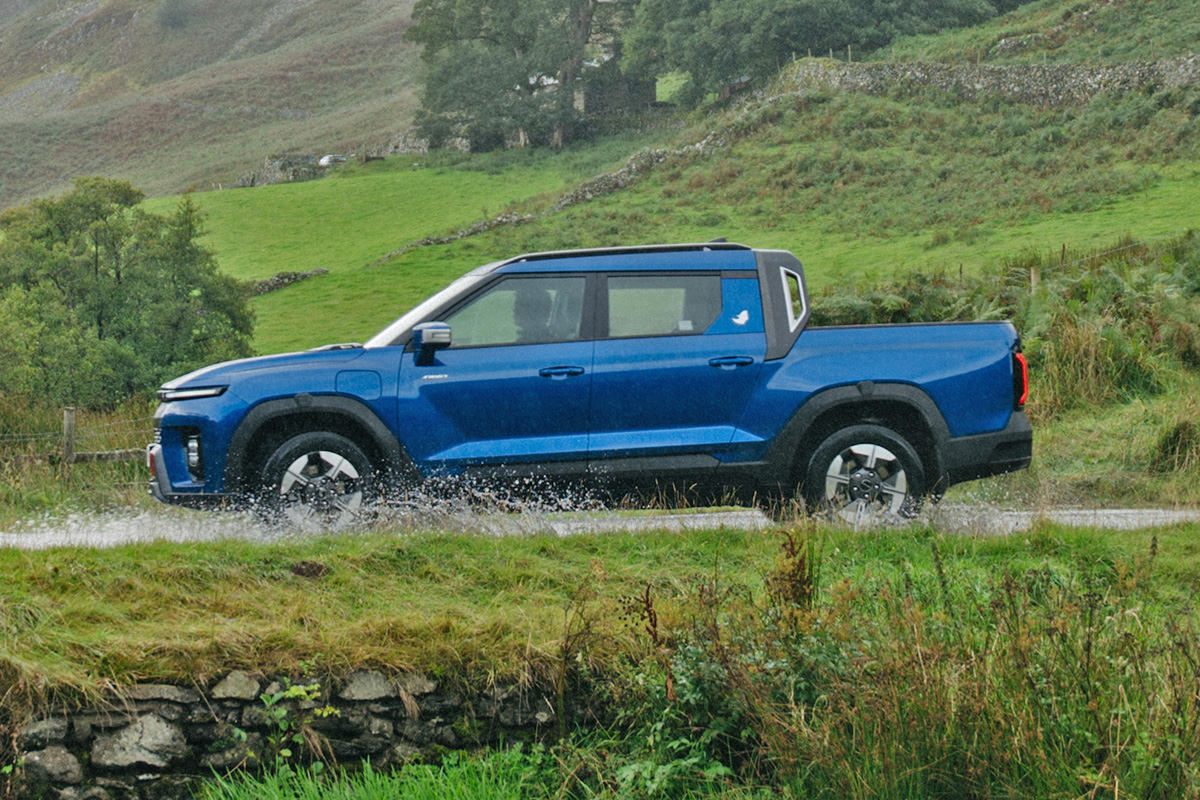
What’s it like to drive?
This is where that more car-like construction really starts to pay off for the Musso EV. Because by pick-up truck standards, it’s very pleasant to drive.
For starters, there’s none of the shake, rattle and roll you usually get with more traditional diesel pick-ups. The Musso EV is quiet and smooth, and of course, with no gearbox, acceleration is strong and seamless – in fact, the Musso EV can sprint from 0-62mph in just eight seconds, which is impressive for a pick-up.
Around corners it feels crisp and well-mannered by comparison with the majority of its body-on-frame rivals, too, and there’s a suppleness to the suspension that few of them can match.
You only get one powertrain option: a 234bhp electric motor, powered by an 81kWh battery, and driving all four wheels full-time.
The official electric range of 236 miles isn’t brilliant by car standards, and will probably mean that the Musso EV can only muster up 200 miles of range in the real-world on its best days (and probably more like 150 in the depths of winter).
That said, all of its electric pick-up rivals are bigger and heavier, and that means even when they’re equipped with a larger battery – as is the case with the Maxus T90EV – they still can’t quite match the Musso EV’s official range figures.
Neither can they charge up as quickly. The Musso’s 120kW maximum charging speed isn’t all that quick by the standards of most electric cars – but when the Maxus only manages 80kW, and the Isuzu D-Max EV a paltry 50kW, the Musso looks pretty spry.
A 10-to-80% charge will take just over half an hour, and give you around 120 miles of extra real-world range – all of which, while hardly groundbreaking, is perfectly tolerable in the real world.
Technology, equipment & infotainment
There’s only one version of the Musso EV, which makes choosing pretty easy. And to be honest, it’s pretty well equipped for the price. You get heated and ventilated seats up front, heated outer rear seats, a heated steering wheel, a 360-degree parking camera system, adaptive cruise control, keyless entry, a heat pump, and a suite of safety kit all included in the base price.
You also get two big 12.3-inch screens; one to display the essential driving information, in place of traditional dials, and the other to serve as the main touchscreen with Apple Carplay and Android Auto.
It’s this latter screen that’s the problem, because its responses can sometimes be glacially slow. You get into the habit of pressing it, waiting for a few seconds, and then checking back to see whether the command you prodded has actually registered. It simply doesn’t provide the snappy responses you need while driving along if you’re to avoid being distracted.
What’s more, some of the menus are idiosyncratically laid out, and it can be a chore to find the function you want, because it turns out not to be where you expected it might be.
Also slightly disappointing is the fact that you have to use this screen to control the heating and ventilation, whose controls take the form of a slide-out overlay that appears on screen from the right-hand margin.
To be fair, this is well laid-out and clear, but the icons are rather small and fiddly; it’s also partially obscured by the steering wheel, meaning you have to peer round the wheel to select some functions.
On the plus side, a swipe-down menu at the top of the screen gives instant access to all the driver aids, which means you can turn them off easily if you want to. And you probably will, given the fact that most of them are far too over-sensitive.
KGM Musso EV running costs
Until relatively recently, the low payload would have been a real sticking point for the Musso EV; as a result, it wouldn’t have counted as a commercial vehicle for tax purposes, which would have meant it didn’t qualify for all the myriad tax breaks a more rugged pick-up could benefit from.
However, a rule-change in 2025 means that almost all double-cab pick-ups are now counted as cars for tax purposes, which has eradicated the Musso EV’s handicap in this regard.
As a result, the Musso now looks like even better value. It’s eligible for the plug-in van grant, which brings the list price down to a very impressive £39,995 – and even with its obvious shortcomings in terms of payload and towing capacity, it’s a lot of truck for that sort of cash.
That low price means a low P11D value, and with zero emissions, the Musso EV’s benefit-in-kind (BIK) rating is negligible, which makes it a tremendously cost-effective option if you’re an employee looking to take on a company car – a point that is especially salient now that double-cab pick-ups are no longer classified as commercial vehicles for BIK purposes.
Servicing costs should be far more affordable than the equivalent combustion-engined pick-up trucks, too, though do keep in mind that KGM specifies that you should get your Musso EV serviced every 12 months or 10,000 miles, whichever comes first. That’s more frequent than most EVs, which can go 24 months or 20,000 miles between services.
KGM Musso EV reliability
It’s hard to find concrete reliability data on KGM, or its predecessor brand Ssangyong, mainly because they sell cars in such low volumes. As a result, most of the big magazines’ reliability surveys rarely get enough responses from KGM owners to form a definitive picture of its cars’ dependability.
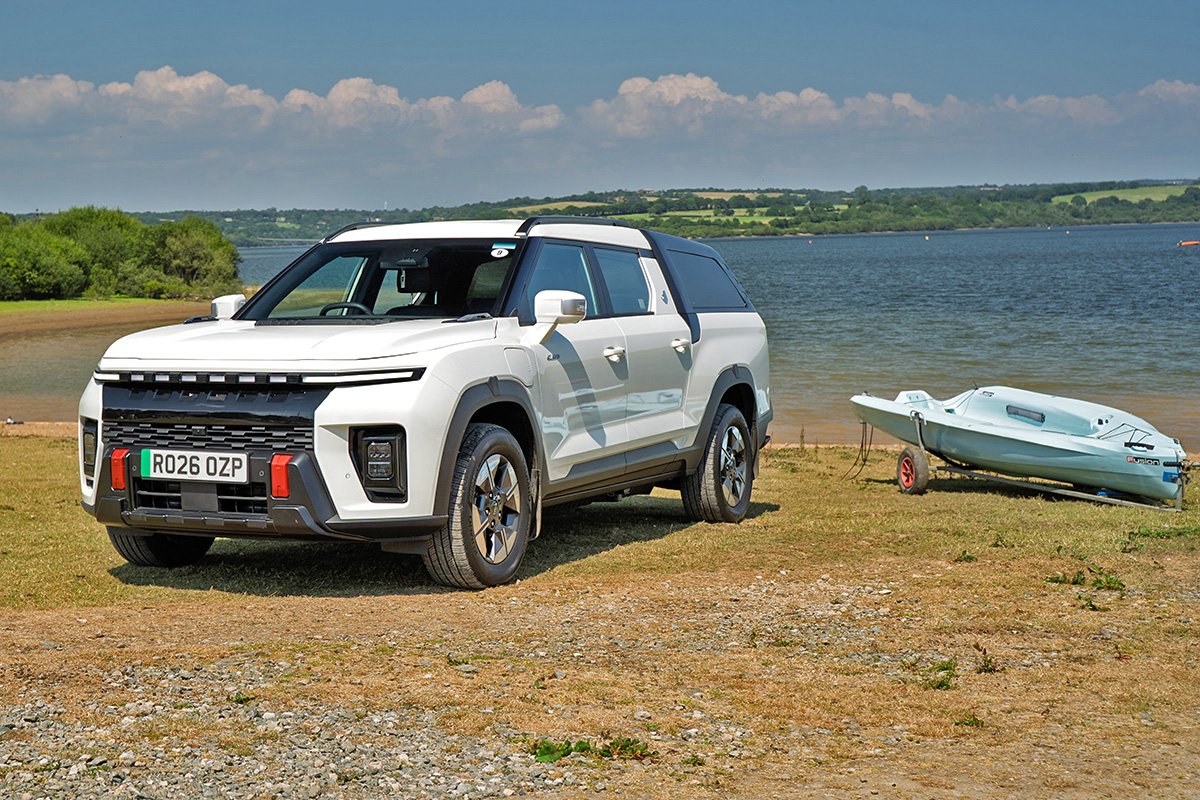
Where KGMs (or Ssangyongs) have featured in reliability studies, though, they’ve generally ranked pretty highly, which bodes well. What’s more, all electric KGMs now come with a seven-year, 90,000-mile warranty.
Also worth noting is that KGM’s battery warranty is better than most EV manufacturers’, at 10 years or 621,379 miles. Yes, you read that right, and no, it’s not a mistake – the warranty is actually to a million kilometres, which is pretty impressive, and it means that even if you’re a high-mileage EV driver, you almost certainly won’t bust the mileage cap on this particular warranty.
- The Musso EV features vehicle-to-load charging capability, which means you get a special adaptor for the charging port that will allow you to plug a three-pin socket in, and draw charge from the truck’s battery. So if you’re working on site without a power source, wanting to charge up your phone while camping,or needing to inflate a paddle board with an air compressor, the Musso EV is a handy thing to have around.
- You might not get much payload capacity in the Musso EV, but its clever self-levelling suspension system means even if you’re carrying its maximum payload, the Musso EV will remain straight and level.
- The Musso EV does come with four-wheel drive, but don’t try and take it too far off-road, or you might get stuck. Ground clearance maxes out at just 181mm, which isn’t really any more than you’d get on an ordinary road-going crossover, and its approach and departure angles of 20.2 and 24.3 degrees aren’t much to write home about either.
- If you want the best all-rounder: well, there’s only one model – simply called the Musso EV – so it’ll have to be that one.
- If you want the most affordable: like we say, there’s only one model, so that’s all you’ve got to choose from – though it is at least pretty reasonably priced.
- If you want the most luxurious: again, there’s just the one Musso EV – and while it’s hardly luxurious, it does at least come with plenty of kit
- If you’re fond of sand dunes and salty air: you’ll probably want to listen to ‘At The River’ by Groove Armada in – you guessed it – the one and only version of the Musso EV.

