Kia Sportage (2015-2022) review | A solid used buy
Kia Sportage cars for sale
4.0
Expert review
Pros
Good value
Strong reputation for reliability
Well equipped
Cons
Seat Ateca is better to drive
Not all safety features are standard
Firm ride on bigger wheel sizes
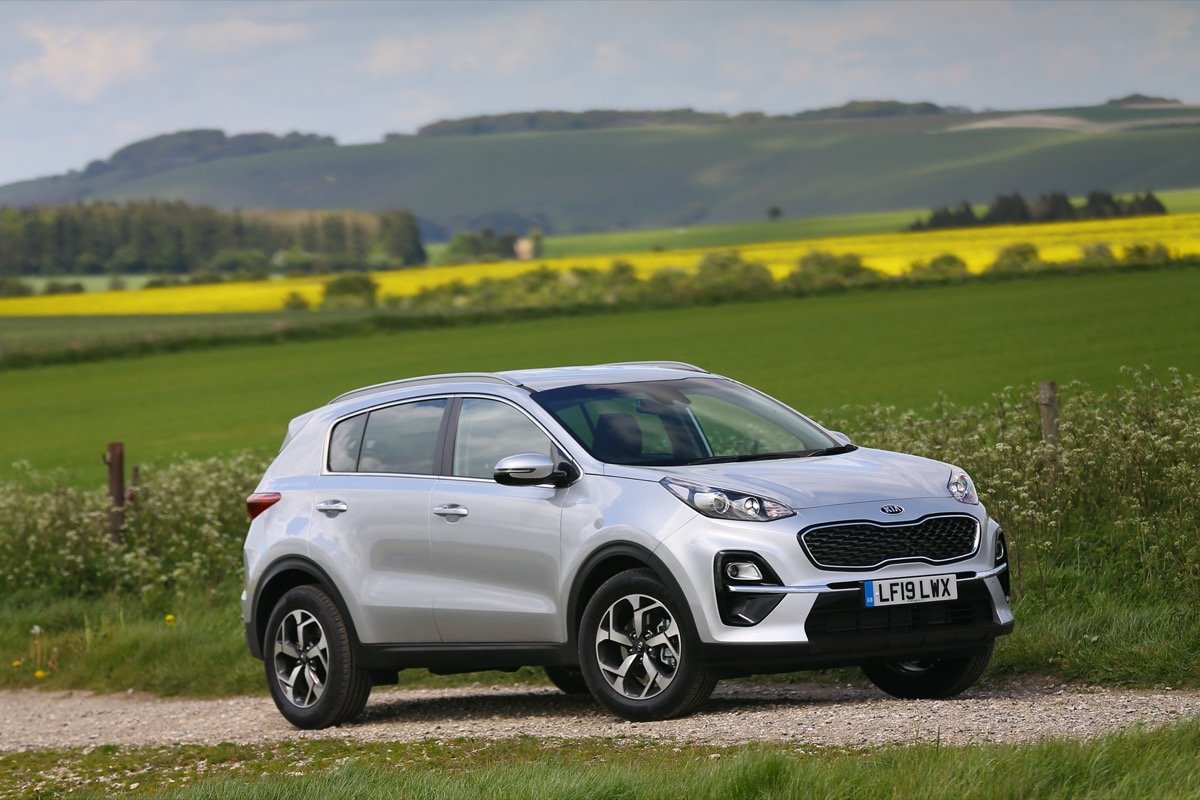
The CarGurus verdict
The Sportage is an attractive proposition for anyone looking at a mid-size SUV. There are lots of them available in lots of different configurations, they’re well equipped, and they’re pretty practical and hassle-free to use and own.
Having said that, poor scores in recent reliability surveys are a concern, especially if you’re buying a Sportage whose warranty has expired. What’s more, there are cars that are more engaging to drive, or a bit nicer inside, or have a little bit more space.
There aren’t many that do such a good job in all areas, though, which is why the Sportage is still worth considering as a sensible family hauler. Just try to get one with a decent bit of warranty left on it, to guard against any potential reliability woes.
What is the Kia Sportage?
The Kia Sportage is often found near the top of the shopping list for people looking for a mid-size SUV, and for good reason. It’s a well established name badge from a brand that’s been growing in reputation over the years, and it now finds itself in an enviable position in the market. This is the fourth generation of Sportage, known in the industry by the codename QL, and Kia has really fine-tuned it nicely.
The styling is sleek but not too out there, there’s a range of petrol and diesel engines to choose from and a plethora of trim levels, but all include plenty of standard equipment for the money, including air conditioning and cruise control. And then of course there’s a market-leading seven-year, 100,000-mile warranty, which means plenty of used examples are still covered.
Of course, this would all be slightly academic if the car was disappointing, but it’s actually pretty good. Sure, there are cars that you can buy that do various things better than the Sportage, but few are as solid all round. No wonder it’s become a firm favourite among family buyers, as an alternative to cars like the Skoda Karoq, Nissan Qashqai, Renault Kadjar, Peugeot 3008 and Citroën C5 Aircross.

How practical is it?
Practicality-wise, the Kia Sportage Mk4 is a solid performer with plenty of space in the rear seats for two adults, and a third without too much of a squeeze. You don’t get the sliding rear seats that some rivals offer, but they do recline and fold flat to improve boot space, which is a good size to start with and pretty cavernous if you open everything up.
Speaking of boot space, the Sportage Mk4 offers 491 litres of boot capacity in most models, which is perfectly respectable for the class. That figure in mild hybrid versions drops to 439 litres to make way for the system’s battery under the boot floor.
Up front, you get a decent sized glove compartment, a pair of built-in cupholders, and an under-armrest cubby. The door bins are rather slim, meanwhile, but they are at least wide enough to hold a small bottle of water.

What’s it like to drive?
On the road, the Sportage tries to tread a line between comfort and enough firmness to provide sprightly handling, and for the most part it succeeds. Compared with something like a Seat Ateca, the ride is positively cloud-like, although it can be a bit firm over larger bumps in the road. That can be helped by avoiding large alloy wheels, which have thinner profile tyres and therefore less cushioning. It feels nice and composed through the bends, nimble even, and the steering is nicely weighted and responsive. The Ateca is still the benchmark for enjoyment behind the wheel, but if that’s not a priority for you then you shouldn’t feel shortchanged by Kia’s efforts.
When it comes to engines, there’s plenty of choice. The Sportage launched in 2015 with a selection of two petrol and three diesel engines. Petrol power came from a 1.6-litre four-cylinder engine with 130bhp; a turbocharged version of this engine with 174bhp and four-wheel drive was available in top-spec GT-Line models.
The entry-level diesel was a 1.7-litre unit, which was serviceable, but rather noisy, and its slightly wheezy 114bhp made the Sportage feel rather sluggish when it was fully loaded. A better bet if you’re after an earlier Sportage, then, is to upgrade to the 2.0-litre diesel, which can be had in 134bhp or 182bhp forms, both with four-wheel drive.
All of these engines came as standard with a six-speed manual gearbox, though the 2.0-litre diesels could also be specified with a six-speed automatic, and the turbocharged petrol could be had with a swift-shifting seven-speed dual-clutch auto.
Toward the end of 2018, Kia facelifted the Sportage and updated the engine range to suit. The petrol engine line-up remained unchanged, but the 1.7-litre diesel was discontinued entirely. Meanwhile, the 2.0-litre diesel was reduced to a single 182bhp version, now with a 48V mild hybrid system to improve its fuel efficiency, and either a six-speed manual or an eight-speed automatic gearbox.
To fill in the gaps lower down the range, a new 1.6-litre diesel was introduced, and aping the engines it replaced, it came in 114bhp and 134bhp forms. The latter of these two engines could be specified with the seven-speed dual-clutch auto, which could then be augmented further with four-wheel drive. In 2020, the 134bhp version of this engine also gained the same 48V mild hybrid system that was already fitted to the 2.0.
If you can stretch to it, we reckon the more powerful of these 1.6-litre diesels is the one to go for, as it balances grunt with fuel economy better than either of the petrol engines, and it feels smoother than the gruff 1.7- and 2.0-litres.
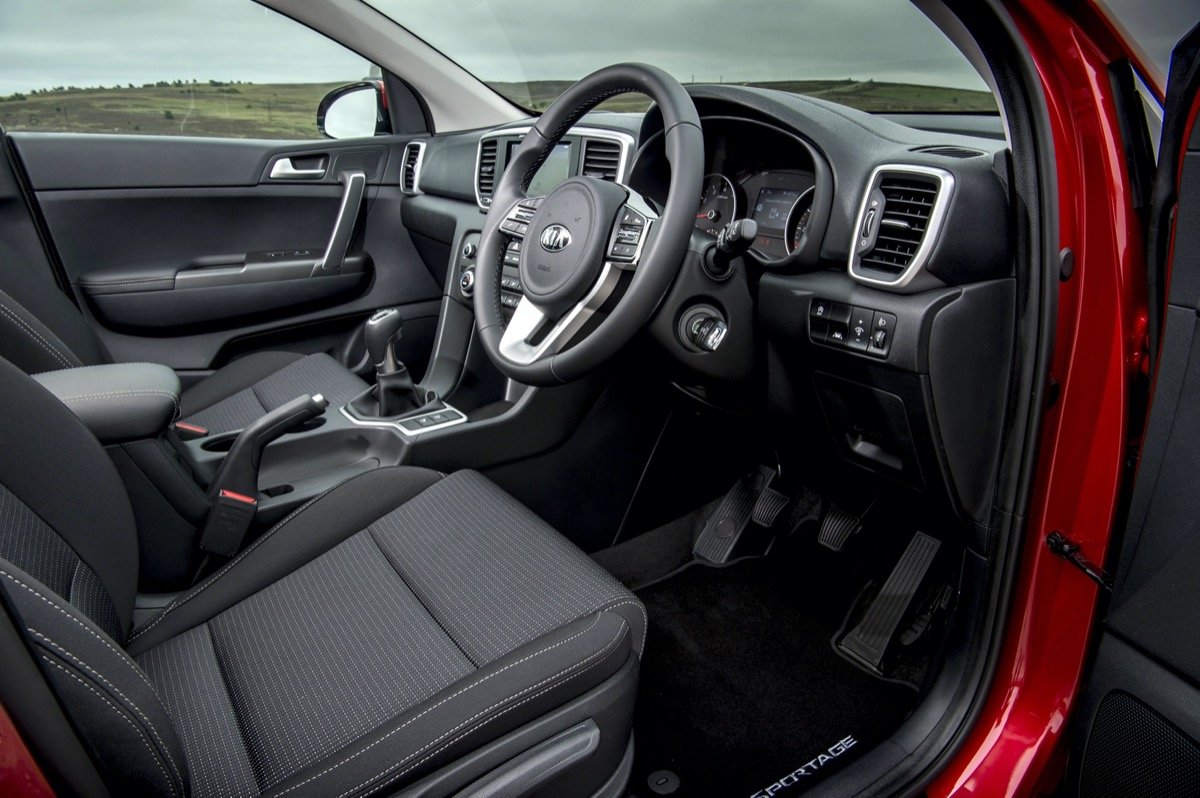
Technology, equipment & infotainment
The Sportage was available in a vast range of variants, which are easy to navigate as they’re simply numbered 1, 2, 3, and 4. Although there’s also the KX-1, KX-2, KX-3, and KX-4. And the KX-5. And the GT-Line. And the GT-Line S. OK, don’t panic – we’ll guide you through it.
At launch, the core line-up started with the 1, which got alloy wheels, air conditioning, cruise control, a digital radio, and front fog lights. 2 then added a reversing camera, rear parking sensors, automatic lights and wipers, and climate control.
It also got a 7-inch touchscreen infotainment system with satnav which, while lacking visual panache, was quick and easy to operate, which we’d take over fancy-looking but slow any day. In fact, we’d say it’s proven to be one of the better systems out there for ease of use.
3 was the next model up, and gained an 8-inch version of the same satnav screen, as well as leather upholstery, heated front and outer rear seats, a JBL premium sound system with a subwoofer, and a panoramic sunroof. 4 added xenon headlamps, front parking sensors, keyless entry and start, LED rear lights, ventilated front seats, and a heated steering wheel.
Models with a ‘KX’ prefix had four-wheel drive, but were otherwise identical to their two-wheel-drive equivalents.
GT-Line was based on the 2, but also got front parking sensors, heated front and outer rear seats, LED rear lights, big 19-inch wheels, and a sporty-looking interior and exterior styling pack, which included twin exhausts, leather seats, and a bodykit.
That was the extent of the model range at launch. Late in 2016, however, Kia added Apple Carplay and Android Auto to every version except the 1, and at the same time, it introduced plush KX-5 and GT-Line S models. KX-5 added a powered boot lid, a wireless phone charger, two-tone leather upholstery and an electronic handbrake to the standard 4 and KX-4 specification.
GT-Line S, meanwhile, took the GT-Line version, and added a panoramic sunroof, Xenon headlamps, a heated steering wheel, that JBL premium sound system, and the larger satnav screen.
With the facelift in 2018, the range was (thankfully) simplified. The most notable change was the removal of the ‘KX’ prefix; four-wheel-drive models were now differentiated with a simple AWD badge at the end of their name.
KX-5 and 3 trim levels were done away with at the same time, and the latter was replaced by a ‘Platinum Edition’, which was only available with the 130bhp petrol engine, in grey or black. It got a similar specification to the 4, but lost the panoramic roof, and had 17-inch instead of 19-inch alloy wheels.
Things stayed this way until October 2020, when the 2021 model year was introduced. From this point onward, specifications of the Sportage got a bit complicated, likely as a result of oversupply following the COVID-19 pandemic, followed by shortages caused by the ensuing superconductor crisis.
For the 2021 model year, Kia ditched the Platinum Edition and 4 models, replacing them with a re-introduced 3 version. It also dropped the slow-selling entry-level 1. However, you could still buy a 2020 model year 1, Platinum Edition, or 4, as these continued to be sold alongside the revised model.
This confusing situation lasted through into 2021, and was made even more baffling by the appearance of what Kia referred to as the 2021.5 model Sportage, which featured the same model line-up, with the exception of the addition of a new JBL Black Edition version. This was based on the 3, but as its name suggested, featured blacked-out body trim and the upgraded JBL speaker system.
By the end of 2021, most of the 2020 models had sold out, but you could still get the petrol Platinum Edition or a GT-Line in 134bhp diesel form. These remained on sale until the start of 2022, at which point Kia was struggling with supply of the all-new Sportage, due for introduction that year.
As a result, it kept some of the old 2021 Sportage models on sale alongside, though these were gradually whittled down as production of the new Sportage slowly came on stream. This meant you could still buy a Sportage 2 in 130bhp petrol or 134bhp diesel form right through until October 2022, which is when the fourth-generation Sportage finally left the stage.
Kia Sportage running costs
As with most cars, the diesel models will prove the most frugal on fuel, with the 114bhp 1.7 CRDi claiming an official fuel consumption of 61.4mpg. With some careful driving, you should be able to get well over 50mpg in the real world. In newer cars, the 1.6-litre diesel with 114bhp should manage similar consumption figures, while the more powerful 1.6 diesel, with 134bhp, will probably be a few mpg adrift. Expect to average around 40-45mpg in the top-spec 2.0-litre.
The petrol engines will naturally be thirstier, but the turbocharged 1.6-litre petrol with 174bhp is particularly so – don’t expect to average more than around 28mpg in one of these Sportages. The 130bhp version is better, but it’s still a bit of a gas guzzler for what it is – it’ll average just over 30mpg.
On most models, opting for an automatic transmission will reduce your fuel economy and boost up your CO2 emissions, which can have an impact when it comes to Vehicle Excise Duty.
When it comes to servicing, most Sportages will need to be looked at every 20,000 miles or 12 months. However, if you’re doing high mileage, be aware that on turbo petrol models, that interval drops to 10,000 miles or 12 months. Kia offers fixed-price service plans on the Sportage, which can help to keep costs down.

Kia Sportage reliability
Kia as a brand has a good record for reliability, sitting mid-table or higher in most independent dependability studies. Having said that, the Sportage’s record is somewhat spotty, with a poor 72.9% score in the 2025 What Car? Reliability Study. That low score placed it second to last out of the 76 family SUVs to be included – only the latest Volkswagen Tiguan fared worse. That’s good reason to seek out a Sportage that’s still covered by the remainder of the seven-year warranty.
What Car? highlighted that diesel models were particularly problematic, with 56 per cent of diesel Sportage owners saying that their cars went wrong, compared with 20 per cent of petrol owners.
Issues to look out for include electrical glitches and clutches juddering or failing earlier than expected. Some owners have also reported throttle hesitation issues, although a software update can cure this. And a few cars have suffered from “notchy” steering feel, which in some cases has required a replacement steering rack.
Many Sportages will be used as family cars and so could bear the scars of a life well lived. Watch out for scuffs, dents, stains and the like, and check the alloy wheels for damage.
- As many people will buy the Sportage as a family car, it’s reassuring to know that it scored the maximum five stars in crash tests by safety organisation EuroNCAP. That said, it’s disappointing that automatic emergency braking wasn’t included as standard across the range. It was only included on 4 trim models and above. Some rivals featured it across every model.
- The Sportage is an adept tow car, especially in four-wheel-drive form. The 2.0-litre CRDi 4x4 models with manual gearboxes can tow a braked trailer of up to 2,200kg, which is impressive for a car of this size, and better than many similar-sized rivals. Two-wheel-drive models have lower maximum limits, but are still capable of towing smaller trailers with relative ease.
- The presence of Kia’s seven-year, 100,000-mile warranty could be a particular boon for used buyers, as later examples will still be covered. By contrast, most other rivals will be long out of warranty before the Kia.
- If you want the best all-rounder: go for one of the 134bhp diesel engines – the 1.6-litre if you can stretch to a post-facelift, or the 2.0-litre if not – and pair it with the 2 version. This should provide enough equipment and performance without overly taxing the wallet. You’ll get enough power for day-to-day driving, two-wheel drive for improved fuel economy, 17-inch alloy wheels for stylish looks without the crashy ride and 7.0-inch touchscreen infotainment system. Oh, and a reversing camera and sensors for easy parking. Cars from 2016 onwards were equipped with AppleCarPlay and Android Auto for smartphone integration.
- If you want to blow the budget: Go for the very latest, lowest-mileage 2.0 CRDi 182 GT-Line S model that you can get your hands on. You’ll get 19-inch alloys, a panoramic sunroof, LED headlights, an upgraded sound system and larger 8.0-inch touchscreen infotainment system with satnav.
- If you want the most exclusive model: The Edition 25 Sportage was released in 2018 to celebrate 25 years since the first Sportage hit the market. It was based on the 4 model and available only with the 1.6-litre GDi petrol engine, and a manual transmission. Special features included 17-inch alloys, black cloth and leather upholstery and special premium paint, as well as an upgraded sound system and the larger 8.0-inch touchscreen infotainment system.
- If you need extra traction: The all-wheel drive-equipped Sportages shouldn’t be confused with proper off-roaders, so don’t expect to go green-laning in them. But if you live in an area that sees regular inclement weather, or you want to do some towing, then an AWD Sportage may well be for you. It’s particularly popular among caravan owners, as it’ll tow up to 2,200kg (braked), depending on the model. The best performing car in this regard is any Sportage with the 2.0-litre CRDi engine and a six-speed manual gearbox.


