MG Cyberster Review (2024-present)
MG Cyberster cars for sale
3.0
Expert review
Pros
Looks sensational
Packed with standard equipment
Fun to drive, in its way
Cons
Driving experience could be more polished
Infotainment setup is just too much
Range is nothing special

The CarGurus verdict
The biggest attraction of the Cyberster is that there really is nothing else like it on the road: how many other cars can you say that about? Two-seater convertible sports cars are rare enough on their own these days, but an all-electric roadster with glamorous scissor doors and a sub-£60,000 price tag? That’s proper class-of-one territory, and probably will be for some time to come.
Okay, so it has its flaws. It could be more polished dynamically, the four-screen infotainment arrangement is confusing, and practicality is limited. However, it also has plenty of other stuff going for it, thanks to its glamorous looks, impressive quality, generous equipment and rip-roaring performance. It’s not a car that’ll suit a large number of people, that’s for sure, but those people it does suit will absolutely adore it. A very likeable thing indeed.

What is the MG Cyberster?
The MG Cyberster is a two-seater electric sports car that marks a return to MG’s glory days, or so you’d hope. You see, once upon a time, MG was famed for its characterful little two-seater open-top sports cars, such as the MGB and the Midget. However, since the wheels fell off - the company, that is, not the cars - in the early noughties, and the brand had to be rebuilt by the Chinese firm that bought up what was left, the company has been reduced to producing dull-but-worthy budget-focused hatchbacks and SUVs in order to get back on its feet.
Until quite recently, that is. During the last three or four years, the firm’s products have displayed a marked improvement, and the last couple of offerings have had much more appeal than just their heaving equipment list and low sticker price. The firm's small stable of electric cars, in particular, has developed quite a following. Quite a few of MG’s models have sold pretty well as a result, and today, MG is knocking on the door of becoming one of the top 10 best-selling car brands in the UK. It’s a proper British success story (thanks largely to China).
The Cyberster could be seen as the car that completes the firm’s renaissance. This all-electric two-seater sports car is a less–than-subtle nod back to those glory days of the past, but one that’s also fitting and suitable for the future.
Rivals? Well, there simply aren’t any, so that immediately makes it the best car of its type by default. There are solid-topped electric sports cars like the Audi E-Tron GT and Porsche Taycan, and there are open-topped combustion models like the BMW Z4 and Mazda MX-5, but none match the Cyberster like-for like, or on price and size, either. Tesla has been promising a second-generation Tesla Roadster model for several years now, but there's still no sign of it so far. And when (indeed, if) it does finally arrive, we can’t see it being as affordable as the Cyberster.
The MG has much more to it than just glamorous looks, too. The new car is also packed with equipment and technology, it has power outputs that range from tempting to terrifying, and it also has the theatre of unconventional scissor doors that rise vertically rather than being hinged horizontally. The question is, is it the thoroughbred sports car that many will want it to be? We took a demanding test drive around the highlands of Scotland to find out.
How practical is it?
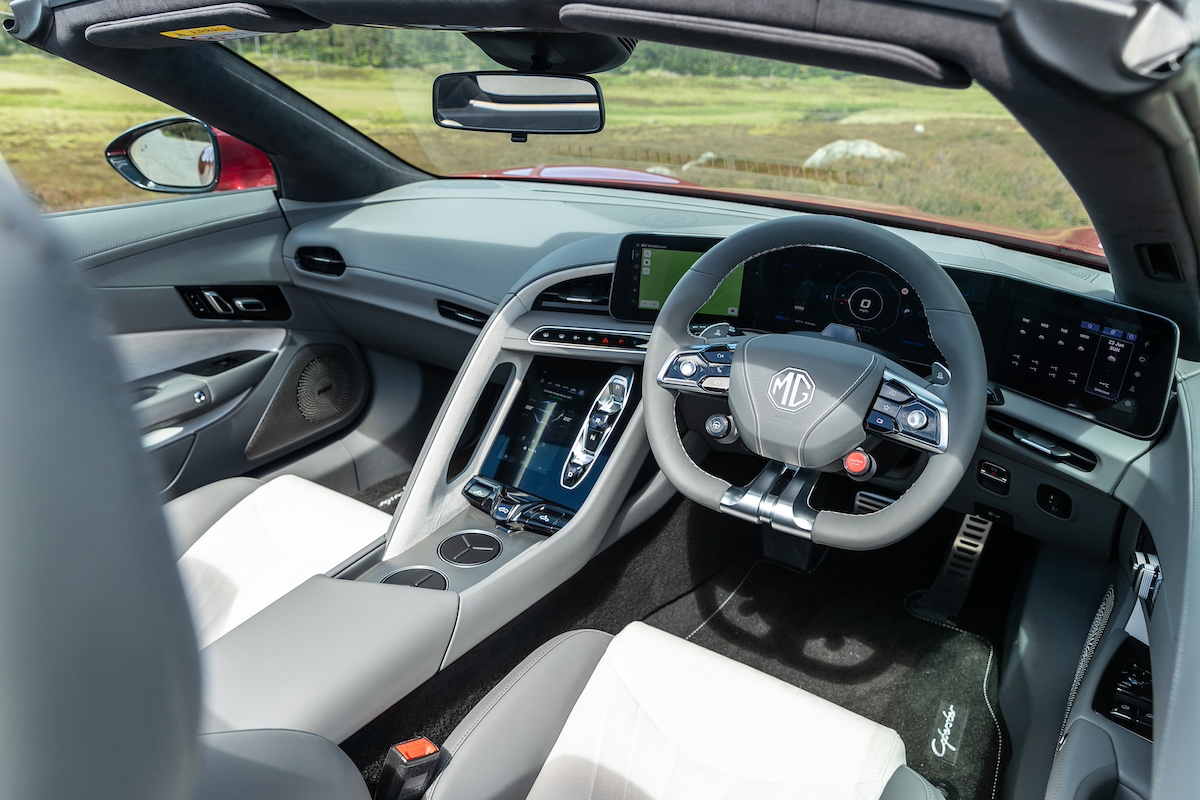
Two-seat roadsters generally aren’t very practical, and the MG Cyberster is no different. The two chairs are surrounded by a very decent amount of space, so a pair of gangly adults should be able to get comfy enough, although taller passengers might feel that their head sits rather close to the top of the steeply raked windscreen. The steep angle of the screen also means that the pillars either side can block your view at the front three-quarters of the car at junctions.
Even with the standard electrically adjustable seats set to their lowest position, you sit quite high up in the Cyberster - not very roadster-like - and the floor also feels quite high relative to the seat. That can give the driving position a slightly awkward feel, not helped by the limited travel in the steering wheel adjustment. However, there’s no denying the appeal of looking down that long bonnet, with the flared front wings either side, and marvelling at the glamorous feeling that brings.
Cabin storage isn’t in huge supply. There’s a small glovebox, a lidded cubby under the armrest and a couple of cupholders in the centre console, but that’s about it. Obviously there are no door pockets, because their contents would drop to the pavement every time the glamorous scissor doors are opened and upended, but there are small lidded storage boxes where you would otherwise expect to find them.
Provided you don’t need to have your seats set too far back, there’s a smidge of extra storage space behind the chairs, but the narrow shape means it's for briefcases rather than suitcases. It’s probably a good place to stash your coat, too.
As you’d probably expect in a car like this, the boot is pretty dinky at 249 litres: That’s about what you’d get in a city car like the Hyundai i10. The space is also very shallow, and the small opening means access isn’t the easiest. MG claims you’ll get a golf bag in, but we suspect you’d have to remove the clubs and fold it in half. What’s more, there’s no underfloor storage for your charging cables, and no ‘frunk’ storage under the bonnet, so your limited boot space is taken up further by the fact that your cables have to travel there.
The quality on show inside the cabin is generally very good, with plenty of premium-feeling materials and a smart design. There are one or two areas -such as the indicator stalks - where materials are used that slightly betray the high-end feel, but they’re not so obvious as to ruin things. Yes, this is a very expensive MG, but it feels it, importantly.
And those scissor doors? Well, they don’t make getting in and out any easier, but they don’t make it any harder, either, although admittedly, we haven’t tried doing that in a tight parking space in a multi-storey. The only slight downside that we can see is that the fully electric opening and closing mechanism is a bit slow.
What’s it like to drive?
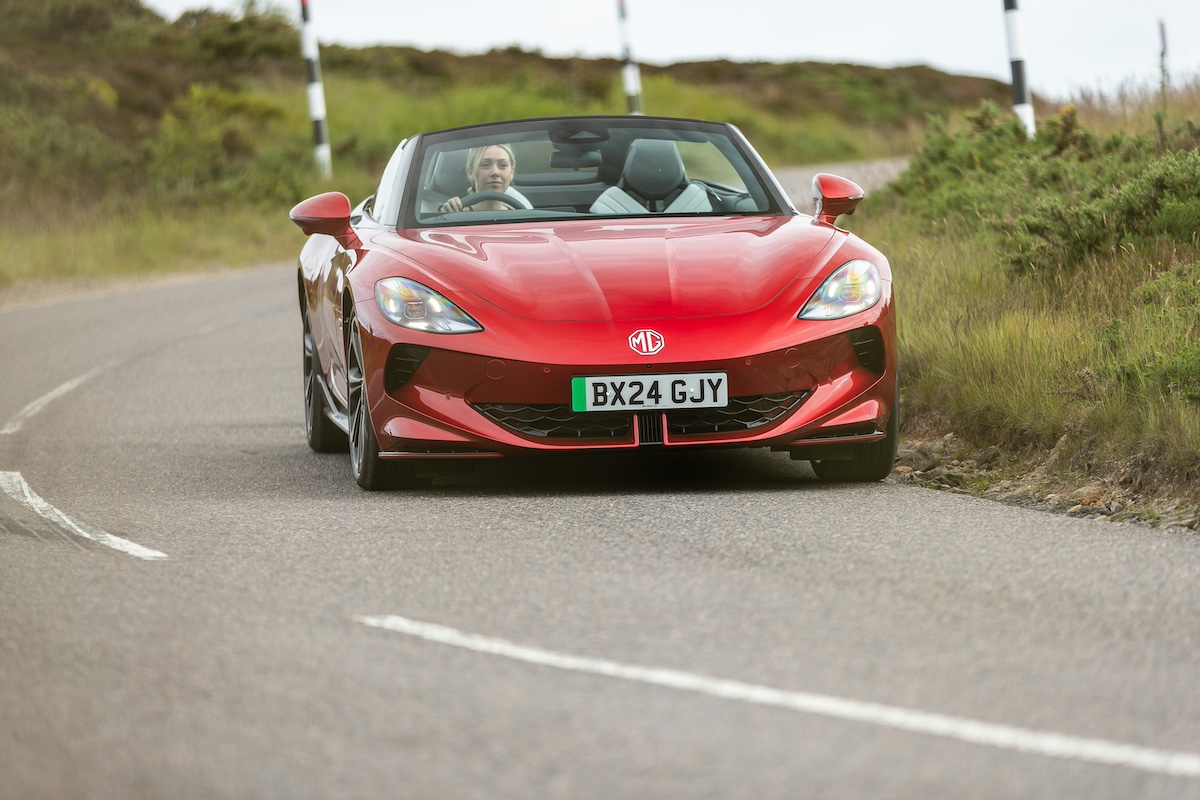
There are two distinct specs of Cyberster, and the first of them is the entry-level single-motor Trophy model. This has a rear-mounted electric motor (so it’s rear-wheel drive) that develops 335bhp. The amount of power and torque you get remains constant regardless of which driving mode you select, we’re told, but the throttle mapping - so the eagerness with which this power and torque is applied when you press the accelerator pedal - does vary. Officially, the 0-62mph time stands at a very handy 5.0 seconds, and the top speed is 121mph.
And sure enough, the Trophy feels suitably rapid. Perhaps quite not as rapid as the generous power figure would suggest, but there’s certainly no shortage of go when you push the accelerator pedal. That applies whether you’re pulling away from a standstill or picking up speed on the move, and is regardless of which of the driving modes you select.
There’s sports car performance, then, but what about sports car handling? Hmm. Well, yes and no. The first thing to note is that this is an extremely heavy car - most electric vehicles are - with a kerb weight of 1,885kg. However, MG claims that this weight is distributed almost perfectly (49% at the front and 51% at the rear) for a good level of balance to accompany the rear-wheel-drive layout.
Tip the car into a bend, and it actually does a very commendable job of keeping its weight under control. Sure, you can feel that immense mass wanting to shift sideways, but the body stays reasonably flat and stable, and grip levels are immensely generous. This alert feel is aided further by the steering, which is responsive and reasonably quick, if not over-endowed with feel.
However, the suspension can struggle slightly in other ways. Despite that impressive suppression of body roll in corners, there’s actually quite a lot of vertical movement in the suspension, and this can have the body bouncing around untidily over bigger bumps, dips and crests. It doesn’t spoil your fun, but it does give the handling and unruly character that could feel a lot more polished and precise. This would be a bit more forgivable if the car gave a pillowy-soft ride, but it doesn’t: there’s a patter at low- and middling speeds that makes it feel just a little bit unsettled. It’s not uncomfortable by any means, but it’s certainly not cosseting, either. The ride improves the faster you go, though, so it makes a very decent motorway cruiser.
Then there’s the dual-motor GT model, which is better for a variety of reasons. First of all, it has an additional electric motor on the front axle that gives four-wheel drive and a power hike of 168bhp, taking the total power output all the way up to 503bhp. Again, that power level remains constant regardless of the driving mode you select, but the rate at which it’s unfurled does differ.
Here, however, there’s a much bigger difference in sensation between the modes. Stick to Comfort mode and the GT doesn’t really feel all that much quicker than the Trophy in the way it picks up speed. Dial everything up to eleven, though, and the rate of acceleration feels far more explosive. The 0-62mph dash is dispensed with in just 3.2 seconds, and it feels good for every ounce of that.
More importantly, though, there’s a shade less vertical movement in the suspension with the GT. This could well be because it weighs an extra 100kg over the Trophy, keeping the body more tied down, which makes it feel more composed in terms of both ride and handling. That’s slightly ironic when heaviness is usually the enemy of both.
Refinement is a mixed bag. There’s a slight whine from the electric motor(s) as you accelerate, but this is masked slightly by the synthetic noise piped into the cabin. In Comfort mode, it sounds like a faint whooshing noise, while in the sportier modes, it has a sound reminiscent of a distant four-cylinder petrol engine. Either way, it’s pretty inoffensive, and not as gimmicky as it sounds.
Tyre noise if fairly well contained, too, but wind noise is more prevalent with the roof up, and when it’s down, you will feel a bit of wind buffeting in the cabin, particularly if you’re tall and the high seating position puts the top of your head level with the top edge of the windscreen.
Technology, equipment & infotainment
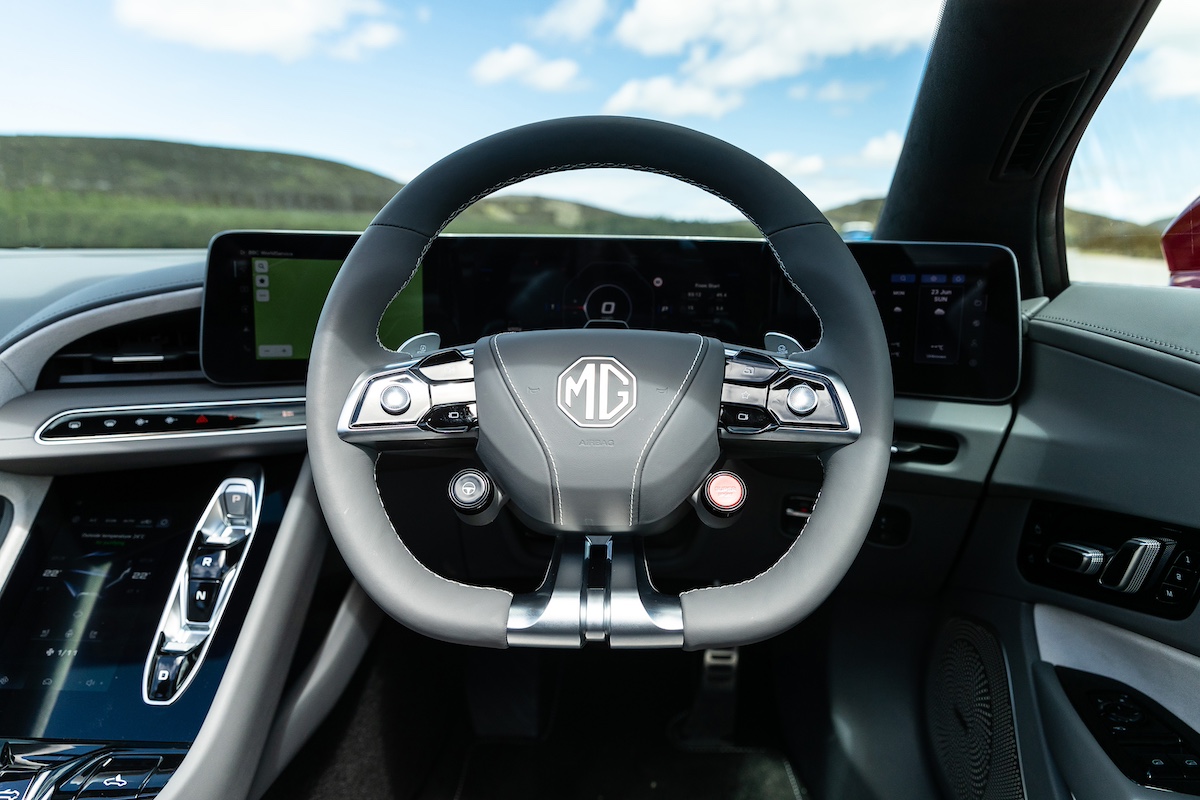
The main event from a technology point of view is the multiple screen layout that faces the driver. There are no fewer than four of the things. A 10.25-inch screen directly behind the steering wheel acts as your instrument panel, and this is flanked by a pair of 7.0-inch touchscreen displays, and the whole arrangement is supposed to wrap around the driver: the one on the left takes care of your nav and entertainment functions, while the one on the right provides various snippets of information about battery charge, energy usage, weather information, the availability of local MG service centres, and more.
The screen in the middle of the dashboard, meanwhile, switches between various car settings - driving modes, safety system, lighting, seat settings - and your climate control settings. There is a separate bank of touch-sensitive climate control buttons just above the screen, so you don’t always have to go delving into on-screen menus.
Now, all of that sounds fabulous at first. However, there are problems. The menus are arranged in submenus that are tabbed, and you swipe between them horizontally. This gives you a fighting chance of finding the function you want, but in reality, many functions are buried too deep and the swiping itself is a fiddly business that diverts your eyes away from the road for too long. And that’s before you factor in that you also have to remember which of the myriad screens you have to access a particular function on. And then throw in the fact that large portions of the two 7.0-inch screens are obscured by the top corners of the steering wheel, so you can’t see them properly without craning your neck sideways.
There’s even a problem with the separate climate controls: the touch-sensitive buttons aren’t all that sensitive, and often fail to register an input unless you press really hard.
When all is said and done, the whole system is too complicated - even performing the simplest of functions can be a confounding process - and using it diverts your attention from the road for too long. That fact is ably demonstrated by the car’s attention assist warning system, which tells you off for not concentrating enough on driving as soon as you start trying to hunt around for a particular function.
While we have quarrels with the ergonomics, however, there’s no complaining about the amount of luxury equipment you get included as standard. Even the entry-level Trophy gets a fully electric hood, electric scissor doors, automatic lights and wipers, heated and electrically adjusting part-leatherette seats, heated steering wheel, dual-zone climate control, keyless entry, adaptive cruise control, 360-degree parking cameras and 19-inch alloy wheels. The infotainment system, meanwhile, comes with Bluetooth, DAB radio, navigation, voice control, Apple CarPlay, Android Auto and an eight-speaker Bose sound system.
The only things added to the GT model are larger 20-inch wheels, along with the extra motor and extra power.
MG Cyberster running costs
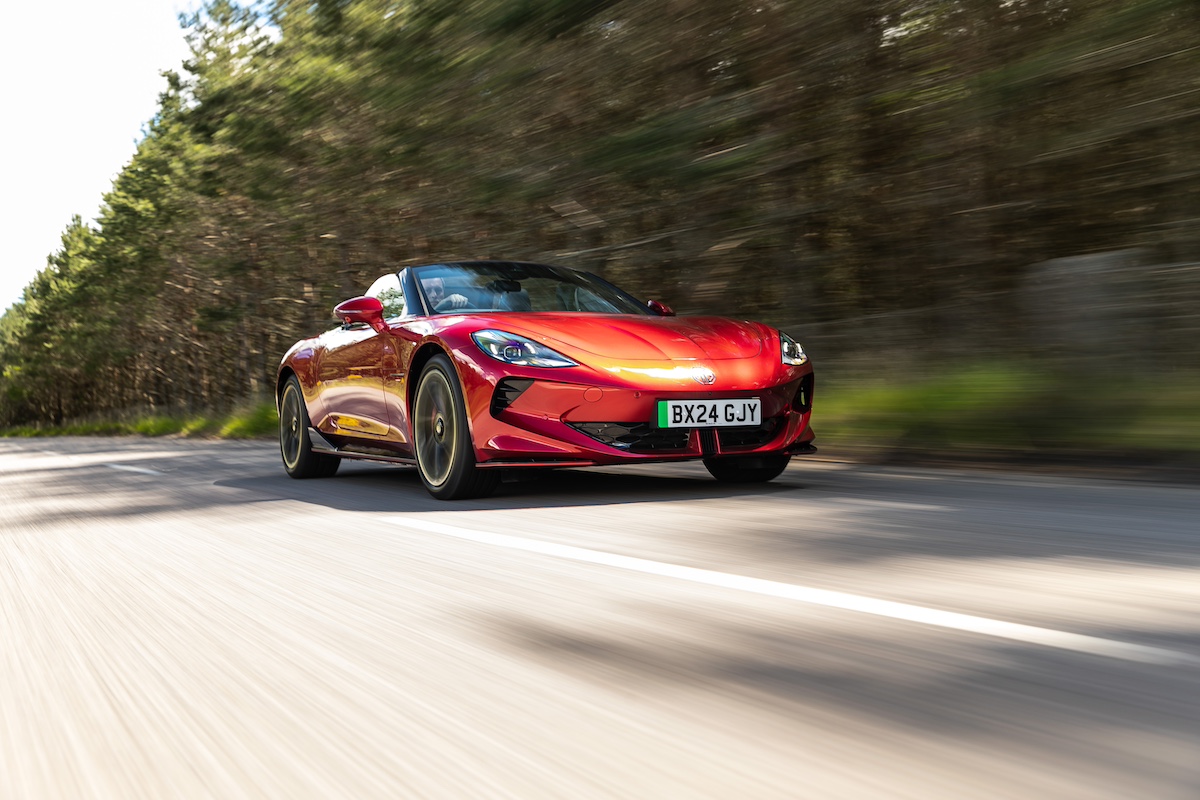
Depending on your point of view, the price of the Cyberster could look like either the biggest swizz ever, or the biggest bargain ever. At the time it went on sale, the Trophy cost £55,000 and the GT set you back £60,000. On the one hand, that’s a minimum of around £20,000 more than MG’s next most expensive car, which even for a flagship halo model, is a sizeable jump. However, if you want to buy another flavour of all-electric two-seater sports car, you’re looking at Rimac and Pininfarina supercar models costing two million quid and up. It really is that unique.
In reality, the biggest appeal will be for company car drivers wanting to run something with style and glamour, but with rock-bottom monthly Benefit-in-Kind tax bills. And as electric cars are liable for a fraction of the tax that combustion-engined cars are, and will be for a few years yet, then the Cyberster massively fits the bill there.
And what about charging? Well, with both versions getting a 77kWh battery capacity (74.4kWh usable), the official WLTP range of the Trophy version stands at 316 miles, while the GT will theoretically go 276 miles between charges. A 10% to 100% charge on a three-pin domestic socket (which we wouldn’t recommend) will take upwards of 31 hours, but the same charge will take around 10.5 hours on a 7kW home wallbox charger. The maximum rapid charging speed supported by the car is 144kW, so if you can find a powerful enough DC public charger, a 10% to 80% charge will be delivered in around 38 minutes.
If you plug your car in at home and fill up with electricity charged at the UK national average rate for domestic power, then a full charge will cost you around £21. You’ll be able to cut that in half if your house has a discounted off-peak tariff, but do bear in mind that if you fill up at a public DC rapid charger, you’re likely to double the original figure.
MG Cyberster reliability
Obviously, the Cyberster is far too new for any reliability issues to have come to light yet. It shares a platform and many parts with the MG4 hatchback, which has been around for a bit longer, so we might be able to take clues from looking at that.
And the news isn’t stellar, it has to be said. In 2023 What Car? Reliability Survey, MG finished 25th out of 32 carmakers considered in the manufacturer standings. With the exception of the MG5 and MG ZS EV, all the company’s models performed fairly poorly in their respective classes, and the MG4 was the least reliable of the lot with a score of 76.1% putting it 18th out of 20 cars in the electric car class. The most common causes for complaint were bodywork and non-motor-related electrical issues. Let’s hope things improve with the Cyberster.
Service intervals on the car stand at 12 months or 15,000 miles, whichever happens first, while the car comes with a generous warranty of seven years or 80,000 miles.
- As standard, the MG Cyberster comes with a suite of driver assistance technologies known as MG Pilot. This brings together systems such as blind spot detection, rear cross traffic alert, lane change assist, door opening warning, front collision warning, traffic jam assist, intelligent speed assist and lane keep assist.
- Part of MG’s schtick is that the company makes the buying decision very easy, and that continues with the Cyberster. You simply choose whether you want the Trophy or the GT, choose your paint colour (one of five), the colour of your fabric roof (black or red), and your interior colour scheme (grey or black and red). Other than that, no optional extras are offered.
- The Cyberster comes as standard with V2L, or Vehicle to Load charging. This allows you to use your car’s battery to power or charge other electrical devices, including other electric cars. This is handy if you want to share your battery charge to help out an EV-driving pal in a pinch.
- If you want the cheapest one: The Trophy is the cheapest version of the Cyberster, and it looks just as glamorous as the range-topper: indeed, the only clue from the outside is that it has 19-inch wheels rather than 20s. It has all the same luxury kit, too, and it’s not lacking pace.
- If you want the best one: The GT is undoubtedly the better car, not just because of its extra power and speed, but because of its slightly more settled ride and controlled handling. We reckon it’s easily worth the £5,000 upgrade.
- If you want the best range: The Trophy is the one to go for if range is a major factor. WLTP tests say it’ll do an average of 316 miles on a charge, compared to the GT’s 276 miles.
- If you’re after a company car: Benefit-in Kind tax rates on EVs are so low right now - and will be for the conceivable - that the £5,000 hike in list price of the GT over the Trophy will amount to little more than pence in terms of you monthly tax bill, so you might as well have the range-topper. Just hope that the Cyberster features on your firm’s company car list.

