Renault Captur Review (2020-present)
Renault Captur cars for sale
4.0
Expert review
Pros
Practical cabin with its clever sliding rear bench
Frugal hybrid model
Excellent Google-based touchscreen system
Cons
Not as much fun to drive as a Ford Puma
Elements of interior build quality could be better
Poor quality reversing camera

The CarGurus verdict
The Renault Captur is definitely one of the more attention-grabbing compact crossovers out there, and even more so when you consider the availability of the hybrid option. There’s substance behind its style, too, though. It is a safe and practical choice, it comes with a good range of equipment, and it isn’t overly expensive.
It is competing in a challenging sector, however, and there are rivals that do certain things better. The Ford Puma, for example, offers up a more engaging driving experience, and both the Hyundai Kona and Kia Stonic offer notably better warranties. Even so, if you're in the market for a small crossover, we think the Captur does more than enough to warrant a place on your shortlist.

What is the Renault Captur?
If you’re shopping for a compact crossover, it’s easy to be overwhelmed by the sheer array of choices available. You could go for a Hyundai Kona, a Ford Puma, a Nissan Juke, a Skoda Kamiq, a Peugeot 2008, a Citroen C3 Aircross, a Volkswagen T-Cross, a Seat Arona, a Vauxhall Mokka or one of the myriad other small supermini-sized SUVs currently available.
On your travels, however, you may have also encountered the Renault Captur. The original Captur was one of the cars that defined the compact crossover market and was a phenomenally popular model, and not without just cause; it was well equipped, cheap to run, comfortable to travel in and more attractive than many a car that followed in its footsteps.
This, the second-generation Renault Captur, builds on the success of its predecessor. It is based on the Clio hatchback but offers more substantial styling, greater interior space, and a more elevated driving position. When it was originally launched, the second-generation Captur's engine range included a plug-in hybrid. However, this was later dropped in favour of a petrol engine with manual gearbox, or a non-plug-in hybrid with an automatic.
In the second half of 2024, Renault launched a facelifted version of the Captur with a redesigned front end that more closely matches the styling of the rest of the Renault range – as well as an updated infotainment system set-up.
How practical is it?
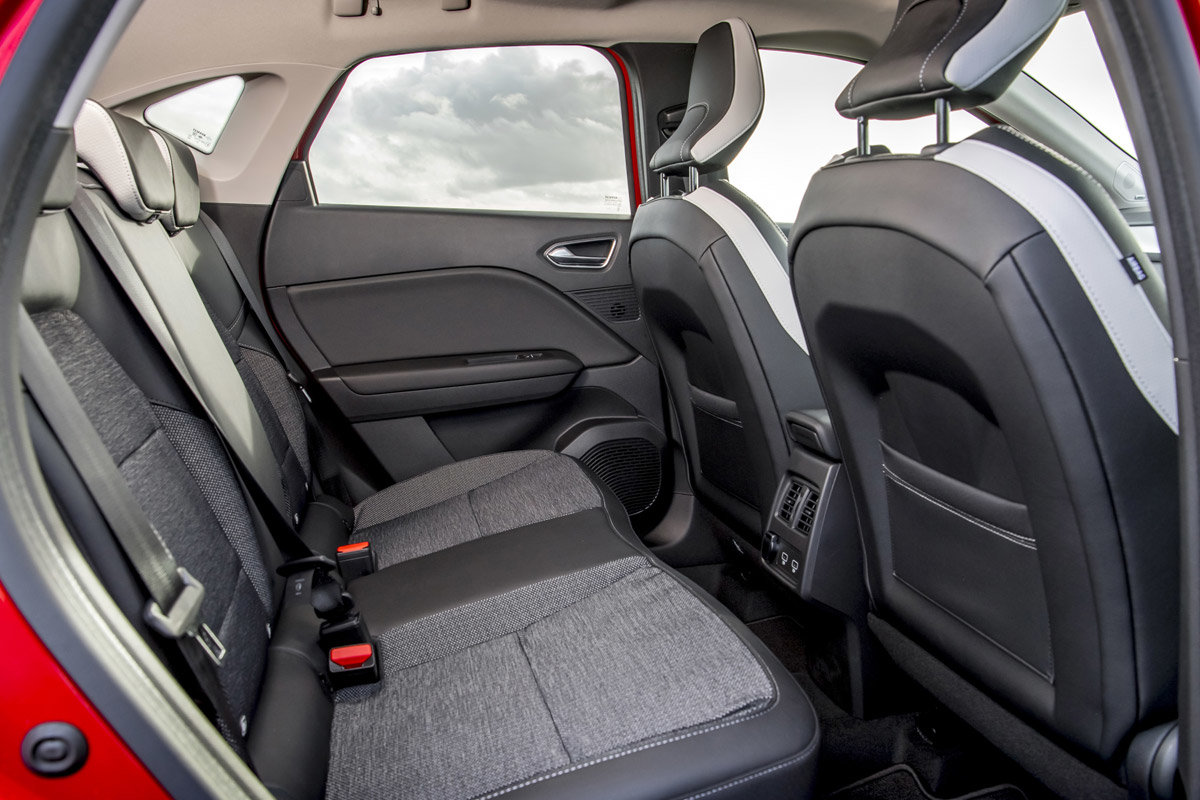
Renault has made this second-generation Captur easier to live with. The neatly designed cabin does a great job on practicality, with enough head- and legroom for four adults to travel in comfort. It’s possible to get three people across the back seat, but expect it to be a squeeze.
One of the Captur’s most impressive features in terms of practicality is the way you can slide the bench fore and aft. This allows you to trade rear legroom for extra boot space if needed.
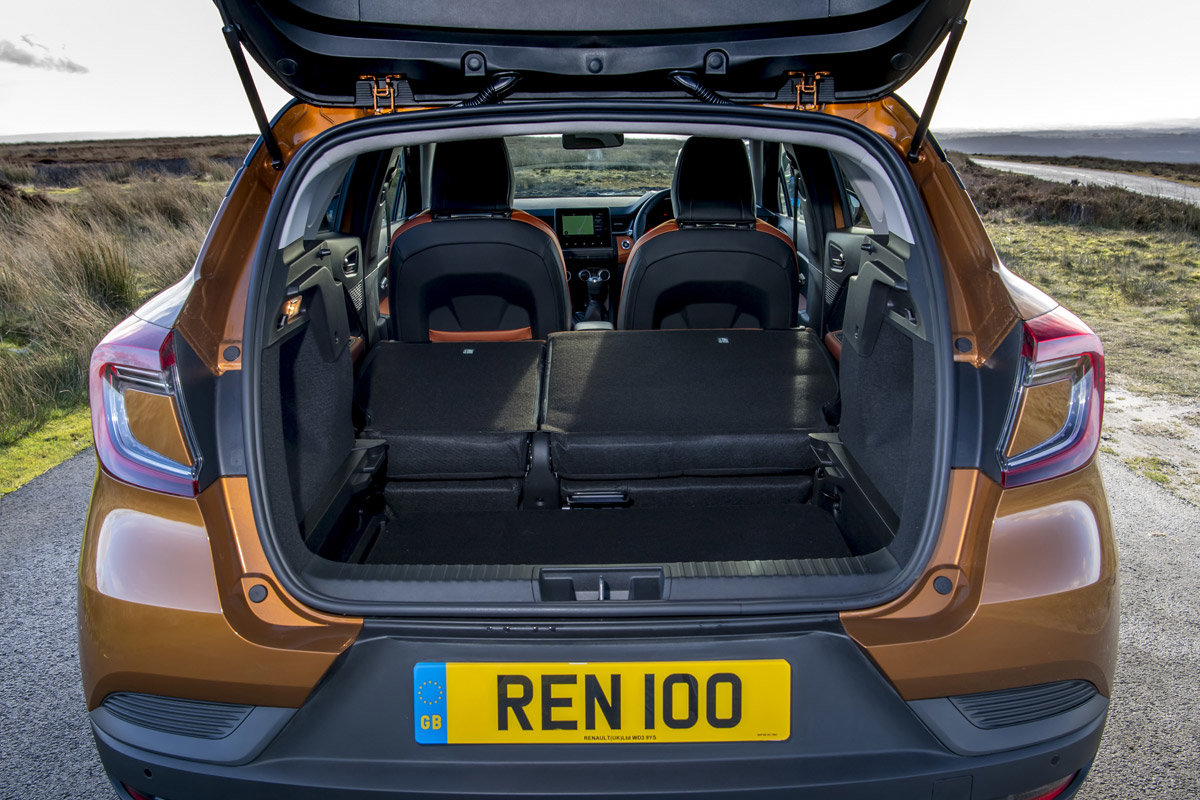
Petrol models also feature a much bigger boot than before, offering 444 litres of storage space, 536 with the rear seats slid forward or 1,275 litres with the rear seats down. But it is worth bearing in mind – if luggage capacity is critical – that the hybrid version has a notably smaller boot than the petrol and diesel models, at just 362 litres.
If you love the styling of the Captur but need more boot space, check out the Renault Symbioz, which takes the front half of the Captur and adds a longer and more practical rear end.

What's it like to drive?
As of the 2024 facelift, the Captur is only available with two engine options. There's a 1.0-litre TCe 90 petrol, which produces 90bhp, comes with a six-speed manual gearbox, and can get from 0-62mph in 14.2 seconds. Fast it isn't.
Alternatively, there's Renault’s E-Tech Hybrid powertrain. This combines a 1.6-litre petrol engine with two electric motors and a 1.2kWh battery, delivering a total system output of 145bhp for a 0-62mph time of 10.6 seconds. It's a particularly impressive system at town speeds, where the Captur will do a lot of running on electric power only. Its automatic gearbox can, however, sometimes be caught out when you ask for a sudden burst of power.
Opt for an older, pre-facelift version of the Captur and you can also choose a more powerful 129bhp 1.3-litre TCe 130 petrol engine with either a six-speed manual or seven-speed dual-clutch transmission. Diesel options are the dCi 95 or dCi 115, which are both 1.4-litre engines but with power outputs of 94bhp and 114bhp, respectively. And there's the E-TECH Plug-in Hybrid 160 Auto with its claimed electric range of up to 30 miles. This is something of a rare beast, however, and might need a brave buyer to consider as a used option.
The latest Captur is a good car to drive. It rides comfortably, it doesn’t roll too much in corners, it grips well, it's civilised and settled on the motorway and the engines return good fuel economy. A Ford Puma is a more involving car to drive, but if you're not after outright thrills then the Captur is perfectly pleasant.
Technology, equipment & infotainment
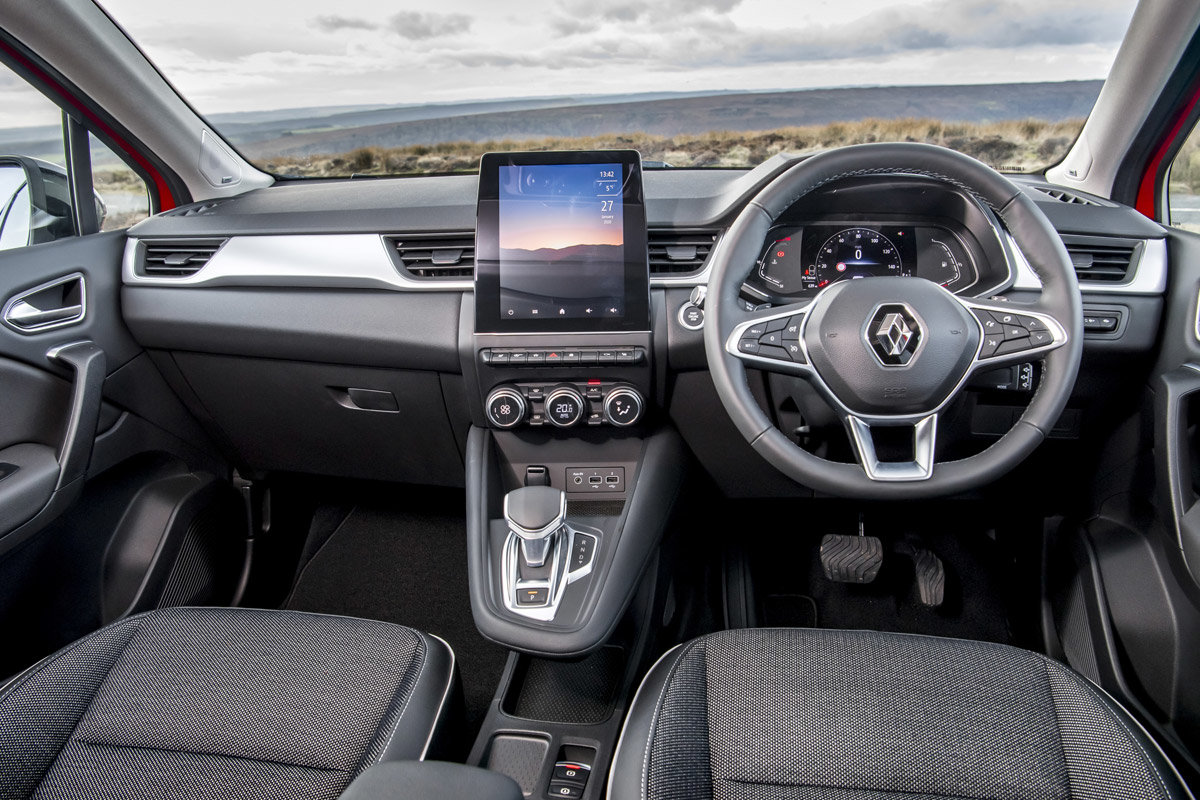
Post-2024 facelift versions of the Captur from mid-range Techno trim and above come with a really good 10.4-inch portrait-oriented touchscreen infotainment system. It is backed by Google, which instantly makes it easier to use than 90% of other in-car touchscreen systems, because the menu layout is logical, the apps (including Google Maps) work well, and the voice recognition is excellent. Apple CarPlay and Android Auto are also fitted as standard. We also like that Renault has kept a row of physical controls for the car's heating and air-con.
Given this thoughtful, tech-first approach, we find the low-resolution reversing camera a strange addition. On a dark, wet day it is close to useless.
The 10.25-inch digital driver display looks impressive at first, but suffers from a bit of lag when transitioning between displays or driving modes.
Typical of Renault, standard equipment is generous across the range. The entry-level Evolution includes climate control, keyless entry and 17-inch alloy wheels. Upgrading to Techno adds 18-inch alloy wheels, adaptive cruise control, digital dials, and the Google-backed infotainment system. Go for the top-spec Esprit Alpine and there are 19-inch wheels, styling upgrades, a heated steering wheel, and a more powerful stereo.
Whatever Captur you go for, it's hard not to spot that while some of the interior materials look quite smart, there are parts of the cabin that feel a bit flimsy (in partular the floating console that houses the gear selector).
If you're looking at an older Captur, bear in mind that the trims were different. Special editions were available at various points, but the range was originally underpinned by three main trim levels: Play, Iconic and the S Edition. Even the Play model features climate control, cruise control and a seven-inch touchscreen infotainment system with Bluetooth connectivity, a DAB radio, Apple CarPlay and Android Auto.

Renault Captur running costs
The Renault Captur, as you’d hope for with a small crossover, won’t cost a fortune to run. Every version is efficient, insurance groups are low and most versions are light and mechanically straightforward, factors which will help keep down the costs of consumables, servicing and repairs.
Go for an entry-level TCe 90 and it’ll average a claimed 47mpg on the official WLTP test cycle. The E-Tech Hybrid meanwhile managed a claimed 60mpg, which isn't out of the question in real-world driving, particularly if you spend a lot of time at town speeds.
As a used model, the plug-in hybrid Captur could prove very cheap to run if you can charge it at home frequently enough to make the most of its EV-only range of up to 30 miles.
Let's not overlook, either, that Renault has employed extremely keen pricing for the Captur, which has helped to make it one of the most popular options in its class.
Renault Captur reliability
The Captur finished 13th of the 23 models in the Small SUV class of the 2024 What Car? Reliability Survey, which is a pretty middling performance. Renault as a brand finished ninth out of the 31 manufacturers included in the study, which is a bit more promising.
Renault's warranty runs to three years and 60,000 miles, which is distinctly basic. Go for a Kia Stonic and you'll get seven years and 100,000 miles of cover, while a Toyota Yaris Cross could be under manufacturer warranty for 10 years or 100,000 miles provided it's serviced at a dealership.
If you're looking at an older Captur, there was a period in time when Renault offered a much better five-year, 100,000-mile warranty on its new cars (the plug-in hybrid also came with an eight-year, 100,000-mile battery warranty). As such, it's always worth finding out what warranty coverage might still apply when buying a Captur.
- There's no fully electric version of the Captur - buyers after an EV will need to look at the larger Scenic instead. That said, the Captur's hybrid system does do a decent job of running in EV-only mode as much as possible, and would be a good stepping stone between a petrol car and a full EV.
- Personalisation was always a strong point of the Captur and the second-generation model continues that trend, with Renault offering an array of trims, wheel designs and pleasingly vivid exterior colours. Buyers can pick from a line-up of extras, too, including underbody welcome lights, a boot liner, illuminated door sills and bodywork protection film. You can even specify different dashboard and interior panel colours on some models. On the Iconic, for example, you can opt for blue or red interior colour packs.
- No Captur comes as standard with a space-saver spare wheel; you’ll have to pay a premium if you want a physical spare. It’s an option worth considering, especially if you regularly venture far and wide, because tyre repair kits can often struggle to fix the damage a tyre has sustained. With a space-saver spare, at least you can get up and mobile quickly and get the car to a workshop or somewhere safe.
- The best all-rounder: We’d go for the E-Tech hybrid in mid-spec Techno trim. This offers excellent fuel economy and the upgraded Google-based infotainment system for a sensible price.
- For all the toys: The top-spec Esprit Alpine trim not only looks sharper than other Capturs (note the contrasting roof colour), but it also has heated seats, a heated steering wheel, 19-inch wheels and improved in-car audio.
- The cheapest option: The TCE 90 petrol Captur in Evolution trim marks the entry to the range. However, it's not terribly fast, you miss out on the Google-based touchscreen, and it's only available with a manual gearbox.
- As a used buy: While the second-generation Captur was available with both diesel and plug-in hybrid petrol power earlier in its life, we'd stick with a simply petrol model if looking at a used buy. Note that you'll need to go for the more powerful TCE 130 if you want an automatic gearbox.


