Renault Zoe Review (2020-2024)
Renault Zoe cars for sale
3.0
Expert review
Pros
Long range for a small EV
Good to drive
Practical cabin
Cons
Poor Euro NCAP safety rating
Not as desirable as some rivals
Rapid charging ability costs extra

The CarGurus verdict
The Renault Zoe is a stalwart of the EV sector, and deservedly so. It remains a competitive and likeable electric car, and the latest version has added performance and a bigger battery.
However, the Zoe's EuroNCAP score is a concern, plus it's now up against some impressive rivals that include the Peugeot e-208, Vauxhall Corsa Electric, and the larger but cheaper MG4. If you can find a great deal, the Zoe is still tempting. But it's certainly no longer the default electric supermini.

What is the Renault Zoe?
The Renault Zoe was a real pioneer when it arrived in 2012. It was among the first affordable small electric cars produced by a mainstream manufacturer to reach the market. For a great many buyers, it was therefore their first taste of EV motoring.
From 2020 it was thoroughly revamped with new styling, improved interior tech, an increased range and enhanced performance.
That overhaul arrived just in time, because where for several years the affordable EV market was populated by the Zoe and the Nissan Leaf (plus one or two others), nowadays the sector is packed full of competitor cars. The Honda E, MINI Electric, Vauxhall Corsa Electric, MG4 and Peugeot e-208 are all out to steal a slice of the Zoe’s market share.

How practical is it?
The new Renault Zoe’s lofty seating position is quite typical of an electric car. With the batteries spread out across the floor, the seats are set higher than they would ordinarily be.
That means you feel perched on top of the Zoe when driving it, rather than nestled down within it. Visibility is at least good as a result. The cabin is airy and spacious and the minor switchgear feels solid enough, while the materials used across the dashboard are adequate for a near-£30,000 car, but no better than that.
The Zoe is only offered in five-door format, which makes getting into the rear seats nice and easy. Once you’re in, the amount of headroom and legroom you get is fair-to-middling: a VW ID.3 and Nissan Leaf are roomier, but the Renault has the beating of cars like the MINI Electric, Honda E and Peugeot e-208 in for interior space.
It’s a similar story for luggage space, because at 338 litres the Zoe’s boot is a good size for a supermini. It absolutely dwarfs those of its rivals from Honda and MINI, and also marginally has the beating of the Peugeot’s. However, there’s a large load lip to contend with when loading heavy or bulky items, and when you fold the back seats down, you’re left with a sizeable step in the load area.

What's it like to drive?
The highest-priced of the Zoe gets a more powerful electric motor. With 134bhp rather than the basic model’s 109bhp, it is appreciably nippier in a straight line.
In fact, with the more powerful motor the Zoe feels very brisk indeed up to about 50mph. It therefore zips around town effortlessly, allowing you to dart into gaps you’d think twice about when driving a comparable petrol hatchback.
Like all electric cars the Zoe is very quiet and, because there aren’t any gears, exceptionally smooth as well. The ride quality is mostly pretty good, while on motorways the car doesn’t feel at all out of its depth. On quiet B-roads it can be reasonably good fun to drive, too, albeit a bit bouncy at times.
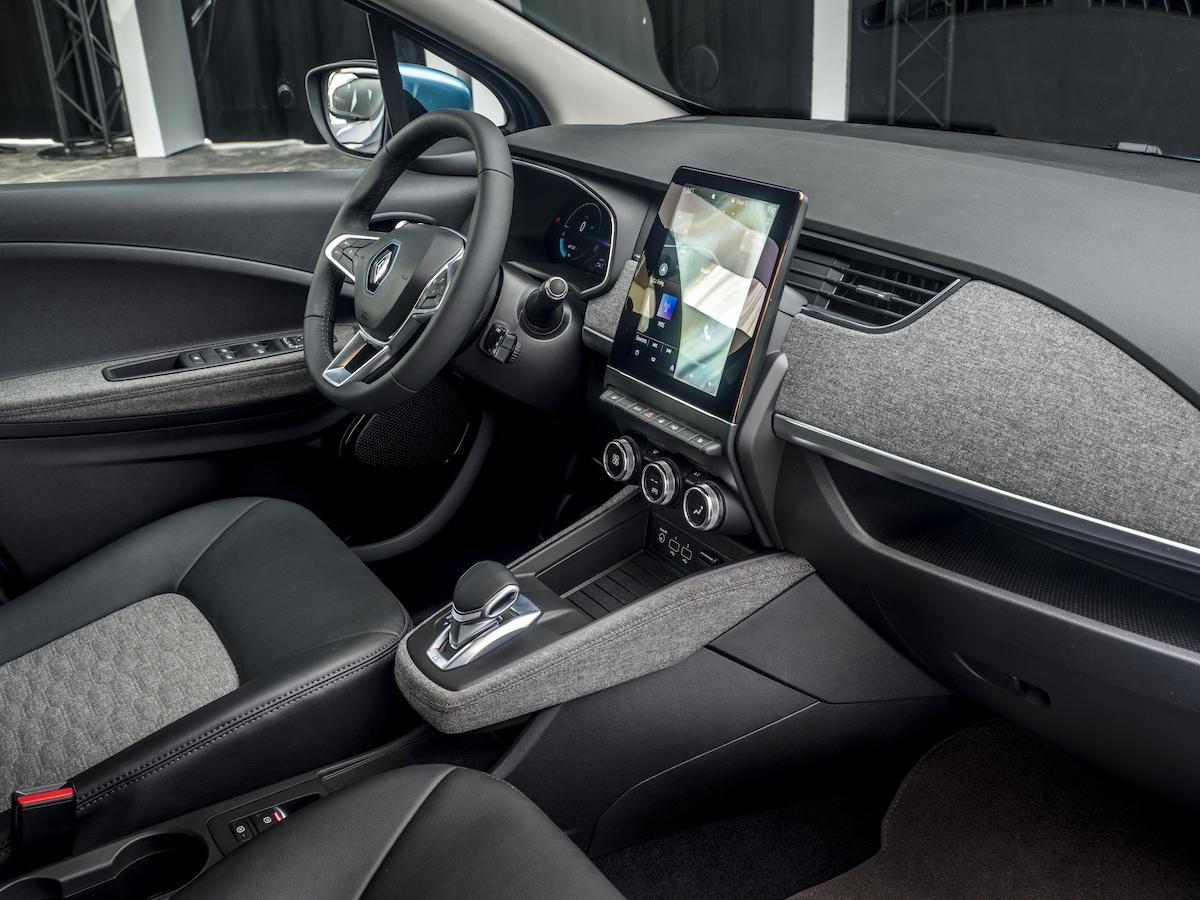
Technology, equipment & infotainment
Until recently, many Zoe buyers didn’t actually own the batteries in their cars. Instead, they leased them. Renault has now ditched that approach, making Zoe ownership no more complex than, say, buying a petrol-engined hatchback.
Trim levels have changed throughout the Zoe's life. Initially this second generation lineup kicked off with the Play trim, followed by the Iconic, which gets a little more kit. At the head of the line-up and packed full of extras is the GT Line. These were later updated to Techno and Iconic.
One key optional extra is the 50kW DC Rapid Charge upgrade, which enables the Zoe to recharge its batteries much more quickly. At a public fast charge station, a completely flat battery will be replenished to 80% capacity in a little over an hour. A 50% charge, enough for around 120 miles of driving, will take 38 minutes.
Without the Rapid Charge option, a 0-80% charge will take around three hours at a public station. Meanwhile, charging at home via a wall box charger will take around nine hours for a full charge.
Renault Zoe running costs
If you’re stepping out of a petrol or diesel car, any electric car will prove to be exceptionally affordable to run. Charging at home certainly isn’t free, although a full charge will cost around half of what you’d pay for a full tank of petrol or diesel, depending on your electricity tariff. Charging at public stations will be more expensive – potentially even on a par with filling up with petrol or diesel.
Like all EVs, the Zoe is exempt from Vehicle Excise Duty and London’s Congestion Charge. Until late in 2019, Renault offered Zoe buyers the option of leasing the battery pack and paying a modest sum each month for it. This brought the initial cost of the Zoe down so it was in line with that of a comparable diesel car. The company has ditched this battery lease option, though, citing the model’s improved resale values, which have ultimately made the Zoe more affordable than it once was.
Replacement tyres will be inexpensive (expect to pay less than £300 for a full set). The basic Zoe sits in insurance group 20 and the higher-powered model in 23, meaning this electric hatchback will prove costlier to insure than its petrol-powered sibling, the Renault Clio.

Renault Zoe reliability
New Zoes are covered by a generous manufacturer warranty. It lasts for five years and is unlimited in terms of mileage for the first two years, then limited to a total of 100,000 miles after that. The battery, however, is covered for eight years or 100,000 miles, whichever comes sooner.
Electric car battery packs have proven to be more durable over time than many people expected. Rather than degrading very quickly in terms of capacity (and therefore nibbling away at the car’s range between charges), the packs have been shown to lose capacity only very gradually. Renault guarantees the Zoe’s battery pack will retain at least two-thirds of its original capacity during the eight-year warranty period.
Electric cars are far simpler than petrol or diesel ones and there’s therefore much less that can go wrong. When faults do emerge, they tend to relate to non-powertrain electrical gremlins (things like heaters and infotainment systems), bodywork and chassis problems and so on. The Zoe has been known to suffer heating and air-conditioning faults, although not on a worrying scale.
In owner satisfaction surveys, Renaults tends to perform well enough to avoid emerging red-faced, although rarely does it really excel itself. Where faults do emerge, owners tend to have their cars fixed under warranty and back with them within a week.
- The second-generation Zoe has a maximum official range of 245 miles (WLTP), which is around 30% more than the previous model. The improved range in the new car is down to its new, bigger 52kWh battery, rather than the previous 41kWh unit. Of course, range depends on all sorts of factors. If you accelerate very hard with any regularity it’ll come down sharply, just as it will during motorway journeys. In mixed driving, 180-200 miles is a realistic target.
- There are a couple of things you can do to make the most of the Zoe’s range between charges (apart from simply driving at slower speeds). The first is to engage Eco mode, which noticeably limits the car’s acceleration to save energy. The second is to switch regenerative braking on. Whenever you lift off the accelerator pedal, the car recaptures energy that otherwise would be lost under braking. In time, you learn to drive the Zoe without touching the brake pedal at all. This is known as one pedal driving.
- There is some controversy when it comes to the Zoe's safety rating. When the first-generation Zoe was tested by Euro NCAP in 2013, it scored a full five-star rating. However, when this latest generation model was tested in 2021, it didn't receive any stars at all, a result of the test becoming more stringent, and Renault changing the configuration of some of the Zoe's safety equipment, including the removal of a head airbag. You can read the full results on the Euro NCAP website.
- If you want the best range: With an official WLTP range of 245 miles per charge, the Renault Zoe is the most usable electric car in the sub-£30,000 price bracket. With the optional 50kW Rapid Charge upgrade, Zoe drivers can quickly and conveniently replenish their car’s batteries at public fast-charge stations, too.
- If you want the best looker: With a real-world range of not much more than 100 miles, the Honda E is very much a city car first and foremost. Its range might be half that of the Zoe’s, but with great styling and a very modern cabin, the little Honda is arguably the more desirable machine.
- If you want the best value: Despite being a bigger car, the MG4 EV undercuts most of its rivals in terms of price. It's also good to drive and roomier than the Zoe inside.


