Seat Leon Review (2012-2019) | A great all-round family hatchback
Seat Leon cars for sale
4.0
Expert review
Pros
Good balance of fun and practicality
Spacious for both passengers and luggage
Extensive line-up means there's something for everyone
Cons
Some rivals are more engaging to drive
Ride a little firm on some versions
Badge lacks a little prestige

The CarGurus verdict
The Seat Leon has always been a dependable, practical and affordable car. The Mk3 version was no different, offering a slightly leftfield alternative to the Volkswagen Golf, but one that could absolutely hold its own. As a result, the Leon remains a tempting option as a used car. Although not the sharpest family hatchback to drive, with alternatives like the Ford Focus and Mazda 3 delivering more engagement, it was always on a par with its VW cousin. What’s more, as the Seat badge doesn’t carry quite the same cachet, you can often pick up a used Leon for less than a Golf of similar age and mileage. There’s something for everyone here, too, due to the extensive line-up of trim levels and engines, which range from super-frugal diesels to the quick and powerful Cupra variants (this was back at the time when Cupra was the halo performance specification for Seat models, rather than its own performance-oriented brand).
While the Leon is unquestionably a talented car, there are alternatives worth considering. Buyers who simply want an efficient and inexpensive hatchback, for example, could go for a second generation example of either the Kia Ceed or Hyundai i30. A more prestigious option could be a third-generation Audi A3, another close relation from within the Volkswagen Group, while a dynamic albeit less practical option is a rear-wheel drive, second-gen BMW 1 Series. If you just want a good all-round choice, however, the appealing and flexible Seat Leon could definitely make the cut.

What is the Seat Leon?
The third-generation Seat Leon was the Spanish brand’s rival to cars such as the Volkswagen Golf, Ford Focus, Vauxhall Astra and Kia Ceed. With Seat being part of the Volkswagen Group, the car shared many of its mechanical bits with similarly sized machines from VW, Audi and Skoda. Specifically – and one thing you’re likely to read about a lot if you’re in the market for this popular Seat hatchback – it used the ‘MQB’ platform, which was the backbone of cars like the Leon, VW Golf and Audi A3, plus other related vehicles like the Audi Q2 and TT, VW Passat and Touran, Skoda Octavia and Superb, and so on.
By being part of the Volkswagen Group, Seat benefitted from plenty of technology and engine development. Yet it was still separate enough that the Spanish-designed Leon never felt merely like a poor relation to the VW Golf. It was designed to be more stylish and sporting than the Golf, with sharp looks and a generally more engaging driving experience, plus a wide array of features that potentially made it more appealing to younger buyers.
When the Leon was unveiled in late 2012, the range was relatively straightforward and consisted of a conventional five-door hatchback. A three-door, coupe-like Leon SC model would follow, along with a five-door estate called the ST. Those wanting something more rugged could later opt for the SUV-style Leon X-Perience, while hot hatchback fans were able to choose the petrol-powered Leon Cupra or diesel Leon FR.
When looking at used examples, be mindful that the Leon underwent a facelift in early 2017, which brought an exterior and interior refresh, plus updated technology and engines. It was replaced by the fourth-generation Seat Leon in 2020.

How practical is it?
The Leon is a sensible choice, offering plenty of interior space and a neatly finished cabin. It might not look as modern inside as some rivals, but what it lacks in wow-factor, it makes up for in ease of use. For example, despite a slightly shorter overall length than the second-gen Leon (33mm, if you’re asking), this third iteration is quoted as having an extra 39 litres of luggage space compared to its predecessor. There is a 14mm increase in kneeroom and headroom for rear-seat passengers, too.
SC versions aren’t quite as practical, due to their lack of rear doors, which is perhaps why the SC was dropped from the line-up in 2018, two years before this generation of Leon was replaced. However, they still offer good rear-seat space and the same boot capacity as five-door models.
The five-door Leon and three-door Leon SC both muster 380 litres of boot space, but the ST estate can accommodate 587 litres. This makes it a far more usable and practical used-car choice for those with children. The ST also has a removable double floor in its boot, allowing you to further increase space to 687 litres. With the rear seats folded down, the standard boot goes from 587 litres to 1,470 litres.
Improving practicality further are neat touches such as an integrated 12-volt power supply in the cargo area of ST versions, which can be used for charging and powering devices. Roof rails were standard on the ST, too.

What's it like to drive?
You won’t be disappointed when it comes to the on-road experience. Even in base form, the Seat feels light, eager, responsive and fun to drive, certainly more so than a similarly aged VW Golf. There’s no ignoring the fact that a comparable Ford Focus is ultimately more enjoyable to drive, a real selling point for every generation of Focus, and a Mazda 3 also feels more agile. But the Seat is still a decent drive.
Go for a used petrol model and any one of the TSI engines will deliver a healthy balance of performance and efficiency, while the diesel options were always frugal.
The hot Leon Cupra delivers great performance for the money. Initially available with 265bhp or 280bhp, this was increased to 290bhp from 2015. They don’t offer the handling or engagement behind the wheel that you'll enjoy in a Renaultsport Megane or Ford Focus ST. Purely in terms of engine performance, though, Cupra versions feel quick to this day: just be sure to find one that has been cherished and maintained properly. The same can be said for Golf GTD-rivalling Leon FR, the diesel-powered hot hatch equivalent. It serves up 181bhp and a huge 280lb ft of torque, yet can achieve fuel economy of around 65mpg.
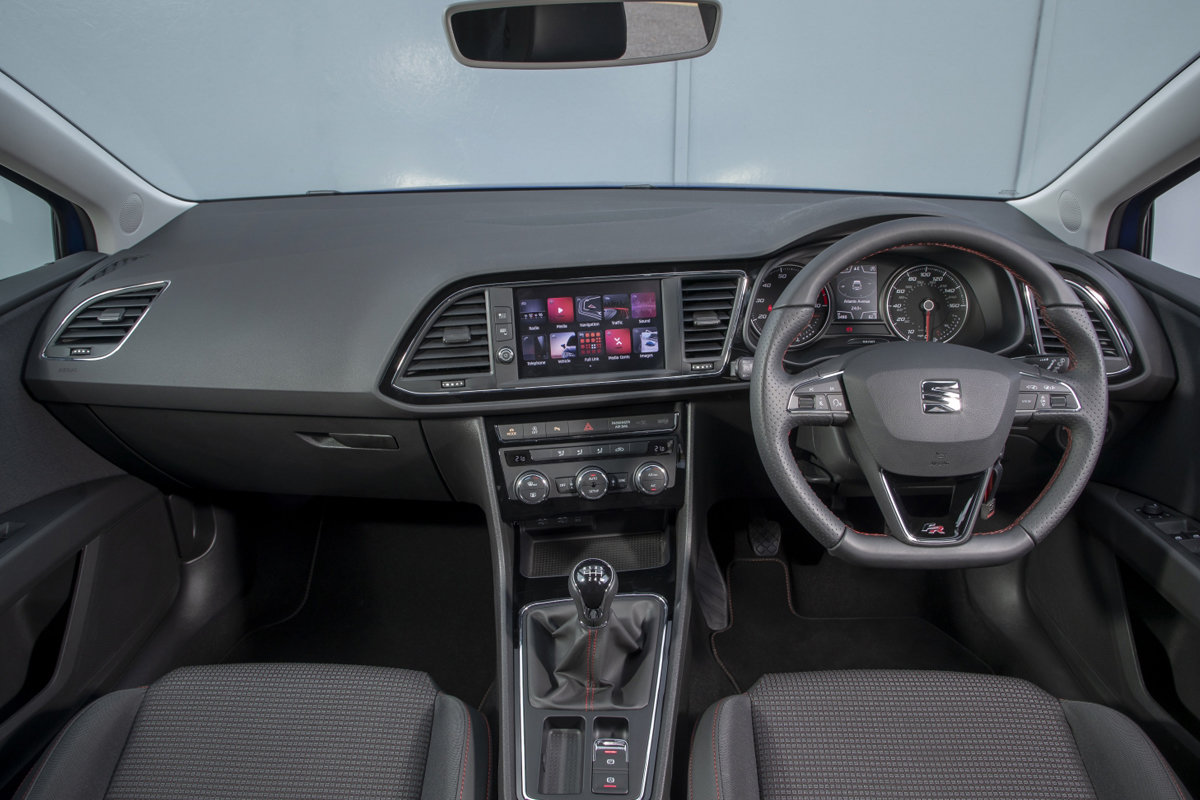
Technology, equipment & infotainment
As you might expect given the third-generation Leon’s age, there were never any hybrid or mild-hybrid powertrains. Nonetheless, there was a healthy mix of petrol and diesel engines. Manual gearbox and dual-clutch (DSG) automatic options were available, while some models were also offered with the Seat 4Drive all-wheel-drive system. A facelifted Leon arrived in 2017, with sharper looks, extra tech and more efficient engines.
Every version of the Leon had some form of touchscreen infotainment system, measuring from five inches upwards. Although only later models had Apple CarPlay and Android Auto integration, you will always be able to connect your phone to play music or podcasts, plus view vehicle information and listen to the radio.
The trim hierarchy at launch in 2012 began with the Leon S. It came with 15-inch steel wheels, air conditioning, front electric windows, central locking, a driver’s knee airbag and heated door mirrors. Stepping up to the mid-range SE added 16-inch alloy wheels, cruise control, front foglights with a cornering function, a leather steering wheel and Seat’s XDS electronic differential lock.
Topping the original Leon lineup was the FR, which rode on sports suspension and 17-inch rims, with more sculpted bumpers and twin tailpipes for good measure. Other equipment included big-bolstered seats, LED rear lights and the ability to switch between drive modes.
The 2017 facelift split the mid-range Leon SE into SE Dynamic and SE Technology grades. The former had larger alloy wheels, while the latter gained extra kit such as LED highlights and rear parking sensors. The FR was also joined by the plush Leon Xcellence, which offered keyless entry, ambient interior lighting and the option of leather and Alcantara trim.
Seat also sold a number of additional feature packs with the Leon. For example, from the entry-level ‘S’ model upwards, you could opt for the Gadget Pack. This included a tablet seat mount, a bag hook for the headrests, a headrest-mounted clothes hanger and – get this – an in-car espresso machine. The Adventure Pack, the Infant Pack and the Young Pack were available, too.
Regardless of specification, it’s hard to fault the overall package offered by the Seat Leon. It looks good, feels well-built, is pleasant to drive (you can thank Seat’s ‘enjoyneering’ – nope, not our phrase) and the extensive line-up makes it easy to find a Leon to suit your needs. It’s often more affordable than rival offerings as well, making for a tempting option for anyone seeking a family car.

Seat Leon running costs
The Seat Leon is generally an inexpensive car to run, thanks in part to its frugal engine line-up. On the petrol front, depending on the model year, you’ll find everything from 1.0-litre three-cylinder engines to 2.0-litre turbocharged units, with various other engine sizes in between. Things were simpler with diesel: there’s either the 1.6- or 2.0-litre turbo.
The running costs for performance Cupra versions will be higher, unsurprisingly, but still reasonable considering the power on offer. You can expect to pay a bit more for tyres (at least £150 per corner, otherwise you’ll be wasting so much of what the Cupra has to give), and we’d recommend staying on top of maintenance to keep the car fighting-fit.
If you want a petrol model and hope to keep costs down, it’s probably best to opt for a Leon with the 113bhp 1.0-litre ‘Ecomotive’ TSI engine. This frugal three-cylinder option emits 120g/km of CO2 and can eke out 53.3mpg, according to WLTP tests, which means fewer trips to the pumps.
The 113bhp 1.6-litre diesel is also a great option, as it emits 125g/km of CO2 yet can return an average of almost 60mpg. Ramping up the engine size to 2.0 litres, the 148bhp TDI engine won’t cost you too much more to run, as it’ll still manage more than 50mpg. However, you’ll have a helping hand of extra torque to propel you down the open road: an important consideration if you regularly load your car up with passengers and luggage.
Servicing and repairs shouldn’t break the bank, either. As Seat is part of the Volkswagen Group, there is a good amount of crossover between the Leon and cars such as the Golf and Skoda Octavia. This means parts will never be very difficult to come by.

Seat Leon reliability
While the three-year, 60,000-mile warranty will have long since run out for any third-generation Leon, the 12-year anti-perforation warranty may still be valid. This is something to be aware of when you’re going for a used car rather than a new one, as UK roads aren’t great when it comes to keeping bodywork and chassis elements rust-free.
Major issues should be few and far-between, and there were only one or two recalls each year for this version of the Leon. You can check the details of the exact car you’re looking at using the government’s ‘Check Vehicle Recalls’ service and then ask the dealership or seller if those issues have been rectified. This is also where a full service history will prove particularly useful.
Used Cupra and X-Perience versions of the Leon may have been worked a little harder, so remember to check for any excessive wear or damage. Keep an eye out for the 1.5 TSI models, too, as there have been issues with the engine juddering, a trait that has now reportedly been fixed. Test any prospective purchase carefully, regardless.
- Bolstering the Seat Leon’s appeal is a strong safety rating. It scored the full five stars in Euro NCAP crash tests in 2012, and ranked particularly well for both adult and child protection. The third-generation Ford Focus, which was also tested in 2012, scored the same five stars but didn’t perform so well when it came to child occupant protection.
- There are myriad sporty versions of the Leon, which benefit from more power, bigger wheels, performance upgrades and styling tweaks. These are ideal for enthusiasts, or those wanting something with some real punch, and they rival cars like the Ford Focus ST, Audi S3 and Volkswagen Golf R. Aside from the ‘regular’ Cupra and FR versions we’ve mentioned, Seat also made the Cupra 300, with a whopping 295bhp (300PS, hence the name) and a muscular 280lb ft of torque. Fitted with all-wheel drive and a DSG gearbox, it could manage 62mph in 4.9 seconds.
- Seat launched an X-Perience version of the Leon ST in 2014, aimed at those who were looking to venture down rougher roads on a more regular basis. It featured a 28mm loftier ride height, all-wheel drive, additional body protection, plastic wheelarch covers and full LED headlights on SE Technology models. Only diesel engines were offered, one with 148bhp and another with 181bhp, and the higher-powered model could only be combined with a dual-clutch automatic transmission. It was never a full-house off-roader, being more of a Seat rival to the Skoda Octavia Scout. But we’re fond of it all the same.
- If you want the best all-rounder: If you’re looking for a fun, practical and frugal daily driver, go for one of the smaller TSI petrol engines. The 1.0-litre three-cylinder in particular is great for around-town work and fine on the motorway, so that’s likely where our money would go. The more miles you’re likely to do, however, the more we’d steer you towards the 1.4. Make sure you don’t simply plump for the entry-level ‘S’ model, though. It was fine, really, but the difference in price between an ‘S’ and a trim level up won’t be as pronounced now as it was when new. Keep in mind, too, that with the exception of the ‘S’, the trim level names were tweaked as time went on, making more features available.
- If you want maximum practicality: In this case, you’ll require a Leon ST. Keep an eye out for models with the optional foldable front passenger seat, which makes the Leon even more practical. Also look out for any number of genuine Seat accessories. These could include roof bars, a bike holder and the ‘protective loadliner’: a special boot floor cover that can be taken out and washed.
- If you do the odd rough-road excursion: If you routinely tackle more challenging terrain or conditions, you’ll need the Leon X-Perience. Aside from its brilliant name, the extra ground clearance and the all-wheel-drive system, combined with some more off-road-focused tyres, all make it more capable. It won’t rival a Land Rover Defender for off-road ability, but 95% of real-world, low-grip conditions will be handled with ease.
- If you want performance thrills: Go for one of the Cupra variants. Whether it’s a three-door, five-door or estate ST, any Leon Cupra will still feel quick and sporty today.


