Volkswagen ID. Polo 2026 review | Cheerful and seriously capable small EV
Pros and cons
What we like
Superb interior and plenty of tech
Robust, reassuring and confident drive
Big-car feel up front and a huge boot
What to consider
Rear seat space could be better
A bit of wind noise is noticeable at speed
Easy to knock stereo volume knob
The CarGurus verdict
The Volkswagen ID.Polo impressed us during our world-first drive overseas in Austria. The design is appealing, with a modern yet still very ‘Volkswagen’ appearance, and the high-quality interior is a real highlight. It’s a lovely car to sit in, with extensive yet user-friendly tech, and the ‘retro’ mode is a fabulous touch. Add in a grown-up drive and efficient, long-range electric drivetrain, and the appeal is obvious.
It’s a compact car, and this shows up in rear seat space that could be better. A bit of wind rustle at speed did spoil otherwise-impressive refinement, too. But, overall, the Volkswagen ID.Polo seems to be a real return to form for the brand – for prices that don’t seem particularly unreasonable given all that you get for your money, too.
out of 5 expert review
What is the Volkswagen ID.Polo?
The Volkswagen ID.Polo is the all-new, all-electric version of the firm’s famous supermini first launched way back in 1975. Unlike earlier electric VWs such as the ID.3, the ID.Polo aims to be an electric version of a car we all know and love, rather than being radically futuristic and different.
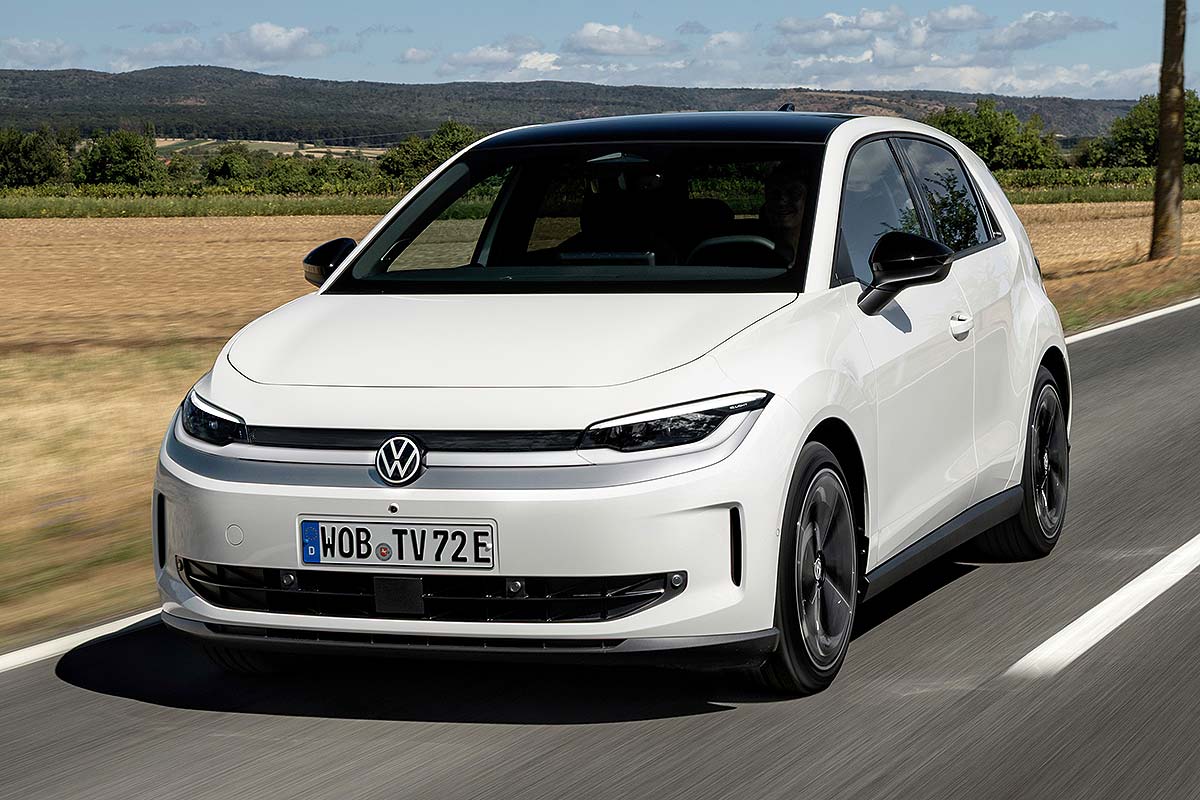
That’s why the cheery design has so many familiar design cues: clean lines, flared wheelarches, a characterful front end with a ‘smile’. It’s safe, solid and sturdy-looking, and every inch a Volkswagen. This, hopes the firm, will be a key reason why people flock to it.
The Volkswagen ID.Polo thoroughly modern beneath the surface, though. It’s derived from VW’s MEB+ platform, and designed specifically as an EV (there won’t be a petrol-powered version; the current Volkswagen Polo will continue). It’s very space-efficient too, with the front-wheel-drive setup promising plenty of interior space for people and their luggage.
There will be two battery options, with the larger of the two, a 52kWh battery, offering a range of up to 281 miles. There is a smaller, cheaper 37kWh battery with a 205-mile range, but this isn’t expected to be sell in particularly great numbers. Even with small cars, range is all.
Rivals for the Volkswagen ID.Polo include the Renault 5, Mini Cooper Electric, Vauxhall Corsa Electric, Peugeot e-208 and Citroen e-C3. There are also Chinese rivals from new brands including the Geely EX2, BYD Dolphin Surf and upcoming Aion UT. There will also be other Volkswagen Group models using this architecture, including the Skoda Epiq and Cupra Raval.

Practicality
How practical is it?
Up front, the Volkswagen ID.Polo is an exceedingly practical small car. Exterior dimensions are compact and supermini-sized – four metres long, 1.8 metres wide, 1.5 metres tall – yet interior space is much better than traditional petrol-powered superminis. It also makes the Renault 5 feel like a car from the class below.
The interior is also a triumph in terms of its welcoming high-quality feel. Stitched fabric on the door trims blends into a fabric-trimmed dashboard, which is set off by polished metal-look trim. The plastics themselves are higher-quality than we’ve seen in some other VWs in recent years as well. It feels really special and a cut above the norm.
The squared-off two-spoke steering wheel is nice to hold – and, praise be, it’s fitted with proper buttons rather than touch-sensitive controls. These are clearly marked and intuitive to use. There’s even a physical volume knob on the centre console – although we found it far too easy to accidentally knock and turn the stereo up to an ear-splitting volume…
The Volkswagen ID.Polo has firm, high-set seats that give a great view out, helped by a low instrument panel and deep windscreen. The seat and steering wheel have plenty of adjustment, making it easy to find a good driving position. Heated seats and steering wheel are standard, and higher-spec cars even have ergonomic massage seats.
As with many EVs, there’s a ‘floating’ centre console, with stowage space both above and below. All models get a wireless inductive smartphone charging pad. What’s more, all Volkswagen ID.Polos have physical heater controls on the centre console – they’re beautifully tactile, with the up-down toggles for temperature control being particularly satisfying. Further back, there are dual cupholders and, below the centre armrest, a cubby deep enough to swallow several more drinks bottles.
Rear seat space is a little tighter. The rear door opening is rather narrow, so it’s a bit tight getting in and out, and a high floor gives a rather perched, knees-in-the-air seating position that may require a bit of compromise from those in the front. The rear seat itself is comfortable and supportive – and there is more space back there than in a Vauxhall Corsa Electric, Renault 5 or MINI Cooper Electric – but while children will be fine, adults may grumble. There are no grab handles in the rear, either.
The Volkswagen ID.Polo is much more impressive in terms of boot space. It has an overall capacity of 441 litres, which is way bigger than the small car norm – indeed, it’s 25% larger than the petrol Polo, and 60 litres larger than the Volkswagen Golf, a car from the next class up.
The space is split above and below the adjustable boot floor; you can have a flat, easy-to-load space, or drop the divider to reveal an ultra-deep extra space commodious enough to swallow a carry-on suitcase and a squashy bag or two. Fold the rear seats and space grows to 1,240 litres. There is, however, no front boot, or ‘frunk’.

Driving
What's it like to drive?
The Volkswagen ID.Polo is a front-wheel drive small car, with three power outputs – 114bhp, 133bhp or 208bhp. We’ve only driven the higher-power version for now, which offers sprightly 0-62mph performance in 7.1 seconds.
Power delivery is very smooth and predictable. Some electric cars can surge forward when you jump on the accelerator, but the Volkswagen ID.Polo is far better-behaved. It’s swift without being snatchy. Sure, the front wheels can scrabble for grip if you try to deliver too much power when pulling away, but traction control soon sorts it out – much more effectively than in some Chinese models, which can struggle here.
The brakes feel nice too, with a smooth, natural and well-weighted brake pedal – it shows none of the artificial grabbiness that some EVs suffer. It’s easy to blend the brakes in and out, and the Volkswagen ID.Polo also offers a one-pedal mode, bringing the car to a complete halt simply by lifting the accelerator. This is switchable for those who don’t like one-pedal driving.
To drive, the Volkswagen ID.Polo has a satisfying long-wheelbase, wheel-at-each-corner feel. You get a sense of good composure combined with agile nimbleness. The steering is direct and well-weighted, turning smoothly off-centre without feeling twitchy, which quickly helps the driver gain confidence.
The Volkswagen ID.Polo’s suspension isn’t over-firm, so there is some initial roll into corners, before settling smartly and confidently to show impressive mid-corner stability. It’s not the sharpest steer – you’ll have to wait for the Volkswagen ID.Polo GTI for the truly driver-focused take – but there’s still a lot to like in its composed, easy-going big-car feel.
Ride quality is very good, too. The Volkswagen ID.Polo has a particularly smooth and cushioned feel at lower speeds, seeing it glide over potholes, drain covers and broken city roads without harshly or noisily crashing into the tarmac. The test cars were running large 19-inch alloy wheels, so they could at times patter over sharp expansion joints, but the core ride quality is impressive enough to give confidence UK cars on the Life's 17-inch and Style's 18-inch wheels will be very smooth and composed.
Refinement is generally impressive too. At lower speeds, electric motor noise is virtually non-existent, helping make it far more refined than a conventional petrol-powered Polo. Volkswagen has worked hard to keep other sources of noise at bay too, with little suspension or road roar. We only really noticed wind noise, with some rustle developing around the windscreen pillars from around 50mph, becoming more pronounced at higher motorway speeds.
Volkswagen was also keen for us to try the ID.Polo’s optional Travel Assist tech. This isn’t self-driving, but still helps the driver by steering within lanes and maintaining either a set speed or set distance from the car in front. There’s full stop-and-go functionality in traffic, and it can also detect traffic lights. It even has 'swarm data', so other Volkswagen Group cars can help improve accuracy over time – such as where lane markings on a complex junction are missing.
A quick go on the autobahn showed it to be a particularly smooth and intuitive system, with little of the disconcerting snatchiness some other systems show. It’s a high-tech option we look forward to testing further in the UK.

Tech and equipment
Technology, equipment & infotainment
All Volkswagen ID.Polo feature digital instruments and a central 12.9-inch touchscreen infotainment display. The driver display has several options, including full satnav mapping – and a brilliant ‘retro’ mode, that mimics the classic Volkswagen Golf Mk2. It’s easy to flick between them via the ‘view’ button on the steering wheel.
The Volkswagen ID.Polo uses the latest VW infotainment software. This is particularly intuitive and logical to use, thanks to a configurable shortcut bar along the top. Particularly useful is the little ‘car’ icon, giving quick access to ADAS settings so you can easily disable lane-keep assist and the like. The display is clear and easy to read, with large and clear icons throughout. The configurable central home screen is configurable, too.
Wireless Apple CarPlay and Android Auto are standard, and there are dual USB-C sockets both front and rear, with a powerful charging capacity of up to 60W. For the first time, this Volkswagen supermini is available with an optional Harman Kardon premium sound system, with nine speakers, a subwoofer and a 480W output. Do note, however, that satnav is only standard on Style models.
Volkswagen ID.Polo Life models are still well-equipped, with 17-inch alloys, parking sensors, rear-view camera, dual-zone climate control, electric folding door mirrors featuring built-in puddle lights, ambient interior lighting and the IDA voice assistant all standard. There are front and rear electric windows – controlled by four proper buttons rather than the silly dual-use switches of the old Volkswagen ID.3.
The Volkswagen ID.Polo Style adds 18-inch alloys, IQ.Light LED matrix headlights, illuminated front and rear ‘VW’ logos, front sports comfort seats and novel ‘play’ and ‘pause’ accelerator and brake pedals. Extended ambient lighting also includes the intelligent ‘ID.Light’. Built into the dashboard, this does clever things such as flicking a band of light from one side of the car to the other to indicate the direction of your next satnav instruction, and blinking red if you go to open a door when there’s something coming from behind. It sounds gimmicky but, in everyday use, it’s surprisingly helpful.
The Volkswagen ID.Polo features standard DC rapid charging tech, although it isn’t the speediest around – either 90kW on the 37kWh battery, or 105kW on the 52kWh battery. Volkswagen quotes around 24 minutes to take the batteries from 10-80% charge, which is about par for the course, but it would be more of a highlight if it were a bit speedier. Oh, and a heat pump is optional rather than standard as well.

Running costs
Volkswagen ID.Polo running costs
Insurance groups for the Volkswagen ID.Polo are still to be confirmed, but we expect it to be competitive, given the detailed engineering that’s gone into making it an affordable real-world car. After all, the existing petrol-powered Polo is very competitive here, with insurance groups from 3E for the entry model, and 9E for the cheapest TSI turbo.
Electric cars are far simpler than petrol cars. This means servicing costs should be cheaper, as EVs don’t need oil changes and such like. With brakes less likely to wear out too, the only real ongoing maintenance expense will be for tyres.
As for electric car efficiency, the Volkswagen ID.Polo looks to have great potential. The 52kWh battery is able to cover 4.6 miles for every kWh of energy, which is very impressive. During testing in Austria, we saw an even higher average of 4.8 miles per kWh – and this was over several hours of mixed-roads driving, including high-speed autobahn. We look forward to putting the new Volkswagen ID.Polo’s real-world efficiency to the test in the UK.

Volkswagen ID.Polo reliability
Although it’s too soon to say for sure, reliability should be another strong suit for the Volkswagen ID.Polo. The MEB+ platform it’s based upon has already been proven, in larger MEB guise, in numerous models dating right back to the 2020 Volkswagen ID.3. This in-market experience will have given ample time for quirks and niggles to be ironed out, meaning it should be dependable and, hopefully, largely problem-free.
Electric cars are fundamentally more reliable than petrol cars anyway, with less to go wrong. Volkswagen is also able to issue over-the-air software updates, which not only means the ID.Polo can improve over time, but the firm can tackle any minor issues by issuing an update rather than having to visit a dealer.
Like all Volkswagens in the UK, the ID.Polo has a three-year, 60,000-mile warranty. Interestingly, the first two years have no mileage limit, which is good news in the unlikely event you're planning on driving more than 50,000 miles a year in your new ID.Polo. The EV battery has an eight-year, 100,000-mile warranty.


What owners say
Three things to know
- The Volkswagen ID.Polo has a brilliant ‘retro’ mode for its driver display. It turns the instruments into digitised versions of the Volkswagen Golf Mk2, complete with LCD-style digital clock and a rev counter reimagined as an energy dial. It’s a fabulous fun touch.
- Think you can’t tow with small electric cars? Think again. The Volkswagen ID.Polo has a 1,200kg maximum braked trailer capacity, an impressively useful figure that’s sufficient even for a small caravan. It also has a 75kg towbar nose weight, so it’ll easily handle a bike rack and a couple of e-bikes.
- The Volkswagen ID.Polo’s impressive 441-litre boot is genuinely huge. It’s a full 90 litres bigger than the current petrol-powered Polo… and 60 litres bigger than the Volkswagen Golf – a car from the class above.
Which one to buy
- If you want the most affordable Volkswagen ID.Polo: the Life 37kWh with a 114bhp electric motor is the cheapest Volkswagen ID.Polo, with prices from £23,945, but make sure its limited power and range work for you.
- If you want the best value Volkswagen ID.Polo: the Life 52kWh Launch Edition looks pretty compelling to us, although you’ll have to be quick because, as its name suggests, it won’t be around for long. It costs £28,830, but is currently eligible for the Electric Car Grant, taking the price down to £27,330.
- If you want the longest range Volkswagen ID.Polo: the Life 52kWh has a range of up to 281 miles, and is surely the sweet spot of the launch range.
- If you want the fastest Volkswagen ID.Polo: you’ll have to wait for the upcoming Volkswagen ID.Polo GTI.