Hyundai Tucson 2026 review | A solid all-rounder with eye-catching looks
Hyundai Tucson cars for sale
4.0
Expert review
Pros
Lots of standard kit
Five-year warranty
Choice of hybrid powertrains
Cons
Not all that fun to drive
Unsettled ride on big 19-inch wheels
Plug-in hybrid range not a match for best in class

The CarGurus verdict
There’s no doubt that the latest new Tucson is a deeply impressive family SUV. It looks and feels well built – if not up there with an Audi Q3 or BMW X1, then certainly a big step up from the previous model – and it offers pretty good value for money considering the amount of standard equipment Hyundai crams into most trim levels.
No, it won’t especially put a smile on your face on a country road, the transmission can feel a little ponderous on occasion, and on big 19-inch wheels it can jostle you a little over bumpy surfaces, but the Tucson is an easygoing companion whether you’re on a long journey or a short hop. Throw in a wide range of hybrid powertrains, and one of the biggest boots in the class, and you have a great all-round family SUV.
Search for a Hyundai Tucson for sale on CarGurus
What is the Hyundai Tucson?
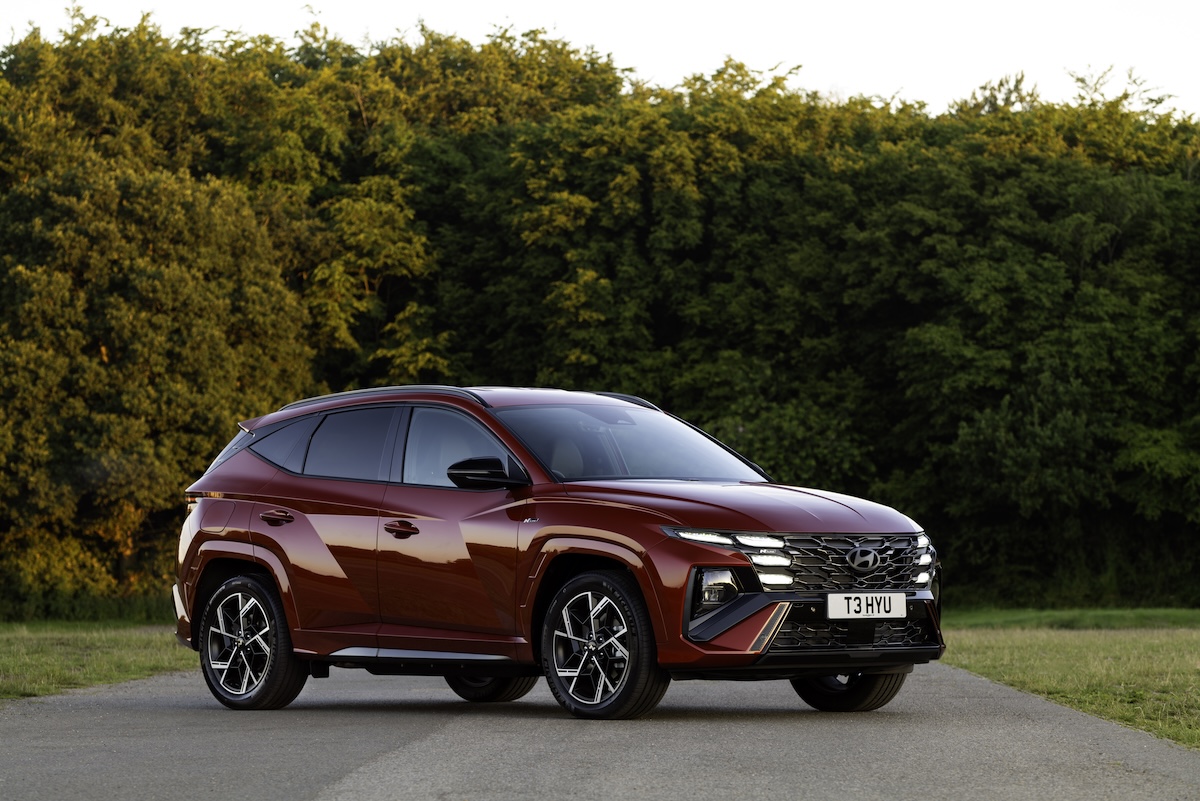
The current Hyundai Tucson went on sale in the UK in early 2021 as a midsize family SUV, and it is thus a very popular choice in today's market. It’s the fourth major redesign since the model was first introduced in 2004. Since then, Hyundai has shifted its focus from being a manufacturer of worthy, budget models to becoming a maker of far more aspirational cars. In fact, the Tucson is upmarket enough to take a serious tilt at premium brands.
So although the Tucson is still a competitor for the Ford Kuga, Skoda Karoq and Peugeot 3008, it’s also now setting its sights a little higher, with top-end Tucson models in the same pricing bracket as the Audi Q3 and BMW X1. Elsewhere, the Tucson also faces strong competition from the new Chinese-built SUVs that have arrived in the UK market, including the BYD Seal U and MG HS.
A facelift in mid-2024 resulted in the Tucson getting a mildly refreshed exterior design as well as a heavily revised interior.

How practical is it?
What, then, makes the Tucson stand out? Well, its styling is certainly distinctive. At the front, the segmented lights blend into a prominent grille, while at the sides, the combination of Coke-bottle curves and sharp creases draw your gaze.
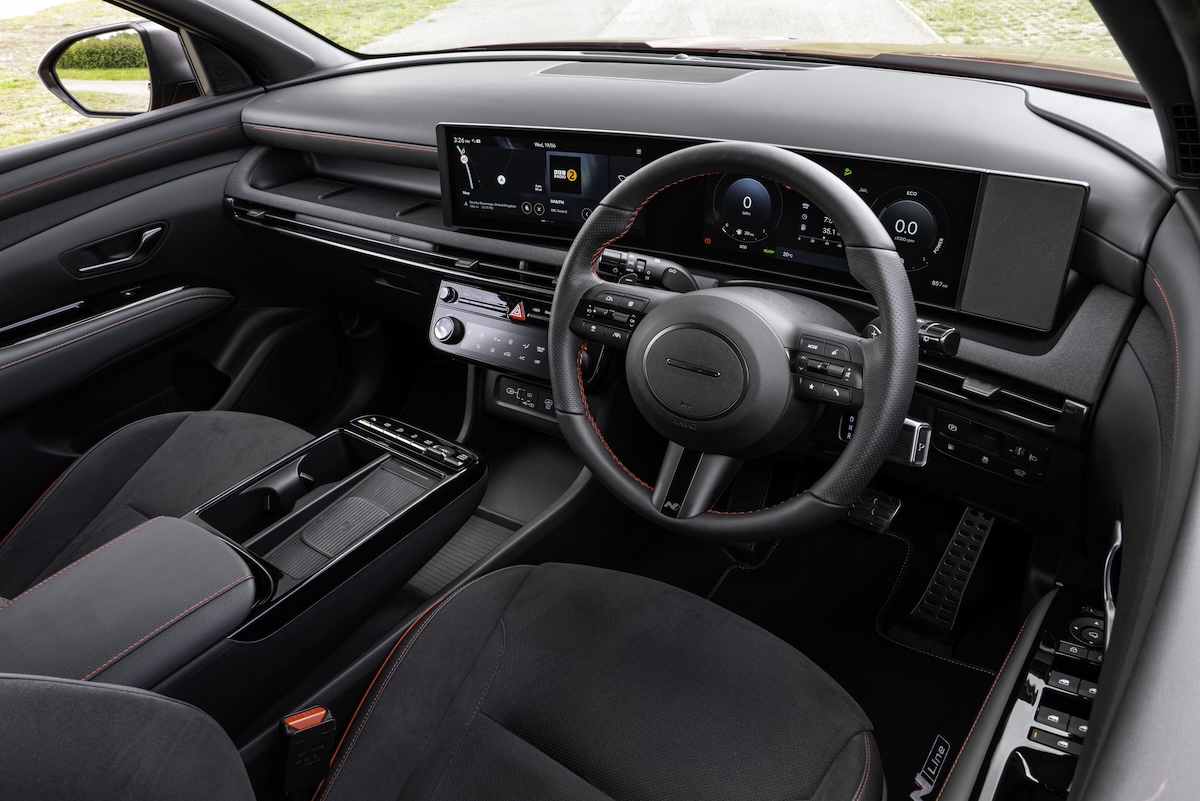
Inside, the Tucson is equally striking, with twin silver trim lines that shoot out from the centre console, wrapping around the front of the cabin and incorporating the front air vents. Post-facelift Tucsons in particular are very striking, with all models getting a curved infotainment setup with two 12.3-inch screens.
Space inside is generous for both passengers and luggage. There’s loads of legroom and headroom up front, while those in the back seats will feel equally well catered for, with enough legroom and headroom for tall adults to get comfortable. Fitting three across the back seats is inevitably tighter, but still perfectly possible.
In the boot, you’ll find 620-litres of luggage space in the non-hybrid petrol model, which is up there with the class best. The boot space does, however, reduce as hybrid tech is added. Go for a mild hybrid or full hybrid version, and the boot space drops to 577-litres, while the plug-in model has 558-litres (which is still very respectable by class standards).

What’s it like to drive?
Power comes from a 1.6-litre turbo petrol engine in all versions, with a choice of 148bhp or 178bhp mild hybrids, a 227bhp self-charging hybrid and a 261bhp plug-in hybrid in pre-facelift cars. There is one non-hybrid model in the range, but without even the small torque boost of the mild-hybrid models, it’s a bit sluggish, and is only available with a manual gearbox, whereas other Tucsons are automatic.
At the 2024 facelift, the Tucson’s engine range had a few tweaks in the pursuit of greater efficiency. 148bhp and 178bhp mild hybrids were dropped, and replaced by a 158bhp version of the 1.6-litre turbo, with a mild hybrid system on the automatic version (manual models remained un-electrified, though had the same power output).
Power for the self-charging hybrid dropped from 227bhp to 212bhp, meanwhile, and the plug-in hybrid actually got a slight hike in power to 284bhp.
Regardless of which engine you choose, the Tucson is an easygoing companion on the road. It’s smooth and quiet, and in self-charging hybrid guise, gets up to speed quite effortlessly. The electric motor means there’s a pleasingly instant response from a standstill, and overtaking response is equally impressive. The six-speed automatic gearchange in this car is somewhat less polished, feeling a bit sluggish in its responses. Mild hybrid models get a crisper seven-speed twin-clutch DCT automatic gearbox instead.
The plug-in hybrid model is similarly good to drive and has an electric-only range of around 40 miles in post-facelift versions (more like 30 miles in pre-facelift models), which is decent but not class leading. Indeed, in this class there are now models from MG and Skoda that can get in the region of 70 miles from a full battery.
Despite being quite tall, the Tucson doesn’t lean too much in corners, but the light steering and that automatic gearbox maks it more suited to relaxed cruising. It’s also quite a comfortable car to ride in, although the 19-inch alloy wheels of Ultimate-spec models mean it can jostle you around a bit over rougher road surfaces.
On pre-facelift versions of both this flagship model and the N Line it was possible to specify adaptive dampers (they came as part of the Tech Pack), and if you can find a car so-equipped, these help soften the ride a little in their Comfort setting. However, this option was no longer available by the time the facelift came out in 2024.
Technology, equipment & infotainment
Inside the pre-facelift Tucson you’ll find two 10.25-inch screens, one of which acts as a digital instrument cluster and the other a central touchscreen infotainment system. The main touchscreen is lag-free and fairly intuitive, but the shortcut buttons and heating controls below it are also touch-sensitive rather than physical buttons, which can be tricky to operate on the move.
In post-facelift Tucsons from mid-2024 onwards, the two screens are mounted in one curved binnacle, which looks extremely smart and is intuitive to use. In fact, we rate it as one of the best systems on the market.
If you’re used to the interior quality that you’d get in an Audi or BMW, you may feel a little short-changed in the Tucson, but the quality is on a par with a Peugeot 3008 or Volkswagen Tiguan. However, given the goodies you’ll get to play with, you probably won’t worry about a bit of overly shiny leather. Even the entry-level model gets a leather-wrapped steering wheel, DAB, Apple CarPlay and Android Auto, satnav, dual-zone climate control and cruise control. Higher-end models add in a panoramic sunroof, adaptive cruise control and wireless phone charging.

Hyundai Tucson running costs
Ironically, the cheapest Tucson – the non-Hybrid model – uses the most fuel. Official combined fuel consumption figures put the pre-facelift version at 41.5mpg and 151g/km of CO2 emissions. That puts it on a par with similar entry-level models from rival manufacturers, although it's still usefully better than the MG HS. Post-facelift non-hybrid Tucsons had more power, but also achieved slightly less impressive fuel economy, at 39.7mpg.
Mild-hybrid Tucsons with the dual-clutch seven-speed transmission and 148bhp can manage 43.5mpg and 144g/km of CO2. The 178bhp mild-hybrid gets four-wheel drive as opposed to the front-wheel drive of the 148bhp model, and the extra weight and friction of the four-wheel-drive system hurts the Tucson’s MPG a little; it can only manage a combined fuel economy figure of 39.8mpg with CO2 emissions of 160 g/km in this guise.
Interestingly, the post-facelift model with two wheel drive actually performs worse than this, with a 39.7mpg fuel consumption figure that matches that of the non-hybrid manual model.
As we’ve come to expect, the plug-in hybrid delivers the most eye-catching claimed efficiency figures, with promises of more than 200mpg. Of course, achieving anything like those numbers will depend on how you drive the car, with frequent charging and lots of short trips making the most fuel efficient combination For longer journeys, the most economical Tucson will be the self-charging hybrid model, which can achieve more than 50mpg and delivers CO2 emissions of 130 g/km.
Servicing intervals are annually or every 10,000 miles and, though you can set up a pre-paid service plan when you buy the car, the costs will vary depending on your usage.

Make Model reliability
The latest Tucson went on sale in 2021, and did very well in early reliability studies. However, its star has fallen a little in recent years, with its average equal-32nd place out of the 76 family SUVs to feature in the 2025 What Car? Reliability Survey suggesting later examples haven’t been quite as dependable as we might have hoped. Having said that, this mid-table showing meant the Tucson still beat key rivals like the Citroën C5 Aircross, Ford Kuga, MG HS and Renault Austral.
Hyundai offers an impressive warranty, which covers the car for five years and for unlimited mileage from new. It also offers a battery warranty of eight years for its electrified models. That’s bettered only by the seven-year warranty you get with cars from Hyundai’s sister brand Kia, plus MG's seven-year warranty. Toyota also offers a 10-year warranty, subject to having the car serviced at one of its dealers.
- Hyundai’s experience with hybrid powertrain technology shows in the Tucson. The mild-hybrid cars use a 48-volt integrated starter-generator to deliver an extra efficiency boost, but there’s no separate electric motor. The self-charging hybrid models get a 59bhp electric motor and a small 1.49kWh battery, so get a greater power boost and the ability to move away from a standstill on electric power alone. The plug-in hybrid, meanwhile, can take a charge from the mains, with a 13.8kWh battery to provide power for the 76bhp electric motor, which means it can travel for up to 43 miles on electric power alone.
- There are some quite complicated gearbox options to choose from within the Hyundai Tucson line-up. An old-fashioned six-speed manual is available, but only on the most basic non-hybrid models. A traditional six-speed automatic is the only gearbox choice for the self-charging hybrid and plug-in hybrid. The mild hybrid Tucsons come with either a seven-speed dual-clutch automatic, or on pre-facelift cars, what Hyundai calls an intelligent manual transmission (iMT). This is a conventional six-speed H-pattern manual gearbox, but with a fly-by-wire clutch so there’s no physical connection between the pedal and gearbox. It allows the car to coast, the clutch automatically disengaging when you lift off the throttle, before re-engaging when you need to accelerate. Post-facelift mild hybrids only come with the dual-clutch auto.
- The Tucson looks after its occupants in surprising ways. As well as an extensive suite of active safety features including autonomous emergency braking, blind spot collision avoidance and lane keeping assist, it has some more unusual tricks. Rear Occupant Alert monitors the rear seats to check for movements, effectively so you don’t forget to let your children out of the car before locking up. And when you step out of the car, the Safe Exit Warning will warn you if there’s any passing traffic when you’re ready to get out.
- If you like your gadgets: The Tucson 1.6 T-GDi Ultimate. One of the nice things about the Tucson range is that you can get the basic engine with the top-spec trim. So if you really love your in-car toys, this is a great way to go; you get all of the kit you would in the Hybrid Ultimate, including heated and ventilated electrically adjustable front seats, a panoramic sunroof and an electric tailgate. All for more than £4,000 less.
- If you want electric-only commuting: The Tucson plug-in hybrid. As well as attractive tax breaks if you’re running it as a company car, the plug-in hybrid version of the Tucson can potentially give you a zero-emissions commute, provided you don’t live too far from the office, that is, and there’s a charging point at work. Fully charged, earlier versions of the Tucson Plug-in Hybrid can manage up to 31 miles on electric power alone, while in later versions this was boosted to 43 miles.
- If you regularly do long-distance journeys: The Tucson 1.6 T-GDi Hybrid might be the most powerful Tucson apart from the plug-in hybrid, but it’s also going to be the most economical over long journeys, with official fuel economy of just over 50mpg. Go for a higher spec of the hybrid model, and its bigger wheels will mean you get slightly less fuel efficiency.
- If you want to go off-road: Go for a used Tucson 1.6 T-GDi 180 Ultimate. It’s unlikely that many Tucsons will go very far off-road, but if you do need to negotiate boggy fields or rutted farm tracks, then a four-wheel-drive model is a wise choice. Although four-wheel drive is available as an option on the 178bhp mild-hybrid, the full hybrid model gets a Terrain Mode selector, which tweaks the four-wheel-drive settings to suit mud, sand or snow. Post-facelift buyers will have to make do with the plug-in hybrid, though, as this was the only version to be made available with four-wheel drive from 2024 onwards.


