
If you're looking for a family-sized Ford SUV, you might find yourself weighing up two very different options from the same brand: the Ford Edge and the Ford Kuga. They might both wear the blue oval badge, but they come from different worlds.
The Edge, sold in the UK between 2016 and 2020, is a big, bold, American-style SUV that puts space and comfort first. It’s a lot of car for the money on the used market. The Kuga, on the other hand, is a thoroughly modern European family crossover, blending practicality with sharp driving dynamics and efficient hybrid power. So, should you go big with the old-school cruiser, or opt for the smarter, more modern all-rounder?
Ford Edge vs Ford Kuga
- Practicality
- Driving Impressions
- Technology and Equipment
- Running Costs
- CarGurus Buyer Insights
- Verdict

Practicality
Ford Edge practicality score: 5/5
Ford Kuga practicality score: 4/5
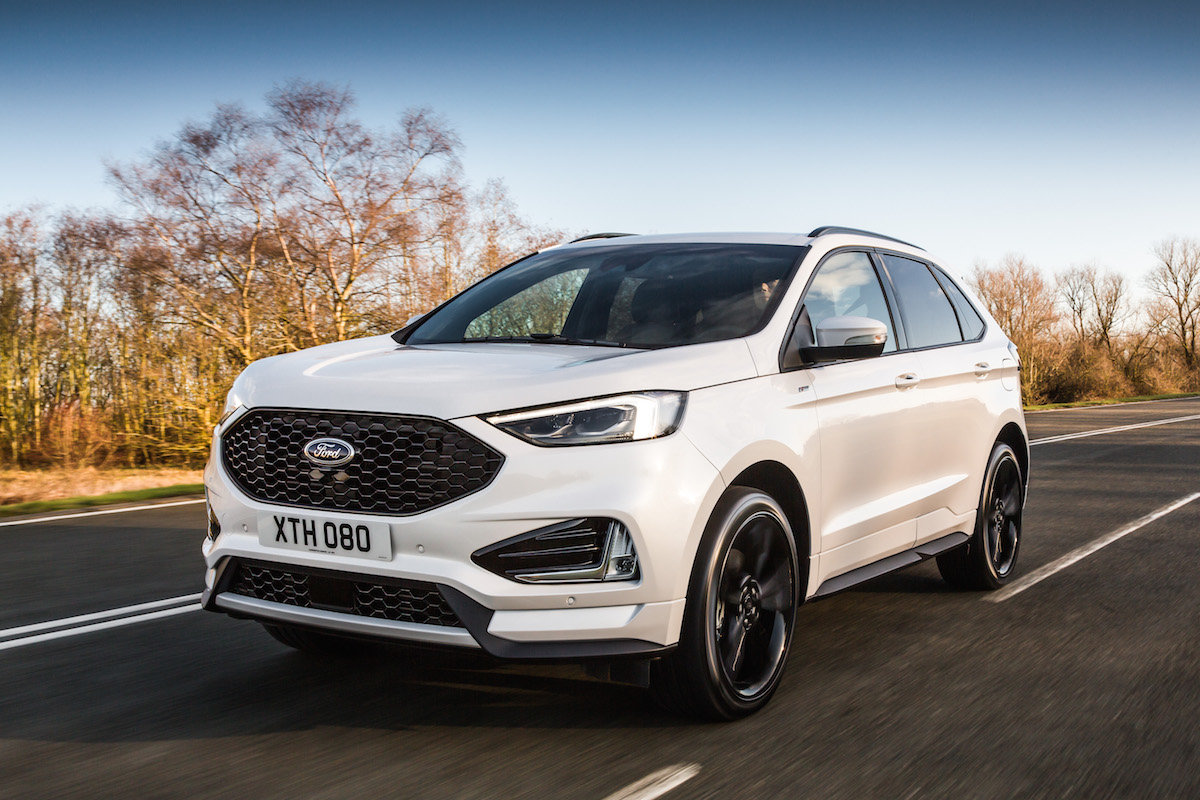
If you believe bigger is better, the Ford Edge is the clear winner here. Its sheer size translates into a vast interior with acres of leg, head, and shoulder room for everyone. The rear bench can easily seat three adults side-by-side, and the boot is enormous at 602 litres. Fold the rear seats down, and you've got a van-like 1,688 litres to play with. It's packed with clever storage spots, too, making it a brilliant choice for families who need maximum space.
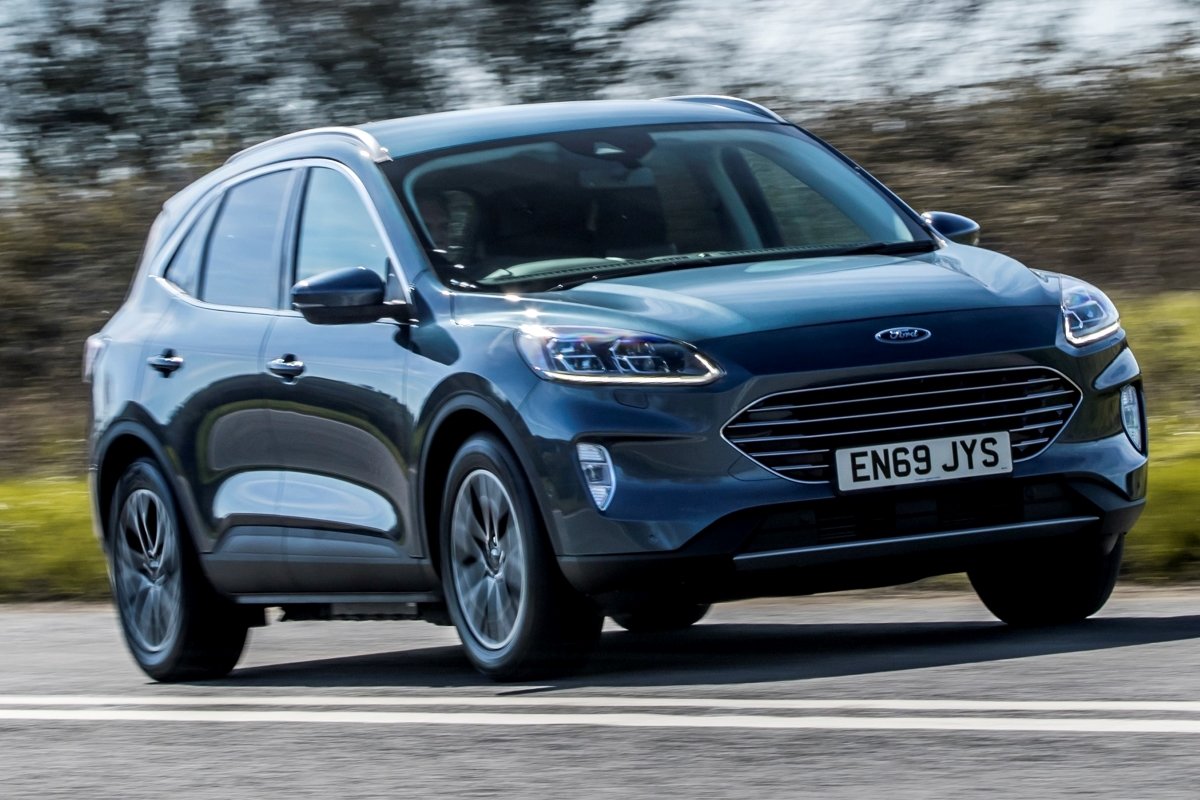
The Kuga is a more compact SUV, but it’s still a very practical family car. There’s plenty of room for adults in the front and back, and the sliding rear seats are a clever touch, allowing you to prioritise either passenger legroom or boot space. At 475 litres, the boot is a useful size and competitive with rivals like the Nissan Qashqai, but it’s dwarfed by the Edge. For pure, unadulterated space, the Edge has it sewn up, but the Kuga is easier to park and manoeuvre around town.
Driving Impressions
Ford Edge driving score: 4/5
Ford Kuga driving score: 4/5
These two Fords offer very different experiences from behind the wheel. The Edge is all about comfort. It was sold exclusively with 2.0-litre diesel engines, and its mission is to be a quiet, smooth, long-distance cruiser. It soaks up motorway miles effortlessly, with low noise levels and a ride that irons out most bumps. It’s not a car you’ll want to throw down a B-road – its size and weight mean it feels relaxed rather than responsive – but for comfortable family hauling, it’s excellent.
The Kuga, true to Ford’s reputation, is much more fun to drive. The steering is direct, it feels surprisingly agile in corners, and the suspension strikes a great balance between comfort and control. It’s a car that proves a family SUV doesn’t have to be dull. The Kuga also offers a much wider range of engines, including efficient petrols, diesels, and a brilliant plug-in hybrid (PHEV) that offers brisk performance and the potential for ultra-low running costs.
Technology and Equipment
Ford Edge technology and equipment score: 5/5
Ford Kuga technology and equipment score: 4/5
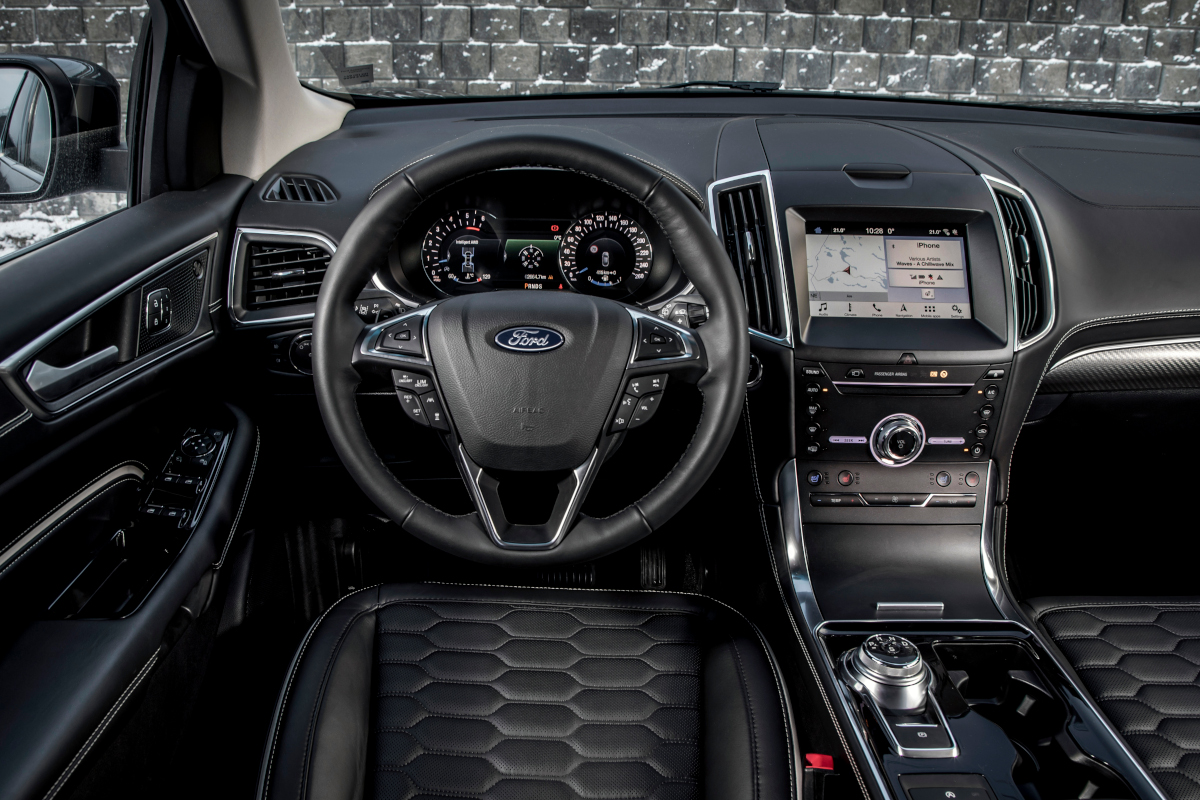
For its time, the Edge was very generously equipped. Even entry-level models came with a 10-inch touchscreen, climate control, parking sensors and a reversing camera. Higher-spec ST-Line and Vignale models added luxuries like sporty styling, a premium B&O sound system, and quilted leather seats. All versions get Ford’s SYNC 3 infotainment system, with post-2018 models also including Apple CarPlay and Android Auto.
Being a newer design, the Kuga benefits from Ford’s latest tech. While the entry-level Zetec is a bit basic, moving up to the popular Titanium trim gets you a sharp 12.3-inch digital driver’s display, a powered tailgate, and keyless entry. All models get an 8.0-inch central touchscreen with Apple CarPlay and Android Auto, which is mounted high on the dash for easy use. While a top-spec Edge feels very luxurious, the Kuga’s tech feels a generation ahead, particularly the slick digital instrument cluster.
Running Costs
Ford Edge running costs score: 3/5
Ford Kuga running costs score: 4/5
This is where the two cars really diverge. The Edge looks like a massive bargain on the used market, with its heavy depreciation meaning you can get a lot of car for your cash. However, the running costs will be higher. Its diesel-only engine line-up returns around 42mpg, and it sits in higher insurance and tax bands.
The Kuga’s running costs are much more appealing, especially if you pick the right engine. The plug-in hybrid is the star, with an official electric range of over 35 miles, meaning many school runs and commutes can be done without using a drop of petrol. If you’re a high-mileage driver, the efficient diesel engines can return over 50mpg. The Kuga will hold its value better than the Edge and will generally be cheaper to tax and insure, making it the smarter financial choice over the long term.
CarGurus Buyer Insights
| Ford Edge | Ford Kuga | |
|---|---|---|
| CarGurus expert rating | 4 out of 5 | 4 out of 5 |
| CarGurus user rating | 4.6 out of 5 | 4.5 out of 5 |
| Percentage of good/great deals available on CarGurus* | 32.9% | 32.8% |
| Overall CarGurus rating | 4.3 out of 5 | 4.4 out of 5 |
The Verdict
Ford Edge Overall CarGurus rating: 4.3/5
Ford Kuga Overall CarGurus rating: 4.4/5
This is a battle between old-school comfort and modern efficiency, and while both Fords have their merits, there can only be one winner. Based on our comprehensive CarGurus Buyer Insights, the Ford Kuga takes the victory.
The Kuga’s higher Overall CarGurus rating of 4.4/5 reflects its superb all-round ability. It’s great to drive, comes with modern technology, and its wide range of powertrains – especially the excellent plug-in hybrid – makes it significantly cheaper to run. It packages this into a car that’s still practical enough for most families but is easier to live with in town than the bulky Edge.
That’s not to say you should ignore the Edge. If your top priority is maximum interior and boot space, and you want a supremely comfortable motorway cruiser for a bargain used price, it’s a compelling option. But for the majority of buyers, the Ford Kuga’s blend of driving fun, lower running costs, and up-to-date tech makes it the smarter buy and the winner of this test.
Ford Edge Pros and Cons
| Pros | Cons |
|---|---|
| Huge interior and boot space | Heavy depreciation |
| Quiet and comfortable on the motorway | Diesel-only engine line-up |
| Great value on the used market | Bulky to drive and park in town |
Ford Kuga Pros and Cons
| Pros | Cons |
|---|---|
| Engaging and fun to drive | Boot isn't the biggest in its class |
| Excellent plug-in hybrid option | Interior quality could be better |
| Lower running costs and modern tech | Less spacious than an Edge |
*The Overall CarGurus rating: that informs these recommendations is based on CarGurus' proprietary market data from January 2026, CarGurus expert reviews, and CarGurus user reviews.