Hyundai Ioniq 3 2026 review | More EV for your money


Pros and cons
What we like
Great value for money
Standout styling
Impressive efficiency
What to consider
Gloomy interior
Small battery is faster than long-range one
Question marks over Hyundai EV reliability
The CarGurus verdict
The Hyundai Ioniq 3 is another fresh entrant in the affordable small electric car sector. Price is key to its appeal, with the Electric Car Grant helping take the entry version down to £18,995, and the bigger-battery entry model still starting from a competitive £21,995. This makes it more affordable than the smash-hit Renault 5 E-Tech.
The Hyundai Ioniq 3 is a more practical car too, with good levels of interior space and a really large and practical boot. It’s well equipped – save for some odd omissions such as sat nav and heated seats on lower-grade models – and the high-tech new infotainment system is promising, albeit one that will take some getting used to. Add in the Hyundai Ioniq 3’s distinctive looks, refined (if not exactly exciting) drive and promise of good real-world range, and it’s easy to see why it’s a car that’s already generated so much interest.
out of 5 expert review
What is the Hyundai Ioniq 3?
The Hyundai Ioniq 3 is a stylish and competitively-priced electric car from one of the UK’s pioneering EV brands. A five-door hatchback, it slots into the Hyundai range in between the smaller Hyundai Inster city car and larger Hyundai Kona crossover SUV. The firm describes it as a small car that offers family car levels of interior space.
The Hyundai Ioniq 3 is based on the same E-GMP architecture as sister brand Kia’s EV2. Whereas the Kia is an SUV, Hyundai has intentionally designed the Ioniq 3 as a lower-slung, sportier-looking hatchback. Described as an ‘aero hatch’, the benefits of its slipperier shape come in terms of real-world range, which promises to be competitive. There is a choice of two batteries, an entry-level 42kWh with a range of up to 213 miles, and a 61kWh with a range of up to 308 miles – which is expected to easily be the best-seller.
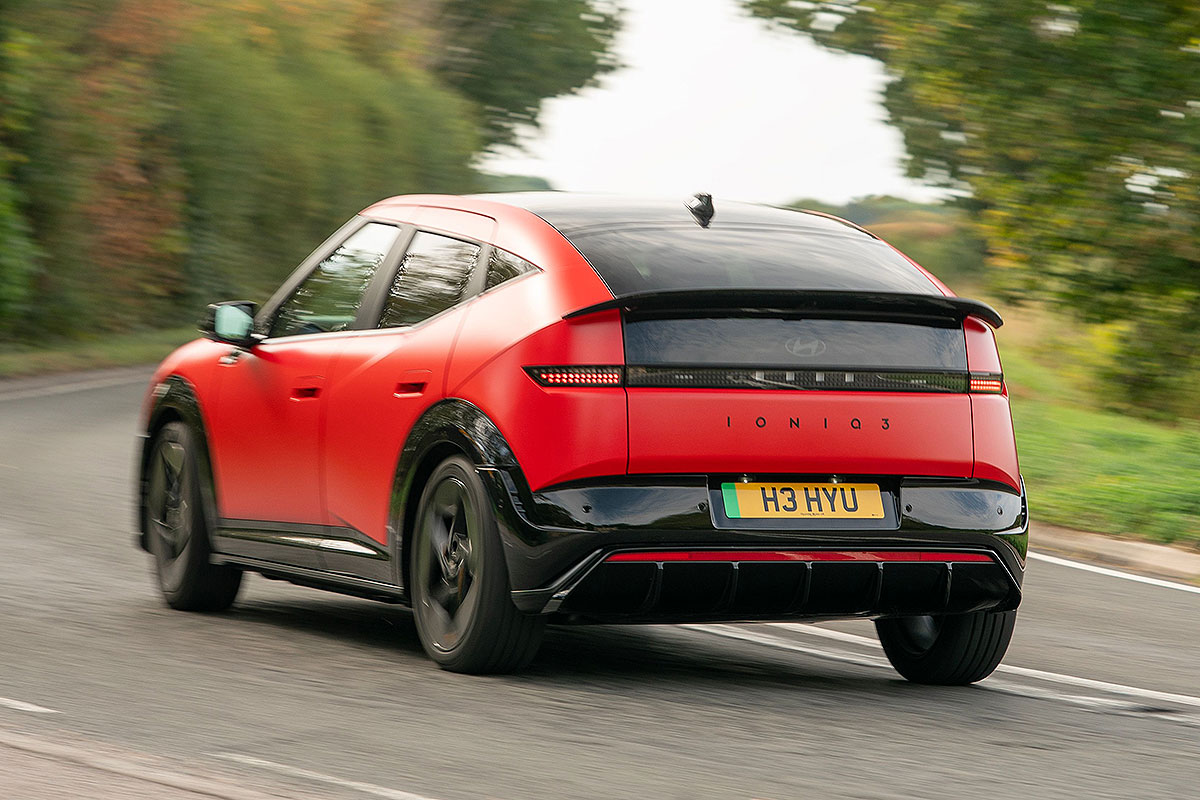
The Hyundai Ioniq 3 is certainly a bold-looking car. The ‘art of steel’ design language is clean, confident and angular. The aim is to bring out the strength of steel through its design – Hyundai says it is one of the few car companies to make its own steel, allowing it to fully optimise the engineering of the Ioniq 3 (and create some of the super-sharp styling details seen throughout).
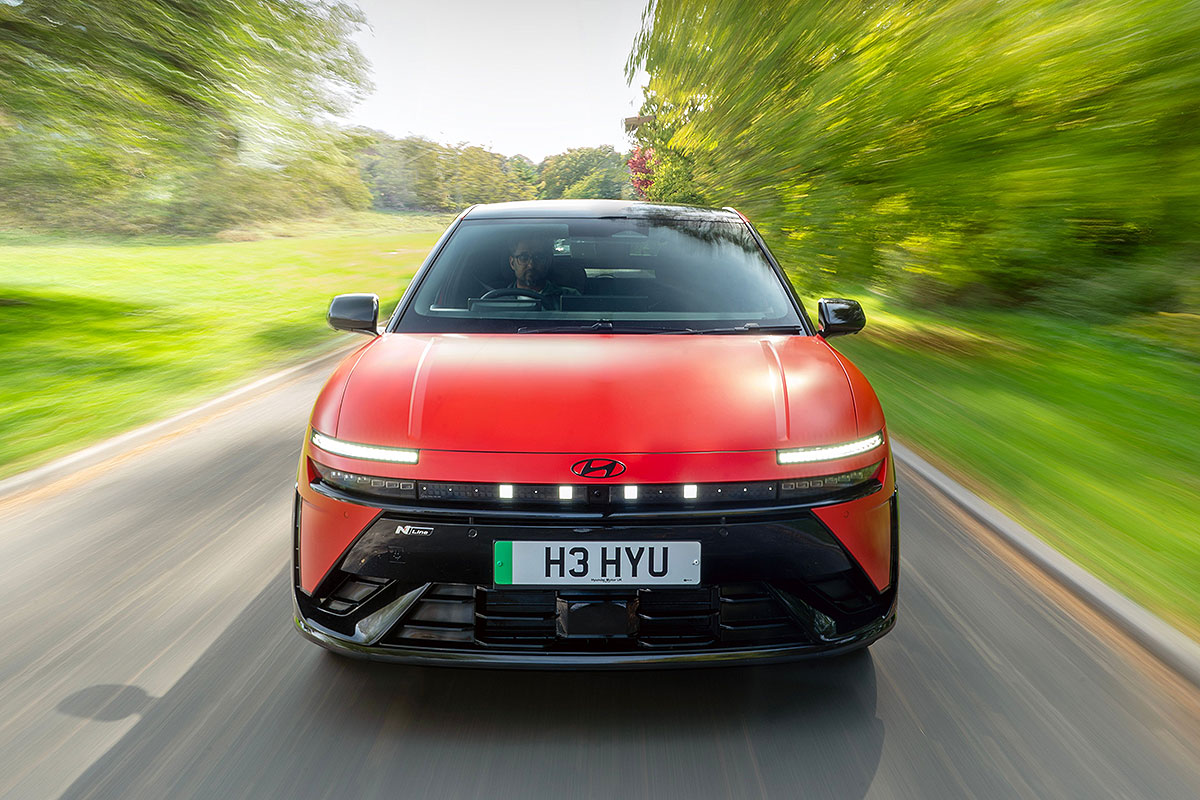
Cool details abound. The gently-curving bonnet wraps neatly into the front wings. The ultra-slim LED running lights are joined by four square ‘pixels’, which are matched at the rear. The side profile features crisp strakes and a distinctive window line, that blends smoothly into the split tailgate. It looks like nothing else on the road, particularly in sporty N Line Evo guise which has extensive gloss black detailing (and optional matt red paint).
Not that the Hyundai Ioniq 3 costs a small fortune to buy. Here’s perhaps its key selling point – very competitive prices that are enhanced by all models qualifying for the full £3750 Electric Car Grant. It means that post-grant prices start from just £18,995 for the 42kWh Advance version; if you’d prefer the luxury of a 300-mile-plus range, the 61kWh Advance still only costs £21,995. That’s around £2000 less than an entry-level Renault 5 – and you get almost 50 miles’ more range with the Hyundai Ioniq 3, too.
This immediately makes the Hyundai Ioniq 3 a keen challenger to the Renault 5 E-Tech, and its roomier sister car the Renault 4 E-Tech. It will also go head-to-head with the Volkswagen ID. Polo, the Kia EV2, Ford Puma Gen-E and Cupra Raval. With the firm boasting over 2000 orders within its first seven days on sale, the Hyundai Ioniq 3 is set to be a significant new affordable electric car… but is it any good?
Practicality
How practical is it?
The Hyundai Ioniq 3 looks like a bigger car than it actually is. The firm’s pitching it as a supermini hatch, making it a rival for the Volkswagen ID. Polo and even the Renault 5 E-Tech and Renault 4 E-Tech. It’s around 100mm longer than the VW, but the stance of the car makes it seem more; indeed, it’s only around 130mm shorter than a Volkswagen Golf.
Unlike the related Kia EV2, the Hyundai Ioniq 3 doesn’t have a crossover SUV stance. This means you sit lower to the ground, which makes it feel that bit sportier and more nimble. I quite liked it, making a welcome change from the usual sit-up driving position of so many small cars these days. The soft seats don’t entirely back up this sporty feel, but while they’re not exactly hip-hugging – not even the N Line Evo chairs – they are well-shaped and supportive.
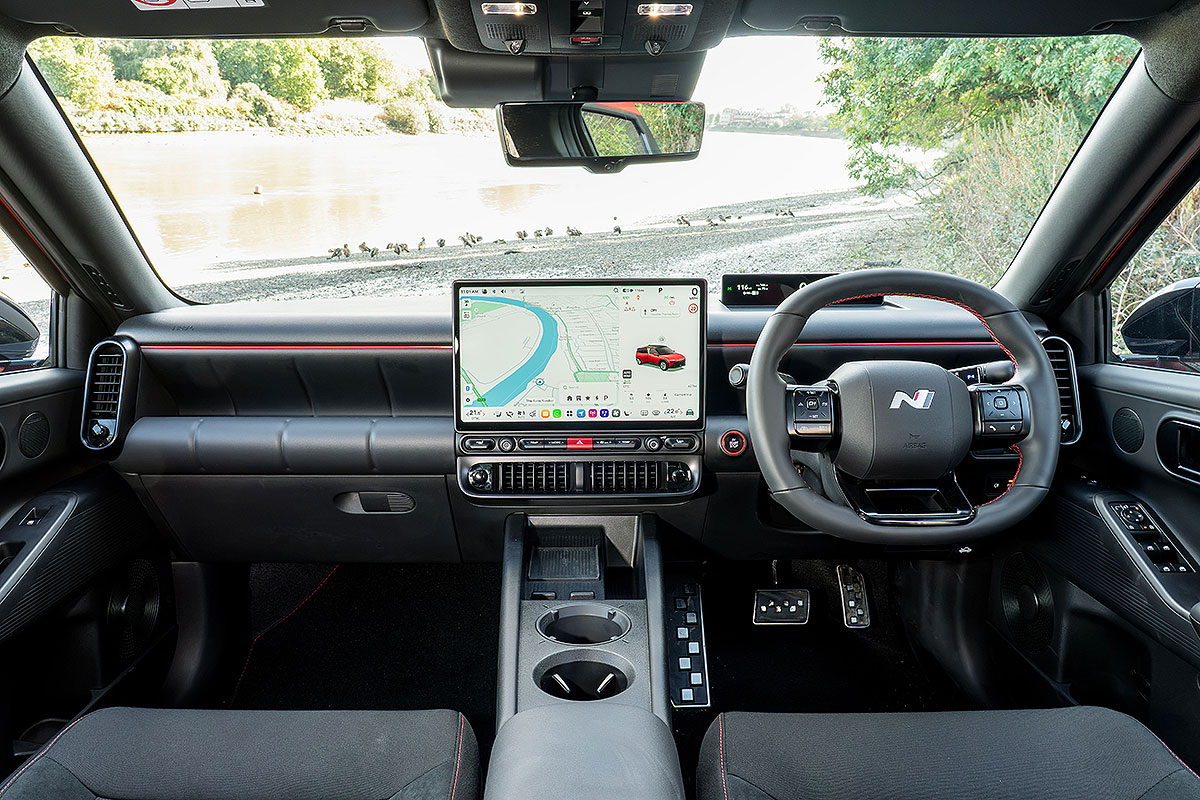
The Hyundai Ioniq 3 has a small, chunky, squared-off steering wheel which feels good to hold. With its fairly quick steering response, it gives it a sporty feel. Pleasingly, the steering wheel is fitted with proper buttons; some of them aren’t very clearly-marked, but they still work well. The auto gearshifter is now on the right-hand side of the steering column, with the left stalk managing indicators and wipers. Lights are controlled through the touchscreen – but there’s a shortcut button on the dashboard too.
The Hyundai Ioniq 3 gets extra marks for retaining physical controls to adjust the cabin temperature – dual-zone climate control is standard on all models, with both driver and passenger getting their own controls – and there’s even a proper volume knob. There are physical controls for door mirrors and electric windows too, but only the front windows get an auto-down function.
Visibility is a mixed bag. It’s OK out the front, apart from a slightly low windscreen header, and the side windows are low enough to give a clear view of the door mirrors. However, the split rear window means there’s a broad bar across the middle of your view through the interior mirror, and Hyundai doesn’t fit a rear wiper either. What’s more, over-shoulder visibility is poor thanks to the very thick C-pillars, and the extreme design of the rear side window means it’s gloomy in the rear – tall people will have to duck to see out.
Most Hyundai Ioniq 3 are finished in a black colourscheme, which exaggerates the dark interior ambience. It’s brightened a little on N Line Evo models, which get contrast red stitching – but they also get a black roof lining, adding the moody feel. Some of the plastics feel a little down-market, particularly the scratchy centre console, but overall build quality seems good, with the Hyundai Ioniq 3 exhibiting a solid, robust feel.
There’s loads of stowage space inside. The ‘floating’ centre console has plenty of stowage beneath it – pity the hard plastic isn’t lined with a rubber mat to stop house keys and the like sliding around – and you can remove the front cupholder to stow tall bottles. There’s a wireless charging pad on Premium and above (which is both rubber-lined and cooled), and a cut-out in the centre console allows you to feed up charging cables from the USB sockets below (a high-power 100W USB-C charger is available as an option). The front section of the door bins is big enough for more water bottles, although they narrow towards the rear.
The Hyundai Ioniq 3 has a soft-touch section in the middle of the dashboard, and this is cleverly shaped to create extra stowage space – similar to a classic Fiat Panda. It extends to sections behind the steering wheel, meaning there’s no shortage of stowage space inside the Hyundai Ioniq 3. Extra marks also to the intricate and nicely over-engineered air vents either side of the dash, while the centre console is deep and useful too. There are even stowage slots built into the front and rear passenger doors.
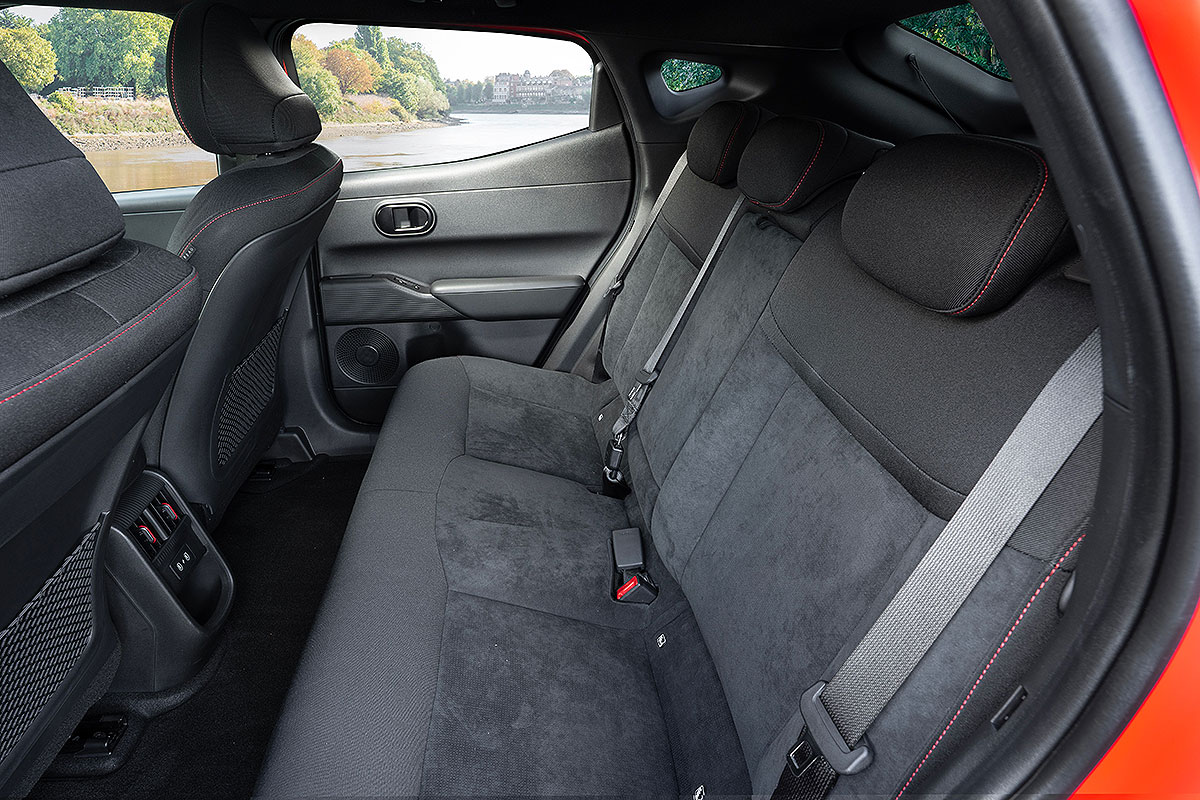
Rear seat space in the Hyundai Ioniq 3 is generous. There’s plenty of legroom and the flat floor adds to the airy feel. Admittedly, adults who are six foot and taller will find their head brushing against the roof, but it shouldn’t be a major issue. As mentioned, though, it is rather dark back there, due to the small rear windows. Only Ultimate and N Line Evo have a rear centre armrest with cupholders.
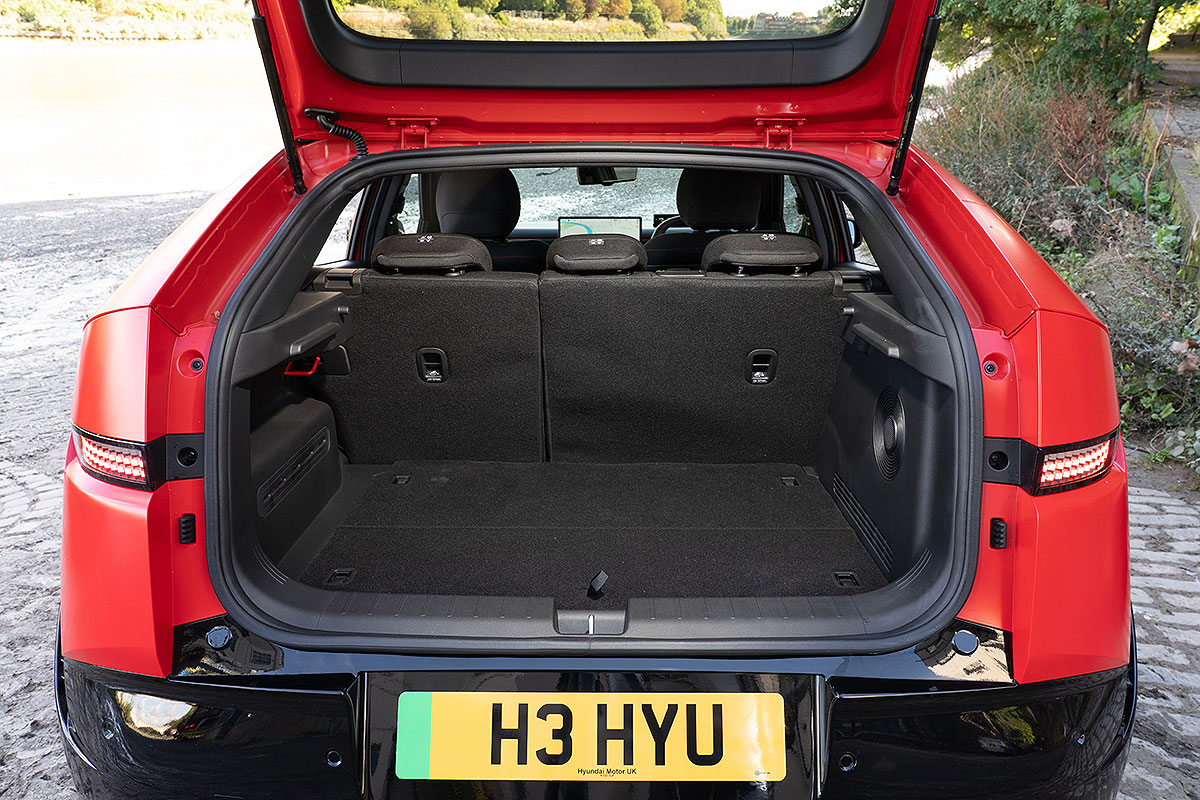
The Hyundai Ioniq 3 has a 322-litre boot when measured to the top of the removable floor. This is a decent size, and the large, angled boot opening makes it easy to access. The shape is square and flat-sided, making it very usable. There’s also an extended ‘megabox’ section below the boot floor, which sees it grow to a mammoth 441 litres. That’s far larger than bigger family-sized cars such as the Volkswagen Golf, and helps underline the Ioniq 3’s impressive practicality. Fold the 60:40 split rear seats and the space expands to 1213 litres. A power tailgate is not available, and the Hyundai Ioniq 3 doesn’t have a frunk either.
Ultimate and N Line Evo models are available with an optional Comfort Pack. This adds electric front seats, heated front and rear seats (with ventilation for the front seats too), an eight-speaker Bose premium sound system, digital key and front ‘premium relaxation seats’ which recline at the push of a button – ideal for snoozing while charging.
Driving
What's it like to drive?
The Hyundai Ioniq 3 feels nimble and compact behind the wheel. The small steering wheel helps here, but so too does the low-to-the-ground feel. The electric motor responds fairly keenly too, although with 0-62mph acceleration in 9.5 seconds, performance isn’t exactly electrifying. There can also be a bit of a delay between pressing the accelerator pedal and feeling the power come in – and quick bursts of drive can cause the front wheels to scrabble a little.
The Hyundai Ioniq 3’s brake pedal feels particularly soft and squidgy, but the brakes themselves are nicely progressive. There are paddles behind the steering wheel so you can vary the amount of brake energy regeneration; they work really well.
So far, we’ve only driven the value-packed Hyundai Ioniq 3 Advance. Running on eco-friendly 16-inch wheels, it felt particularly softly-sprung and compliant, soaking up bumps and rough surfaces really well. Ride quality was a standout – so we wait with interest to see how the Ioniq 3 fares on the 19-inch wheels of N Line Evo models.
The Hyundai Ioniq 3 didn’t feel the sharpest through corners, with noticeable body roll on turn-on and a floaty sensation through switchback sections, but the chassis nevertheless seems confident and stable. The various ADAS driver safety aids weren’t too intrusive either (and Hyundai’s engineered several clever software solutions to help make them easy to disable).
Refinement was very good – excellent, in fact, at slower speeds. At city speeds of 30-40mph, the Hyundai Ioniq 3 felt almost premium-grade in how well it isolated those inside from noise, vibration and harshness. The hushed, near-silent drivetrain is sophisticated and noise levels don’t increase too much even as speeds rise. All that work in helping make this an ultra-aerodynamic car that’s slippery through the air has clearly paid dividends in terms of refinement too.
Tech and equipment
Technology, equipment & infotainment
The Hyundai Ioniq 3 is the firm’s first car to feature its all-new Pleos Connect infotainment system. This is based on Android Automotive OS, and is both much more powerful than the previous setup, and significantly more feature-packed. There’s even an app store, allowing owners to download Netflix or YouTube to stream content while they charge.
The new system takes a fair bit of getting used to. Unlike the previous Hyundai infotainment system, which involved lots of sideways swiping, the Pleos Connect setup is more like that of a smartphone, with plenty of icons and dedicated apps. It’s a colourful system that’s much more modern-looking than the old setup, although it’s perhaps shown at its best on N Line Evo models, which get a 14.6-inch centre touchscreen. Other models get a 12.9-inch centre screen, which feels a little cramped.
Base Advance models also lack the useful driver display, which shows speed, EV range and other essentials. Without it, the speedo is relegated to a small section in the top right of the screen; as it’s so small and crammed in between other icons and readouts, it’s almost dangerously hard to read. This alone is reason to insist on an Ioniq 3 Premium as a bare minimum. The EV readout is clever, though – it dynamically shows minimum and maximum range alongside the estimated average, all of which alter depending on how you’re driving.
In the same vein as many modern cars, there’s a shortcut strip along the bottom of the centre touchscreen. This is packed with colourful icons and will take some familiarisation, although physical buttons for the climate control will save you from having to use it to change temperature. The upper section is split into as many as three sections, which can be controlled by swiping sideways; again, the configurability is useful, but will take more than a few hours behind the wheel to get used to.
In short, there’s a lot going on with the Hyundai Ioniq 3’s new Pleos Connect infotainment system – which the firm perhaps acknowledges by including its Gleo AI voice assistant. This can be used to tweak settings via voice control rather than clicking through the screen. Test cars were still too new to test this functionality but we look forward to trying it out properly. For now, many may rely on wireless Android Auto or Apple CarPlay connectivity – which we couldn’t try out as our test car refused to connect to our iPhone.
Hyundai boasts the Ioniq 3 has a clever EV route planner, that factors in charge stops on longer journeys. Such systems always work well – but here, it’s only available on Ultimate and N Line Evo models, as Advance and Premium lack standard sat nav. However, all grades are available with the Pleos Connect Pro app store, to add on apps such as YouTube and Spotify – but owners only get six months’ trial subscription as standard. After that, it’s £9.99 a month or £99 a year.
The Hyundai Ioniq 3 has a strong standard spec with all models coming with dual-zone climate control, keyless start, electronic parking brake, blind spot warning and a rear view camera. Premium builds on this with rear privacy glass, that all-important 9.9-inch driver instrument display, rain-sensing wipers, electric-fold door mirrors, wireless charging and the option to choose the £1250 EV Pack with heat pump and vehicle-to-load functionality.
Hyundai Ioniq 3 Ultimate models finally add sat nav, plus matrix LED headlights, heated front seats and steering wheel, ambient lighting and a more advanced Highway Drive Assist cruise control. The favoured N Line Evo model brings the 14.6-inch infotainment display, 19-inch alloys, Suede and cloth N Line seats, a moody N Line interior design and 360-degree parking sensors.
Running costs
Hyundai Ioniq 3 running costs
The Hyundai Ioniq 3 should be relatively cheap to insure for a modern electric car, thanks to sensible insurance group ratings. It starts at group 22 for the Ioniq 3 Advance 42kWh, moving up to group 25A for the Advance 61kWh – with other more upmarket versions also sharing the group 25A rating.
Hyundai Ioniq 3 running costs should be competitive in terms of powering it, too. The modern electric car architecture seems efficient – during testing, we saw an average of 4.5 miles per kWh on a twisting rural route. This is promising, particularly for in-town efficiency.
The Hyundai Ioniq 3 has a so-so max DC rapid charging rate of 119kw for the 42.2kWh battery, and 110kW for the 61kWh battery. Find an ultra-rapid 350kW DC charger and it’ll take 29 minutes for the smaller battery to go from 10-80%, while the long range battery takes 30 minutes.
Tyres could have a noteworthy impact on the range of the Hyundai Ioniq 3. While the Advance 61kWh, with its 16-inch wheels, has a 308-mile range, this drops to 303 miles on Premium models running 17-inch wheels, 300 miles on Ultimate models which have 18-inch wheels… and just 265 miles on N Line Evo models which sport 19-inch wheels.
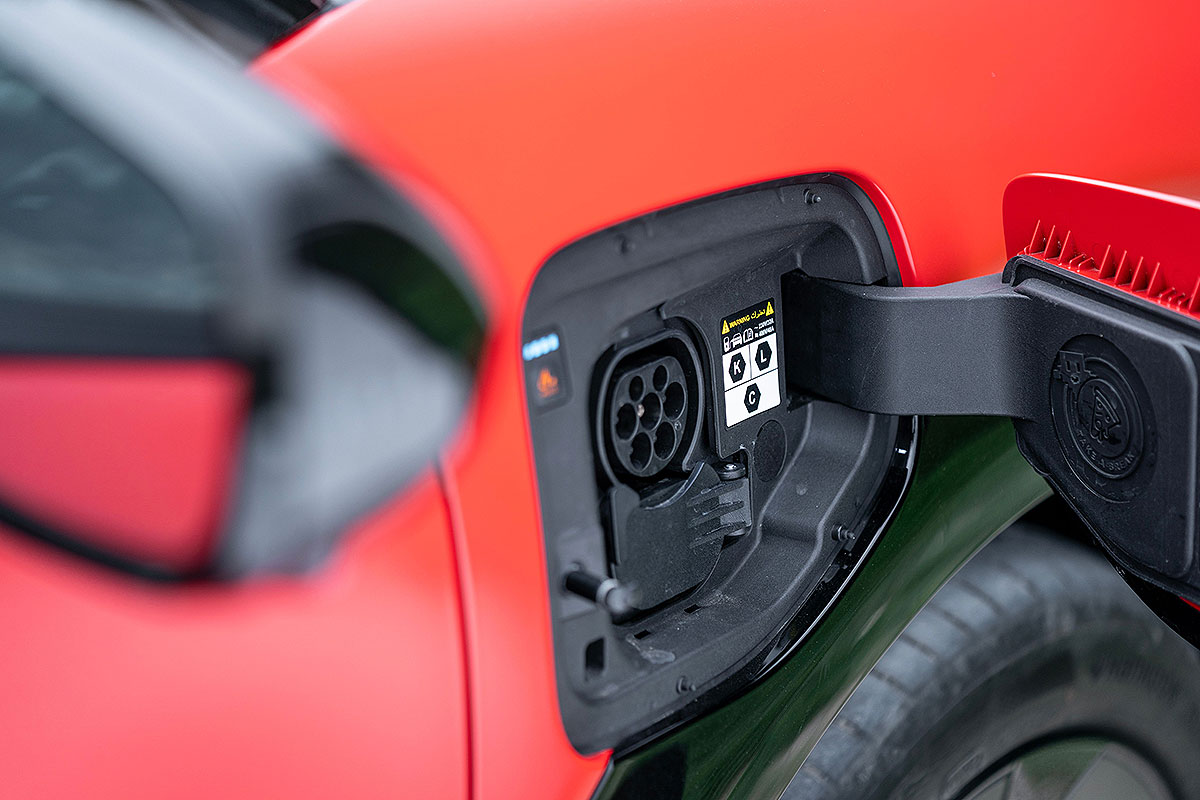
Unlike some earlier Hyundai models, the Ioniq 3 has its EV charge point mounted in the offside front wing. Moving it away from the front of the car could potentially save on accident repair costs if you have a front-end shunt, as it’s less likely the EV charging system will be damaged.
The Hyundai Ioniq 3 Advance has a sensibly-sized set of 16-inch wheels. They grow to 17 inches for Premium, 18 inches for Ultimate and a racy set of 19-inch wheels for N Line Evo. Replacement tyre costs will increase accordingly.
Hyundai Ioniq 3 reliability
Hyundai famously offers a five-year warranty, with no mileage limit. For longer-distance drivers, it’s probably a better overall bet than sister brand Kia’s seven-year warranty, which comes with a 100,000-mile cap. It’s also better than mainstream rivals such as Volkswagen, Renault and Ford.
However, Hyundai electric cars have had their reliability niggles. The Hyundai Ioniq 6 is actually the third worst-rated EV in the 2026 What Car? reliability survey, afflicted with the same 12-volt battery issues also suffered by the Hyundai Ioniq 5. It is hoped the firm has overcome these with the latest Ioniq 3.
Overall, Hyundai has a middle-ranking 14th-place reliability rating in the survey, placing it alongside French brand Citroen. Sister company Kia performs much better, placing seventh overall. Here’s hoping Hyundai Ioniq 3 reliability marks a turn for the better.
What owners say
Three things to know
- The Hyundai Ioniq 3 has four distinctive square LED lights in its front grille. The firm calls these ‘pixel lights’ – and adds that the four dots spell ‘H’ in Morse code. So now you know.
- The Hyundai Ioniq 3 is mainly available with a gloomy black interior colourscheme. Advance, Premium and N Line Evo models are all only offered with black; the only respite is the optional blue and grey interior of Ultimate models, which brightens things up considerably. It’s a no-cost option, but only with certain paint colours.
- In a surprising twist, it’s actually the cheapest Hyundai Ioniq 3 with the smallest battery that’s the fastest – the 42kWh battery helps the electric motor produce 144bhp for 0-62mph in 8.8 seconds; the sporty-looking N Line, with its 61kWh battery, ‘only’ produces 133bhp for 0-62mph in 9.6 seconds. Hyundai puts this down to the faster deployment rate of the smaller battery, which can provide the electric motor with more power.
Which one to buy
- If you want the most affordable: The Hyundai Ioniq 3 Advance 42kWh has the lowest list price of £22,245 – or just £18,995 once the £3,750 Electric Car Grant is subtracted. But remember, it only has a 213-mile range…
- If you want the cheapest real-world option: You’re best to spend £3500 extra and pick the Hyundai Ioniq 3 Advance 61kWh. The bigger battery gives it a much more useful range of up to 308 miles.
- If you want the most popular: Hyundai expects either Ultimate or N Line Evo versions to be the most popular; both coming with the 61kWh battery, they start from £26,195 and £28,195 respectively, both prices with the Electric Car Grant taken off.
- If you want a heat pump: You don’t get one as standard on any Hyundai Ioniq 3 – rather, it’s part of the £1250 EV Pack, which also adds V2L vehicle-to-load functionality and an internal three-pin plug. It’s only available with the 61kWh battery. Entry-level Advance models also lack a battery heating system, and can’t be preconditioned.


