Kia Sportage 2026 review | Is this the best family SUV you can buy?
Kia Sportage cars for sale
5.0
Expert review
Pros
Wide range of powertrains
Superb infotainment
Well equipped
Cons
Divisive styling
Ford Kuga is better to drive
Top-spec models are very pricey

The CarGurus verdict
The Kia Sportage is bold enough to stand out from the crowd, features a smart interior, and has all the practicality you could expect from a five-seat family SUV. Its technology is well integrated, equipment levels are generous across all specifications, and you can choose between petrol, hybrid or plug-in hybrid drivetrains.
Throw in a well-judged balance of ride comfort and handling, along with Kia’s reassuring seven-year warranty, and you have one of the strongest all-rounders in the family SUV class. It might face more rivals than ever before, but the Kia Sportage is an easy family SUV to recommend.

What is the Kia Sportage?
The Sportage is Kia's best-selling car in the UK, Europe and globally. Here, it accounts for around 40 percent of all Kia’s new car registrations, so it's no surprise to learn that it's a regular fixture in Britain's list of top-selling car models.
The latest Sportage was launched in 2022 and updated in 2025. It is based on the same underpinnings as the Hyundai Tucson, but the execution is different enough that choosing between them is not as simple as opting for whichever vehicle is cheapest. That's not to mention the seemingly endless number of other rivals the Sportage is up against, from more familiar competitors such as the Toyota RAV4 and Ford Kuga, to newer models from China that include the MG HS and BYD Seal U.
Given the level of competition and its desire to defend the Sportage's position as the UK's best-selling SUV, it's no surprise Kia saw fit to give it a midlife refresh. Post-facelift, the Sportage is available with petrol, hybrid and plug-in hybrid powertrains, and across three well specified trim levels: Pure, GT-Line and GT-Line S.
In this Kia Sportage review, we'll cover how practical it is, what it's like to drive, the technology and equipment on offer, and its projected running costs. How will it fare in a very crowded market for family SUVs?

How practical is it?
Anybody coming from a previous generation Sportage will find more luggage space and more room for passengers in this latest model. The boot capacity varies slightly depending on which powertrain you go for, ranging from 591 litres in the front-wheel-drive petrol model with a manual gearbox to 587 litres in all-wheel drive HEV (hybrid). In all cases, there’s an adjustable height boot floor, a flat loading lip and a useful square shape to the load bay with only minor intrusions from the rear wheelarches. All models come with 40:20:40 split-fold rear seats, which leave a flat floor when folded down. Do note that if you're looking at a used Sportage with a diesel engine and all-wheel drive, the boot space is reduced to 526 litres.
Rear-seat passengers get plenty of legroom and have the option of adjusting the angle of their backrests. Unlike the Skoda Karoq or Honda CR-V, however, you can’t slide the rear seats forward to create more boot space. Top-spec GT-Line S models come with a panoramic sunroof, and while this steals some headroom from the rear of the car, anybody up to six-feet tall will feel perfectly comfortable.
Those in the front seats will find generous storage almost everywhere they look. The centre console has a lidded tray for a phone and keys, along with two cupholders and an additional tray for odds and ends. There's also a large storage box under the armrest, the glovebox is a good size and, although slim, the doorbins have just enough room for a water bottle.
Quality, fit and finish are impressive by class standards (that is, mostly very good if not as tactile as models from the premium German brands such as BMW and Audi). There’s enough variety in the materials to look stylish.
Additionally, a large range of Kia accessories is available to purchase with a new Sportage. There are rubber floor mats, for example, as well as boot organisers and a cover to fold out of the boot and protect the paint on the rear bumper, should you have a dog who regularly jumps in and out. There are fixed, detachable and electric tow bars available, as well as roof racks and roof-mounted storage boxes. Although it won’t make the Sportage any more practical, you can even specify red, white or black racing stripes for £194. So if you wanted a Ferrari 360 Challenge Stradale but family life got in the way, Kia has you covered.

What's it like to drive?
Gone are the days when you bought a Kia simply because it was good value, or indeed when a Kia Picanto would cost you less than £6,000. The Sportage is further proof that Kia’s cars are now genuinely good to drive, having come on leaps and bounds in the past 10 years.
On the ride and handling front, the Sportage strikes a sensible balance between comfort and driver engagement. Regardless of wheel size (they range from 17 to 19 inches), the Sportage offers a comfortable ride both at low speeds around town, and when travelling faster on country roads or motorways. Grip is plentiful whether you opt for front-wheel drive or all-wheel drive, and the Sportage turns into corners keenly. There’s a meaty weight to the steering that makes this generation of Sportage feel far more substantial to drive than any of its predecessors. Don’t expect much feel through the rim of the steering wheel, but that aside the Sportage does a neat job of blending SUV solidity with useful agility. Quick direction changes are handled with minimum fuss, and even when driven quickly the Sportage never feels ragged or on edge.
Add in high levels of refinement and the result is an extremely well-rounded family SUV, not to mention a great long distance cruiser with modest wind and road noise levels. A Seat Ateca or Ford Kuga is going to be slightly more fun to drive, but the Sportage certainly doesn't disgrace itself.
The driving position and visibility are good. Kia has added an extra small window at the leading edge of the front doors to minimise intrusion from the windscreen pillar, which helps when it comes to seeing out of junctions. At the rear of the car, the sloping roofline results in a chunky C-pillar that does restrict visibility. Kia’s way around this is to fit technology such as blind-spot cameras on higher spec models, as well as a good reversing camera and front and rear parking sensors on all trims.
On the drivetrain front, the hybrid model is popular with UK buyers. It’s a good system, with a seamless switch between EV running and petrol power, plus a smooth-shifting six-speed automatic gearbox. When cold, the petrol engine sounds a little gruff, but it quietens down once warmed through – and for the vast majority of the time is a distant companion.
Performance from the 235bhp hybrid powertrain is easily strong enough for a family SUV. Expect 0-60mph in around 8.0 seconds, as well as enough pull through the automatic gearbox's six ratios to make overtaking easy. Selecting Sport mode rather than Eco mode via a button on the steering wheel adds enough extra urgency to the throttle response to be worthwhile using when the road gets twisty or you want to make swift progress.
We've also driven the entry-level 1.6-litre turbocharged petrol Sportage, which can dash from 0-62mph in 9.7 seconds. With 147bhp, the engine is gutsy enough in the low- to mid-range, although it does sound strained when revved hard. However, with the Sportage’s remit as a family SUV, that isn’t a huge problem. Cars with Kia's six-speed manual gearbox – now only the base Pure version – are a little easy to stall on account of the clutch's vague biting point. However, the seven-speed dual-clutch automatic available with the 1.6-litre, non-hybrid engine is smooth and responsive. It would be our pick, although it's disappointing that you can’t combine it with the entry-level Pure specification.
Technology, equipment & infotainment
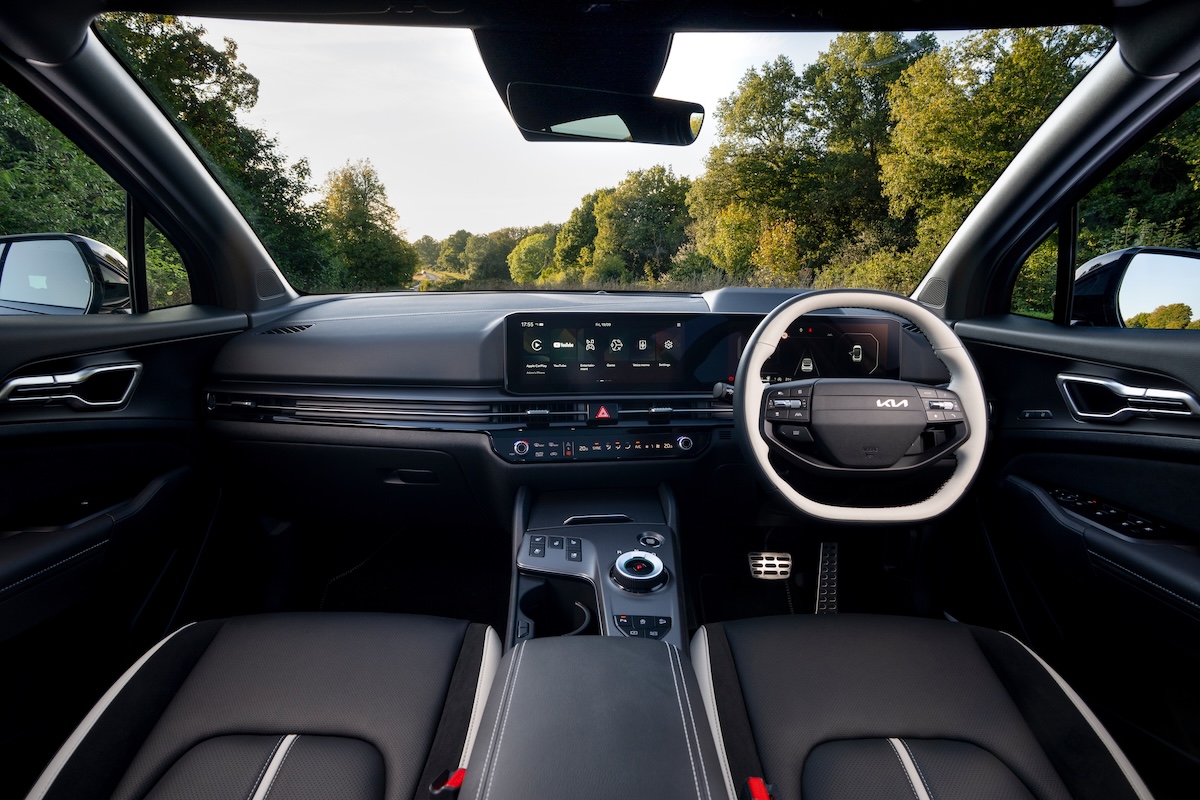
As of the 2025 facelift, all versions of the Kia Sportage come with a 12.3-inch central infotainment screen as standard. This is paired with a 4.2-inch colour trip computer on Pure and GT-Line models, while GT-Line S upgrades the trip computer to a full 12.3-inch digital dial display. Buy a pre-facelift Sportage and the ‘2’ specification, now renamed Pure, comes with a smaller 8.0-inch touchscreen.
Both the dials and infotainment feature sharp graphics and logical menu structures, and are generally really easy to use. All models come with Apple CarPlay and Android Auto smartphone connectivity, which is wireless on post-facelift cars. While there are no permanent physical shortcut buttons, there is a panel beneath the screen so you can switch between heating and audio controls, meaning that not everything is housed within the screen itself.
Every Sportage comes with LED headlights and daytime running lights, front and rear parking sensors and a reversing camera, cruise control, automatic wipers, power folding and heated door mirrors, and a range of active safety systems that include lane-keeping assist, forward-collision avoidance with pedestrian and cyclist detection, intelligent speed limit assist and a driver alert system.
Above and beyond the Pure model, the mid-range GT-Line gets 18- or 19-inch wheels rather than 17s, heated front seats, a heated steering wheel, two rear-seat USB-C ports and a number of cosmetic differences. The top-of-the-range GT-Line S, meanwhile, further benefits from adaptive headlights, ventilated front seats, heated rear seats (the outer chairs only), an electric boot lid, an eight-speaker Harman Kardon sound system (six speakers are standard on the other models), a head-up display, a 360-degree camera and more. There’s a difference in price of around £10,000 between the Pure and the GT-Line S, with paint options adding a further £650 across all trim levels.
All cars get over-the-air update functionality built in, too, meaning software upgrades can be sent directly to the car without the need to visit a dealership. However you’ll need a Kia Connect service subscription to make use of this.
In short, while some rivals might undercut the Sportage on price, the Kia still offers good value when it comes to standard equipment and technology.

Kia Sportage running costs
The self-charging hybrid Sportage with front-wheel drive will average between 40-45mpg in normal driving on town, motorway and country roads: perfectly respectable for this size and type of vehicle. Over the same route, the standard, non-hybrid 1.6-litre petrol Sportage with a manual gearbox returned between 35-40mpg. The difference isn't night and day, then, but remember that the hybrid model is also more powerful, which makes the fact it uses less fuel still more impressive.
For maximum economy, you'll either want a plug-in hybrid Sportage with its electric-only range of about 40 miles, or one of the now-discontinued diesel models. The latter could manage 45-50mpg on a long motorway run.
Residual values for the Sportage tend to be quite strong, so it's perhaps surprising that Kia's monthly PCP finance prices (which are calculated based on predicted depreciation) aren't always as tempting as those of some rivals. Also, note that while the Sportage range kicks off from around £31,000, there are a few versions that tip the £40,000 threshold, pushing their owner into paying the 'expensive car tax' premium rate of vehicle excise duty (road tax). This will add hundreds of pounds to annual running costs until the car is six years old. It’s one of the reasons we’d be tempted to stick to a mid-range GT-Line model, rather than a GT-Line S, as you still get enough tech, but you pay much less of a premium – and less tax.

Kia Sportage reliability
The fifth-generation Kia Sportage has a good reputation for reliability. In petrol and hybrid forms, it finished 13th out of the 76 cars in the family SUV class of the 2025 What Car? Reliability Survey. The plug-in hybrid version ranked lower, however, coming 56th. The previous-generation Sportage finished 75th, however, which shows how strong the class is generally and how much better this generation of Sportage is proving.
Kia as a brand, meanwhile, came eighth out of the 30 brands included in the same analysis, up from 11th place in 2024.
If faults do occur with your Sportage, you will have the reassurance of Kia’s seven-year, 100,000-mile warranty to fall back on. This remains one of the best new car warranties available today.
- Opt for a pre-facelift Sportage and you can still expect it to come loaded with equipment across all trim levels. Even the entry-level '2' model (there was no Sportage 1 in the UK) had LED lights, 17-inch alloy wheels, climate control air-con, cruise control, Apple CarPlay and Android Auto, parking sensors at the front and rear, and a reversing camera. Moving up to GT-Line adds 19-inch wheels, a larger infotainment screen, adaptive cruise control and suede/leather seats. Opt for ‘3’ trim and you add a larger digital instrument display, powered seats (heated both front and rear) and a heated steering wheel, while ‘4’ trim also includes a panoramic sunroof, adaptive LED headlamps, a 360-degree parking camera and wireless phone charging. The top-spec GT-Line S variants offer sportier styling, ventilated seats and 19-inch alloy wheels. Mercifully, the current model line-up is much simpler.
- Kia has followed most other car manufacturers and removed the option of a diesel engine from the Sportage range. You can, however, still find Sportage diesels on the used market: either a 1.6-litre CRDi with 113bhp and a six-speed manual gearbox, or a mild hybrid version with 134bhp and a seven-speed DCT automatic.
- The family SUV landscape has evolved significantly, even since this latest Sportage went on sale. Whereas it used to be a value player in the class, it now faces a whole range of Chinese competitors that offer higher specifications for less money. For example, what you'd pay for a self-charging hybrid in a Sportage will get you a full plug-in hybrid system in a BYD Seal U, as well as more standard equipment.
- The sensible choice: A non-hybrid, front-wheel-drive Sportage with an automatic gearbox in mid-spec GT-Line trim is a great all-rounder. It’ll set you back £35,135 at the time of writing and will make a great family holdall.
- The luxury option: A hybrid in top-spec GT-Line S is the closest you’ll get to a premium experience in your Sportage, on account of its panoramic roof, Harmon Kardon sound system, wireless phone charging and full suite of active safety systems. You’ll pay handsomely for it, though, with prices starting at £40,335 for the non-hybrid version and £42,175 for the hybrid.
- For company car users: The low CO2 emissions of the plug-in hybrid will appeal to those on a company car programme. This is no bad thing, however, as the impressive fuel economy doesn’t equal an unpleasant or lacklustre driving experience.
- For those out in the sticks: While not the cheapest way into a Sportage, Kia does offer an all-wheel-drive version with the hybrid GT-Line S. It’s not the kind of system that’ll haul you over muddy moorland, but for rutted tracks or areas prone to heavy snow it could be worth considering. Do note, however, that in our experience you'll pay a fuel economy penalty of around 5mpg compared with a front-wheel-drive model. It’s also the most expensive car in the whole range: priced from £43,755, or a £1,600 hike over a front-wheel-drive car of the same specification.


