Mercedes-Benz E-Class 2026 review | Executive saloon combines comfort and tech
Mercedes-Benz E-Class cars for sale
4.0
Expert review
Pros
Serene comfort for long journeys
Broad range of engine options
Traditional feel combines with high-tech equipment
Cons
Expensive for private buyers
Bewildering array of trims and options
E450 d is astonishingly expensive

The CarGurus verdict
The Mercedes E-Class is a very enjoyable, if rather expensive, executive car. It differentiates itself from its rivals with a somewhat traditional, stately feel and an impressively varied diesel engine range, all of it alongside cutting-edge technology. That’s a hard balance to strike.
As company cars, the plug-in hybrid E-Class models make a lot of sense, and that’s where the bulk of sales go. As a retail buyer? Well, they’re lovely things, but high list prices mean the E-Class PHEVs don’t make a whole lot of sense, so we'd stuck with a regular (mild hybrid) petrol or diesel model instead. If pushed, the idea of a smooth and muscular diesel is really appealing.

What is the Mercedes-Benz E-Class?
The Mercedes-Benz E-Class is a traditional executive saloon that sits between the smaller C-Class and larger S-Class limousine, just as it always has done. The BMW 5 Series and Audi A6 have long been its arch rivals, but there are few other direct alternatives left in today’s SUV-dominated car market, especially now the Jaguar XF and Volkswagen Arteon have been discontinued. The Lexus ES is a possible competitor, albeit a touch smaller (the latest E-Class has a 4.93-metre length) and usefully cheaper.
The E-Class, ultimately, is the ‘old money’ of executive cars: an expensive saloon for well-off people. And let us briefly underline ‘expensive’ there, as some regular variants of the E-Class now match the prices of V8-powered E63 AMG performance models from 10 years ago (which themselves were around 20% more expensive than the most pricey non-AMG versions of the time).
Helping to justify that premium, the E-Class has been a benchmark for excellent engineering and understated quality for more than 40 years, albeit with a notable blip in the 1990s when many Mercedes models became best known for rust and high running costs. Thankfully, recent decades have restored the lofty reputation of the three-pointed star’s products, if not to quite the same world-leading standards. Now, quality is merely at the expected level to put up a good fight against BMW and Audi.
One of the most notable things about the current Mercedes E-Class – dubbed the ‘W214’ in Mercedes nomenclature – is its plug-in hybrid (PHEV) powertrains. For a start, Mercedes is the only brand to offer both diesel and petrol PHEV models. They’re also usefully long-range by PHEV standards: the 19.5kWh battery in the saloon returns an official electric range of around 70 miles, while the estate manages around 68 miles depending on wheel size and spec. You can also get conventional petrol and turbodiesel models, something that can’t be said for the latest BMW 5 Series, which isn’t sold with a diesel engine at all.
There’s no fully electric version of the E-Class, but if you’re keen on battery power then you could always try the swoopy, futuristic-looking Mercedes EQE instead.

How practical is it?
E-Class practicality is reasonable enough, but not class-leading. You’ll easily get two taller adults in the back seats, where they’ll enjoy a centre armrest with pop-out cup holders, USB-C charging ports and climate control air-con, although there are no rear heated seats, which have become a popular feature in quite a few executive cars. It’s a small detail, yet one that seems like an odd omission.
There’s also plenty of room in the front, along with great seat adjustability and good visibility. And wherever you sit, the sense of quality, bolstered by high-grade materials and understated interior design, is one of the E’s chief selling points.
Boot space was a big problem in previous-generation E-Class plug-in hybrids, but this latest model is drastically improved, despite the bigger battery needed for its electric motor. The boot is now a decent shape, and you will find 370 litres of space in the hybrid saloon and 460 litres in the hybrid estate (plus 1,675 litres in the estate with the rear seats folded flat). The rival BMW 530e plug-in hybrid saloon offers a bit more space, although the Mercedes estate trumps BMW’s 530e Touring wagon for carrying capacity.
All other versions of the E-Class, which use integrated starter-generators and are therefore classed as mild hybrids, offer 540- or 615 litres of boot space for the saloon and estate versions, respectively (1,830 litres for the estate with the rear seats folded flat). That’s no small difference: one you’ll certainly notice if you need to carry golf clubs, a baby buggy or a dog. For comparison, an Audi A6 saloon musters 492 litres of space, while the estate A6 Avant holds 503 litres.

What's it like to drive?
The E-Class is lovely to drive: an alluring blend of serenity and comfort without feeling too soft. The petrol-electric Mercedes E300 e that we sampled had cosseting front seats that should deliver a good driving position for most body shapes. Its steering is light yet precise, and its long-legged ride comfort feels like it could ease you through any cross-continent motorway drive. There’s a sophistication to the whole vehicle, from its weighty door-shut to perceived quality in the cabin, not forgetting the way it ambles down the road on the standard adaptive dampers. An E-Class keeps you pleasingly isolated from the world outside.
It’s quieter in electric mode, of course (and you can force it into EV mode, leave it to make its own mind up, or use the engine to recharge the battery). But even with the 2.0-litre turbocharged petrol engine thrumming gently away, and the nine-speed automatic gearbox blurring calmly through gearshifts, the E-Class is the sort of car that doubles up as a retreat from daily life. Especially if you specify the massage seats.
Having said all of that, our test car came on large 20-inch alloy wheels, and so there was a bit of tyre roar, patter and thumping that occasionally intruded on the peace and quiet. It could be worth considering the ‘refinement package’, which will set you back around £3,500 on the saloon and includes air suspension and rear-wheel steering, the latter providing additional cornering stability and a tighter turning circle. It is standard on the E450 d, as you’d hope given the lofty asking price. We haven’t tried this set-up on the E-Class yet, but if experience with other Mercedes-Benz models is anything to go by, air suspension will elevate the E-Class to an even greater level of calm and comfort.
Is the E-Class as fun to drive as the BMW 5 Series? No, not quite. The BMW has a bit more of an edge to its handling, as does the Audi A6 provided you’ve got it in the right spec. The E-Class is the one to go for if it’s comfort and an aura of grandeur that you’re after; the BMW’s better if you want a sporty drive, as has often been the case historically.
What we really love is the balanced mix of petrol and diesel engines, not to mention the option to combine both fuel types with hybrid hardware. There’s even a six-cylinder diesel engine in the Mercedes E450 d 4Matic, which is the only non-AMG E-Class with air suspension as standard: and also the only one that gets all-wheel drive (the rest are all rear-driven). We haven’t tried the Mercedes E53 AMG Hybrid 4Matic yet, which is a model and trim line in its own right. But with a turbocharged and hybridised 3.0-litre V6 with 577bhp, it sounds very spicy indeed. Mercedes claims 0-62mph in 3.8 seconds and an electric-only driving range of 60 miles.
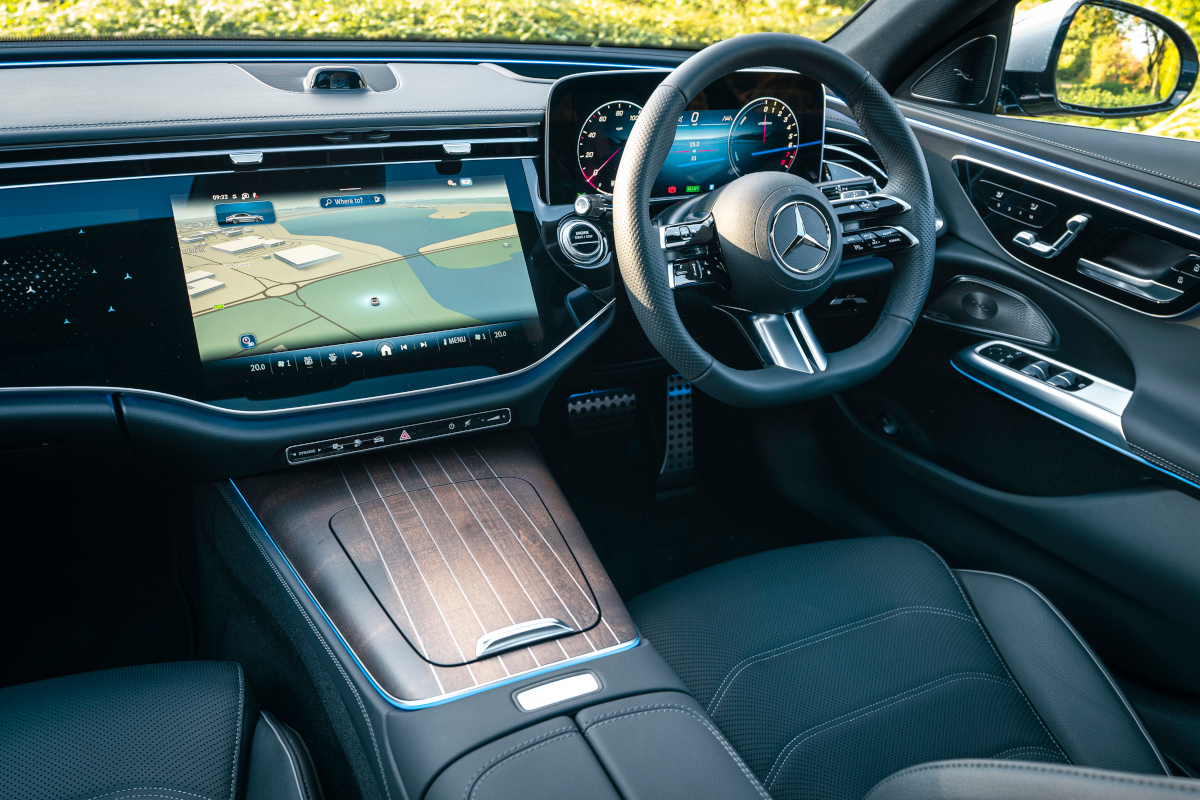
Technology, equipment & infotainment
Before we mention the plethora of equipment and options on the Mercedes E-Class, let’s talk about the MBUX Superscreen. If you don’t speak fluent ‘Mercedes options list’, that’s basically where the entire dashboard and centre console become one huge curved screen, including an enormous central touchscreen media system, a screen for the passenger and also the driver’s readout. It’s standard on AMG Line Premium Plus and Exclusive Premium Plus versions of the E-Class, or an option (around £1,500-worth) on the AMG Line Premium and Exclusive Premium.
The Superscreen is essentially a slightly smaller version of the Hyperscreen that we have tested in the Mercedes EQS; it’s a pretty amazing system in terms of graphics and functionality. There are atmospheric moods to choose from, for example, where you can enjoy twinkly, relaxing ambient music alongside gently shifting images on the screen, in case you wish to make your car feel like a spa (without the towelling robes, hopefully). And whether you go for the Superscreen or the standard MBUX system, the screen is so large that the icons are big and easy to prod. You also get in-built navigation, wireless Apple CarPlay and Android Auto connectivity, over-the-air software updates and more.
Mind you, what’s deeply frustrating are temperature controls that aren’t always visible, and menu layouts that aren’t always intuitive. You need to learn to swipe downwards for certain things, and it can feel a bit overwhelming. It takes time to get used to, in short, and we’d likely stick with the standard 14.4-inch display as it’s arguably easier to use. With familiarity, though, the Superscreen is a very impressive system, and fairly easy to live with.
Now, the equipment… There are currently five trim levels for the Mercedes E-Class saloon and estate, one fewer than at the car’s launch in 2024. Excluding the Mercedes-AMG E53 Hybrid 4Matic, these are Urban Edition, AMG Line Premium, Exclusive Premium, AMG Line Premium Plus and Exclusive Premium Plus. Using the Mercedes-Benz online configurator can be confusing, with your initial choice of engine, body style and trim level all bundled together into a single page of specification overload. For a simpler overview of the model range, search online or request the latest E-Class brochure from a dealer. It lays out the various spec levels, options, standard features and prices more clearly.
The entry-level Urban Edition gets 20-inch wheels, a diamond-look radiator grille, keyless entry, LED headlights, the 14.4-inch touchscreen, blind-spot assistance, a 180-degree reversing camera, folding mirrors and, in the estate, an electric boot lid. After that you can have the AMG Line Premium, which now gets 19-inch alloy wheels (rather than the 18s it wore at launch), the 14.4-inch central touchscreen, a Burmester 4D surround-sound audio system, a 360-degree reversing camera and a panoramic sunroof. AMG Line Premium Plus follows, adding 20-inch wheels, acoustic glass, the Superscreen, a head-up display and heated armrests. Because why only heat your legs, back and hands – who wants a chilly forearm?
On the Exclusive side of the model range, Exclusive Premium models all feature the more traditional Mercedes front grille instead of the diamond-like version of Urban and AMG Line variants. Exclusive Premium adds 19-inch wheels, acoustic glass, keyless entry, a panoramic sunroof, blind-spot assist, the Burmester 4D sound system and wireless phone charging. Finally, Exclusive Premium Plus further includes 20-inch wheels, the Superscreen, a head-up display and massage seats.
Broadly speaking, there’s a £2,000 price difference between the E-Class saloon and estate, fluctuating slightly depending on the exact specification and engine chosen.
One of the biggest issues is that the range can be confusing in its complexity, as you have probably realised by now. But as we’ve said, the brochure is a genuinely useful tool here. So too might be the old-fashioned route of going to the dealership and talking to a sales person. Yep, an actual, real-life human being. Fancy that.

Mercedes-Benz E-Class running costs
That real-world electric range of the E-Class, which we found to be more than 60 miles on a top-spec E300 e saloon in warmer weather, means that most people will be able to do the majority of their journeys without waking up the petrol engine. That’s great, as electric running costs as little as 4p per mile if you charge up using a cheap overnight tariff, or roughly 13p per mile if you’re charging at the 25p per kWh standard rate. By contrast, it’s reasonable to expect the petrol E 300e to cost around 22p per mile in fuel when the engine is in use. The diesel will be more like 18p per mile.
We haven’t tried the standard, mild hybrid Mercedes E200 and E220d models, but they offer competitive CO2 emissions of 152g/km and 129g/km, respectively. Most business users will opt for the E-Class PHEV variants, as their long range and low official CO2 emissions (from just 12g/km) make for very low Benefit-in-Kind (BiK) company car tax costs.
Nobody’s going to buy the Mercedes E450 d for efficiency reasons, and it’ll be catastrophically expensive on company car tax (if there’s even a scheme out there that allows it). Having said that, the big six-cylinder diesels are very unstressed and often make for surprisingly efficient everyday running, so we wouldn’t be surprised if you manage more than 35mpg. The E220 d, with its 56mpg tested fuel economy figure, will certainly be more economical, not to mention cheaper to buy.
List prices for the Mercedes-Benz E-Class aren’t low, but they are competitive with the BMW 5 Series and Audi A6, as are monthly finance deals.

Mercedes-Benz E-Class reliability
Mercedes came a disappointing 22nd out of 35 brands in the 2025 What Car? Reliability Survey, some way behind Lexus in ninth (a drop of seven positions compared to the previous year) and BMW in sixth (up two places), albeit joint with Audi. Mind you, the survey considers cars up to five years old, so this new generation E-Class is unlikely to have impacted the results much just yet, either positively or negatively. The previous-generation E-Class claimed fourth place out of 23 on the list of the most reliable executive cars, so hopefully this new version will continue that success.
You get a three-year, unlimited-mileage warranty on the Mercedes-Benz E-Class, while the plug-in hybrid cars have an eight-year, 100,000-mile warranty on the battery system. This is pretty standard for this class of car.
- The E-Class plug-in hybrid models have a 25.4kWh lithium-ion NMC (nickel manganese cobalt) battery with a usable capacity of 19.5kWh. In plain English, this means they offer a very generous EV-only range of around 60 miles before the combustion engine cuts in.
- When the new E-Class plug-in hybrids were first introduced, they weren’t available with DC rapid charging in the UK. However, this has now been rectified and you can charge the E300 e and E300 de via a CCS socket in the rear wing. A charging speed of up to 55kW is good enough for a 10-80% rapid charge in 20 minutes. Plugging into a standard 7kW home charger will deliver a full charge in around four hours, while a standard three-pin domestic socket will require more like 10-12 hours.
- The Mercedes E-Class is the only car in its class that you can still get with a six-cylinder diesel engine, in the E450 d. The Audi A6, which will continue to be sold alongside the electric Audi A6 e-tron for a few years, is offered with a four-cylinder diesel, but the BMW 5 Series has no diesel option; only petrol or plug-in hybrid (or there’s the all-electric BMW i5). The E450 d is seriously expensive, though, costing more than £81,000 in its cheapest form: at least £8,000 more than the diesel plug-in hybrid E300 de, and £19,000 more than the four-cylinder E220 d. As such, don’t expect to see many examples of the E450 d on the road.
- If you want the best value: As a retail buyer, we’d go for the E200 AMG Line Premium, or the E220 d if touring economy is a priority. This specification balances luxury and value well, and you’ll save around £8,000 compared to the AMG Line Premium Plus and £1,000 compared to Exclusive Premium models.
- If you want the best company car: Either of the plug-in hybrids, quite simply. The fact that Mercedes offers long-range plug-in hybrid powertrains in both petrol or diesel forms is a real standout quality of this car. If you do a lot of long journeys and think you’ll rely on the engine, don’t discount the diesel as it will deliver usefully better real-world economy. However, for most drivers in the UK, a range of more than 60 miles will cover most needs, so stick with the quieter, petrol-electric E300 e.
- If you want the best high-mileage commuter: For business users, the E300 de will make most sense, while retail buyers may want to stick with the usefully cheaper mild hybrid E220 d. AMG Line Premium trim is still our pick, but add the Driving Assistance Package (around £1,700) to get the full suite of semi-autonomous driving systems, including traffic stop-and-go. If ultimate comfort is a higher priority than cost, add the Refinement Package for £2,500-£3,500 to get air suspension as well.
- If you want the best family car: Clearly, the Mercedes E-Class Estate is the model to go for, and we’d be very happy with the mild hybrid E200 AMG Line Premium. Mercedes sells rubberised boot liners, and you can add a tow bar that will open up your options for a rear-mounted bike carrier.


