Peugeot 308 2026 review | A stylish and broadly defined family hatchback
Peugeot 308 cars for sale
3.0
Expert review
Pros
Hi-tech interior
Wide engine range
Cost-effective to run
Cons
Rivals offer better practicality
Quirky driving position won't suit everybody
Choppy low speed ride
The CarGurus verdict
The Peugeot 308 offers an appealing blend of common sense and desirability. Whether you’re considering the facelifted model or an earlier car, it’s great to look at, pleasant to drive, and feels plush to sit in, yet it comes with reasonable purchase and running costs. However, there are more practical hatchbacks, and some rivals are also more fun to drive. The extra practicality of the SW estate version is worth noting, however.
Overall, while it might struggle to qualify as class-leading, the Peugeot 308 is classier, more recommendable, and generally better than ever. So if you love the way it looks (and why wouldn’t you?), feel comfortable with its quirky driving position, and can find a suitable finance deal, you’re unlikely to regret choosing one.

What is the Peugeot 308?
The Peugeot 308 is a familiar name in the family hatchback class. It’s been around since 2007, when it replaced the Peugeot 307. This current model is the third generation of 308 and it represents a big shift for the marque and the model. The previous 308 was a definite step on from the first, and it’s another – if not quite so big – step here, as Peugeot moves even further upmarket, signified by sharp styling and a minimalist, screen-focused interior.
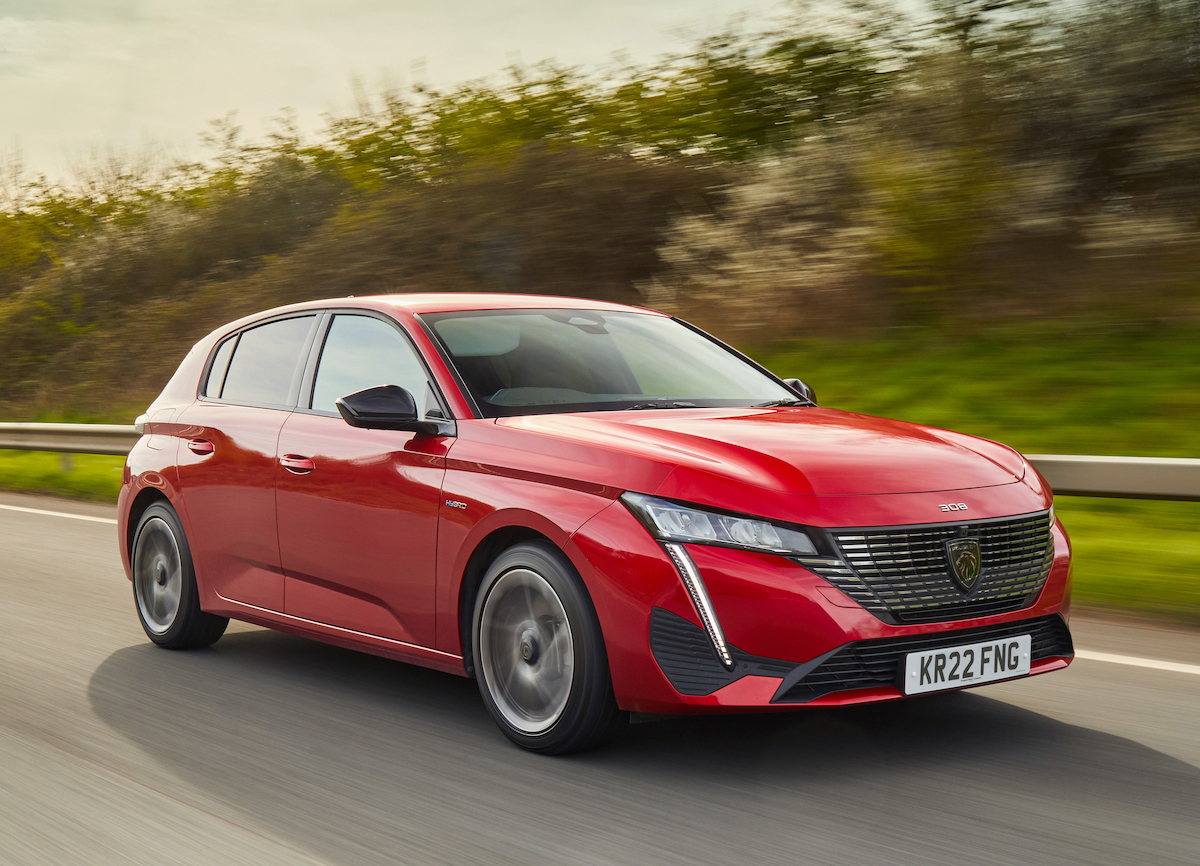
First launched in 2022, Peugeot unveiled a facelifted 308 at the very end of 2025, complete with a revised interior, design tweaks and an updated range of powertrains. We'll be driving it as soon as it arrives in the UK. The 308 you see pictured is the pre-facelift model, but, like the facelift car, it too was sold as a petrol hybrid, plug-in hybrid, diesel and fully electric model, as well as in hatchback or estate body styles – the latter known as the 308 SW. Note that there is no manual gearbox on offer, nor is there an all-wheel-drive version.
Buyers can choose from a range of electric, petrol-hybrid and diesel powertrains. For 2026 onwards, new Peugeot e-308s feature a single-motor powertrain, with 154bhp and 270Nm of torque going to the front wheels. The 58.4kWh battery (55.4kWh usable) is good for 279 and 275 miles in the hatchback and estate versions respectively. In the case of the hatchback, that’s 25 miles further than before.
If you’re looking for petrol power, there’s the Hybrid 145 and the Plug-in Hybrid 195. The hybrid pairs a 1.2-litre, turbocharged three-cylinder petrol engine with a 21bhp electric motor, 0.9kWh battery and six-speed dual-clutch transmission, sending 143bhp to the front wheels. Plug-in 308s, meanwhile, use a 1.6-litre, four-cylinder turbocharged engine paired with a 123bhp electric motor, 17.2kWh lithium-ion battery and seven-speed dual-clutch gearbox, with a total output of 192bhp (the pre-facelift car was available with 155bhp and 221bhp outputs). You can do 53 miles with a full battery, 16 miles further than before.
The BlueHDi 130, meanwhile, is a 1.5-litre, four-cylinder diesel with 128bhp, combined with the older EAT8 gearbox. Older doesn’t mean bad, though, as this was a development of the EAT6 gearboxes used by Peugeot in the previous-generation 308, which also worked well. The EAT8 is smoother and more refined – and still a good performer some years after it was introduced.
Whether you’re interested in the latest 308 or the pre-facelift model, it’s a seriously good looking car, both inside and out. What’s more, there’s a truly refreshing level of choice. There aren’t many manufacturers that sell one car with electric, hybrid, plug-in hybrid or diesel power, plus the choice of a hatchback or estate body.

How practical is it?
The 308 is practical enough, although there are better options at this price. Two average-sized adults will be comfortable in the back seats, where you’ll also find a centre armrest and small door bins. However, anyone over six feet might find the headroom and legroom quite tight. There are two pairs of Isofix mounting points in the outer rear seats if you need to fit child car seats, but none on the front passenger seat.
With 412 litres of boot space in the standard, non-plug-in cars, the 308 has a big enough boot to take a single baby buggy or a big dog with relative ease. Its fairly low load lip and square-shaped boot floor helps, too. The plug-in hybrid loses a bit of space to its batteries, offering 314 litres, while the fully electric car has 361 litres of capacity. Opt for a 308 SW estate and you get a much more useful 599 litres in non-electrified models, dropping to 467 litres in the PHEV and 505 litres in the e-308 SW.
Fold the rear seats down and, again, space varies by powertrain and body style. Petrol, plug-in and electric hatchbacks have 1,323, 1,271, and 1,258 litres of space respectively with the seats flat, while estate cars offer 1,487, 1,483 and 1,402 litres.
To make the most of that storage space, Peugeot sells a range of accessories, from luggage nets to boot dividers and rubber mats. There are roof boxes too, varying in length as well as height, plus bicycle racks and ski carriers. There are also items like covers for the back of the front seats, so younger rear-seat occupants won’t leave scuff marks everywhere, along with coat hangers, phone and tablet cradles, child seats, dog guards, and even winter steel wheels and snow chains.
One point to note: hatchback versions of the mid-range GT trim and top GT Premium trim benefit from a ‘ski hatch’, whereby you can fold the centre armrest of the rear seats down and open up a hatch into the boot. So if you’re carrying skis or even just a long plank of wood, you don’t have to have the rear seats down to get the objects into the car. You can avoid the classic and very dodgy ‘hold the boot open with a piece of rope and dangle a long item out of the back with a high-vis jacket stuck to its end’ approach to load transportation, too.
Where the 308 does stand out is its really plush, modern interior. The materials feel classy and the minimalist dashboard design looks good and has a pleasing combination of tactile finishes. It does take a bit of getting used to the touchscreen, which is the go-to interface for just about everything, and you should make sure you can get comfortable and see the dials clearly over the small steering wheel (this unconventional layout might not suit everyone, as has been the case since Peugeot introduced its first generation of the ‘I-Cockpit’ back in 2012). If you’re OK with that, the finish and features in the Peugeot 308’s cabin are likely to be big selling points.

What's it like to drive?
The Peugeot 308 offers a more enthusiastic drive than you might expect. It features the company’s familiar (but divisive) small steering wheel, which helps to provide a quick steering response. This in turn means the Peugeot turns into corners keenly and has quite a darty feel, even if you’re just swinging around a mini roundabout or along normal suburban streets.
The pre-facelift car’s 221bhp plug-in hybrid powertrain could manage 0-62mph in 7.6 seconds, but is no longer available. Now, the fastest 308 is the 192bhp plug-in hybrid, which can spring to 62mph in 7.9 seconds – respectable enough for a family hatchback. The petrol engine and electric motor interact neatly, making the Peugeot a calm and enjoyable daily commuter. Refinement is excellent when the car is in pure EV mode, but it’s a shame the 1.6-litre turbocharged petrol engine sounds quite coarse, even under moderate acceleration.
The 143bhp hybrid will hit the same 62mph benchmark in 9.3 seconds, and is a really good motor that revs happily and feels fast enough in everyday use, while the E-308 manages 0-62mph in 9.8 seconds. The top speeds for the PHEV, hybrid and EV are 140mph, 130mph and 108mph respectively. The electric e-308 model impresses with its refinement, but acceleration is not nearly as punchy as you might expect from an EV.
Regardless of powertrain, ride comfort in the Peugeot 308 is generally good. True, it can feel choppy over town roads, but it settles once up to speed.
We haven’t driven the 1.5-litre diesel Peugeot 308 yet, but we’ve tried the same engine in the Astra (with which the 308 shares its ‘EMP2’ structure). It proved pleasantly torquey and responsive, with decent refinement.
This is quite a fun car, then, even if it isn’t particularly fast. But that’s OK with us – we’d rather have a nicer driving experience overall than a quick-in-a-straight-line car that feels shambolic through the bends.

Technology, equipment & infotainment
The Peugeot 308 comes in three trim levels: Allure, GT and GT Premium. Previously, you had a choice between Active Premium, Allure, Allure Premium, GT, and GT Premium, so things have been simplified a bit.
All models benefit from full LED headlights, climate control air-con, a heated steering wheel, cruise control, six speakers, heated and electrically folding side mirrors, rear parking sensors, a 180-degree reversing camera, auto lights and wipers, four USB-C sockets (two up front, two in the back) and a 10-inch digital instrument cluster for the driver and 10-inch touchscreen display in the middle of the dashboard. These are the same screens as before, but the instrument cluster on facelift examples features new graphics. Although navigation isn’t included on the Allure model, all cars have Bluetooth and a DAB radio, plus Apple CarPlay and Android Auto connectivity. It’s a good system overall – miles better than Peugeots from a decade ago – and is fairly quick and logical to use. The touch-sensitive shortcut buttons below the touchscreen look cool and can be personalised, but they’re also too easy to push by accident when you use the screen.
Jump from Allure to GT and you’ll get Matrix LED headlights, 18-inch wheels rather than 17s (with the exception of the E-308, which only comes on 18-inch wheels), front parking sensors as well as rears, keyless entry and start, voice recognition, built-in navigation, and the option of a panoramic roof. There are also various styling and material upgrades inside and out, including scrolling-style indicators.
The high spec GT Premium models up the ante with features such as adaptive LED headlights, an electric boot release, Alcantara heated, electric and massaging front seats, a 360-degree camera system, a 3D digital instrument cluster, puddle lights and additional driver assist features including rear cross-traffic alert, adaptive cruise control with stop-and-go functionality, blind-spot detection and lane-position assist.
For greater efficiency when heating the cabin in colder temperatures, the new E-308 comes as standard with a heat pump on the GT Premium. It’s available as an option on the Allure and GT.
All cars are well catered for with safety technology overall, including a plethora of airbags, auto-locking doors, speed limit recognition, automatic braking that recognises bicycles and pedestrians, and tyre pressure sensors.

Peugeot 308 running costs
A Peugeot 308 will be a cost-effective car to run, and is priced favourably compared to rivals like the Skoda Octavia and Volkswagen Golf, which are between £1,000-£1,500 more expensive. However, the Vauxhall Astra is around £1,300 cheaper like-for-like.
As for economy, the standard hybrid with its six-speed dual-clutch gearbox manages an official WLTP-tested figure of 48.5-62.6mpg, whether you go for the hatchback or estate, but depending on wheel size and trim. The plug-in hybrid manages an official 106.9-148.1mpg. You’re unlikely to see that in the real world, but charge the car regularly, go easy on the throttle and complete short journeys most of the time, and you will rarely need to fill the tank with fuel.
Figures for the 1.5-litre diesel engine in the refreshed 308 aren’t out yet, but pre-facelift models managed 54-65mpg, so we’d expect similar in the latest version.
As for the e-308, it should prove very affordable to run if you're on a competitive energy tariff and can charge at home. On the subject of charging, the car can be topped up at speeds up to 100kW with a suitable rapid charger. That's OK, but not as fast as many of its rivals. Expect a 10-80 percent charge in 30 minutes, while a full charge from a 7kW home wallbox will take around seven hours.
Peugeot recommends servicing intervals of every year or 20,000 miles. Truth be told, if you’re racking up 20,000 miles in less than a year, don’t wait for the year to be up. Service your car every 10,000 miles, and you are more likely to have a healthy, happy vehicle for longer, with a lower risk of problems further down the line. Service plans from Peugeot are available from around £8 to £20 per month, depending on if you want your car serviced for three years and/or 30,000 miles, and whether you have an e-308, hybrid or PHEV. You can also spend between £10 and £26 per month if you lock yourself in for five years and/or 50,000 miles. Spreading servicing payments out monthly means you can wrap up costs within a finance deal on the car itself.

Peugeot 308 reliability
The Peugeot brand was ranked 11th overall in the 2025 What Car? Reliability Survey, tied with Dacia on a list of 30 manufacturers. Sadly, there is no specific data on this generation of 308 just yet.
Petrol and diesel models get a three-year, 60,000-mile warranty – on a par with Volkswagen, but a way behind the warranty you get from Kia, for example. You can extend your warranty for up to 10 years and 100,000 miles at extra cost, mind you.
The electric e-308 gets Peugeot’s ‘Electric Promise’, which includes an eight-year, 100,000 mile warranty on the car and the battery, plus access to a Free2Move Charge Pass, in partnership with Octopus Electroverse. This will give you single-tap access to more than 700,000 public charge points across the UK and Europe.
- The Peugeot 308 plug-in hybrid uses a 17.2kWh battery, and it comes with a Type 2 socket in the rear wing, with a 7.4kW charger optional on Allure and GT cars (standard on the GT Premium). That’ll get you a full battery in around two hours from a standard 7kW home wallbox. It’s the fastest charge you’ll see, even if you plug into a Type 2-compatible rapid charger capable of much higher speeds, since the car’s hardware restricts charging to a 7.4kW maximum. With a three-pin domestic plug at 2.3kWh, a full charge will take just over seven hours.
- All 308s benefit from QS 3, Peugeot’s air quality system. This monitors the quality of the air coming into the cabin and automatically activates the air recirculation function if pollution is detected outside. Optional on the GT and included as standard on the GT Premium is ‘Clean Cabin Technology’, with a higher-spec interior air filter that further prevents particulates from entering the car. Real-time air quality can be displayed on the central touchscreen.
- The 308 PHEV and e-308 electric car offer charging control via a phone app called Peugeot e-Remote Control, meaning you can set timed charging, check the car’s charge status and also pre-set the cabin temperature so it is cooled or warmed ready for when you set off.
- If you want the best value: Stick with the 1.2-litre hybrid hatchback. It’s a cheerful little engine, as well as the cheapest car in the range. There’s plenty of equipment on the Allure, so don’t feel like upgrading to GT trim is an absolute must.
- If you want the best family car: Go for the plug-in hybrid with an estate body and GT trim. You’ll get keyless entry, a panoramic roof, the benefits of plenty of EV driving from the hybrid powertrain, plus front and rear parking sensors. Although it’s only standard on the GT Premium model, you do have the option of adding an electric boot to the GT as well, which isn’t the case with Allure trim. So if that’s really important to you, there is no need to spend top dollar on the GT Premium.
- If you’re a company car buyer: The Peugeot e-308 is the one to go for if you’re an employee paying Benefit-in-Kind tax, as you’ll get the pure electric running for low fuel costs. Stick with Allure if you need to keep costs down, but we favour the GT for its better compromise between cost, comfort and technology.
- If you’re a high-mileage driver: The 1.5-litre diesel is efficient and will make for a relaxing motorway cruiser. GT Premium will give you maximum comfort with massaging seats, but you’ll have to weigh up the potential for a tad more depreciation. A high-mileage used diesel car will be slightly less appealing than a car with the same mileage and spec, but a PHEV or regular hybrid powertrain.


