Polestar 3 Review (2024-present)
Polestar Polestar 3 cars for sale
3.0
Expert review
Pros
Huge performance potential
Excellent refinement and interior space
Cool image
Cons
Huge over-reliance on touchscreen tech
Ride could be cushier
The CarGurus verdict
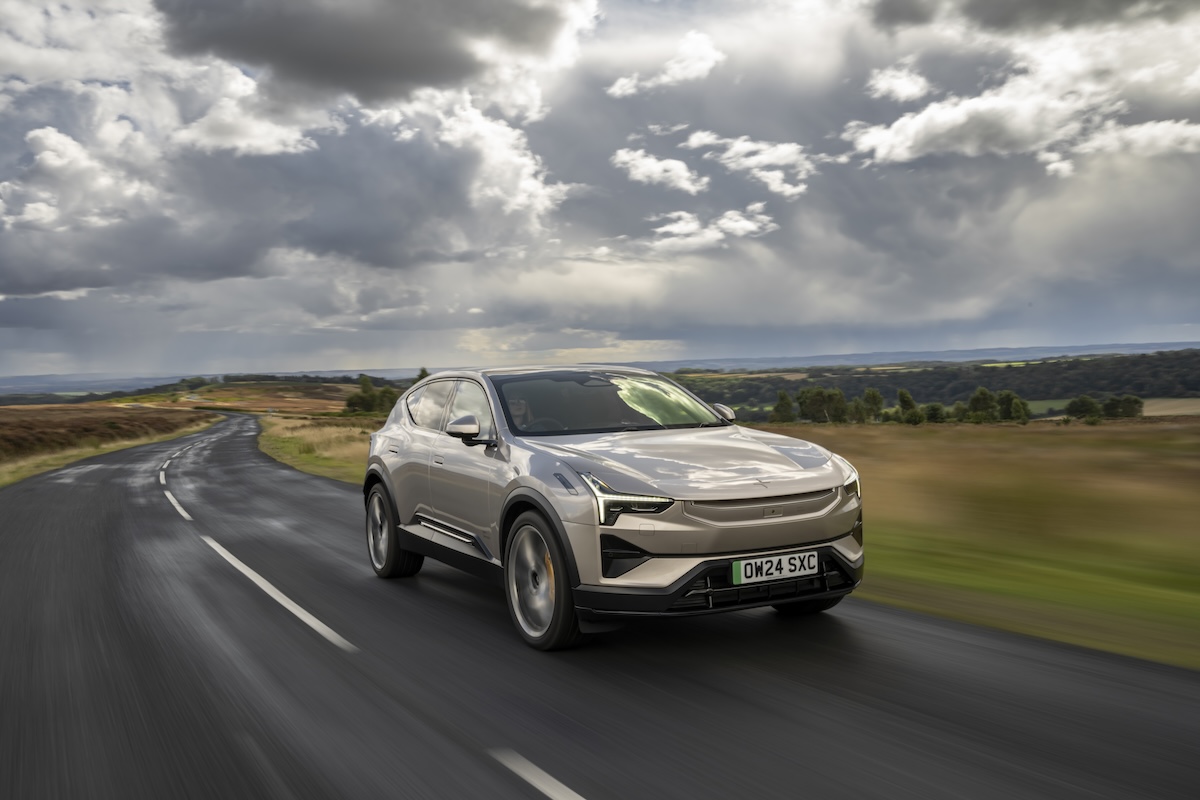
The Polestar 3 is an interesting, stylish and fairly compelling alternative to the increasing number of large, luxurious all-electric SUVs on the market. It looks good inside and out, it’s roomy and practical, it drives nicely and it’s stuffed with tech.
Granted, some of that tech can be tricky to use due to the car’s massive over-reliance on the touchscreen system, and there are a few other associated ergonomic foibles as well. It’s not a cheap option, either. But for anyone looking for an electric luxury SUV with a bit of a difference, the Polestar 3 will hold some appeal.

What is the Polestar 3?
The Polstar 3 is Polestar’s largest SUV, but you might not know that from the name. That's because while for most companies their model naming strategy usually ties higher numbers to larger cars, Polestar has instead decided to work chronologically. So its first car was called the Polestar 1, its second the Polestar 2, and so on. The Polestar 3 was the company’s third model to be unveiled, even though it arrived in the UK at pretty much the same time as the Polestar 4, a coupe-style SUV that’s actually slightly smaller. Confused? Yep, took us a while, too…
Polestar describes itself as an electric performance car brand, and the 3 is its current flagship, bringing a sports car edge to the large luxury electric SUV market. And large it most assuredly is, measuring more than 4.9 metres in length. It shares the same SPA2 electric car platform as the latest Volvo EX90, but makes do with just five seats rather than seven for a bit more space and luxury. As such, it competes with other large electric prestige SUVs such as the Audi Q8 E-Tron, the BMW iX, and the Mercedes-Benz pair of the EQE SUV and the EQS SUV. There’s also the now-ancient Tesla Model X (the newer Tesla Model 3 and Model Y models are a bit small for comparison), while the electric products from brands as diverse as Porsche and Volkswagen might well also factor in your decision-making.

How practical is it?
The Polestar 3 is an absolutely enormous car, the biggest one Polestar makes. The good thing is that those gargantuan proportions - coupled with the fact that the car is only a five-seater rather than trying to squeeze in seven seats like its Volvo EX90 sister car - translate into similarly gargantuan interior space.
Sit in any one of those five seats, and legroom is simply massive. Headroom isn’t quite so massive, but there’s still plenty, enough for extremely tall passengers to sit very comfortably.
Perhaps the most striking dimension, though, is the incredible width of the cabin. We can’t think of many cars that are better suited to carrying three people across the rear bench in comfort, because there’s ample space for three sets of shoulders. What’s more, the middle seat is as wide as those on either side, and there’s also a completely flat floor in the rear of the car, too.
Lift up the hatchback tailgate, and the boot space of 484 litres when measured to the top of the rear seatback doesn’t sound that huge, but the space looks bigger than the number suggests, and when measured up to the roof, the figure rises to 597 litres. That includes a large 90-litre storage compartment under the floor, and you don’t even have to waste that space by carrying your charging cables in it, because there’s a 32-litre ‘frunk’ compartment under the bonnet for those.
If you need to maximise loadspace, you can get 1,411 litres of the stuff by folding down the rear seats. This happens in a 60/40 split, which isn’t as versatile as the 40/20/40 arrangement found in some rivals. However, it’s good that the folded seatbacks lie perfectly flat, and sit flush with the boot floor, giving you a totally level load area with no steps or slopes. There is a small lip at the boot entrance, though, which can get in the way when loading heavy items.

What’s it like to drive?
The entry-level version of the Polestar 3 line-up is the Long Range Single Motor, which will have a rear-motor layout (so it’s rear-wheel drive) delivering 295bhp for an official 0-60mph time of 7.5 seconds.
In addition to that, you choose between two Long Range Twin Motor variants, both of which add an extra motor on the front axle, delivering four-wheel drive. The standard version has a combined output of 483bhp for a 0-60mph time of 4.8 seconds, but when fitted with the Performance Pack, the output is upped to 510bhp, while the 0-60mph time is trimmed to 4.5 seconds.
We’ve so far only had the opportunity to drive one Polestar 3, a Twin Motor without the Performance Pack. The powertrain has two selectable settings, one aimed at maximising the range achievable and one aimed at maximising performance. Select the former, and the acceleration you feel initially has a brisk-but-fairly-restrained feel. However, press the accelerator pedal with a bit more purpose, it’s not long before the car picks up its skirts and starts to really fly along.
Select the performance setting, meanwhile, and the full force of the powertrain is served up a lot more readily, making the car feel much more eager and aggressive. You barely have to brush the right-hand pedal before explosive performance is unfurled, and when it does so, the car feels exceptionally fast, even faster than the already-impressive numbers suggest. And that applies whether you’re accelerating away from the mark or picking up speed on the move. To be honest, we can’t think of a single reason why you’d want to go any faster in a car of this size.
The Twin Motor versions also come as standard with self-levelling air suspension, complete with adaptive dampers. If needed, you can select a jacked-up off-road setting to increase ground clearance by 40mm, which cancels itself when you go above 25mph. Similarly, while when you’re going faster, the suspension automatically lowers itself slightly to aid aerodynamics and efficiency.
The adaptive dampers, meanwhile, have three settings - Standard, Nimble and Firm - which are designed to make the ride-and-handling balance progressively more focussed. In truth, while you can just about detect the effect of the various settings, it's very marginal indeed, and makes very little difference to the general attitude of the car or the level of enjoyment you get from it.
In all situations, the ride is of the firm-but-fair variety, so it’s comfortable enough to keep life civilised (although it’s also true that other luxury SUVs we could name are more cosseting), but controlled enough to keep the car feeling tidy in the bends. The car is too huge and too heavy (it weighs around 2.6 tonnes) to feel genuinely nimble, but the levels of grip and traction you experience are pretty much unshakable, thanks in part to electronic torque vectoring, so it changes direction very well for something of its size, and flows along the road quite nicely.
Overall, the Polestar 3 has the kind of dynamic abilities you respect rather than adore, but it’s an impressive piece of kit nonetheless. Refinement is also sensational, even at motorway speeds.
Technology, equipment & infotainment
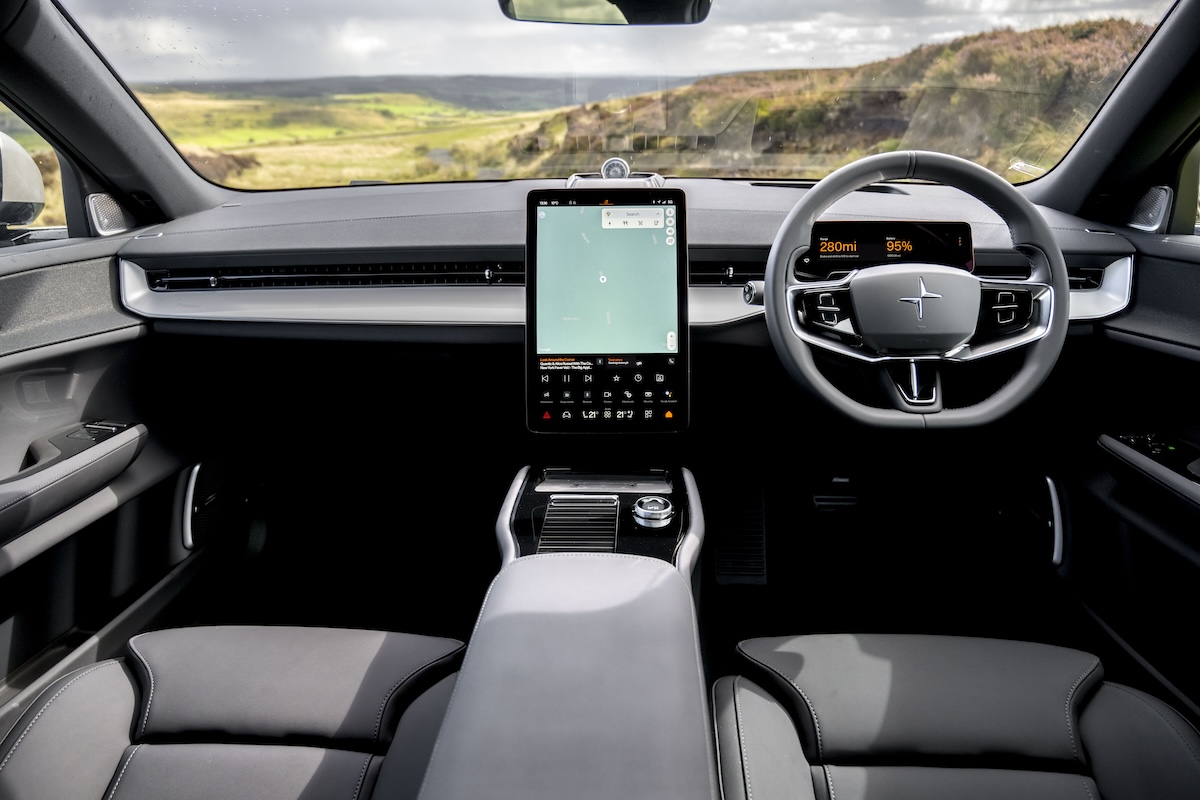
The Polestar 3’s cabin is dominated by a huge 14.5-inch portrait touchscreen mounted on the middle of the dashboard: that domination isn’t just because the screen is massive, it’s also because it’s the only ‘thing’ inside the cabin, because Polestar has done away with traditional switchgear almost completely in the pursuit of design minimalism.
The operating system - named Android Automotive OS - has been co-developed with Google, and this tie-up means you get Google Assistant voice control, satnav powered by Google Maps, and the ability to download various apps directly from the Google Play store. Naturally, the system has all the functionality you expect as standard including Bluetooth, DAB radio, wireless phone charging, four USB-C connectors (two in the front, two in the rear), and 5G internet connection, and the whole thing is kept fresh with over-the-air updates.
In addition to the big screen, there’s also a 9.0-inch LCD driver display behind the steering wheel, plus another touchscreen in the back with air-con and seat heating controls for the rear-seat passengers.
Let’s deal with the good bits first. The main screen looks really cool with sharp, stylish graphics and slick animations. What’s more, the user-interface is designed so that you don’t scroll up and down menus, or swipe side-to-side between them, and that makes the system a fraction easier to use than it would otherwise be.
That’s not to say it’s easy, though, far from it. Screen sensitivity isn’t what it might be, so you often find yourself jabbing at the screen repeatedly with your finger in order to get it to register a command. Worse, though, is that the system is so massively complex, with so many different menus and tiles, that trying to find your way through it is utterly bamboozling. Try and search out a minor function, and you could easily try four or five different menus before you find it.
Why so complex? Well, remember when we said that Polestar had done away with traditional switchgear pretty much entirely? Well, that’s why, because the touchscreen is your only source of control for pretty much every function. We know we’re forever moaning when a car’s air-con controls are squirrelled away in an on-screen menu, but the Polestar 3 takes this phenomenon to new levels. Even a task as simple as opening the glovebox requires seeking out an on-screen icon buried deep within the menu structure.
And that’s before you’ve even attempted to adjust your driving position, which ridiculously, can take several minutes. You have to seek out the correct menu from the myriad ones on offer on the touchscreen, press an icon to tell the system whether you want to move your seat or your steering column, and then bizarrely, use the joysticks on the steering wheel to carry out the movements. It’s an insane way of doing things, especially when traditional controls would achieve the same feat in a few seconds.
As well as the complicated infotainment kit, standard equipment includes LED exterior lighting, a panoramic roof, a rearview camera with automatic cleaning function, heated and electrically adjustable door mirrors, three-zone climate control, a heat pump, plus a whole host of clever safety kit (we’ll talk about this in the ‘Three things to know’ section).
Initially, the Polestar 3 is only available in a single Launch Edition trim level, which automatically ticks the boxes on the options list for the Pilot Pack (ordinarily £2,300) and the Plus Pack (ordinarily £5,000). The former adds more semi-autonomous driving functions, including lane change assist, plus super-high-res 360-degree cameras. The Plus Pack adds active road noise cancellation, a head-up display, heated rear seats, heated steering wheel, and soft-close doors. The Plus Pack also upgrades the standard 10-speaker audio to a Bowers & Wilkins system with no fewer than 25 speakers and Dolby Atmos Surround Sound, and the sound quality it delivers has to be experienced to be believed.

Polestar 3 running costs
It’s fair to say that the Polestar 3 is not a cheap car, but then again, as an enormous, all-electric luxury SUV, you probably wouldn’t expect it to be. New-car prices begin at around £70,000 for the Long Range Single Motor, while the Twin Motor starts at around £76,000 and the Twin Motor Performance Pack sets you back at least £81,500. That’s with no optional extras, either, and adding those will increase the price of your car very rapidly.
The driving range you get from the enormous lithium-ion 111kWh battery pack (that’s total capacity, of which 107kWh is usable) depends on which version you buy. According to official WLTP figures, the Single Motor does the best at 403 miles, while the long range dual motor version isn’t far behind on 392 miles, but that falls to 348 miles when you specify the Performance Pack.
Polestar quotes an AC charging time of 11 hours, but that’s based on an 11kW hookup, and the vast majority of UK homes don’t have the three-phase electrics needed to make that speed possible. Your average domestic electric car wallbox charger usually has a 7.4kW connection, so that same 0-100% charge is likely to take somewhere in the region of 18-19 hours.
If your domestic power is priced at the UK’s national average of 28p per kWh, then that charge will cost you around £30. However, get yourself on an electricity tariff that allows you to charge your car overnight using discounted off-peak power, and you can easily cut those costs in half, maybe even more.
The situation flips when you need to use a DC public rapid charger, because each unit of power costs much more from these outlets: you can easily double the national average domestic figure, and it’s often even more. We wouldn’t rely on these chargers regularly, then, but when you do need a juice-up on the move, the car’s maximum DC charging rate of 250kW allows a 10-80% charge in just 30 minutes, provided you can find an appropriately powerful public charger.
You wouldn’t expect cheap insurance on a car this expensive and this powerful, and sure enough, the Polestar 3 has a group 50 classification, which is the most expensive group you can get.

Polestar 3 reliability
In the latest What Car? Reliability Survey, Polestar placed 23rd out of 31 carmakers considered in the brand standings. That’s not a great performance, and it put Polestar behind pretty much every other premium brand except Audi. Obviously, the Polestar 3 is way too new to have contributed to that, and the result was based entirely on the Polestar 2, which uses a completely different platform and parts. So, you’d hope for an improved performance once enough time has passed to the Polestar 3 to get involved.
Polestar’s warranty arrangement is a bit underwhelming, too, with three-year, 60,000-mile cover on most of the car, while the battery is covered for eight years or 100,000 miles. If the battery falls below 70% of its original capacity within that period, it’ll be replaced for free.
Slightly more pleasing, though, is that all scheduled maintenance for the first three years or 31,250 miles of ownership is free.
- Polestar’s relationship with Volvo means you’d probably expect a high level of safety from the 3, and it doesn’t disappoint. The standard roster of safety kit includes various semi-autonomous driving functions including automatic emergency braking and adaptive cruise control, and there’s also blind spot monitoring with steer assist, lane departure warning, a lane keeping aid, a driver monitoring system, intelligent speed limit assist, road sign information, plus rear collision warning and mitigation. If trouble becomes unavoidable, there are nine airbags to help keep you from harm.
- You’ll notice the word ‘SmartZone’ written on the nose of the car, and behind this panel sit the car's myriad cameras and sensors, which facilitate much of the safety functionality we’ve just listed. On top of the optional Pilot Pack we talked about earlier, there will be another option pack available from mid 2025 called Pilot Pack with LiDAR. This adds yet more sensors and cameras to read your surroundings in even greater detail, and will eventually enable fully autonomous driving once it becomes legal. Be warned, however, that these extra sensors are housed in a small bump in the roofline, just above the centre of the windscreen, rather than in the SmartZone. This spoils the car’s styling, making it look a bit like a very large taxi.
- The interior of the Polestar 3 isn’t just roomy, it’s also very pleasantly trimmed. The construction feels solid, and all the materials feel of a very high grade. Which is slightly ironic, really, when you consider that many of them are recycled, from old plastic bottles and the like. Any leather used is animal-welfare-certified, meanwhile, and the wool textiles are fully traceable.
- If you want the longest range: Then you’ll want the Single Motor version, which has the longest range of any Polestar 3 at a very impressive 403 miles. That’s an official WLTP figure, though, so don’t bank on getting that in the real world.
- If you want the best all-rounder: The Twin Motor version adds a whole heap more performance for not all that much more cash, and there’s not a huge penalty to be paid in range, either, returning an official figure of 392 miles.
- If you want the fastest one: That’s the Twin Motor equipped with the Performance Pack, but quite honestly, it’s not all that much faster than the regular Twin Motor car, but it costs quite a bit more. We'd recommend you spend the extra cash on the Plus Pack instead, which gets you the amazing Bowers & Wilkins sound system.
- If you want the ugliest car: Specify the Pilot Pack with LiDAR once that becomes available in 2025. It adds a pod full of sensors to the roof of your car, just above the windscreen, which will likely have passers-by trying to flag you down thinking you’re a taxi.

