Renault Symbioz review (2024-present)
Renault Symbioz cars for sale
3.0
Expert review
Pros
Standard full hybrid powertrain
Generous equipment levels
Big boot
Cons
Some cheap-feeling interior materials
Petrol engine can be noisy
Some of the tech frustrates

The CarGurus verdict
The Renault Symbioz fills the gap between its compact and mid-size SUVs, and serves as a rival to the likes of the MG HS, Nissan Qashqai and Skoda Karoq. It delivers on its core promises of enhanced practicality over the Captur and good fuel economy from its standard hybrid powertrain.
It is a good value and reasonably likeable entrant in the family crossover class, plus it looks great. However, overall it falls short of its best competitors, with details such as the poor-quality rear-view camera, cheap-feeling interior materials, and occasional refinement issues with the powertrain all counting against it. For buyers who prioritise practicality, efficiency, and value, Renault’s hybrid SUV is worthy of consideration, but those seeking the most refined and complete package might want to look elsewhere.

What is the Renault Symbioz?
The Symbioz is yet another addition to Renault's SUV lineup, alongside the Captur, Arkana, Austral, Rafale, Scenic E-Tech, et al. Strictly speaking, it fills the gap between the smaller Renault Captur and the larger Austral, and it does this by taking the front half of the Captur and elongating the rear end to give more passenger space and a larger boot.
As a result, it's a reasonably distinctive offering in the crowded crossover market, because it is a bit narrower than family car rivals such as the Nissan Qashqai and Kia Sportage, but still offers decent practicality. It also comes with a full hybrid petrol-electric powertrain as standard, which sets it apart from many rivals that only offer mild hybrid systems or charge a premium for full hybrid technology.
With pricing starting from £29,300 for the entry-level Techno model and rising to £33,300 for the top-spec Esprit Alpine version, the Symbioz is thousands of pounds cheaper than full hybrid versions of the Hyundai Tucson or Kia Sportage, if still not a match for Chinese rivals such as the MG HS.

How practical is it?
If you’re upgrading from a Captur to get more space, the Symbioz shouldn’t disappoint. Its boot capacity is 492 litres with the adjustable boot floor in its lower position and the rear seats in their standard setting. Usefully, the rear bench can slide forward as one unit to increase boot space to an impressive 624 litres, though doing so creates a significant drop behind the seats where items could fall, and reduces rear legroom.
With the adjustable boot floor in its higher position it provides a flat load area when the rear seats are folded (in a 60/40 split). Do note, though, that when the rear seats are in place the parcel shelf design makes it easy to hit your head when reaching into the far end of the boot.
Rear passenger space is good, with sufficient legroom for adults sitting behind a driver of average height. Headroom is adequate, even with the ‘Solarbay’ panoramic glass roof fitted to higher-spec models. Legroom does of course take a hit when you slide the rear bench forwards. Also, because the Symbioz is the same width as the Captur, it is a squeeze to get which means three adults across the rear seat. Three children, however, should be comfortable.
Storage options in the front of the car are plentiful, with multiple trays, two cup holders, a key card holder, storage under the armrest, and a large glovebox. Overall, then, the Symbioz delivers on its promise of enhanced practicality compared to the Captur, but those who regularly carry four passengers may want to look at a rival with a wider rear bench.

What's it like to drive?
The Symbioz comes exclusively with Renault’s E-Tech Hybrid powertrain that combines a 1.6-litre petrol engine with two electric motors and a 1.2kWh battery, delivering a total system output of 145bhp. That this system is fitted to every Symbioz is part of what makes it look like such good value next to rivals that only give you a standard petrol engine for the same price, or charge thousands more for a proper hybrid setup such as this.
Performance is adequate rather than exciting, with 0-62mph taking 10.6 seconds - perfectly appropriate for this kind of car. However, some of this relatively modest acceleration feels attributable to the transmission's hesitation when deciding what to do. When the petrol engine does engage, it's noticeably vocal, especially when driving at higher speeds, or accelerating to join a dual carriageway or motorway. Indeed, where the hybrid setup works best is in urban environments, where the Symbioz always pulls away on electric power and can maintain electric-only driving up to around 20mph.
At low speeds (where the drivetrain is at its most refined), the ride is a little fidgeting. However, at higher speeds (when the petrol engine can be noisy) the suspension copes much better, and the ride really smooths out.
The Symbioz handles smartly enough, with steering and bodyroll that are more in line with a conventional car than a taller and heavier SUV. It’s not fun (few of these crossovers are), but nor does it frustrate with sloppy dynamics. It is, in order words, entirely fit for purpose, but nothing special.
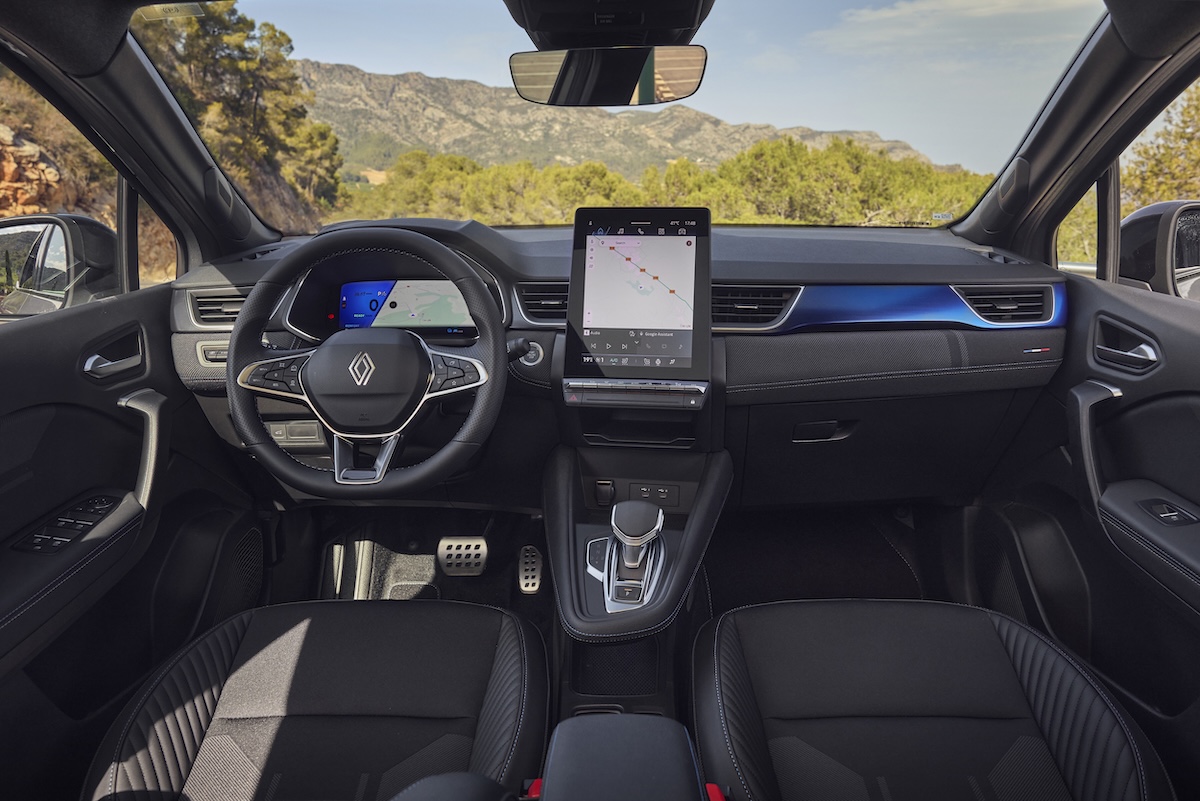
Technology, equipment & infotainment
All Symbioz models come well-equipped with 10.25-inch digital instruments and a 10.4-inch portrait-oriented touchscreen infotainment system. This Google-backed system offers good integration with Google Maps, your Google accounts and apps, as well as some of the best voice recognition technology available in any car at any price (thanks Google for that). Apple CarPlay and Android Auto are also fitted as standard.
The system isn’t faultless, however. The most glaring problem is the weirdly low-resolution reversing camera, which is close to useful in the dark. What’s more, in our test car the problem was compounded because the image from the camera kept freezing, creating a fairly serious safety issue when reversing.
The digital driver display also suffers from noticeable lag when transitioning between displays or driving modes, which is frustrating in daily use. On the plus side, the Symbioz retains physical buttons for the climate control, which is much easier to use than burying them in the touchscreen, as many manufacturers are prone to do.
Standard equipment is generous across the range, with even entry-level Techno models featuring 18-inch alloy wheels, adaptive cruise control, digital dials, and the Google-backed infotainment system.
Move up to Techno Esprit trim and it adds 19-inch wheels, heated front seats, a powered tailgate, and sportier styling.
The top-spec Iconic Esprit Alpine version adds features like the panoramic "solarbay" sunroof that can be shaded in different sections, as well as electric seats, an upgraded Harman Kardon audio system, and extra styling touches. Some cheap feeling plastics in the cabin do somewhat ruin the upmarket feel, however.

Renault Symbioz running costs
The Symbioz impresses with its fuel economy, achieving 48-50mpg in real-world testing against an official WLTP figure of 60mpg. For a family SUV like this, that’s really not bad, and we have been particularly impressed with the car’s efficiency when driving around town, where the electric motor does a lot of the work.
Pricing starts at around £29,000 for the entry-level Techno and rises to over £33,000 for the top-spec Esprit Alpine version. While not inexpensive, this represents good value considering the standard hybrid powertrain and generous equipment levels across the range.

Renault Symbioz reliability
The Symbioz is too new to have any reliability data to fall back on. However, given it shares so much with the Captur, it is worth looking at that car’s performance as an indication of how dependable you can expect the Symbioz to be. In that regard, the Captur finished 13th of the 23 models in the Small SUV class of the 2024 What Car Reliability Survey. Renault meanwhile finished ninth of the 31 brands included. All of which points to
Renault's typical warranty cover period seems to change every five minutes, but at the time of writing stands at three years and 60,000 miles. This is as basic as it gets, and frankly a little embarrassing when Kia offers seven years and 100,000 miles of cover, and Toyota will cover its cars for 10 years or 100,000 miles provided one of its dealerships services it.
- Unlike many competitors that offer multiple powertrain options, the Symbioz comes exclusively with a full hybrid system across all trim levels. This simplifies the buying process and ensures every buyer benefits from the improved efficiency of hybrid technology.
- The rear seats in the Symbioz can slide forwards and backwards as a single unit, allowing owners to prioritise either passenger legroom or boot space depending on their needs. This feature is far from standard in the class, and could be a real selling point for some.
- As with all new cars, the Symbioz is festooned with safety equipment, much of which beeps and bongs at you not only for minor transgressions, but also if the system has misread a road sign. Renault does however make it extremely easy to tailor the configuration of these safety systems to your liking and then save those settings to be accessed at the touch of a button. Other manufacturers take note!
- For the best value: The entry-level Techno trim at £29,300 offers the best balance of features and value. It includes all the essential equipment (alloy wheels, digital displays, adaptive cruise control, and the Google infotainment system) without the higher price tag of more luxurious versions.
- For tech enthusiasts: The mid-range Techno Esprit Alpine trim adds extra technology features and styling enhancements without the full price premium of the top-spec model, making it a sweet spot in the range for those who want more than the basics.
- For maximum luxury: The top-spec Esprit Alpine at £33,300 includes all the bells and whistles, such as the fancy pants "solarbay" panoramic roof, electric seats, and distinctive Alpine styling touches. Even at this price the Symbioz still looks quite compelling next to rivals with a full hybrid powertrain.
- For company car drivers: Since all versions use the same hybrid powertrain with identical emissions figures, those buying with BIK tax implications in mind might want to look at rivals that offer a plug-in hybrid or fully electric car instead.


