Hyundai Santa Fe 2026 review | A stylish, and very practical, large SUV
Hyundai Santa Fe cars for sale
5.0
Expert review
Pros
Huge space and versatility
Pleasantly trimmed interior
Lots of standard equipment
Cons
Disappointingly low towing limit
Cabin storage could be cleverer
Limited electric range on PHEV

The CarGurus verdict
The only things that really stopped us from giving the Hyundai Santa Fe five stars were the disappointing towing limit, and the fact that we’d like a longer real-world electric range for the PHEV.
A lack of charging cable storage, or space for the loadbay cover, are also niggles that feel a bit out of character for a car that is – otherwise – so useful and well thought out.
The first of those two issues has now been largely resolved; the others remain, but they are no longer enough to prevent the Santa Fe from – just – attaining a full five-star verdict. Because elsewhere, the Santa Fe is a truly brilliant and peculiarly lovable seven-seat SUV. If you want something that’s useful and rugged, but that doesn’t cost the earth and promises great reliability, it should be at the top of your list.
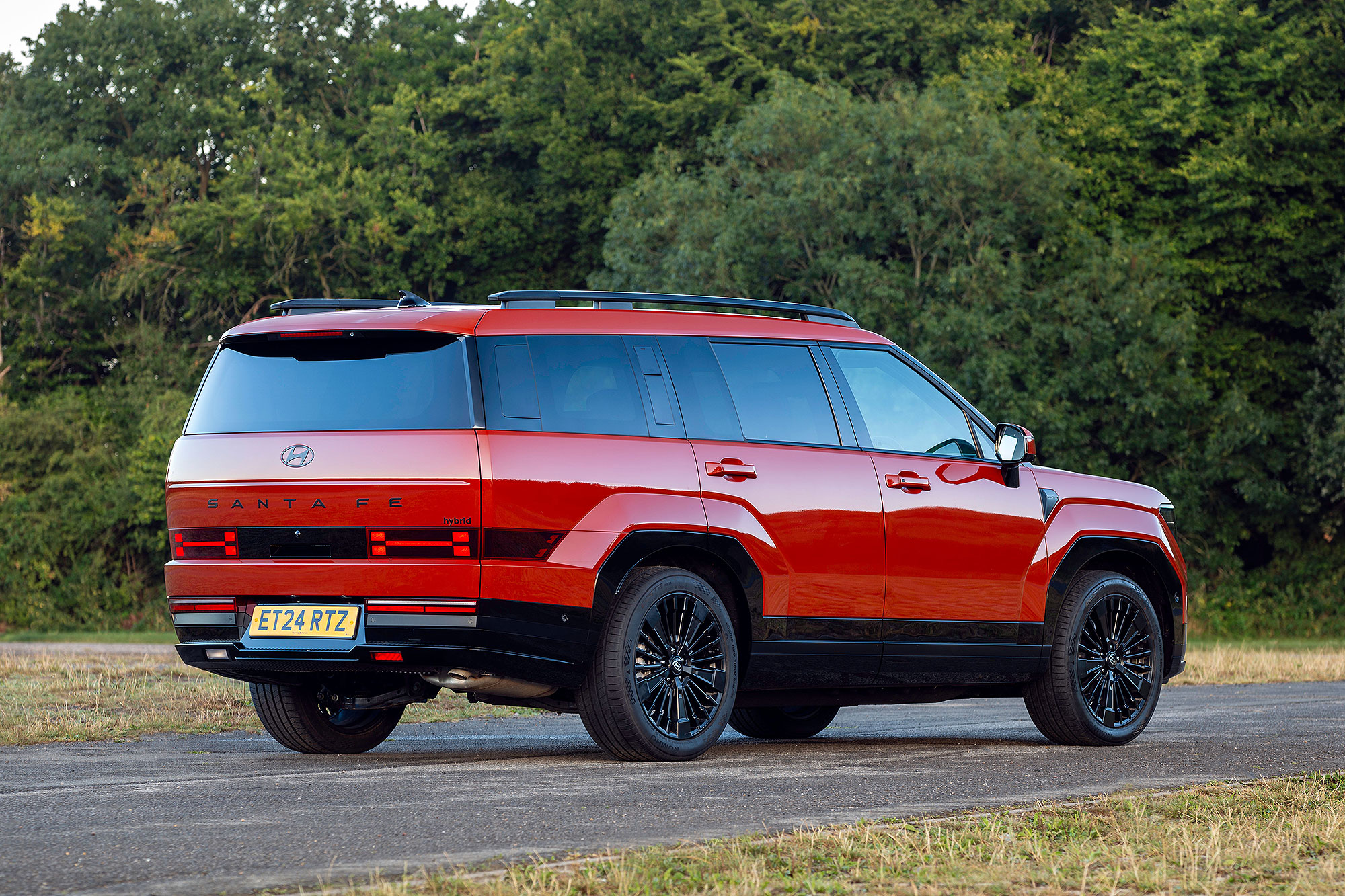
What is the Hyundai Santa Fe?
The Hyundai Santa Fe is a large, seven-seat family SUV. It’s now in its fifth generation, and is more upmarket and expensive than ever. That said, it’s also roomier, more versatile, more efficient and more crammed with technology. So is the higher price justified?
The Santa Fe is offered as a full hybrid with a 1.6-litre turbocharged petrol engine, which you can have with front-wheel drive or all-wheel drive, or as a plug-in hybrid that uses the same engine but adds 33.6 miles of fully electric range thanks to a 13.8kWh battery.
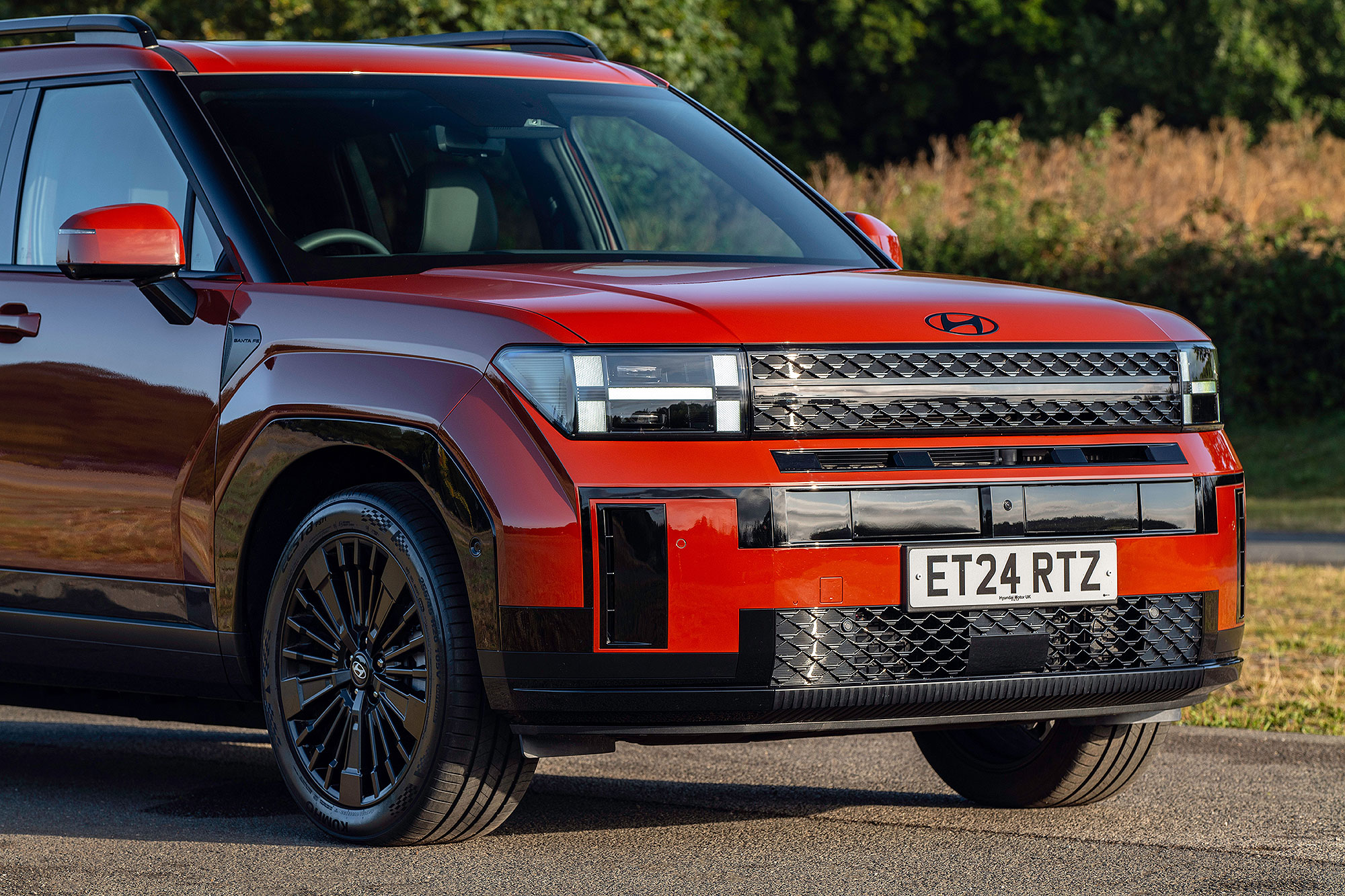
It has a much bolder, much boxier appearance than a generation ago. In some ways, the Sante Fe looks more in line with Kia’s recent design philosophy, with a chunky, box-like silhouette. It’s not a bad-looking car, but it is a big one, measuring 4.83m long, 1.90m wide and 1.78m tall. It’s therefore a fraction larger than a Peugeot 5008, and noticeably shorter than the electric Kia EV9 that could be considered a rival.
More likely is that you’ll be considering the similarly-sized Kia Sorento, which is the Santa Fe’s chief competitor, or even the more upmarket Land Rover Defender 130. Other rivals in the seven-seat SUV class include the fully electric Mercedes EQB, the Volvo XC90 and the Nissan X-Trail. The latest Skoda Kodiaq plug-in hybrid will also compete for your cash, with an EV driving range of 62 miles, as will the Mazda CX-80 and premium rivals such as the Audi Q7 and BMW X5.
In terms of its place in Hyundai’s own model range, the Santa Fe is the flagship among combustion-engined cars, sitting above the Kona and Tucson. It’s also more versatile than the South Korean firm’s electric vehicles, such as the Ioniq 5 and Ioniq 6.
How practical is it?
Happily, that stylish exterior isn't a case of form over function, because the Santa Fe is one of the most versatile SUVs out there.
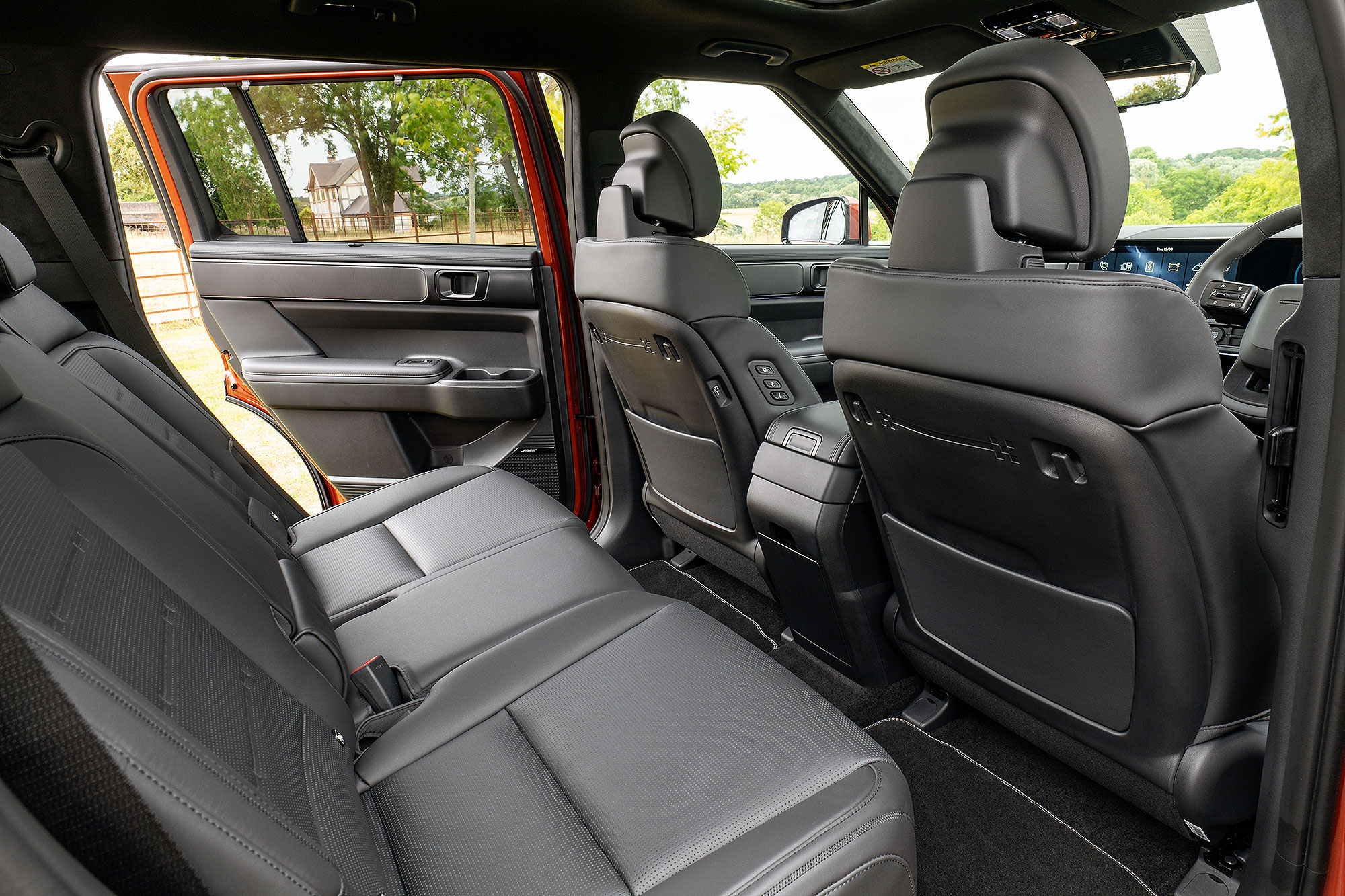
Firstly, there's the middle row of seats slide and recline in a 60:40 split, and offer loads of legroom and headroom even for tall adults. A one-touch button has the seats tilting and sliding forwards for reasonable access to the third row, too. And when you’ve climbed into the rearmost seats, there’s actually room for adults to sit in reasonable comfort for shorter journeys. The floor is quite high, though, and there’s not much foot space, but there are cupholders and climate control, which is by no means a given in seven-seaters.
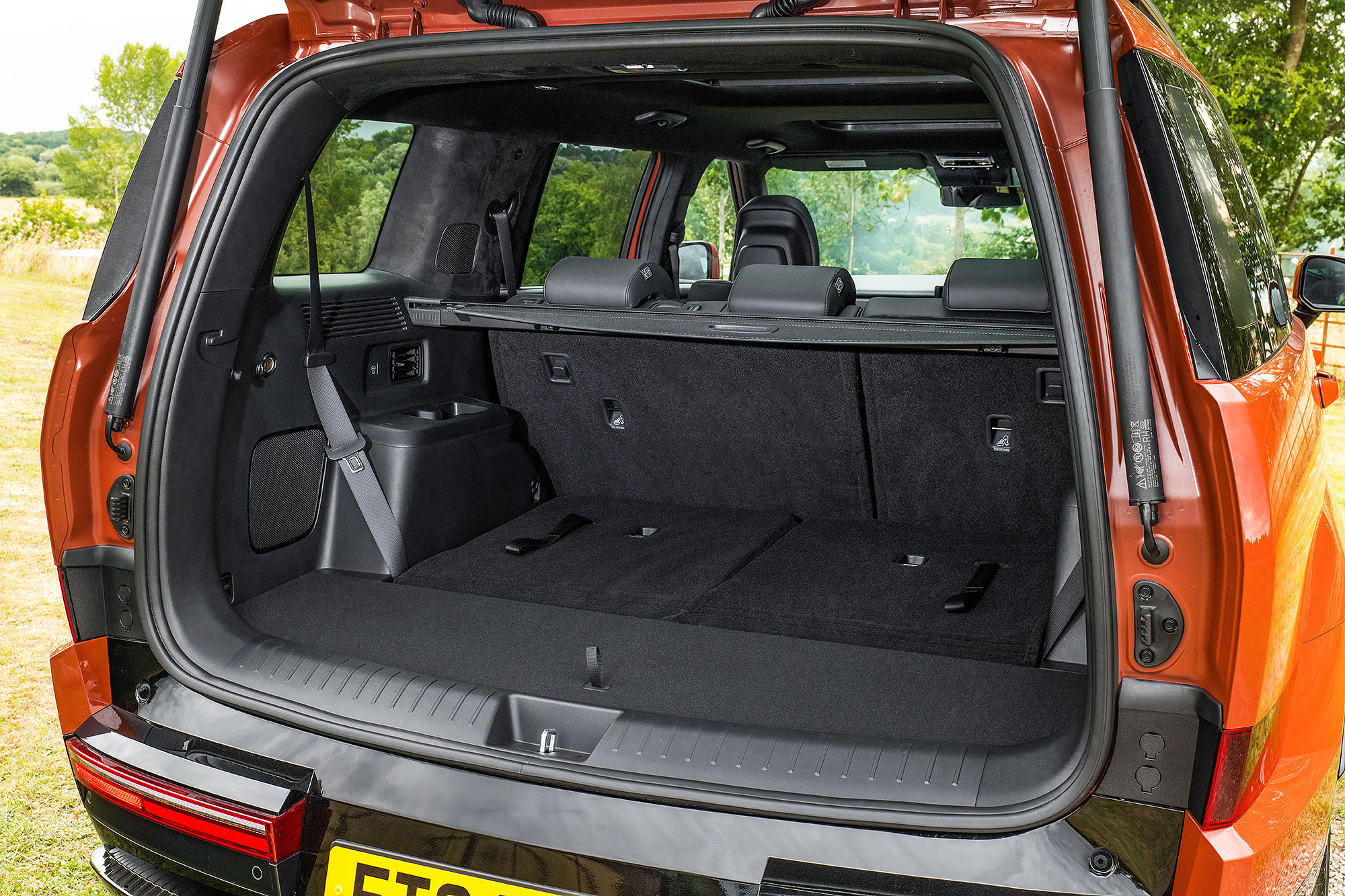
It's also a doddle to raise the third row of seats up from the flat boot floor when you want them. There’s still enough room for a single buggy or a couple of soft bags even with all seven seats in use (Hyundai doesn’t quote a capacity figure). Mind you, there is nowhere for the loadbay cover to go when you take it out in order to raise all seven seats, which is annoying.
Fold those rearmost seats down to reveal the five-seat mode that most owners will default to, and you have a healthy 621 litres of boot space in the plug-in hybrid and 628 litres in the standard hybrid: plenty for most things that family life can throw at you in either case. Fold down the next row and there’s a whopping 1,942 litres in the plug-in hybrid and 1,949 litres in the hybrid.
There are also Isofix fittings on the third row of seats, as well as two set of Isofix in the second row, which families with multiple small children may consider a big advantage. You can optionally get the Santa Fe in six-seat executive configuration, albeit only in the top-spec Calligraphy trim, which in turn means a £7,000 price hike compared to the cheapest version.
If you want to buy a Santa Fe to use as a tow car, avoid cars made before the 2026 model year changes came in in September 2025. These earlier cars have disappointingly (and surprisingly) low towing ratings, with the PHEV only able to tow a braked trailer of up to 1,010kg; the hybrid isn’t much better, at 1,110kg.
The Santa Fe has been a favourite with caravanners and horse lovers for years, so to have this new car arrive with such a low towing capacity (one that a standard Volkswagen Golf can rival) alienated a fair few loyal fans.
Thankfully, Hyundai realised the error of its ways, and from September 2025 onwards, the Santa Fe’s towing abilities were improved considerably. Now, the PHEV can tow 1,700kg, while the hybrid can haul 2,000kg. And while these figures aren’t a match for serious heavy-duty haulers like the Land Rover Defender, they are at least enough to tow the majority of caravans and box trailers.
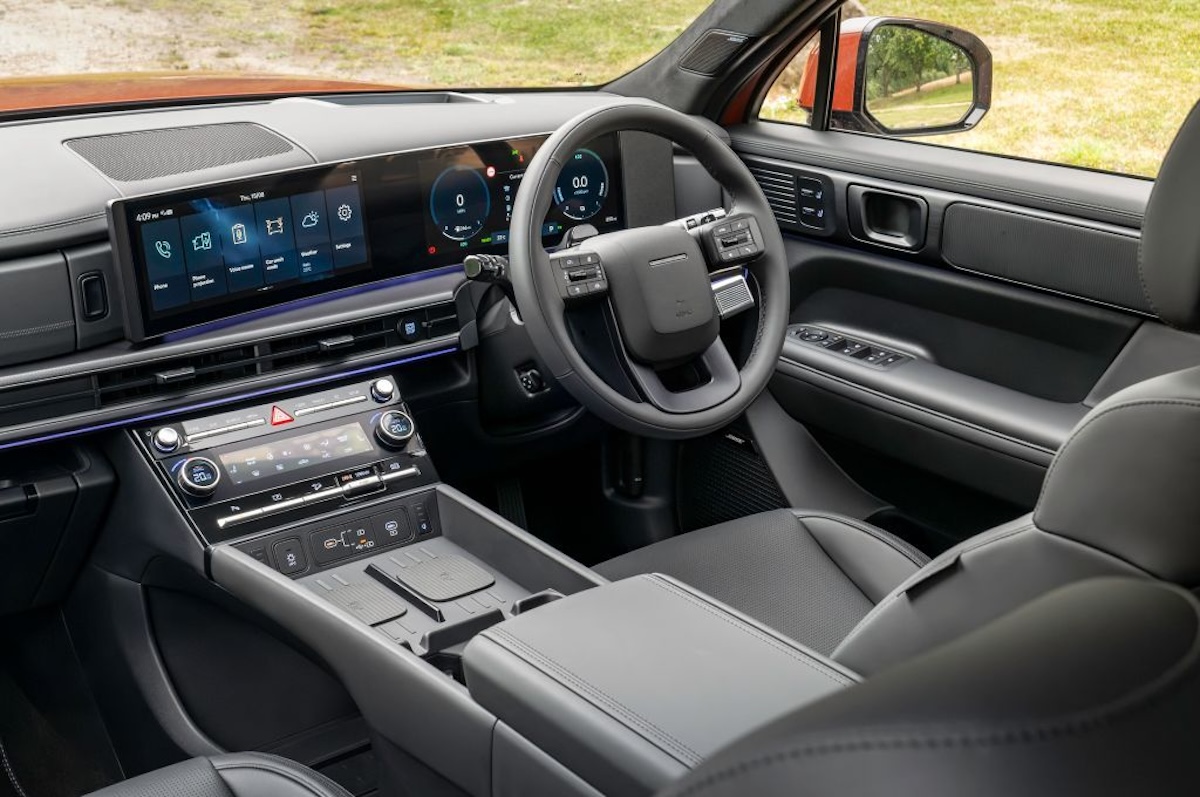
Whether you go for a used or a brand-new Santa Fe, you can enjoy a seriously cool cabin up front. There are definite Defender 130 vibes in the straight, bluff dashboard architecture and hard-wearing materials, while the high-set driving position gives an appropriately commanding view down the road. There are loads of cubbies and a double glovebox, plus an excellent curved touchscreen. It really does feel classy, and is robust enough to stand up well to a hard life in the countryside: quite a tricky balance to strike.
What’s it like to drive?
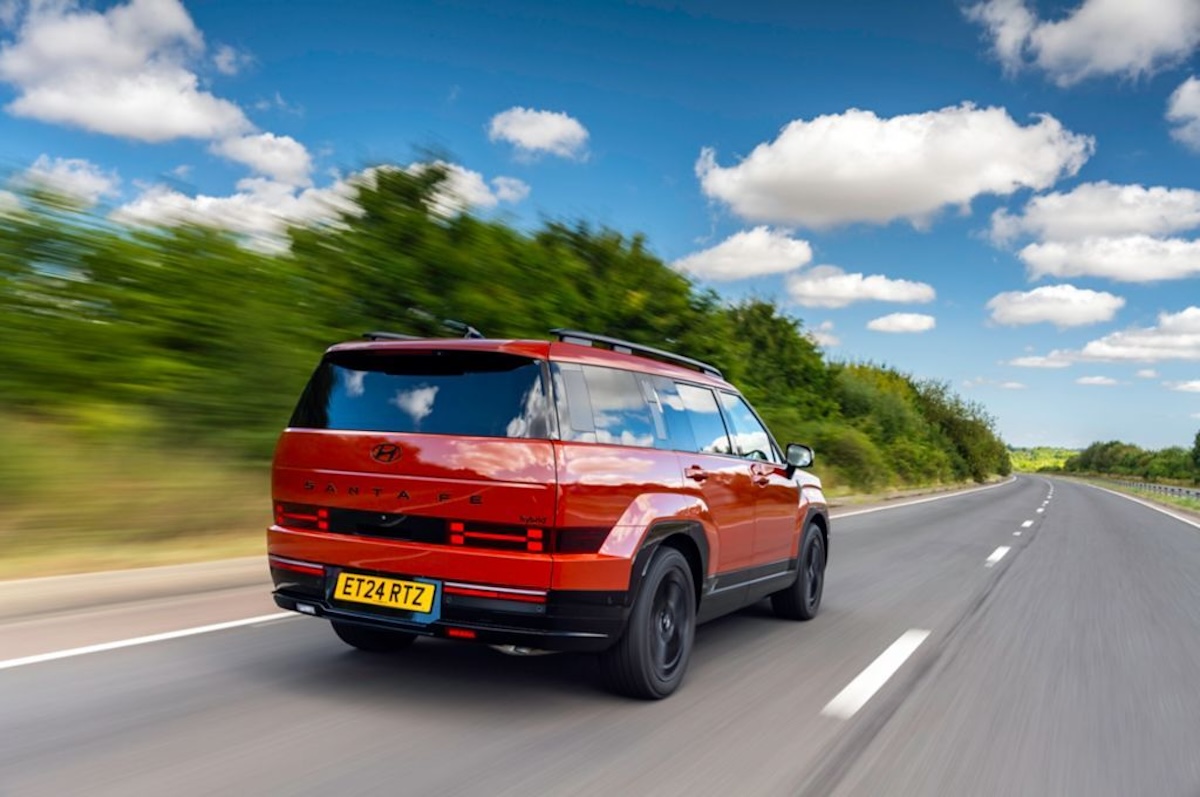
The Hyundai Santa Fe isn’t fast, but it is planted, refined and surprisingly satisfying to drive, regardless of whether you’re pottering around town or enjoying a twisty road.
We’ve driven both the full hybrid (which has a small battery for intermittent electric running at low speeds, or when you lift off the throttle) and the plug-in hybrid (which has all-wheel drive as standard). Both flick between electric running and propulsion from the 1.6-litre turbocharged petrol engine very smoothly, with the six-speed automatic gearbox blurring gears and making it easy to forget about what the powertrain is doing. It’s also pretty refined: the petrol engine does get noisy if you really rev it, but in the sort of moderate driving that suits the Santa Fe, it’s hushed and relaxing.
Performance-wise, the hybrid serves up 236bhp and 195lb ft of torque. It will hit 62mph in 9.0 seconds in front-wheel-drive form and 9.2 seconds with all-wheel drive. These figures apply from the 2026 model year onwards (released in September 2025), at which point there was a small power hike. Previously, the powertrain delivered a total of 213bhp for 0-62mph times of 9.6 seconds and 9.8 seconds, respectively.
The plug-in hybrid, meanwhile, delivers 284bhp and 280 lb ft, and will dash to 62mph in eight seconds dead (again, those figures only apply from September 2025 onwards; before that date, the plug-in hybrid’s 249bhp and 271lb ft powertrain took it to 62mph in 9.3 seconds). They all have the same suspension setup, the same turning circle (11.6 metres) and the same brakes. The hybrid Santa Fe weighs 1,900kg, while the four-wheel-drive hybrid and plug-in hybrid weigh 1,965kg.
Every Santa Fe gets self-levelling suspension, which manages to keep things very cushy without feeling too soft or motion-sickness-inducing. In fact, the big seven-seat Hyundai is actually surprisingly decent to drive on a nice road if you stick it in Sport mode for weightier steering (although its cornering ability won’t have you mistaking it for a sports car from behind the wheel). Otherwise, it’s just a big, laid-back seven-seater, as indeed it should be.
It's not as off-road-oriented as the Defender 130 (not in the slightest), but the ground clearance and all-wheel drive, matched to automatic terrain settings for the traction control, mean it can dispatch a rutted farm track or muddy field without too much hassle.
Technology, equipment & infotainment
The Santa Fe is offered in three trim levels: Premium, Ultimate and Calligraphy. All get heated front seats, leatherette upholstery (the Pecan Brown option is interesting), keyless entry, wireless phone charging, sunblinds for the rear windows, that seven-seat layout, 20-inch alloy wheels and a suite of semi-autonomous driver assistance systems. They also get a 12.3-inch touchscreen infotainment system with navigation, wireless Apple CarPlay and Android Auto connectivity, and over-the-air software updates, not to mention a configurable driver’s display that also measures 12.3 inches across.
Ultimate trim adds a camera that displays a view down the side of the car when you indicate to compensate for blind spots, a head-up display, a Bose sound system, heated seats in the back, a double opening sunroof, dual wireless phone charging pads, a digital rear-view mirror and more.
Calligraphy adds fancy styling features such as black alloy wheels, Nappa leather upholstery and a front seat that fully reclines for lounge-like comfort. One neat feature is a UV sterilisation tray, a little compartment in the dashboard that uses UV light to kill germs on items like keys, gloves and facemasks.
Although it’s all down to personal preference, we’d be inclined to go for one of the more interesting colours, rather than the black, silver, grey or one of the two whites. There’s Cyber Sage, which isn’t overly impressive, but there’s also pearly effect Olive Green, solid Terracotta Orange, and the matte-finish Earthy Brass.
Hyundai Santa Fe running costs
The Hyundai Santa Fe isn’t cheap. The range starts with the Premium version at almost £50,000, and moves up to around £52,000 for the Ultimate and around £55,000 for the Calligraphy. Add around £2,000 to those prices to go from front-wheel drive to all-wheel drive.
On the plug-in hybrid front, prices start at around £53,000 for the Premium, then around £56,000 for the Ultimate and around £59,000 for the Calligraphy. That’s not a massive leap to go from a regular hybrid to one that can do a significant journey on EV power alone. Still, there’s something unsettling about a near-£60,000 Hyundai.
Noteworthy if you’re in the market for a Santa Fe as a company car, is the fact that a Peugeot 5008 is cheaper on Benefit-in-Kind company car tax, as are the Kia Sorento, Dacia Jogger and Skoda Kodiaq. Still, many won’t mind as the Hyundai is roomier, has all-wheel drive, and arguably offers more kerbside appeal and styling swagger.
Servicing with a Hyundai main dealer shouldn’t be hugely costly, with plans available where you pay yearly, or subscriptions to pay monthly. With the latter, known as Subscribe myHyundai, prices start from £11 per month, and you can include extras such as roadside assistance, key cover, European breakdown cover, anti-perforation checks on the bodywork and money off Hyundai accessories. Cars five years old or more are eligible for fixed-price servicing, starting at £200 for a minor service and £300 for a major, but that doesn’t apply to this generation of Santa Fe yet.
Make Model reliability
Hyundai has a good reputation for reliability, and its cars come with a five-year, unlimited-mileage warranty, which is usefully better than you’ll get on most rivals (with the notable exception of sister brand, Kia). The battery is also covered for up to eight years and 100,000 miles, there’s an anti-perforation warranty of 12 years and a paint warranty of five years with any mileage.
The new Santa Fe hasn’t been around for long enough to feature in any owner surveys, but the brand as a whole came 14th out of 30 brands in the 2025 What Car? Reliability Survey (which factors in used cars of up to five years old), a drop from seventh the year before. What bodes well is that the previous Hyundai Santa Fe came first out of 14 cars in the seven-seat SUV category.
- It does seem a shame that you don’t get vehicle-to-load (V2L) charging on the Santa Fe PHEV. It’s likely because the battery simply isn’t big enough, but Hyundai offers this feature – which allows you to charge another electrical device, such as a portable fridge, from the high-voltage battery via a three-pin plug – on its fully electric cars.
- The Santa Fe PHEV charges at a maximum of 3.6kW, which is not fast – but it’s also not unusual for plug-in hybrids to charge at this speed. It’ll still get you a full battery in less than five hours from a dedicated car charger. A normal domestic plug will fully charge the Santa Fe in around seven hours.
- Hyundai has really thought about the usability of the Santa Fe. From the hard plastic seat backings (complete with bag hooks and map pockets) to a neat hidden handle in the C-pillar on Calligraphy models that helps you step up to reach anything mounted on the roof, it all speaks of proper attention to detail. For ultimate useability, ensure you look at the accessories on offer before ordering. There are add-ons such as door side steps, bicycle racks, a whole range of alternative wheels, dog seat covers, rubber boot mats and more.
- If you want the best value: Go for the front-wheel-drive Santa Fe Hybrid in Premium trim. Yes, it’s the entry-level vehicle, but there’s plenty of kit included as standard on every Santa Fe. Just be mindful, if you’re in the market for a seven-seater and aren’t 100% set on a Hyundai, ultimate value for money is likely to be found elsewhere. Both the Skoda Kodiaq and Kia Sorento can be had for less.
- If you want the best company car: Choose the Santa Fe Plug-in Hybrid and find the extra to go for Ultimate spec if you can. The sound system and sunroof make a big difference, and the difference in cost won’t be huge.
- If you want the best high mileage commuter: As a retail buyer, go for the regular hybrid, as it should manage 41.5mpg in Ultimate trim. Company car buyers paying benefit-in-kind tax would be best to follow our PHEV recommendation above, however, which returns a claimed 166mpg (that won’t be what you see in the real world, mind). Again, Ultimate trim is the one to go for, as that sunroof, ventilated- and heated seats up front, head-up display and Bose sound system will make life much more relaxing when you’re on the go. You could step up to Calligraphy for a reclining front seat, but it’s a lot of extra cash for a slightly comfier nap at the motorway services.
- If you want the best family car: Avoid the six-seater and go for the standard seven-seater, that’s the main thing. Beyond that, we’d choose Ultimate trim, which isn’t the cheapest but it’s our favourite for a balance of cost and equipment. Which powertrain suits you best will come down to your lifestyle. If you can charge regularly and do shorter journeys, the PHEV is a smart choice. If not, you should go for a regular, non-plug-in hybrid.


