Volkswagen Passat Review (2024-present)
Volkswagen Passat cars for sale
4.0
Expert review
Pros
Posh-feeling interior
Generous standard equipment
Lots of space for people and luggage
Cons
Infotainment system is difficult to navigate
A few strange ergonomic issues
Doesn’t come cheap
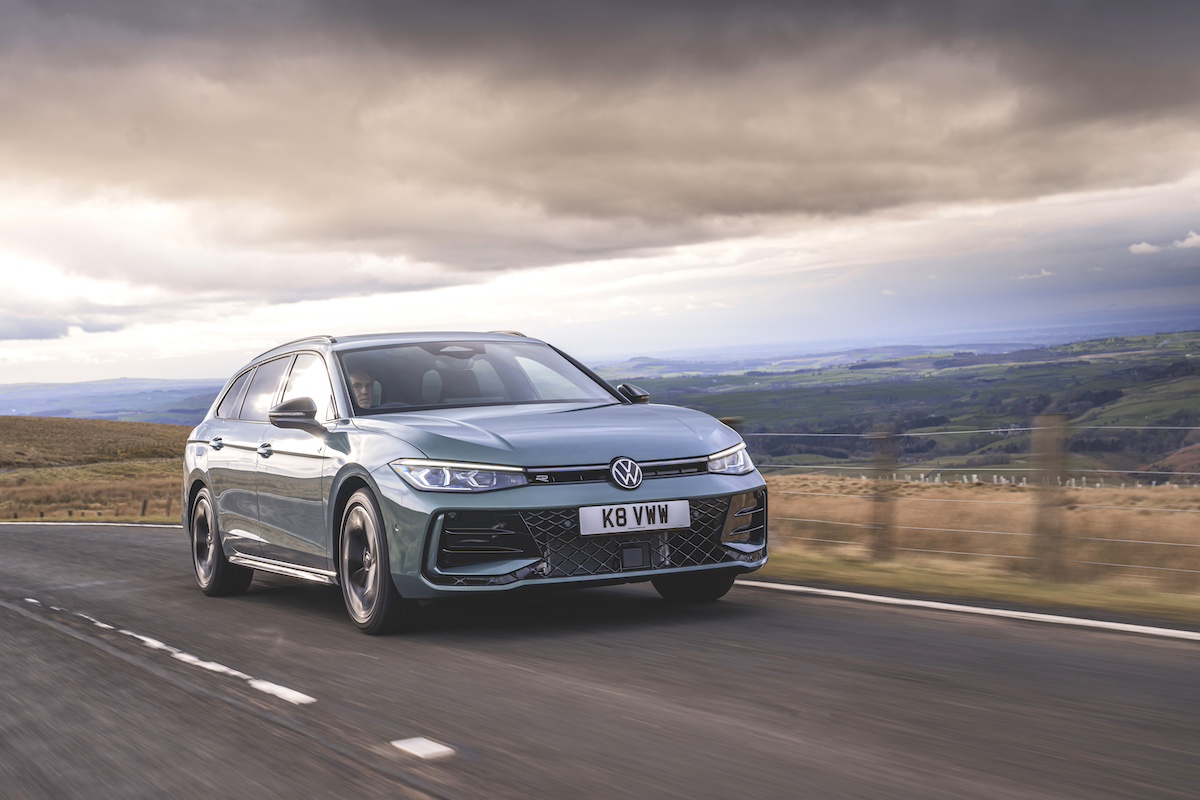
The CarGurus verdict
The tastes of the car-buying public have changed in recent years, and that means there aren’t many mainstream family estates left any more. Of those that remain, the Passat is one of the best. It delivers big on space and practicality, with an enormous boot and huge passenger space. It’s well built, nicely finished and comes with lots of standard equipment, too.
Yes, we have some big reservations about the complexity of its infotainment system, and there are a few other ergonomic oddities that might send you gently potty. It’s not cheap, either. However, if you’re after family-friendly practicality in a smart and sophisticated-feeling package, then you could do a whole lot worse.

What is the Volkswagen Passat?
With VW placing so much emphasis and investment into its ID range of zero-emissions all-electric cars, and the current car market being so savagely dominated by SUVs, we wouldn’t have been surprised if the Passat was a nameplate that the German company quietly put out to pasture. It would've been a shame, mind, because having originally been launched in 1973, the Passat has been around even longer than the Volkswagen Golf. Good news, then, that in 2024, Volkswagen has seen fit to launch a ninth-generation version of its family car.
Not in a form you might immediately recognise, though. The unstoppable rise of the SUV has meant that the writing has been on the wall for the traditional family saloon car for some time, so while previous Passats have been available in both saloon and estate forms, that latest incarnation is offered in estate form only. It’s also a considerably bigger car than the one it replaces at almost five metres long, and happily, the size increase equates to a huge amount of space and practicality.
You’ll find that several traditional Volkswagen traits are present and correct on the new Passat, too. The styling takes a smartly conservative approach, the interior quality is a cut above that of most mainstream rivals and the driving experience is grown-up and sensible. All good things in a family car, we’d say.

How practical is it?
Getting comfy at the helm of the Passat is fairly easy: in all versions, you get manual seat height adjustment via a lever that you crank up and down, but the backrest moves electrically, which is both easier and more precise. There’s plenty of adjustment in the steering column, too, so drivers of all shapes and sizes should be able to find an acceptable position.
Visibility is pretty good, too, with large windows all around the car, and all versions come with front- and rear parking sensors and a reversing camera as standard.
As we said earlier, the ninth-generation Passat is available as an estate car only, and it’s a pretty massive one at that. It’s now 144mm longer than its predecessor - making it almost five metres long - and it’s also 20mm wider.
With the extra length, 50mm of it has gone into the car’s wheelbase (the distance between the front and rear wheels), and that means more generous legroom. Even with six-foot occupants in the front, there’s loads of space behind for passengers of a similar size to stretch out in comfort, with no fear of their knees being impeded. Headroom is also very generous, so the rear seats feel hugely roomy when carrying two in the back. There’s enough shoulder space to squeeze in a third when needed, although whoever ends up in the middle will have to sit with their feet either side of a transmission tunnel in the floor, which is very bulky.
The extra size also means a significant uplift in boot space compared with the previous Volkswagen Passat estate, with an extra 40 litres taking the total up to 690 litres. The space is usefully square-sided, too and the powered tailgate and powered load cover - which are both standard throughout the range - move out of your way electrically to give you excellent access to the space.
The rear seats fold down in a 60/40 split, which isn’t as versatile as the 40/20/40 split in some rivals, but it’s easy to do: you simply pull catches either in the boot or on top of the seats themselves. The backrests lie almost flat, and with the standard moveable boot floor in its uppermost position, there’s no step between them and the boot floor, leaving you with a level loading area. That also leaves barely any load lip at the boot entrance, and you get a little bit of extra space under the boot floor.

What’s it like to drive?
The Passat has the kind of grown-up feel that you’d expect from a large family estate car. Life and Elegance versions come with a standard passive suspension, and it gives a very decent balance of comfort and control. The ride is perhaps a fraction firm, so some ripples and ruts do make themselves known in the cabin, but they don’t upset the calm, and the suspension does a good job of dealing with larger bumps and potholes.
The car feels solid and secure in corners, too. It’s too big and heavy to feel in any way agile, but it has good control over its body movements, strong grip and responsive, accurate steering, and that all makes the Passat feel entirely precise and predictable.
R-Line cars, meanwhile, get Volkswagen’s Dynamic Chassis Control system adaptive suspension as standard, and it can also be added to the other trims as an optional extra. This varies the stiffness of its suspension according to which of the driving modes you select, but we haven’t had the chance to try it yet.
Initially, the VW Passat is offered with only one powertrain: a 1.5-litre turbocharged four-cylinder petrol engine, fitted with 48-volt mild hybrid technology, known as the eTSI. It delivers 148bhp to the front wheels via a standard seven-speed dual-clutch DSG automatic gearbox.
It’s fair to say that it’s no ball of fire. The engine plainly has its work cut out in dragging the Passat’s huge, heavy body around: you’ll notice the engine revving quite hard just to achieve and maintain a moderate pace, and the gearbox searching around, trying to figure out which ratio it needs. The performance on offer will probably be adequate for most, but you’ll need to accept that you won’t get anywhere particularly quickly. If you try putting your foot down, then engine revs even harder, but you don’t ultimately go a lot faster.
It won’t be too long before the eTSI is joined in the Passat range by the eHybrids. These are plug-in hybrids that use the same petrol engine, but combine it with an electric motor, a bigger 19.7kWh battery and a six-speed automatic gearbox to deliver either 204PS or 272PS. VW says these will run around on electric power alone for around 70 miles, but we’re slightly disappointed that VW hasn’t reprised the Volkswagen Passat GTE name for its PHEV offerings. In the fullness of time, there will also be a 2.0-litre petrol version with 204PS and four-wheel drive. Interestingly, a TDI diesel engine won’t be offered.

Technology, equipment & infotainment
Volkswagen sees the technology in the Passat, most notably its sophisticated infotainment system, as one of its main selling points. Sadly, though, it almost ends up being the undoing of the car. Allow us to explain.
All versions have the same system as standard, which brings together a 10.25-inch digital instrument panel behind the steering wheel and a large 12.9-inch central infotainment touchscreen in the middle of the dashboard. If that middle screen isn’t big enough for you, it can be upgraded to a whopping 15.0 inches using the options list. You also get eight speakers, Bluetooth, DAB, Apple CarPlay and Android Auto, wireless smartphone charging and voice control
Undeniably, the system has some serious initial wow-factor. It looks great, with sharp, modern graphics and slick screen transitions, while the sensitive screen and glitch-free software means the system reacts quickly and reliably to your inputs.
However, all that doesn’t stop the system from being hopelessly confusing to use. With almost no physical switchgear in the car, pretty much every function has to be operated through the screen, and the sheer number and variety of icons on display - many of which are also ambiguously designed so it’s not immediately clear what they do - makes the screen look cluttered, which is quite an achievement given its generous size. There are seemingly endless menus and submenus, many of which are bafflingly arranged, and it all means that performing even the simplest of tasks is both complicated and time consuming.
And then comes the ironic bit. As you drive along, squinting and jabbing at the screen trying to find and operate a specific function as you go, the car’s driver attention monitor detects that your eyes have been diverted from the road for too long, and you promptly get told off. It’s a bit like being gaslit by your own car.
So that’s the technology on board the car: what about the equipment? Well, three trim levels are offered in the line-up: Life, Elegance, and R-Line.
Even entry-level Life cars are well equipped, with 17-inch alloy, all-round LED lighting, powered and heated door mirrors, keyless entry and go, three-zone climate control, ambient lighting, heated- and massaging front seats, part-electric seat adjustment, leather multifunction steering wheel with paddle shifters, automatic lights and wipers, parking sensors, a reversing camera, adaptive cruise control, high-beam assist, a powered tailgate and a powered luggage cover.
Elegance cars look a bit posher with adaptive matrix LED headlights with a light strip running between them, and you also get a heated steering wheel, sports seats with a more sophisticated massaging function, more sophisticated ambient lighting with 30 colours, and a panoramic sunroof.
Cars in R-Line trim look posher still with 18-inch alloy wheels and sporty styling elements inside and out, and you also get the Dynamic Chassis Control adaptive suspension.

Volkswagen Passat running costs
Official fuel economy for the 1.5-litre petrol eTSI stands at between 50-52mpg depending on the trim level you choose - so expect 42-45mpg in the real world - and insurance groupings stand at between 30-32, varying with spec.
With the eTSI being a 48-volt mild hybrid, it qualifies for the £10 annual discount on VED road tax, leaving you with £180 left to pay per year. However, do bear in mind that cars costing more than £40,000 when brand new - including optional extras - are subject to an additional £390 ‘luxury car’ surcharge for a temporary five-year period between years two and six of the car’s life. Only the entry-level Life trim is priced below that threshold, and adding a few extras could take it over quite easily.
When the plug-in hybrid versions arrive, these will inevitably have MPG figures running into the hundreds. As ever, these figures should be treated with a healthy amount of scepticism, because the official tests are unrealistically flattering to PHEVs. The fuel return you actually get in the real world will depend entirely on how much you have to call upon on the petrol engine. They’ll still be tax-friendly for company car drivers, though.

Volkswagen Passat reliability
Usually it’s impossible to know how a brand new car is going to perform in this area, but since the latest Passat is based on an enhanced and developed version of its predecessor’s architecture (if you’re interested, it’s called MQB Evo, and it also underpins the latest Tiguan SUV), you could reasonably assume that there will be some parallels.
In the 2024 What Car? Reliability Survey, the previous Passat placed 19th out of 20 cars considered in the Executive Car category, with only the BMW 5 Series diesel faring owrse. The Volkswagen brand as a whole saw a middling result, placing 18th out of 31 car manufacturers.
Volkswagen’s warranty offering is nothing special, either. You get two years of unlimited-mileage cover, and a third year limited to 60,000 miles. That’s the bare minimum you should expect from any car company these days, and the likes of Toyota, Kia and Hyundai are considerably more generous in this regard.
- Volkswagens come with a certain expectation of quality, and the Passat really delivers on that front. The interior features plush materials and thoughtfully chosen finishes, giving the impression that you’re sitting in a posh environment. Root around in the footwells, and you will find a few plastics that aren’t quite up to the same standard as those higher up, but they don’t ruin the effect by any stretch.
- Safety is important in any family car like the Passat. The standard safety equipment looks competitive: you get adaptive cruise control, autonomous emergency braking that detects pedestrians and cyclists, a driver attention/drowsiness monitor, three Isofix points and dynamic road sign display.
- Instead of being placed on the centre console as is more conventional, the Passat’s automatic gearbox selector is located on the right-hand side of the steering column. That means that the right-hand stalk that conventional wisdom says would control the windscreen wipers has been done away with, so you control those, along with the indicators, with the left-hand stalk. The way it all works takes a bit of getting used to.
- If you want the best balance of kit and cost: There’s really no need to look beyond the entry-level Life trim, because it’s really well equipped as standard. If you want to spend extra, wait a little while and spend it upgrading to a more powerful engine instead.
- If you want a stylish alternative: Not all that many family estates remain on the market these days, but of those that do, the Peugeot 508 SW is arguably the best looking, with its bold details and rakish lines.
- If you want a sensible alternative: The latest Skoda Superb Estate is essentially the same car as the Passat underneath, but it costs a bit less. It also has a wider range of engines to choose from than the Volkswagen, and that includes diesel, which will still be good for high-mileage drivers who regularly do long-distance motorway schleps.
- If you want a prestige alternative: Aside from the rivals already mentioned, finding a big estate car involves delving into the premium market. Price-wise, the Passat is a rival for the Audi A4, BMW 3 Series or Mercedes C-Class, but size-wise, it’s more comparable to the class above. The BMW 5 Series is the best of these, but it’ll cost you way more than the Passat and it’ll come with less standard kit.

