Citroen e-C5 Aircross 2025 review | French family SUV with electric power
Citroen e-C5 Aircross cars for sale
4.0
Expert review
Pros
Comfortable interior
Really roomy
Excellent value
Cons
Ride can get unsettled on some roads
No heat pump on lower-spec models
Not as rapid as its rivals

The CarGurus verdict
It’s a shame the e-C5 Aircross doesn’t quite make good on Citroen’s promises of comfort; with a smoother ride quality, it might get the full five stars out of five here.
Even as it is, though, this is a brilliant-value family EV, with a high-quality, well-executed interior that doesn’t give away just how affordable it is, and a tonne of room for your family and their things. It should prove pretty cost-effective to run, and it’s backed up by a good warranty, too. If you’re thinking of buying a big, family-friendly electric SUV, you’d be wise to add it to your shortlist.
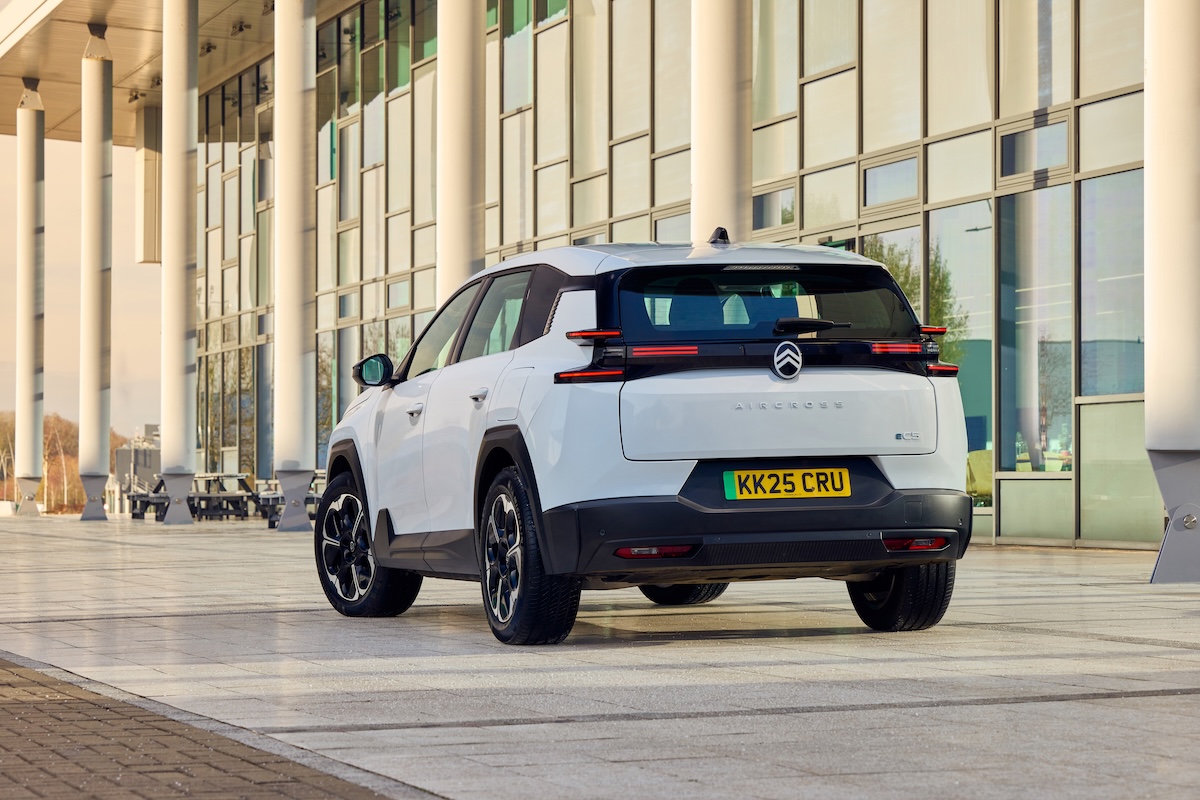
What is the Citroen C5 Aircross?
What a difference a few years makes, eh? When the mk1 Citroen C5 Aircross first came out in 2018, Citroen offered it with petrol, diesel, and plug-in hybrid powertrains.
Now, with the arrival of the second-generation car, the diesel model has been dropped completely, and the petrol version has been replaced with a hybrid. And for the first time, an electric powertrain has joined the range: the e-C5 Aircross, which we’re looking at here (we’ll write a separate review of the combustion-engined C5 Aircross once we’ve driven it).
It’s taken a while for Citroen to add electric power to the C5 Aircross, and during that time, a plethora of large electric SUVs have popped up. The most popular is probably the Skoda Enyaq, which combines huge amounts of interior space with smart interior finishes and no-nonsense prices, and as a result, it’s probably the car the e-C5 Aircross is going after most directly.
But it’ll also be going head-to-head with plenty of other models, including the Hyundai Ioniq 5, Kia EV6, Volkswagen ID.4 and Toyota bZ4X, not to mention in-house rivals from the Stellantis group, such as the Vauxhall Grandland Electric and Peugeot e-3008.
And all the while, it’ll be fending off newly-arrived Chinese rivals trying to grab a piece of the same pie, including the Leapmotor C10 (also affiliated to the Stellantis group), Geely EX5, Xpeng G6, and Skywell BE11 among them. In other words, this is a car that’ll have its work cut out.
How practical is it?
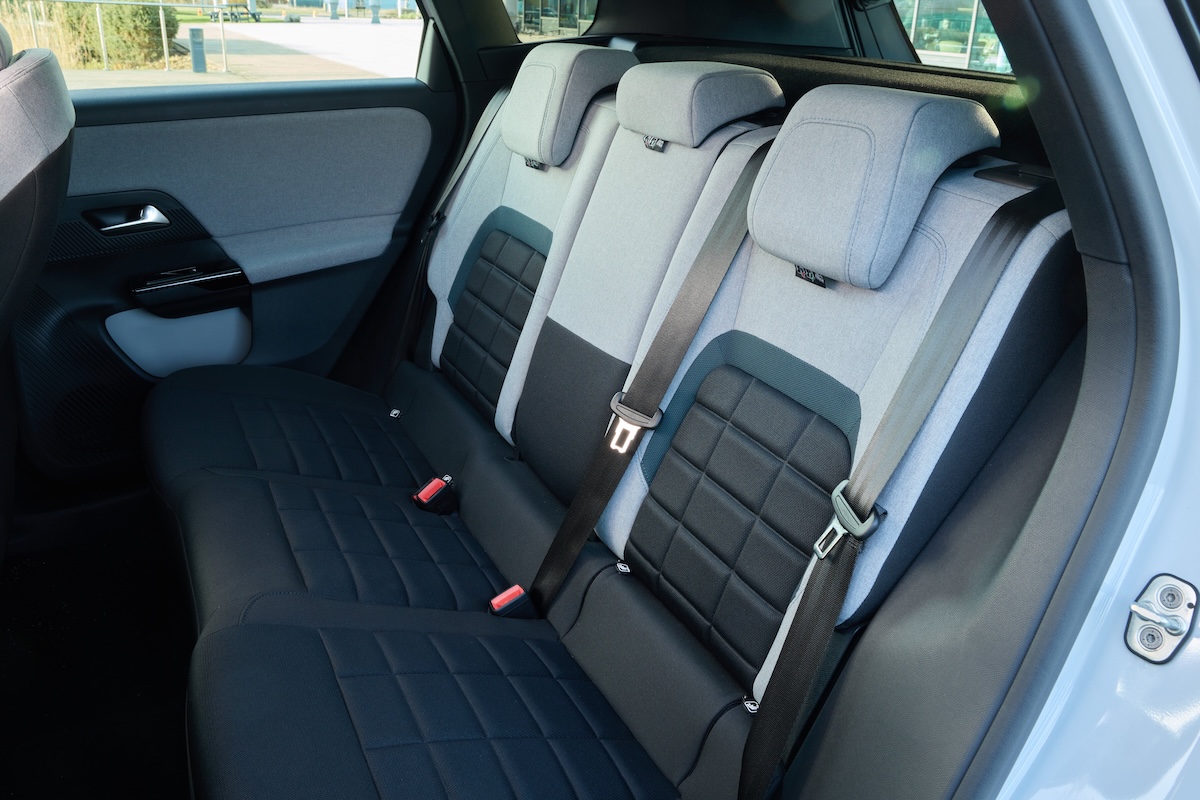
The old C5 Aircross used to have three individual seats across the rear that you could slide, recline and fold individually. The joy of this was that it meant you could set the interior up just as you needed: perhaps with one seat folded down and the other two slid forward, to take extra luggage and a couple of sets of skis to the Alps, while retaining the ability to seat two children in the back. Sadly, that’s no longer the case, because Citroen has replaced the three-seat layout in the back with the sort of rear bench you’d usually find in rivals.
The backrest still folds in a 40/20/40 split, so you do retain some of that flexibility, but it’s a bit of a shame you can no longer slide the seat backwards and forwards, as you can do in a Hyundai Ioniq 5.
Mind you, the rear seats offer a simply vast amount of head- and legroom: Citroen reckons there’s as much of the latter, in fact, as you’ll get in the much larger C5 X.
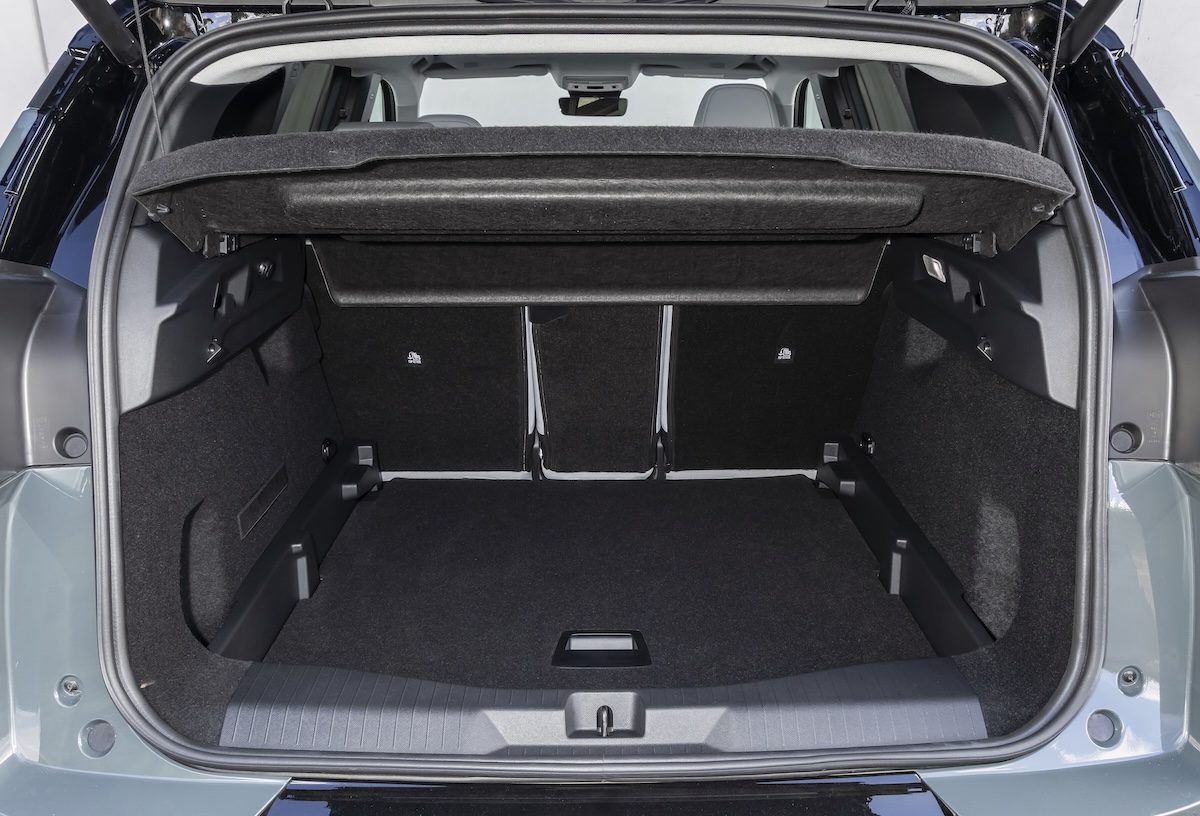
There’s even better news in the boot, where the e-C5 Aircross can boast one of the largest luggage bays of any EV. At 651 litres, the boot space is the same as you’ll find in the petrol C5 Aircross, which means there’s no penalty for choosing the electric model.
It’s also far more than you’ll find in a Skoda Enyaq, hitherto the benchmark for boot space in this class. What’s more, the level of the boot floor can be positioned high, to sit flush with the folded rear seats and create a hidden compartment beneath, or low, to maximise the overall volume.
Up front, there’s plenty of room, too, with a central covered bin that’s chilled, and a huge storage area behind the rather lovely floating centre console. If there’s a downside, it’s that the cup holders are mounted within this latter space, which makes them hard to reach.
The rest of the dashboard is beautifully finished, though, and trimmed in high-quality fabric that lends it a tactile and welcoming feel.
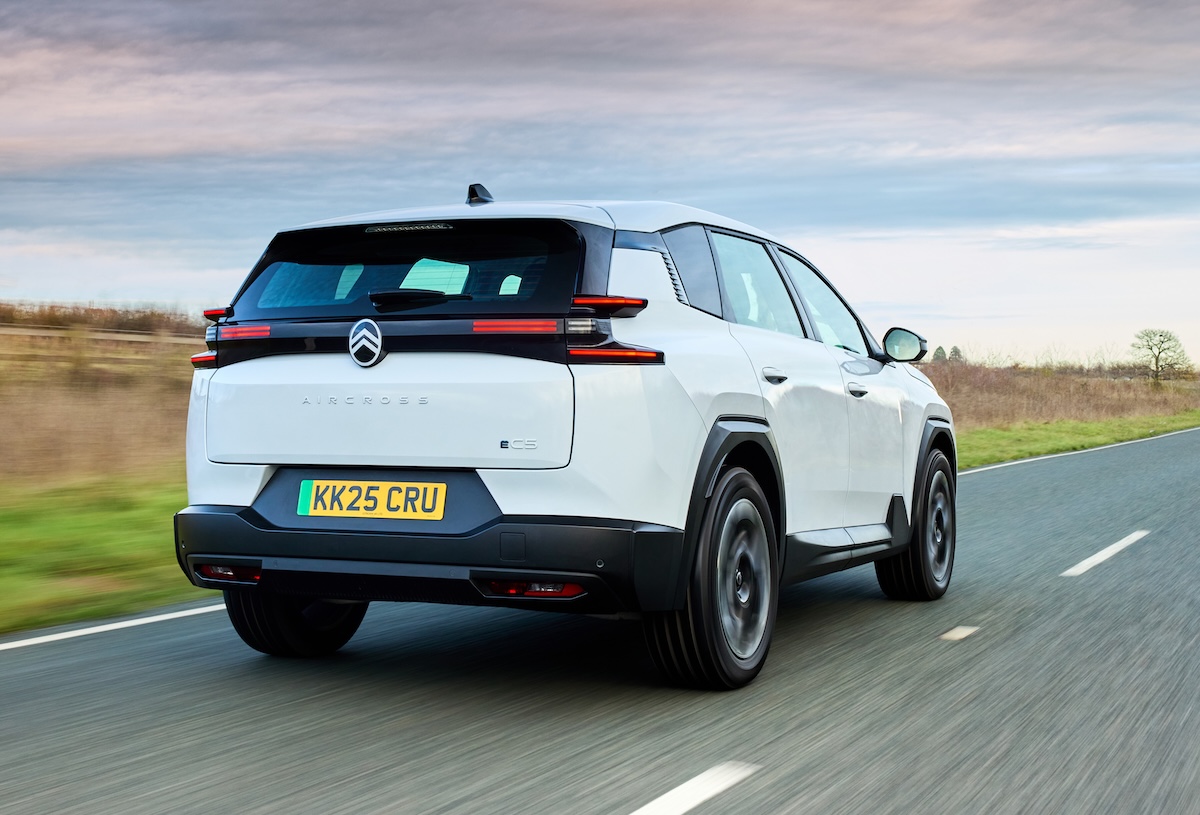
What’s it like to drive?
There’s a choice of two powertrains on offer in the e-C5 Aircross. The ‘Comfort Range’ model gets 73kWh of usable battery capacity, a 210bhp motor, and an official range of 320 miles (expect around 250, depending on the weather conditions, in the real world).
That should be more than enough for most people, but if you regularly do longer distances, the ‘Long Range’ model is worth looking at instead. This brings a 97kWh usable battery capacity, and with it, a 421-mile official range, which should result in a real-world range of 320-ish miles.
Interestingly, Citroen claims a peak charging rate of 160kW for both models, but the Comfort Range version actually charges up more slowly across the whole of its charging duration; a 10 to 80 per cent charge will take you 36 minutes, at an average rate of around 90kW.
By contrast, a 10 to 80 per cent charge in the Long Range model will take just 33 minutes, despite this model having a much bigger battery; this is reflected in the average charge rate, which is around 130kW.
You shouldn’t be disappointed by the C5 Aircross’s performance, as long as you aren’t looking for a car that can challenge a Tesla in a traffic-light duel. The Comfort Range will do 0-62mph in 8.9 seconds. The Long Range’s extra power only mitigates the added weight of the bigger battery, and so it hits 62mph just 0.1s faster.
This is not an EV that’ll tear your face off with its outright grunt, in other words, but there’s more than enough for most everyday situations, and you’ll have no problems keeping up with traffic. Oddly, there’s quite a bit of whine from the electric motors, but once you’ve got the radio on, you shouldn’t really notice this.
If you’re used to the old C5 Aircross, you might find yourself slightly disappointed by the way that the new one behaves on the road. It’s not that it isn’t comfortable any more, but Citroen has clearly tried to eliminate some of the soft, wallowy feel of the old car in favour of better resistance to body lean in bends.
This has worked, to a point, but it’s also resulted in an underlying woodenness to the suspension that means it isn’t as supple as before, and that’s particularly the case in the electric model, where the extra weight gives the springs and dampers more to do.
You can therefore hear and feel the wheels clumping through sharper bumps, and there’s quite a lot of lateral movement on more undulant surfaces; when only one side of the car dips into a divot on the road, the whole car follows stiffly. Multiply this effect along a road that’s covered with ruts, and soon you feel as though you’re being shaken from side to side.
And there are limited dividends to this change; while its new-found crispness does mean that the e-C5 Aircross feels more composed in bends, it doesn’t really turn it into a car you’ll relish driving. In fact, the overall effect is that this car now feels far more like the competition (of which there is a vast amount), and to an extent, it’s lost that wafty smoothness that used to be its USP.
Happily, most motorways don’t have the sort of wobbly surfaces that challenge the C5 Aircross, so at higher speeds, it feels far more settled; as a result, it’s an easy car to cover long distances in.
Technology, equipment & infotainment
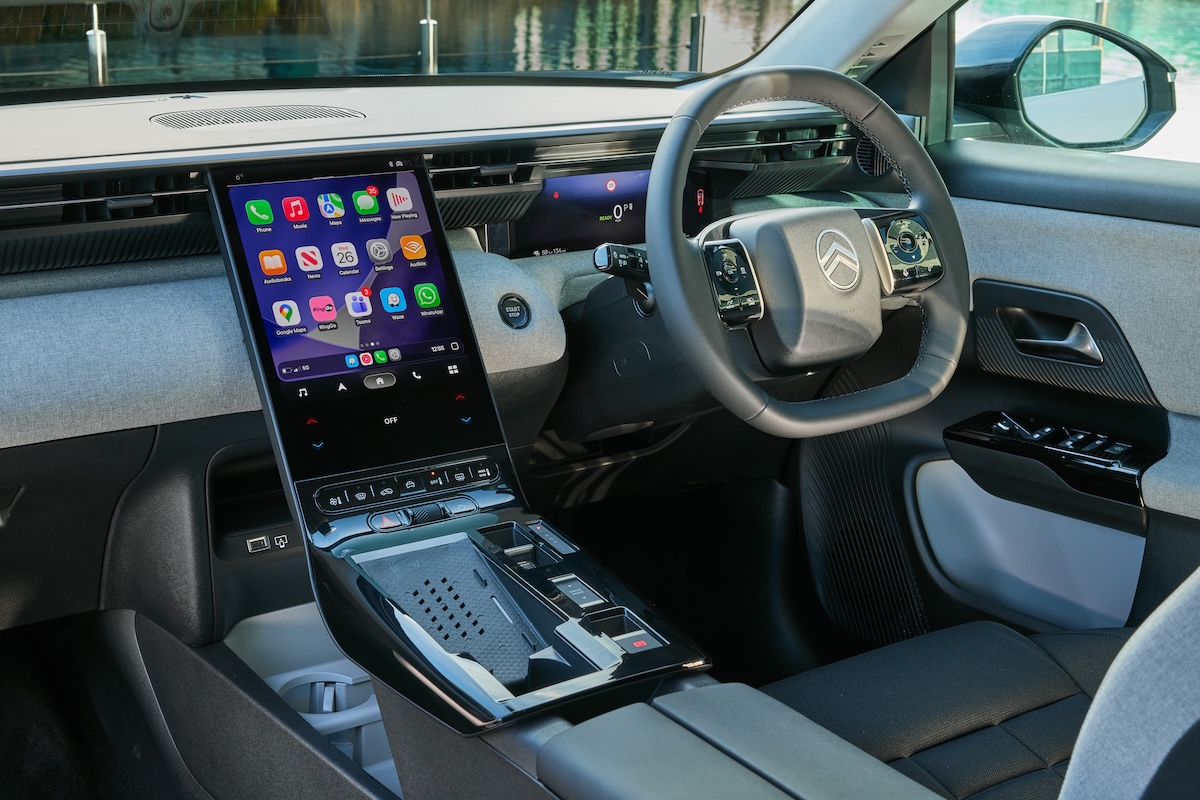
The first thing you’ll spot when you climb into the e-C5 Aircross is the vast slab of touchscreen that spans the gap between the centre console and the dashboard. It’s actually the largest touchscreen that the Stellantis group makes.
And Citroen has deployed the screen’s size intelligently, using the extra space to make the on-screen icons larger, rather than trying to cram in more functions. As a result, it’s much easier to access each function at a glance, and much less distracting on the move than some rivals’ similar systems: we’re looking at you, Volkswagen ID.4.
As a result, it isn’t such a big deal that there aren’t physical switches to adjust the climate control. Instead, you get an always-on section of the screen that features big, easy-to-hit icons, and these are pretty simple to use without having to look away from the road for too long.
Another, smaller screen ahead of the driver’s seat serves as the instrument binnacle, and you get a rather appealing on-screen backdrop here, of a blue sky during the day, and stars at night. It’s a gimmick, but one that adds to this car’s warm, welcoming feel.
Sadly, you won’t feel as warm in lower-spec models of the e-C5 Aircross, because these don’t come with a heat pump, a handy bit of kit which helps improve efficiency and minimize range drop-off in colder conditions. Most rivals now give you one of these as standard across the range, but Citroen only includes it on the top-spec Max model: otherwise you have to add it as an option at extra cost. Boo.
In the entry-level You! version, you do at least get dual-zone climate control, adaptive cruise control, rear parking sensors, and Citroen’s ‘advanced comfort’ seats, which use a layer of memory foam to add to their plushness.
Given its emphasis on comfort, though, it feels a little churlish that Citroen doesn’t include adjustable lumbar support unless you upgrade to the Plus version. This model also adds front parking sensors and a reversing camera, keyless entry, interior mood lighting, and reclining rear seats.
It’s only when you get to the top-spec Max that you get features like heated seats and a heated steering wheel, as well as that heat pump. You also get a 360-degree parking camera system, a powered boot lid, leather-effect seats, and a head-up display.
Citroen e-C5 Aircross running costs
Citroen is proud to point out that the e-C5 Aircross is eligible for the £1,500 Government plug-in car grant, which helps to make it even better value.
With the grant taken into account, prices start at just over £32,000, which is extraordinary value for a car that offers so much space, and such a good level of interior finish.
To put that in context, a Volkswagen ID.4 with a broadly equivalent range will set you back more than £36,000, even after the grant. And while there are some Chinese rivals that better the C5 Aircross on price, none of them offers as much space, or as high a level of finish.
If you charge your car at home, and your domestic electricity is billed at the UK’s national average rate, then a full charge of the 73kWh Comfort Range car will cost you around £20, while the 97kWh Long Range car will cost around £27 for a fill-up. However, get yourself on a variable home tariff that allows you to charge overnight on steeply discounted power, and you’ll cut those sums down to around a third. Conversely, if you use a DC public rapid charger, you can likely treble those figures, as the power that comes out of these is much more expensive.
We don’t have any information on the e-C5 Aircross’s energy efficiency yet, but the low asking prices mean that only the most expensive model qualifies for the higher rate of car tax. That’s something that can’t be said for most other EVs, and it means the e-C5 Aircross will continue to be affordable to run in years to come.
Servicing will need to be carried out every two years or 16,000 miles. That mileage interval is lower than most EVs’, which means if you’re a high-mileage user, you might find the e-C5 Aircross needs to be serviced more frequently than, say, a Hyundai Ioniq 5.
Citroen e-C5 Aircross reliability
Given it’s so new, there’s still very little information out there on whether this iteration of the e-C5 Aircross will be reliable or not. However, the brand’s reputation for reliability has been improving in recent years, as evidenced by its 10th-place score in last year’s What Car? Reliability Study.
This, allied to the fact Citroen now offers a service-activated warranty on cars that are up to eight years old, up to a maximum of 100,000 miles, suggests it’s been working hard to improve reliability of late.
It’s not all good news, though: the one potential cloud on the horizon is the fact that the Peugeot e-3008, which shares the same electric underpinnings as the e-C5 Aircross, came a lowly 65th out of the 76 family SUVs to be featured in What Car?’s survey.
- In case you needed proof that the e-C5 Aircross was conceived in France, just look at the doors; they’re partly made from by-products of wine-making. No, really; each e-C5 Aircross features 160kg of recycled materials, and that includes the interior door panels, of which 20 per cent are made from crushed-up grape vines. How quintessentially French is that?
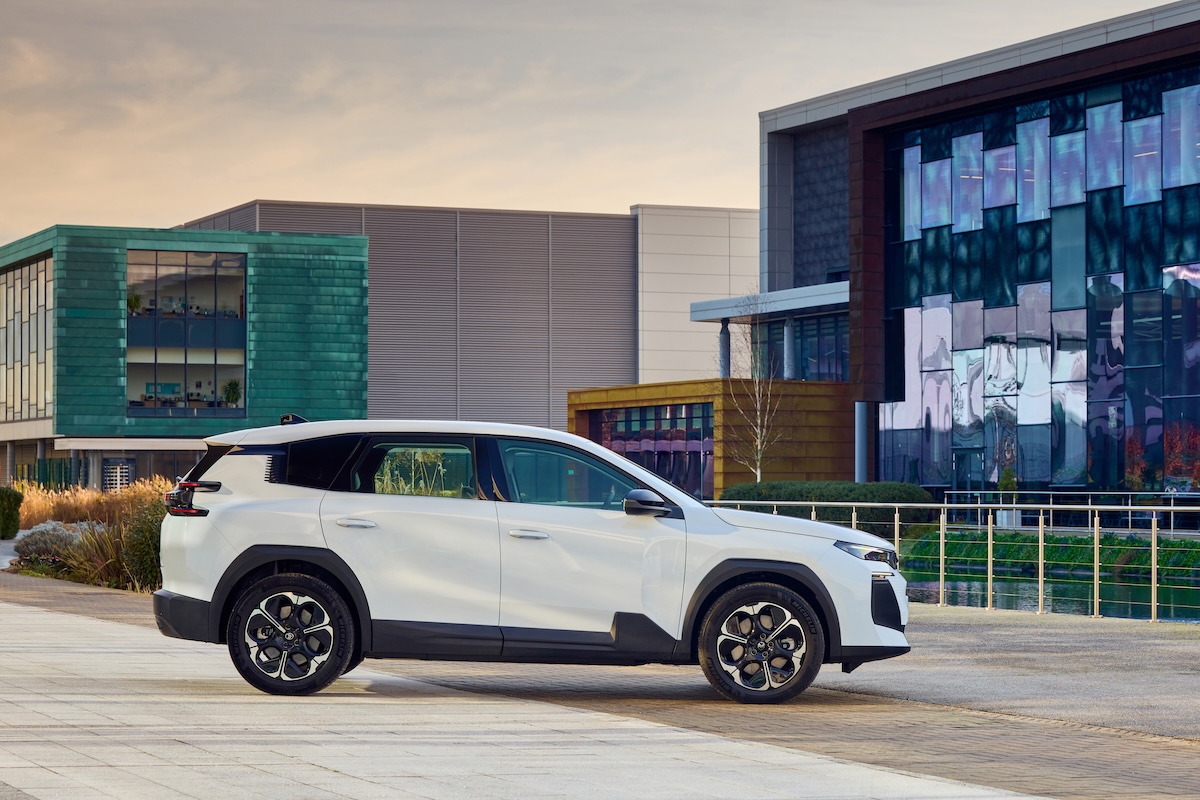
- Part of the reason the C5 Aircross ekes out such impressive range figures is that Citroen has worked hard on its aerodynamics. The tapering roof, and the air channels that run along the car’s sides (finishing in the bizarre rear lights) are reckoned to have added around 15 miles to the range.
- We’re reviewing the electric version of the C5 Aircross here, but if you don’t want to rely on electric power alone, you can also get this car with mild hybrid and plug-in hybrid petrol powertrains.
- If you want a lot of car for relatively little cash: choose the Comfort Range You!. You do miss out on certain nice-to-have toys, but really, you get everything you need – and the surprisingly affordable price means this is a cheap way into electric family motoring, with a range that won’t disappoint.
- If you want the best all-rounder: go for the Comfort Range Plus. This will get you a slightly lighter battery, ergo better energy efficiency, and it still comes with more than enough range for a day out with the family. It doesn’t boast some of the fancy toys of the top model, but there’s still easily enough here to feel comfortable.
- If you want those toys, though: choose the Comfort Range Max. By sticking with the smaller battery, you keep the cost down to reasonable levels despite adding the bells and whistles.
- If you regularly do longer journeys: go for the Long Range Plus. This gives you the bigger battery as well as faster charging speeds, so that you can top up slightly more quickly when you do run out of charge. Going for the Plus gives you that adjustable lumbar support, too, so it’ll be easier to get comfortable for those long stretches behind the wheel.
