Smart #3 Review (2025-present)
Smart #3 cars for sale
4.0
Expert review
Pros
Smart interior (no pun intended)
Good fun to drive
Decent value
Cons
Firm low-speed ride
Overly touchscreen-centric controls
Boot could be bigger
The CarGurus verdict
If you’re a pragmatic type looking for sensible, wholesome family transport, the Smart #3 is probably not for you. Its small boot means it isn’t best suited to carrying huge amounts of stuff, while up front, the fact that Smart’s eschewed all but a few buttons means the #3 isn’t the easiest thing in the world to get used to.
However, if you’re willing to sacrifice a bit of pragmatism in favour of style and fun, the #3 makes a lot of sense. It’s roomy enough to carry kids – and even adults – in the rear seats in comfort, and when you’re on your own and taking the long way home, you’ll even find it capable of putting a smile on your face. If you’re one of its target audience, you might even say it’s got rizz, and frankly, that’s all you’ll need to know.

What is the Smart #3?
So you’re hitting mid-life, you’ve got a little one at home and another on the way, and you need a family car. Inside, however, you still feel 18. You care about your aesthetic, and you want a bussin’ new car that matches your vibe. And crucially, you actually understand what all of that means.
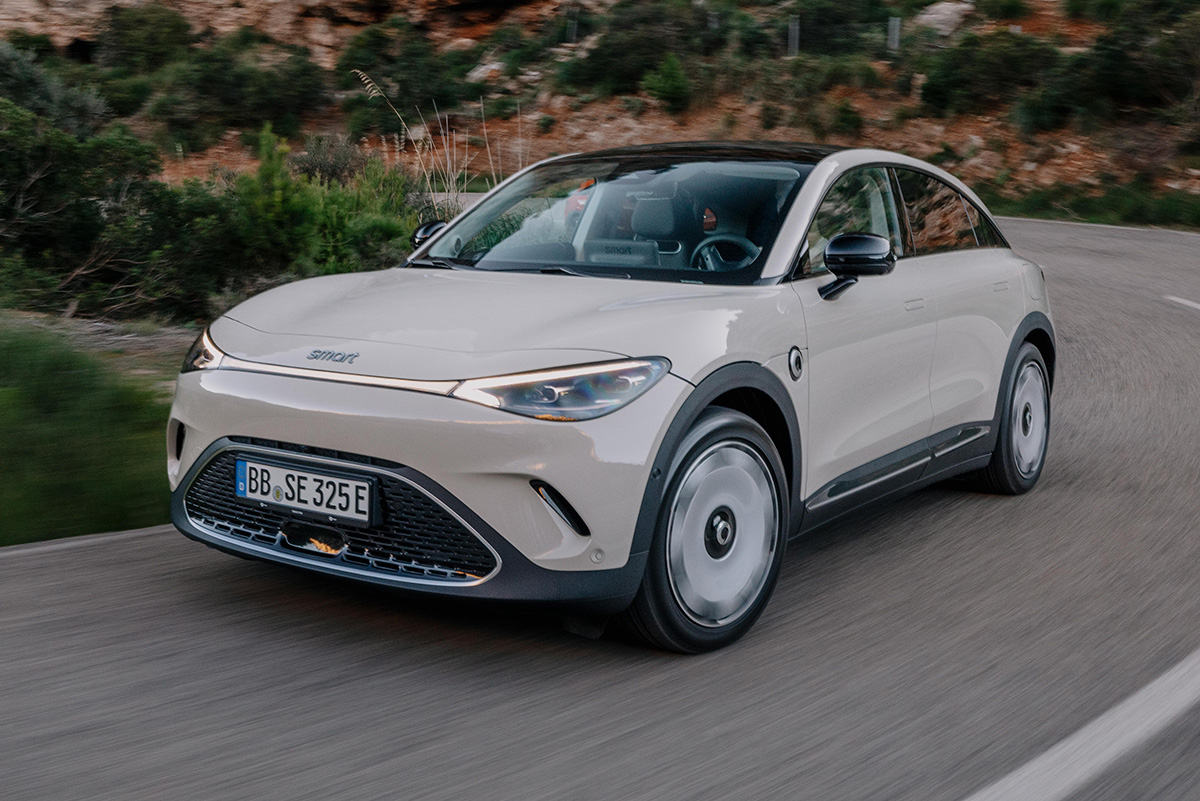
Smart gets it. And it’s brought out the #3 just for you. It knows a common-or-garden hatchback won’t cut it, so the #3 is a relatively compact electric SUV with coupe overtones, intended to offer a more family-friendly automotive alternative to the even smaller Smart #1 while retaining that car’s urban fashionista vibe.
This is the biggest car that Smart - a name more usually associated city cars - has ever made. That’s because the brand is now a joint venture between Mercedes-Benz and Chinese car maker Geely, the latter of which owns Volvo, and that’s why the #3 is a crossover, based on the same platform as the Volvo EX30.
It also goes up against fashion-conscious rivals like the MINI Countryman Electric and BYD Atto 3, as well as more pragmatic offerings like the Renault Scenic, Kia EV3, Skoda Elroq and Hyundai Kona Electric. Smart will also be hoping it can scoop up customers who might otherwise have chosen a Volkswagen ID.3 or Cupra Born, which is one reason the #3 is priced fairly aggressively.
But to succeed, it’ll have to blend style and function into an all-round package that appeals to the head as well as the heart.

How practical is it?
You might expect the #3 to be pretty cramped inside given its swooping roofline and emphasis on aesthetic appeal. In fact, that couldn’t be further from the truth.
Up front, the high centre console makes you feel quite enclosed, but not in a bad way, and in fact, there’s plenty of room for your legs and elbows. What’s more, that console houses more cubbies for stowage of knick-knacks than you’ll know what to do with.
In the back, meanwhile, there’s what feels like half an acre of leg room. What’s even more surprising is that there’s plenty of head room, too, in spite of that heavily raked roof line. And because of the seat height, it isn’t even tricky to buckle kids in. You really get the sense that despite the #3’s fashion-consciousness, Smart’s engineers have really thought about making it child-friendly.
That thought holds until you get to the boot. At 370 litres (plus a 15-litre cubby under the bonnet), there’s enough boot space for a few bags, but you get a lot more space even in the (smaller) Hyundai Kona Electric. The Renault Scenic, which is a similar length, gives you a whopping 545 litres, meanwhile. And where have the neat sliding seats you’ll find in the Smart #1 gone? Their omission here feels like something of an oversight.

What’s it like to drive?
You get a choice of two batteries and two powertrain setups in the #3. Most models come with a 66kWh battery, the exception being the entry-level Pro model, with a 49kWh battery.
All models but one get a single motor rated at 268bhp and driving the rear wheels; the exception is the hot Brabus version, which adds another, 154bhp electric motor on the front wheels (making it a dual-motor four-wheel drive), for a not-inconsiderable total maximum power output of 422bhp.
Mind you, even the rear-wheel drive #3 is pretty quick, with a 0-62mph time of just 5.8 seconds. Upgrade to the Smart #3 Brabus, and that drops to a faintly shocking 3.7 seconds; all versions top out at 112mph.
Official maximum range figures vary, therefore, depending on which model you choose, from a minimum of 202 miles in the Pro, to a maximum of 283 miles in the Premium (or between 150 and 230 miles in the real world). Oh, and it’s worth noting that the lack of a heat pump in the Pro+ means it gets only a 270-mile range, despite having the same battery as the Premium.
Charging speeds are pretty respectable, at 150kW for the majority of the range, or 130kW for the Pro; you can therefore expect a 10 to 80 per cent charge on a DC charger that matches those speeds to take 32 minutes (gaining you around 112 miles) in the Pro, and 25 minutes (gaining you around 154 miles) in every other model.
Our first impressions of the #3 are marred by the way it rides at low speeds. Every version is fitted with whopping 19-inch wheels (except the Brabus, which gets 20-inch rims), and these result in a jarring, slightly wooden quality to the way the #3 deals with bumps.
Fortunately, this trait dissipates with speed, and once you’re up to 40mph or above, the #3’s suspension keeps up with churned-up road surfaces much better. At motorway speeds, it’s actually respectably composed, with only a spot of road noise from the big tyres causing any disturbance.
The suspension’s stiffness pays dividends on a twisty road, too, which is what you’d expect, given that this car is all about having fun. There’s a tonne of grip on offer, and despite the #3’s not-inconsiderable weight, the body doesn’t lean over all that much.
The steering is sharp and direct, too, and the nose turns in eagerly, lending the whole car a sense of agility you just don’t normally get with most EVs of this size. And with so much power on offer, delivered through the rear wheels, it’s immensely satisfying to feed in the throttle on the exit of a bend, and feel the #3 tighten its line and fire you off down the next straight.
The brakes are good, too, blending friction- and regenerative braking well, and giving you confidence to press on a bit, knowing you’ll easily be able to scrub the speed off again when you get to the next bend.
This is not the most comfortable car of its type and size, then, but it’s undoubtedly one of the most amusing to drive.

Technology, equipment & infotainment
Despite being the entry-level version of the Smart #3, the Pro gets a fairly generous equipment list, which includes automatic climate control, a 360-degree parking camera, a powered tailgate, a choice of three driving modes, Apple CarPlay, Android Auto, and a panoramic roof.
Most buyers will upgrade to the Pro+, which gets you heated- and electronically adjustable front seats, faux leather upholstery, a wireless phone charger, and adaptive cruise control.
The Premium version is the most luxurious in the line-up, and adds a Beats sound system, a head-up display, an automatic parking system, and ambient lighting.
As you might expect, however, the Brabus model, with its performance bent, gets the most generous equipment list, with ventilated suede seats, red brake calipers, and a sportier bodykit to match that extra power.
On the face of it, the #3’s touchscreen infotainment system is one of its finest features: it’s huge, crisp, and responsive, with a graphical user interface that’s relatively easy to understand from behind the steering wheel.
But the big problem is not so much the touchscreen itself, but just how much it’s been forced to control. Smart’s minimalist interior design ethos has resulted in its designers incorporating as few buttons as possible, and that means a great many functions have been buried in menus in the touchscreen.
That even includes driving controls you might consider crucial: for example, turning on the headlights. Of course, climate control options are to be found in their own menu, too, as are simple functions like adjusting the door mirrors.
And because there are so many functions controlled by the touchscreen, that means many menus with lots of different options, which can make finding your way around quite a chore.
The problem with this is that doing so on the move can be hugely distracting. For example, when you hit a patch of fog and want to turn on your rear fog light, you must dive into the touchscreen to do it, rather than keep your attention focused on the road ahead, where it should be in such hazardous conditions.
Smart has tried to make up for this with a sense of fun, by adding an animated cheetah on the home screen that reacts when you prod it. All very cute, but also rather distracting in and of itself. Frankly, less of this gimmickry and a few more buttons for major functions would have been a far more sensible way of doing things.

Smart #3 running costs
Given its high-fashion ethos, you might be surprised to discover that the #3 is actually rather decent value, especially when you take into account how much standard equipment you get. Prices start at just shy of £34,000, while the fully-loaded Premium model costs just over £40,000.
By comparison, the Hyundai Kona Electric starts at £35,000, while the Renault Scenic starts at closer to £37,000. For a car of its size, and equipped with the features you’re getting, then, the #3’s pricing looks pretty reasonable.
The car is reasonably efficient, too; not quite as frugal as the best, but better than the worst, its WLTP average of 3.8 miles per kilowatt hour (mi/kWh) places it somewhere in the middle of the class. And, as with many EVs, the #3 only needs servicing every two years or 20,000 miles.
One real bonus is that every new Smart comes with the brand’s Integrated Service Package, which means maintenance and wear-and-tear repairs are covered for three years or 30,000 miles, whichever comes up sooner. That should mean your first service is free of charge.
And because prices are low, only the most costly Smarts will incur the top rate of VED. Meanwhile, company car drivers will be pleased, because low list prices mean low P11D values, which in turn means there’s less company car tax to worry about.

Smart #3 reliability
We’d love to give you an idea about whether a Smart #3 is a dependable choice, but unfortunately, there’s very little data available to suggest whether it will or won’t be.
Not only is the #3 relatively new to the market, which means there’s barely any data on it, but Smart is too small a manufacturer to feature in most reliability surveys, too. The exception is MotorEasy’s Reliability Index, which places Smart in a very respectable seventh place out of the 45 manufacturers included.
A word of caution, though: this score is worked out using historic warranty claims, which means it’ll be based largely on the reliability of Smart’s older models like the ForTwo, and these are largely unrelated to its newer EVs.
- The idea of a Smart car towing a caravan might sound daft, but in fact the #3 has a highly credible maximum towing weight of 1,600kg. That’s enough to haul a small- to medium-sized caravan.
- The #3 is a particularly safe choice in its class. Euro NCAP awarded it the maximum five stars, with scores for adult occupant and child occupant protection of 90% and 85%, respectively. Safety assist and vulnerable road user scores were similarly respectable.
- A heat pump is a really useful feature to have in an EV in the UK, because it helps minimise the deleterious effect of cold weather on your range during the winter. Unfortunately, only the Premium version comes with one as standard, meaning you’ll experience far greater range drop-off during the winter in the other versions.
- If you want the best all-rounder: go for the Premium. You get the most range and strong performance, and that heat pump as standard.
- If you’re on a budget: the Pro is the most affordable version, but for the increase in range and charging speed it gives you, we’d be tempted to see if you couldn’t stretch to the Pro+.
- If you’re a speed demon: the Brabus version offers performance that could scare some supercars. Just keep in mind the ride quality is even firmer.
- If you want a colourful Smart: go for the Premium model. It’s available in a huge range of hues, with orange, blue, yellow, a retro beige, and a pastel green all on the table. And you can even choose a contrasting roof for that two-tone look.


