The BMW M4 was introduced as a brand-new nameplate in 2014, but it’s a model that has plenty of history to it. In fact, its bloodline runs all the way back to the first BMW M3 of 1986, with the M4 badge only coming into existence due to BMW’s decision to rename the 3 Series coupe and convertible as the 4 Series from the sixth generation models onwards. The M3 continues as a saloon and Touring estate model and, bodywork apart, shares most components with the M4.
Introduced a year or so after the standard 4 Series models, the first-generation BMW M4 got the familiar M Division treatment. That means a bespoke – and wildly powerful – engine and major bodywork and chassis changes. Power comes from a twin-turbo six-cylinder engine, a big change over the naturally-aspirated V8 in the previous M3. In other respects, it was evolution rather than revolution, with rear-wheel drive and the choice of a six-speed manual gearbox or a seven-speed M-DCT dual-clutch transmission. A wealth of new features added a high-tech flavour, but at heart the M4 is made using the same recipe as every other BMW M car, giving you sensational performance and handling while retaining most of the everyday practicality of the standard model it’s based on. As with its predecessors, some even faster and more hardcore versions were added during the car’s life cycle, for those looking for extra thrills on the road or racetrack.
BMW, in the UK at least, mixed things up a bit for the second-generation BMW M4 that came along in 2021. While a standard model is sold in other foreign markets, we only get the higher-powered Competition model with an automatic transmission as standard. The other departure was the introduction of four-wheel drive for the first time, available as an option soon after launch. The elevated model lineup and wealth of standard features pushes the price of the M4 when new up to a new level, with £100k+ a reality for the later, racier versions, or a standard car with a few choice options.
Here’s our guide to the history of the BMW M4, covering which models are available, how it’s changed over time, and what to look out for if you’re in the market for one.
BMW M4 Generations
Frequently Asked Questions
Which BMW M4 years are the best?
If you can live with its uncompromising looks, and you can afford it, the post-2021 BMW M4 is the pick of the two generations of car available. It’s faster, better to drive and has all the high-tech features you’d expect of a contemporary BMW.
Which BMW M4 years are the worst?
There are no ‘worst’ years as such for either the first- or second-generation BMW M4, since both have a solid record for reliability. As with many models, however, improvements made over each version’s life cycle mean that the earliest examples of each are more likely to have niggles that were fixed in later years.
Is a used BMW M4 a good deal?
The BMW M4 is a great deal if you can afford it since it’s one of the best cars of its type, and it should be a solid long-term investment. While there are cars that offer a similar blend of excitement and everyday practicality, few are as convincing overall as the M4.
BMW M4 Pros and Cons
Pros:
- Rewarding to drive and extremely fast
- Combines four-seat practicality with supercar pace
- All versions are well-equipped
Cons:
- Some versions are very expensive
- Second-generation model has divisive looks
- High ownership costs
BMW M4 mk2 (2021-present)
Bodystyles:
- Two-door coupe
- Two-door convertible
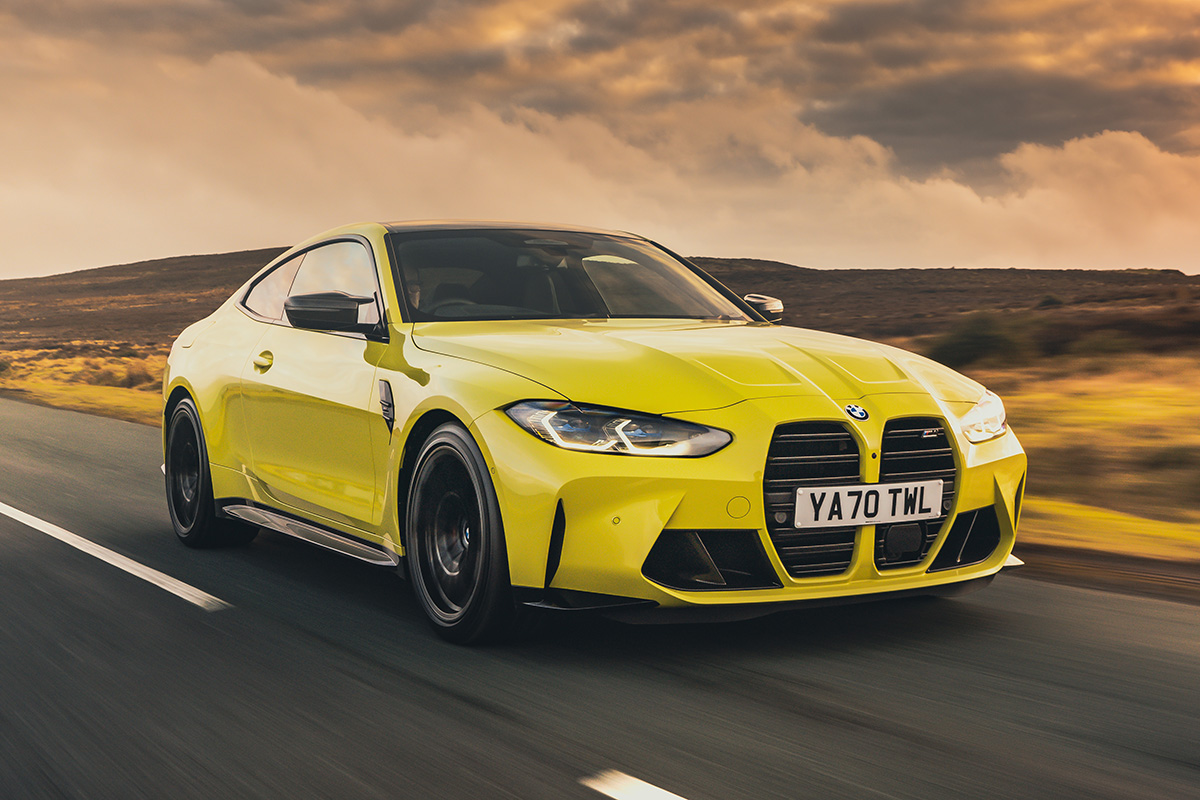
As with the 4 Series it’s based on, any discussion about the BMW M4 will at some point cover, or even start with, a debate about its exterior design. And that huge, vertical front grille. If anything, the M4’s is even more strident than the regular 4 Series’, with its angular outline and horizontal slats, although arguably it suits the car’s brutish character. Make no mistake, this is a car with savage performance, yet it’s also comfortable, well-equipped and perfectly civilized everyday transport. Gaping grille apart, the second-generation M4 gets the traditional M division makeover, with wider bodywork, extra air vents, bespoke alloy wheels and a range of motorsport-inspired details. As with the first M4, there’s an exposed carbon fibre-reinforced-plastic (CFRP) roof, while an optional ‘M carbon exterior package’ adds extra CFRP inlays for the front air intakes, door mirrors, rear diffuser and spoiler.
As with the first-gen car, power comes from a 3.0-litre, six-cylinder engine with two turbos and there’s a choice of two-door coupe or convertible body styles. While other foreign markets get a ‘standard’ M4 with 467bhp, only the M4 Competition version is sold in the UK. That means a power output of 503bhp and 479lb ft of torque. It also means there’s no manual version, with a conventional eight-speed automatic the only transmission available. In addition to the standard rear-wheel drive layout, four-wheel drive – badged M xDrive – became available a few months after the car was introduced. BMW’s Adaptive M Suspension is standard. The interior is a step up over the previous car’s, with a luxurious feel and high-tech look. Standard equipment is lavish, and includes LED headlights, front- and rear parking sensors, a rear-view camera, head-up display, three-zone climate control, leather upholstery and electric front seat adjustment.
A limited-edition M4 CSL (there were just 100 for the UK) was introduced in 2022. It featured a boost in power to 543bhp, chassis upgrades and a 100kg weight reduction, thanks to the use of even more lightweight components and the removal of its rear seats. In 2023, the dashboard was updated to incorporate the ‘BMW Curved Display’, which replaces the two separate digital screens with what looks like one large display (actually a 12.3-inch driver display and a 14.9-inch centre display) that stretches across two-thirds of the dashboard. The M4 got its mid-life update in early 2024. Changes include new headlight lenses, new alloy wheel and steering wheel designs and, last but not least, a 20bhp power boost, taking the output up to 523bhp. The M4 CS, a racier edition with 542bhp and a sportier look and feel than the M4 Competition, was introduced in autumn 2024.
So far, the second-generation BMW M4 has a good reputation for reliability, with little in the way of major or minor issues raised. BMW as a brand has performed well in recent years, so the omens are good.
Search for a BMW M4 on CarGurus
BMW M4 mk1 (2014-2020)
Bodystyles:
- Two-door coupe
- Two-door convertible
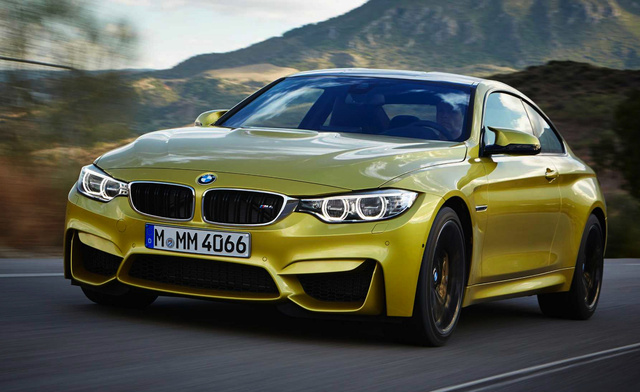
New nameplate apart, the first-generation BMW M4 was created using a familiar formula. Introduced in 2014 as the high-performance version of the 4 Series, it got the thorough re-working that BMW M models have been treated to since the early noughties. On the outside, the basic shape, lights, door handles and windows are shared with the 4 Series, but the M4 looks like it’s been on a course of steroids, with flared front- and rear wings, aggressive bumpers, a rear spoiler and a ‘powerdome’ on the bonnet. There are bespoke alloy wheels, naturally, along with characteristic ‘twinstalk’ door mirrors and, for coupe versions, a visible carbon fibre roof. Convertible models have the same folding metal roof as the 4 Series Convertible.
Prodigious performance is supplied by a 3.0-litre six-cylinder engine with two turbochargers. Power output is 425bhp, an 11bhp hike over the previous V8-engined M3, yet those two turbos help to give 406lb ft of torque, a 40% increase. Official figures suggest a 25% improvement in fuel economy and emissions, but this is still an expensive car to run. Rear-wheel drive and a six-speed manual gearbox are standard, with a seven-speed dual-clutch automatic labelled ‘M DCT’ as an option.
Lightweight suspension components and body parts help to keep weight to a minimum, and a number of motorsport-derived features help to keep the power under control. One is an ‘Active M Differential’, an electronically controlled limited-slip differential that maximises traction through corners. Early models also had a carbon fibre driveshaft, but this was replaced in later versions by a smaller steel version to make way for a petrol particulate filter. Beefy ‘M compound’ brakes are standard, but lighter (gold-coloured) carbon ceramic brakes were an option. Adaptive M Suspension, which gives the choice of Comfort, Sport and Sport+ driving modes, is standard. It all adds up to the kind of engaging driving experience that BMW M models are famous for, although earlier versions could be rather nerve-wracking to drive fast on wet or bumpy roads: improvements over the years gave later versions a more controlled feel.
The interior is essentially an upgraded version of the one you’ll find in lesser 4 Series models. That’s a good place to start, and there's enough in the way of bespoke features to justify the M4’s significant price hike. These include supportive sports seats, and an M-specific driver display, gear lever, trim inserts and steering wheel design. This is no stripped-out racer, either: standard equipment is comprehensive and includes heated- and electrically adjustable front seats, front- and rear parking sensors, leather upholstery, metallic paint, sat nav and xenon headlights.
In 2016, BMW added the Competition Package as an option. This gives the M4 an even sportier look and feel, with power boosted to 433bhp, Shadow Line (high-gloss black) exterior trim, 20-inch alloy wheels and uprated springs, dampers and anti-roll bars. The limited-edition M4 GTS of 2016 has 493bhp, just two seats and a range of track-focused chassis and cosmetic tweaks: just 30 were available in the UK, priced at more than £120,000. The BMW M4 CS – on sale new between 2017 and 2019 – has 454bhp. It’s pretty hardcore, albeit dialled back a step or two from the GTS. The snappily-named M4 Edition ///M Heritage Coupe of 2019 was another limited-edition model, with all the features of the Competition Package Coupe, plus bespoke 20-inch alloy wheels and special interior and exterior trim details inspired by BMW’s motorsport heritage.
The first-generation BMW M4 has a generally good reliability record. As with any high-performance car, though, it’s likely to have been driven hard and may have seen track use, so if you’re buying a used example, look out for any aftermarket modifications and check that the brakes, suspension and steering behave as they should on a test drive.
BMW M4 Mk1 Review
Search for a BMW M4 on CarGurus
Related Topics: