After a 14-year absence, however, the Toyota Camry returned to the UK in eighth-generation form in 2019 as a sort-of-replacement for the discontinued Avensis. It was an unusual fit for the UK market, being a large, non-premium saloon available only with hybrid power. Sales weren’t great (again) and it was dropped from the UK lineup in 2021.
Our guide to the Toyota Camry covers the six model generations that were sold in the UK, with the lowdown on which Toyota Camry models were available and which are the best and worst versions to buy.
Frequently Asked Questions
Which Toyota Camry years are the best?
The 2019-2021 Toyota Camry is a very different car to the previous models sold in the UK and, by any criteria, the best yet. The older versions are impressively reliable and well-built, but even the youngest of those are now more than twenty years old.
Which Toyota Camry years are the worst?
In all its generations, the Toyota Camry has a reputation for being one of the most dependable and robust cars around. For UK cars, there’s no worst year as such, since all the pre-2004 models are of an age where their maintenance history is more important than any inherent reliability.
Is a used Toyota Camry a good deal?
The Toyota Camry can be a good deal if you’re looking for a roomy, comfortable car that’s likely to be very dependable, but the post-2019 model is a bit out of step with UK tastes, and the pre-2004 versions are getting on in years.
Toyota Camry Pros and Cons
Pros:
- Roomy and comfortable
- Great reliability record
- Later hybrid model is fuel-efficient
Cons:
- Bland looks inside and out
- Not much fun to drive
- Very limited choice as a used car
Toyota Camry Generations
8th Generation (2019-2021)
Body Styles:
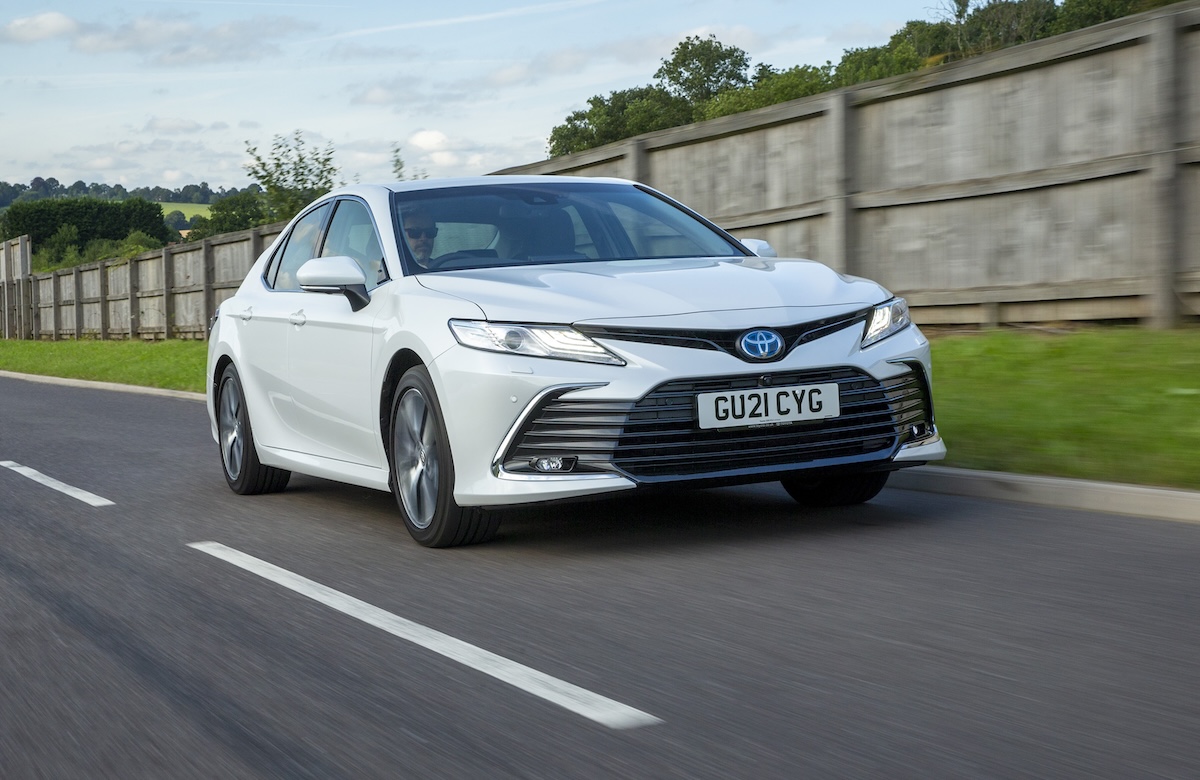
After a 15-year absence, the Toyota Camry returned to the UK market in 2019. Now in its eighth generation, the Toyota Camry had evolved subtly over the intervening years. It continued to be a huge seller in the US, where its blend of (generally) rock-solid dependability, generous interior space and ease of ownership proved ever-popular. While it might have looked at home in the US, the 2019 Camry didn’t exactly have style on its side, with a generic exterior and interior design that wasn't in tune with UK tastes. The ‘fastback’ roofline suggests five-door practicality but it’s actually a four-door saloon. The load space is massive, but the boot opening is oddly small. Overall, however, you get a lot of car for the money.
Priced on a par with the BMW 3 Series when new, the Camry is actually closer in size to the BMW 5 Series of the time. The real USP, though, is that this Camry is available only with a hybrid powertrain. A 2.5-litre petrol engine is combined with an 88kW electric motor (and a CVT transmission) for a total output of 215bhp. Combined fuel economy of more than 50 mpg and CO2 emissions of 98-101 g/km are creditable for such a big car.
Toyota threw the lot at the Camry in terms of equipment, too. While the trim levels for the Camry hybrid in the USA were Camry LE, Camry SE and Camry XLE (that market also got non-hybrid Camry models that were badged L, LE, XLE, SE, XSE, TRD and Nightshade), over here, the trim levels available were Design and Excel. Entry-level Design trim includes front- and rear parking sensors, a reversing camera, dual-zone automatic climate control, electric adjustment for the driver’s seat and front passenger seat, heated front seats, touchscreen infotainment with sat nav, voice control and MirrorLink smartphone compatibility (through Apple CarPlay and Android Auto), a rear-seat power outlet, leather upholstery and LED headlights and taillights. Excel trim adds features such as a power-adjustable steering wheel, larger alloy wheels, a wireless phone charger, rear cross traffic alert and blind spot monitoring. All models have headlight with automatic high beams, adaptive cruise control, automatic braking function with pedestrian detection, and a lane departure warning system, a suite of safety features known as Toyota Safety Sense. While it ticked plenty of boxes, the eighth-generation Toyota Camry Hybrid was an odd fit for the UK market and sales figures were low. It was discontinued here in late 2021, so if you’re hoping to stroll into your local Toyota dealer and buy yourself a brand new 2025 Camry, you’ll be disappointed.
So few eighth-generation Camry models were sold in the UK that there's no robust reliability data available. A vast number have been sold in the US and, as with its predecessors, it’s proving to be very durable. Toyota as a brand has an admirable reliability record, finishing near the top of most independent reliability surveys in the UK.
5th Generation (2002-2004)

Body Styles:
The fifth-generation Toyota Camry continues the themes developed by the previous four models. It’s spacious, comfortable and extremely well-built, but also rather dull. What sets this version apart is its Lexus-on-a-budget character. Inside and out, there’s more than a hint of Toyota’s premium brand in the way the fifth-gen Camry looks and, as ever, it has the build quality to match.
A new 2.4-litre four-cylinder petrol engine is the entry-level option. It has 150bhp and, according to the official figures of the time, gives an average of 32.8mpg with the standard five-speed manual gearbox, or 29.1mpg with its optional four-speed automatic. The alternative is an auto-only 3.0-litre V6 that gives an average of 25.7mpg. Entry-level GLS trim is reserved for 2.2 models and it’s far from basic, including climate control, electric door mirrors, electric front seat adjustment, a CD player and automatic headlights and wipers. High-spec CDX trim (standard for the V6) includes a six-disc CD changer (how very noughties!) and leather upholstery.
Despite offering a lot for the money, the Camry was more expensive than family cars such as the Ford Mondeo, and didn’t offer the diesel engines or hatchback practicality that buyers of the time wanted. As with previous models, the fifth-generation Camry never really clicked with UK buyers, and in 2004, Toyota stopped selling it in the UK.
The Toyota Camry of this era is as solid as you’d expect, but a good maintenance record is important to finding one in decent health. Excessive oil consumption can be a problem but, since it’s such a rare car, your biggest headache could be finding spare parts if anything goes wrong.
4th Generation (1996-2002)
Body Styles:
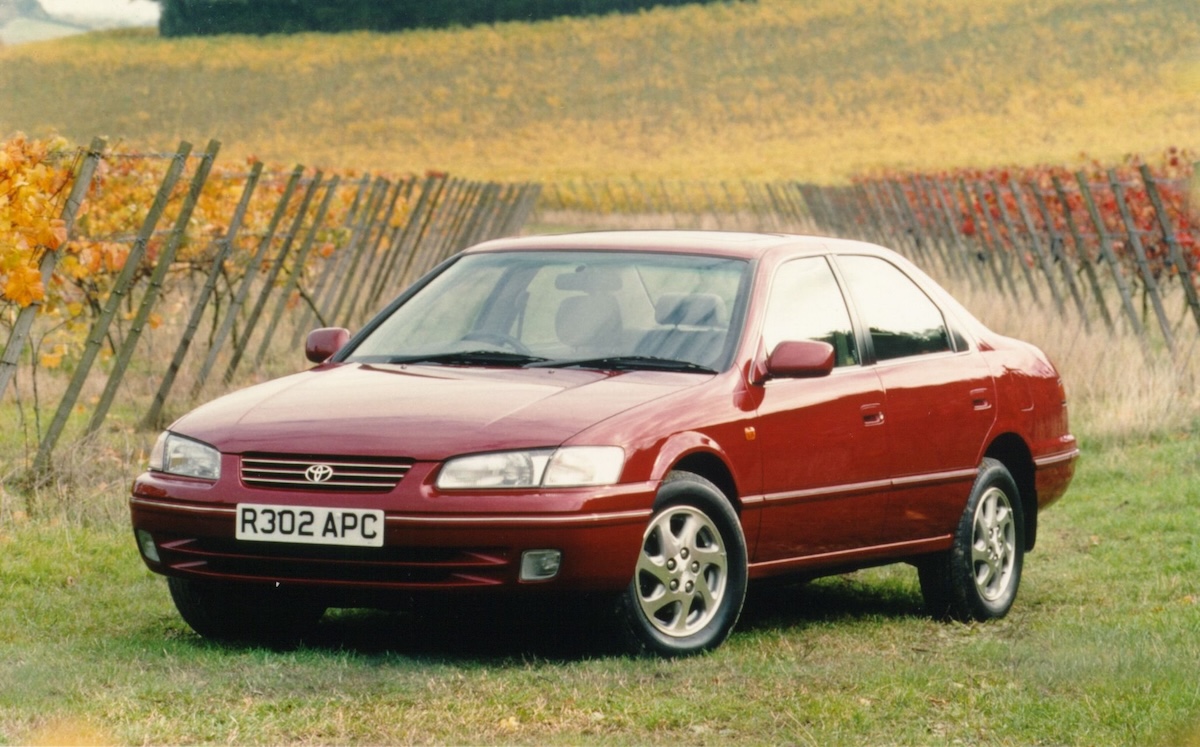
Toyota changed tack slightly for the fourth-generation Toyota Camry that was introduced in 1996. While build quality and comfort remained key attributes, style and value were pushed to the fore. On the outside, it had sharper looks, albeit by Camry standards. In fact, Toyota’s press blurb for the car said it was ‘designed to have a sportier look, to appeal to younger (but not young) buyers’. Quite. The pricing was competitive compared with rival large saloons, and the Camry was more spacious than ever, with a 50mm longer wheelbase than the previous model. From here on in, though, there was no estate version.
The engine line-up is familiar from the third-generation Camry, with a choice of a four-cylinder 2.2 or a 3.0-litre V6 petrol. A five-speed manual gearbox was standard for the 2.2, with a four-speed automatic standard for the V6 or optional for the 2.2. In keeping with the Camry’s more ‘youthful’ demeanour, a new Sport model – with lowered suspension, an exterior bodykit and Connolly leather interior – joined the range. It was initially available with the V6 engine, and 18 months later, with the 2.2.
A high standard of equipment justified Toyota’s claims that the fourth-gen Camry was excellent value for money. Standard kit for 2.2 models includes two front airbags, ABS, remote central locking, four electric windows, electric door mirrors, climate control and an electric sunroof. Extra standard features for V6 models include alloy wheels, leather trim, cruise control, headlamp washers and electric front seat adjustment. An update in 1999 brought a new look for the front bumper, grille and headlights, along with minor equipment upgrades.
As with most Camry models, the fourth-generation car has a reputation for being long-lasting, but any example will now be more than twenty years old, so its condition and reliability will largely depend on how well it’s been cared for over the years. Excessive oil consumption can be an issue and, as with any car of this age, worn steering and suspension parts are almost inevitable.
3rd Generation (1991-1996)
Body Styles:
- Four-door saloon
- Five-door estate
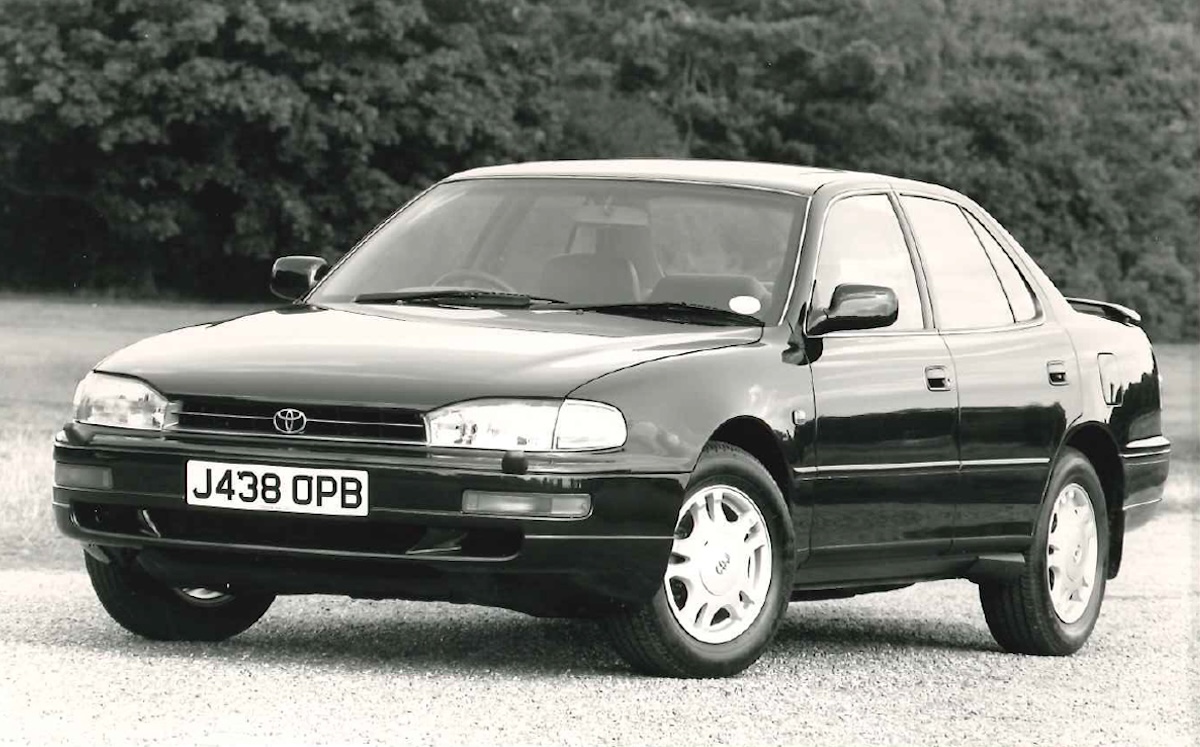
The third-generation Toyota Camry went on sale late in the 1991 model year. It’s significantly larger than its predecessor, gaining 29cm in length and 7cm in width to make it larger than the BMW 5 Series of the time.
Available as a saloon or estate, the development of the third-generation Camry was partly influenced by Toyota’s new Lexus luxury brand, with a greater focus on comfort and quality than ever. Two petrol engines were available: a 2.2-litre four-cylinder engine with 134bhp and a 3.0-litre V6 with 185bhp. While the 2.2 could be ordered with a five-speed manual or four-speed automatic gearbox, the 3.0 powertrain is auto-only.
High equipment levels (for the time) helped to position it as a lower-cost alternative to executive saloons. Standard features for the 2.2 GL included ABS, electric door mirrors, an electric sunroof, a leather-trimmed steering wheel and central locking. Additional features for the top-spec V6 GX model included headlamp washers, a rear spoiler, leather upholstery, air conditioning and cruise control.
Although the third-generation Camry has a reputation for being as tough as old boots, any examples that are still on the road are likely to be showing at least a few signs of wear and tear. Fundamentally, it’s a very well-engineered car, but at this age, an individual car’s service and maintenance history are likely to play the major part in how reliable it is.
2nd Generation (1986-1991)
Body Styles:
- Four-door saloon
- Five-door estate
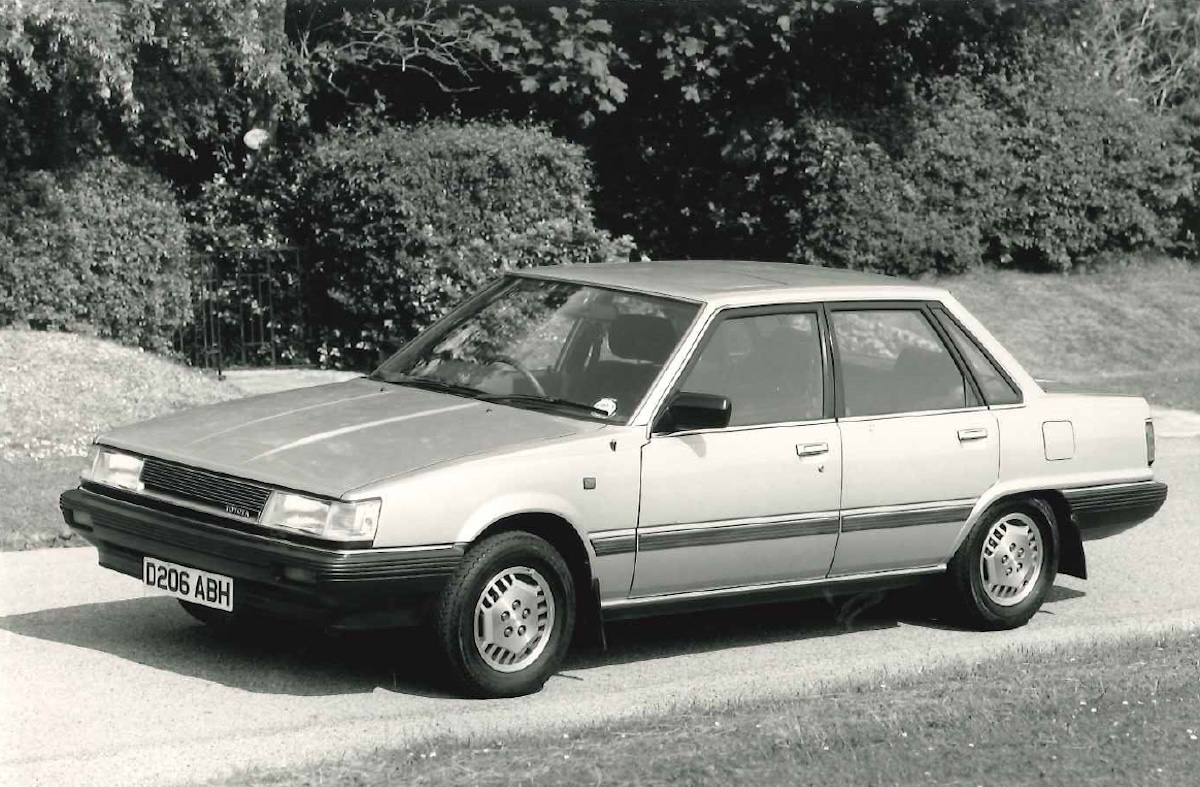
The second-generation Toyota Camry took the strengths of the first one and added an extra layer of refinement and style. Slightly larger than before, and with a more rounded exterior design, the new car has a much more modern look. And for the first time there was also an estate variant, with sleek, aerodynamic looks and a roomy load area.
The only engine available from launch was a 2.0-litre petrol engine, which could be combined with either a five-speed manual or four-speed automatic gearbox. It was a strong engine, giving the Camry a top speed of 125mph and a 0-60-mph time of 9.2 seconds. Heady stuff in the mid-80s, but there was more to come…
An all-wheel-drive (AWD) version called Camry GLi 4WD joined the range in 1988, while in 1989, the Camry V6 GXi was introduced: this front-wheel-drive model had a 2.5-litre V6 petrol engine with 158bhp.
The second-generation Camry helped to cement the model’s reputation as an extremely reliable car, but only a handful remain on UK roads today. Those that survive are likely to be well-looked-after examples, but finding a Camry of this era that doesn’t have any issues could be a challenge.
1st Generation (1983-1986)
Body Styles:
The Toyota Camry was introduced to the UK in 1983, a year after it went on sale in its home market of Japan. The first-generation model was known for its comfortable ride, practical interior and excellent dependability, rather than its design flair or driver appeal, setting the tone for every subsequent Camry.
A fairly large saloon by UK standards (it was a larger alternative to the Corolla mid-size sedan and hatchback of the day), the new Camry was front-wheel drive and power initially came from a 1.8-litre petrol engine. A 1.8-litre diesel was added in 1984, but later in the model run, both were replaced by new 2.0-litre petrol and diesel engines. Transmission options were a five–speed manual transmission or, as an option for petrol models, a four-speed automatic transmission. A high-spec Camry GLi Executive model arrived in late 1984, pushing the Camry subtly upmarket.
There are very few Toyota Camrys of this era left: any that are still roadworthy are likely to have been scrupulously maintained or restored, because the oldest versions are now forty years old.
Related Topics: